- The paper introduces a framework where magnetic dipole coupling in van der Waals bilayers produces nontrivial Berry curvature and chiral hybrid modes.
- It details hybridization in FM, AFM, and SkX systems, showing clear signatures in thermal Hall and spin Nernst responses through anticrossing behaviors.
- The findings imply practical pathways for spintronics and topological plasmonics, with robust chiral edge transport even in the presence of non-Hermitian damping.
Topological Magnon-Plasmon Hybrids in van der Waals Heterostructures
Introduction
The study "Topological Magnon-Plasmon Hybrids" (2510.07916) presents a comprehensive theoretical analysis of the topological and geometric properties that emerge from the coupling of magnons and plasmons in effectively two-dimensional van der Waals heterostructures. By treating magnetic dipole interaction as the mechanism mediating this interlayer coupling, the work demonstrates the formation of nontrivial Berry curvature, intrinsic anomalous transport responses, and chirality in magnon-plasmon hybrid states. The investigation spans ferromagnetic (FM), antiferromagnetic (AFM), and skyrmion crystal (SkX) systems, revealing fundamentally new types of hybrid band topology and their associated edge excitations.
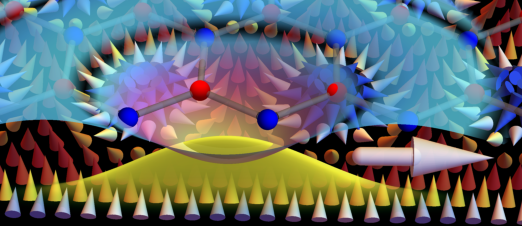
Figure 1: Topological chiral edge magnon-plasmons in a metal/magnetic skyrmion crystal bilayer; spectral anticrossing supports chiral hybrid edge excitations.
Theoretical Framework and Model Systems
Bilayer Construction and Coupling Mechanisms
The considered heterostructure consists of a metallic layer supporting gapless plasmons (modeled after graphene) placed adjacent to a magnetic insulator. The plasmon-magnon interaction ensues via magnetic dipole coupling, formalized in an effective Hamiltonian:
H=Hmagnet+Hplasmon+Hcoupling,
where Hcoupling is linear in both the magnon and plasmon bosonic operators, with a phase winding property encoding topological effects. The analysis investigates three magnetic ground states: FM, AFM, and SkX.
Ferromagnetic Bilayer
The FM regime is described by a Heisenberg model with easy-axis anisotropy, mapped to bosonic magnons via the Holstein-Primakoff transformation. The hybridization leads to a 2×2 Hamiltonian kernel in momentum space, with an off-diagonal coupling Gkeiφk. Diagonalization generates upper and lower hybrid bands exhibiting characteristic spectral anticrossing.
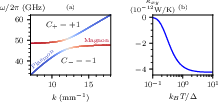
Figure 2: (a) Hybrid magnon-plasmon dispersion in a FM/metal bilayer with Chern numbers annotated; (b) thermal Hall conductivity as a function of temperature.
The Berry curvature calculation reveals rotational invariance, with Chern numbers C±=±1. The nontrivial band geometry produces an intrinsic anomalous thermal Hall effect, quantifiable via the transverse response κxy, which shows clear thermal activation near the magnon gap, saturating for kBT≳Δ.
Antiferromagnetic Bilayer
AFM order is modeled by a two-sublattice Hamiltonian. The magnon-plasmon hybridization involves an effective enhancement factor in the coupling, due to the nontrivial magnon basis. This yields three bands: two with anticrossing character and one pure magnonic branch.
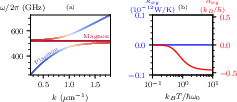
Figure 3: (a) Hybrid mode dispersions in AFM/metal. (b) Thermal Hall conductivity and spin Nernst conductivity vs.\ temperature.
In the absence of explicit time-reversal symmetry breaking, the Berry curvature of all bands vanishes; thus, there is no thermal Hall response. However, the system hosts a finite spin Nernst signal, αxy, which encodes transverse spin current generation by temperature gradients—a signature that remains robust due to spin mixing from the plasmon sector.
Skyrmion Crystal Bilayer: Emergence of Topological Edge Modes
SkX/metal heterostructures realize the most intricate physics. The magnetic ground state—stabilized by a combination of exchange, anisotropy, Zeeman, and Dzyaloshinskii-Moriya interactions—is computed for realistic van der Waals materials. Linear spin wave theory yields magnon bands, which, upon hybridizing with plasmons, exhibit nontrivial topology.
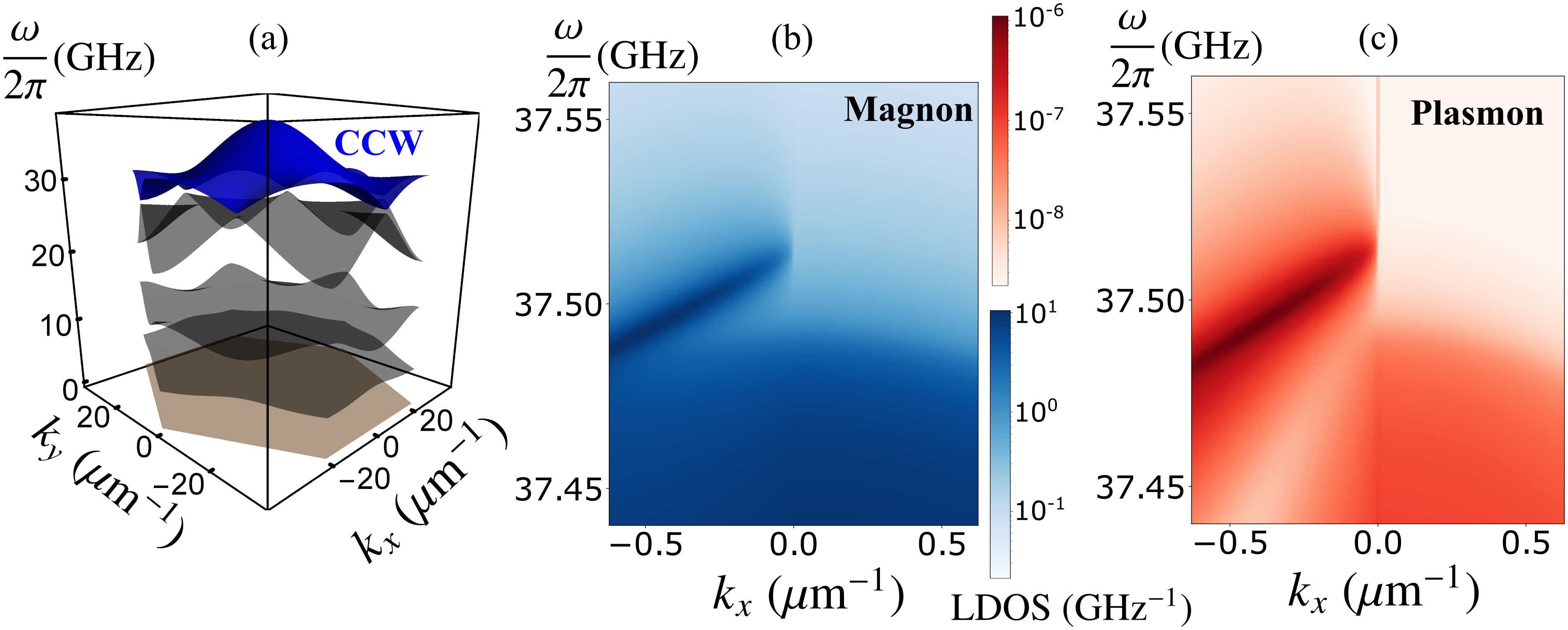
Figure 4: (a) Magnon bandstructure for SkX. (b) Local density of states (LDOS) for magnons and (c) plasmons, highlighting edge-localized chiral states across the topological gap.
A two-band effective model is constructed, capturing the anticrossing between the counterclockwise (CCW) magnon mode (with negative effective mass and C=−1) and the plasmon. Hybridization inverts Chern numbers and induces robust chiral edge states—magnonic and plasmonic—connecting the lower (magnon-like) and upper (plasmon-like) bulk bands. Simulations of the LDOS in semi-infinite geometries confirm the spatial localization and spectral isolation of these states, with their existence persisting up to realistic magnon and plasmon damping rates.
Results, Numerical Analysis, and Constraints
The fundamental numerical results include the identification of finite Chern numbers in bulk hybrid bands and direct calculation of temperature-activated anomalous Hall and spin Nernst coefficients. Theoretical analysis predicts that FM and SkX/metal bilayers generically host C=±1 bands and support thermal Hall responses, with the latter showing genuinely gapped chiral edge states (unlike the FM case where monotonic dispersion obstructs isolated edge modes).
A critical observation is that these edge states are not topologically protected against all forms of backscattering, as their energies and momenta are not generically separated in the surface spectra. Nevertheless, the large group velocity mismatch suppresses hybridization, lending robustness within realistic parameter regimes. The analysis also incorporates non-Hermitian effects (e.g., Landau damping), addressing their impact on edge state persistence.
Implications and Outlook
This work establishes that magnon-plasmon hybridization in van der Waals heterostructures enables engineering of nontrivial band topologies, yielding transverse heat and spin transport phenomena, and facilitating chiral edge transport of hybrid excitations. The findings prompt several practical and theoretical consequences:
- Spintronics/Caloritronics Integration: Magnon-plasmon hybrids offer a platform for leveraging both charge and spin currents for thermal management, spin information transfer, and nonreciprocal device architectures.
- Topological Plasmonics: Extension of topological photonic paradigms to the spin-charge coupled domain, allowing for new device strategies in THz and microwave regimes.
- Material Platforms: While the focus is on bilayer van der Waals materials, the analysis and results generalize to single materials with strong spin-orbit coupling, expanding the catalog of candidate systems.
- Experimental Probing: Chiral edge modes in these systems can be observed via near-field techniques, THz transmission, or NV center magnetometry, facilitating tests of the predictions in well-characterized heterostructures.
Future directions include the design of structures with enhanced magnon-plasmon cooperativity (e.g., via tailored interfaces or Mott moiré bands for undamped plasmon modes) and the study of non-Hermitian topology as the interplay between damping and coherence becomes technologically relevant. The results also highlight the need for models of hybridization into electron-hole continua, opening the pathway for new classes of topological quantum matter.
Conclusion
The theory of topological magnon-plasmon hybrids elucidates how interfacial coupling in van der Waals systems precipitates nontrivial geometric and topological band features. This not only enables unique anomalous transport effects in the bulk but also supports the realization of chiral edge states, with significant promise for novel magnonic, plasmonic, and spintronic devices. The material and theoretical landscape for such hybrid excitations is broad, inviting continued exploration of their quantum transport properties, robustness, and device applicability.