- The paper identifies a dominant shift from traditional logic errors to configuration and tooling faults in modern TypeScript projects.
- It employs a mixed-methods pipeline to annotate 633 bug instances across 16 repositories, thereby establishing a detailed taxonomy of fault types.
- Results reveal that ecosystem complexity and toolchain entanglement are key drivers of bug prevalence, suggesting new directions in integration-aware static analysis.
Empirical Characterization of Bugs in the TypeScript Ecosystem
Introduction and Motivation
The adoption of TypeScript (hereafter, Type) has reshaped modern web development by layering static typing, modular abstractions, and an extensive tooling infrastructure onto JavaScript. Despite substantial adoption and promises regarding improved correctness and maintainability, the nature and distribution of faults in large-scale Type projects remains under-characterized in the literature. Leveraging a dataset of 633 bug instances sampled from 16 prominent open-source Type repositories, this paper develops an empirically grounded taxonomy of fault types, quantifies their prevalence and distribution, and systematically relates them to project-level and ecosystem-level characteristics. A key contribution is the longitudinal comparison with historical JavaScript bug studies, which reveals a structural shift in the nature of defects from logic-level and DOM-centric errors to faults emerging at tooling, configuration, and integration boundaries.
Taxonomy Construction and Dataset Composition
A mixed-methods pipeline was used to curate the dataset, consisting of qualitative manual annotation and iterative refinement, coupled with semi-automated NLP-driven labeling for the remaining artifacts. The projects analyzed span diverse domains, including AI integration, API/service providers, end-user applications, UI libraries, educational platforms, and testing infrastructure, selected to maximize coverage of contemporary Type practices with at least 1,000 GitHub stars and active maintenance. Key metadata—LOC, age, commit activity, dependency complexity—was collected to enable multi-factor correlation analyses.
The resulting taxonomy spans eleven categories, crucially including Type/Ecosystem-specific faults such as Tooling/Config, Type Error, and Async/Event, alongside legacy categories like Logic Error, API Misuse, and UI Bug. Notably, new classes such as Test Fault and build-system driven errors have emerged, reflecting modern development workflows.
Prevalence and Distribution of Fault Types
The study demonstrates an overwhelming dominance of Tooling/Config, API Misuse, and Type Error across the evaluated corpus, collectively accounting for nearly two-thirds of all annotated faults. In contrast, traditional runtime exceptions, unhandled errors, and pure control-flow bugs are markedly less frequent, indicating an effective suppression of low-level programming errors via static analysis and language-level guarantees.
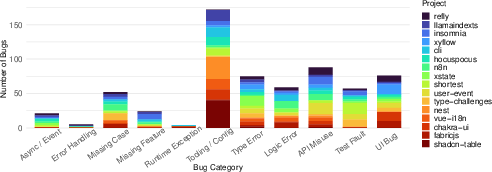
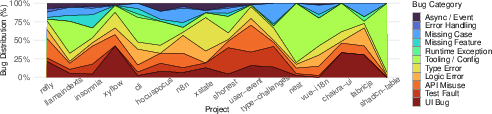
Figure 1: Bug category distributions across and within projects, highlighting the dominance of Tooling/Config, API Misuse, and Type Error across the ecosystem.
The upper subplot in Figure 1 visualizes stacked category frequencies per project, while the lower subplot normalizes within-project distributions to reveal systematic differences in bug composition by domain. Toolchain- and configuration-driven fragility is substantially greater in larger, more modular repositories and those that employ diverse, multi-stage CI/CD pipelines.
Correlation Analyses: Architecture, Domain, and Ecosystem Complexity
Project-scale and architectural complexity exert a profound influence on fault distribution. Larger and older projects exhibit greater prevalence of Error Handling, Missing Feature, and Logic Errors, a likely signature of cumulative architectural and technical debt. Tooling/Config and API Misuse correlates strongly with ecosystem complexity (e.g., number of unique dependencies, build stages, automation scripts) rather than with pure code size, indicating that the integration of diverse tools, compilers, and continuous integration processes is a major vector for the emergence of faults.
Figure 2: Stacked bar chart showing the distribution of bug categories across the analyzed Type projects, illustrating substantial variability by project and domain affiliation.
Cross-category correlation analysis reveals that many errors propagate or co-occur: for example, incomplete Error Handling, Missing Case, and Async/Event faults are strongly correlated, reflecting their shared role in propagating defects in complex control and data-flow paths. Tooling/Config issues show inverse correlation with UI centric bugs, underlining a polarity between infrastructure-heavy and frontend-heavy system architectures.
Dependency analyses further indicate that “toolchain entanglement”—the presence of multiple overlapping build systems, linters, formatters, and test orchestrators—is the primary predictor of configuration and integration faults, surpassing the influence of any single dependency's code footprint. Notably, the number of direct dependencies is less predictive of fragility than the breadth and heterogeneity of roles assumed by these dependencies.
Longitudinal Comparison with Historical JavaScript Studies
A key contribution is the mapping and qualitative comparison of the derived Type taxonomy with that developed for client-side JavaScript in previous empirical studies. The data show a significant reduction in UI and DOM-related error prevalence, dropping from 68% of client-side JavaScript bugs to only 12.5% in Type projects, due to widespread adoption of framework-mediated UIs and the abstraction of direct DOM manipulation. Type-related faults fell from ∼33% to 12.4%, directly correlating with improved compile-time checks and static guarantees.
Crucially, new fault classes—Tooling/Config and Test Fault—have risen to prominence, reflecting increased reliance on orchestrated build pipelines, polyglot toolchains, and formalized automated testing. This empirically substantiates the proposition that, in mature Type projects, reliability bottlenecks have shifted from control logic to integration and orchestration.
Theoretical and Practical Implications
The study's findings imply a structural transformation in the reliability landscape of web software. Static typing and incremental specification have effectively suppressed a wide class of logic and runtime errors but have done little to mitigate, and in some respects have exacerbated, the fragility arising in configuration, build-time integration, and asynchronous orchestration. The “attack surface” for reliability defects has moved upward and outward in the stack—into configuration metadata, build scripts, and API boundaries—making traditional intra-module static analysis alone insufficient for reliability engineering.
This reframing suggests that future research and tooling for type-oriented development should prioritize:
- Automated build tool and configuration validation: To statically check and minimize inconsistencies across compilers, bundlers, linters, and CI/CD orchestration scripts.
- Asynchronous and cross-layer analysis: Extending code analysis beyond synchronous data/control flow to target temporal and coordination properties emergent in complex toolchains.
- Integration-aware static analysis: Bridging the gap between static guarantees and runtime behavior, particularly at the boundaries between typed and untyped modules or services, and across third-party APIs.
The data support the projection that as ecosystems mature and static guarantees become the norm, further reliability gains will depend on advances in meta-level analysis: configuration synthesis, automated migration/adaptation of build pipelines, and dynamic validation at integration boundaries. AI-driven solutions may play a decisive role in reasoning across hundreds of configuration and dependency files, identifying inconsistent states, and synthesizing corrections that respect the invariants of the entire toolchain. Additionally, reinforcement of developer education and culture regarding incremental typing and disciplined configuration practices remains essential.
Conclusion
This empirical study rigorously characterizes the evolving fault landscape of the TypeScript ecosystem. While Type’s static typing and modular framework have suppressed traditional logic and runtime errors, defect density has migrated toward ecosystem-level failures in configuration, orchestration, and asynchronous workflows. As reliability becomes a property of entire toolchains and integration practices, future advances in both research and practical tool development must elevate build orchestration and ecosystem cohesion as first-class reliability concerns.

