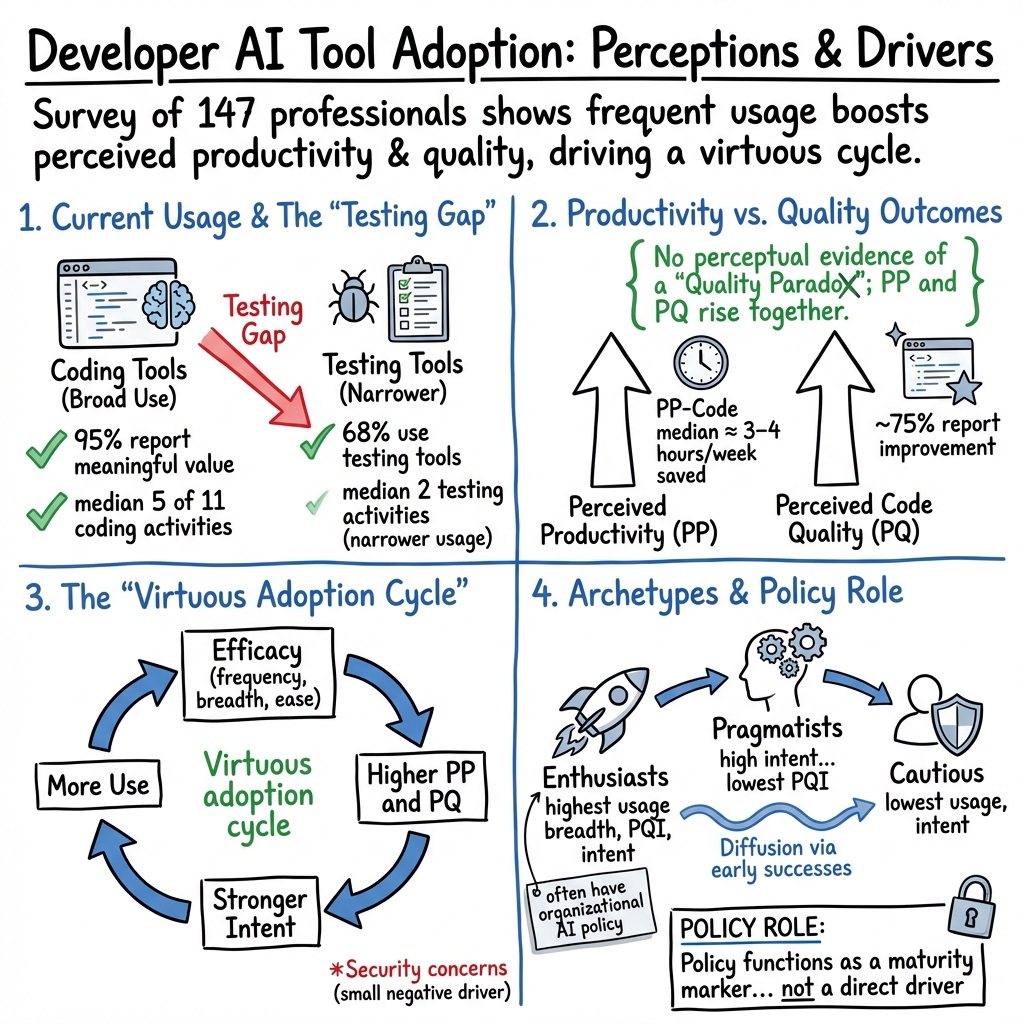
- The paper reveals that AI tool adoption significantly enhances developers' productivity and code quality without inducing a 'quality paradox'.
- The paper's analysis of 147 developers identifies distinct archetypes—Enthusiasts, Pragmatists, and the Cautious—aligned with Rogers’ diffusion theory.
- The paper details the growing importance of AI-native architectures like Agentic Architectures and RAG for shaping future software development practices.
AI Adoption in Software Engineering: An Expert Analysis
Introduction
The paper, "Developers in the Age of AI: Adoption, Policy, and Diffusion of AI Software Engineering Tools" (2601.21305), provides a comprehensive analysis of how AI tools are being integrated into contemporary software development practices. The research highlights key trends, such as the perceived productivity benefits, challenges to adoption, and the sociological dynamics involving distinct developer archetypes. By analyzing the responses from 147 professional developers, the study explores various dimensions of AI adoption in software engineering, including productivity, code quality, and organizational policies.
Key Findings
The study finds that AI tools are widely utilized in software development, significantly augmenting perceived productivity (PP) and code quality (PQ). These tools, particularly for coding, are employed by 95% of developers, whereas testing tool usage lags behind. Developers report a median productivity gain of 3-4 hours saved per week in coding, contrasted with 1-2 hours saved in testing. Interestingly, the developers reject the "Quality Paradox" assumption; they believe that increased speed through AI does not degrade code quality, but rather enhances it.
This perception is supported by the correlation between AI tool usage and self-reported productivity and quality improvements. The study highlights a "virtuous adoption cycle" where frequent use of AI tools boosts both perceived productivity and code quality, subsequently motivating further adoption.
Organizational Impact and Innovation Diffusion
The organizational adoption of AI tools aligns with Rogers’ diffusion of innovations theory, indicating structured stages of incorporation within development teams. The research identifies three distinct developer archetypes: Enthusiasts, Pragmatists, and the Cautious. Enthusiasts, who lead adoption privately, are followed by Pragmatists as adoption becomes organizationally sanctioned. Meanwhile, the Cautious remain on the periphery, awaiting stronger organizational policies to legitimize adoption.
Organizational policies and the lack thereof appear as a maturity marker rather than a driver of individual adoption. These policies signal to developers that AI adoption is organizationally sanctioned, reducing perceived risks and encouraging broader adoption.
Future Emphasis on AI-Native Architectures
The paper underscores the significance of AI-native architectural patterns, such as Agentic Architectures and Retrieval-Augmented Generation (RAG). These architectures are expected to dominate future software development, requiring developers to acquire new skills in orchestration and data management. Developers generally view the future optimistically, anticipating AI-integrated applications to become anticipatory and multimodal, despite concerns over security risks and hallucinations in model outputs.
Implications and Future Work
The study presents actionable insights for development teams and managers, emphasizing the necessity of broad AI tool integration and the importance of user experience in driving adoption. For developers, mastering orchestration and data management is crucial, aligning with anticipated AI architectural shifts.
Future research should address the limitations of self-reported data and explore objective measures of productivity and quality gains. Longitudinal studies tracking these developer archetypes could elucidate adoption patterns further, especially in understanding the causal relationships between organizational policies and individual developer adoption.
Conclusion
This paper provides critical insights into the rapidly evolving landscape of AI in software engineering. By elucidating the dynamics of AI tool adoption, perceived productivity and quality benefits, and the broader sociological impact within organizations, it lays a foundation for future efforts to harness AI's potential in creating more efficient and effective software engineering practices.