Nucleus and Postperihelion Activity of Interstellar Object 3I/ATLAS Observed by Hubble Space Telescope
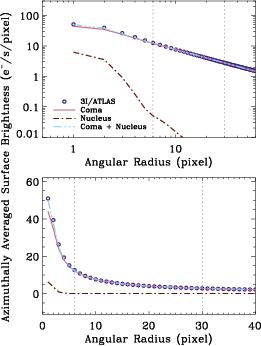
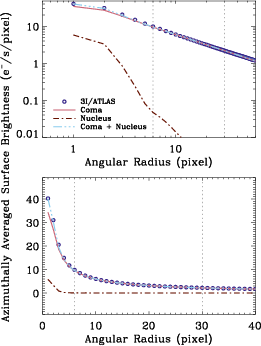
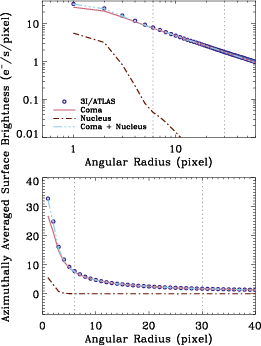
Abstract: We report the successful detection of the nucleus of interstellar object 3I/ATLAS, achieved by applying the nucleus extraction technique to our Hubble Space Telescope (HST) observations from December 2025 to January 2026. The product of the V-band geometric albedo, $p_V$, with the physical cross-section of the nucleus is $0.22 \pm 0.07$ km${2}$, which corresponds to an effective radius of $1.3 \pm 0.2$ km if assuming $p_{V} = 0.04$, as is typical for cometary nuclei in the solar system. This size is in agreement with our estimate derived from the reported nongravitational effect and activity of the interstellar object. If the measured photometric variations are solely due to the rotation of an aspherical nucleus, the axis ratio must be $2:1$ or greater, and the rotation period $\gtrsim!1$ hr. Leveraging the range of covered phase angles, we identified a significant opposition surge of $\sim!0.2$ mag with a width of $3\circ \pm 1\circ$, which may include concurrent contributions from orbital plane crossing and tail projection, and determined a linear phase slope of $0.026 \pm 0.006$ mag degree${-1}$ for the coma dust. Compared to the preperihelion brightening trend, 3I faded more rapidly on the outbound leg, following an activity index of $4.5 \pm 0.3$, not unusual in the context of solar system comets. This activity asymmetry is further corroborated by a postperihelion coma surface brightness profile that is significantly shallower than its preperihelion counterpart. From the statistics, we infer that multiple interstellar objects resembling 3I likely went undetected even before the discovery of 1I/`Oumuamua.
Paper Prompts
Sign up for free to create and run prompts on this paper using GPT-5.
Top Community Prompts
Explain it Like I'm 14
Overview
This paper is about an interstellar object called 3I/ATLAS, which is a visitor from another star system. Using the Hubble Space Telescope (HST), the researchers wanted to do something that’s very hard: spot and measure the solid core (the “nucleus”) of 3I/ATLAS, even though it’s wrapped in a glowing cloud of dust and gas (a “coma”). They also studied how the object behaved after it swung past the Sun, especially how its dust reflected light and how its overall brightness changed.
Key Questions
The study set out to answer a few clear questions:
- Can we separate the bright coma and reveal the actual solid nucleus with Hubble images?
- How big is the nucleus?
- Does the nucleus spin, and if so, how fast and how stretched-out is its shape?
- How does the dust around 3I/ATLAS reflect sunlight at different viewing angles (including near “opposition,” when the Sun is almost directly behind us)?
- How did its activity (the amount of dust and gas it releases) change after passing closest to the Sun?
- What do these results say about how many similar interstellar visitors exist and how often they pass through our solar system?
How They Did It (Methods)
Think of trying to spot a streetlight in thick fog. The fog (coma) makes everything look bright and blurry, hiding the streetlight (nucleus) in the middle. The team used several clever tricks to see the streetlight through the fog:
- Hubble images: They took repeated images from December 2025 to January 2026, using a very sensitive filter to collect a lot of light.
- Cleaning the images: Space images sometimes get zapped by cosmic rays, which make fake bright spots. The team cleaned those out so the data were reliable.
- Camera “blur” model: Every camera has a signature blur pattern, called the “point-spread function” (PSF). They built a PSF for Hubble’s camera to know exactly how a tiny point of light should look if there were no coma.
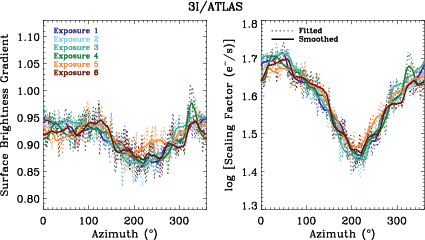
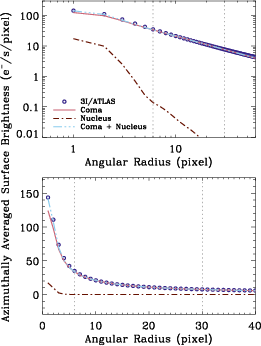
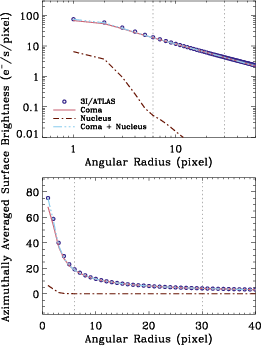
- Nucleus extraction: They modeled the coma’s brightness as a smooth pattern that changes with distance and direction from the center, then subtracted this coma model from the original image. If the model is right, whatever is left behind at the center should be the nucleus. This is like estimating the fog’s glow and taking it away to reveal the streetlight.
- Brightness measurements: They measured how bright the nucleus and the coma were, and corrected for geometry factors like distance from the Sun and Earth, and the “phase angle” (the Sun-object-observer angle). This angle matters because dust can look brighter or dimmer depending on how sunlight hits it.
- Cross-check with physics: They also estimated the nucleus size using the “rocket effect.” When a comet releases gas, it gets a tiny push. Measuring that push (the “nongravitational acceleration”) and knowing how much gas is released lets you estimate how heavy and big the nucleus must be. It’s like inferring the size of a balloon from how fast it moves when air escapes.
Main Findings
- Nucleus detected and sized: They successfully revealed the nucleus and found that, assuming a typical comet reflectivity, it has a radius of about 1.3 km (plus or minus 0.2 km). That’s bigger than the cores of the first two interstellar visitors: 1I/‘Oumuamua (~0.08 km effective radius) and 2I/Borisov (~0.4 km).
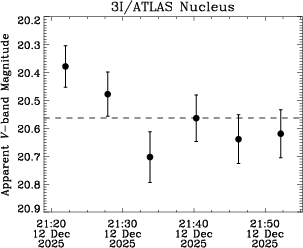
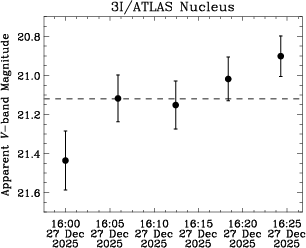
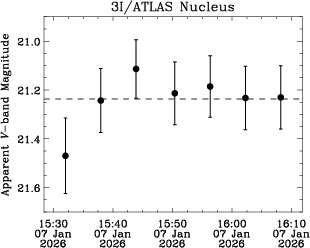
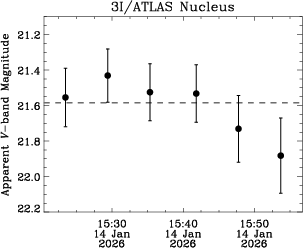
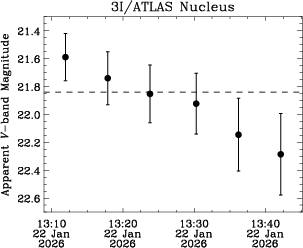
- Spin and shape: The nucleus brightness varied over time. If those changes are mostly due to rotation, then the nucleus is likely stretched out (an axis ratio of at least 2:1, like a rugby ball rather than a perfect sphere), and the rotation period is at least about 1 hour. Some of the brightness variation could also be from short-term changes in nearby dust.
- Dust “opposition surge”: As the viewing angle approached opposition (near 0 degrees), the dust looked distinctly brighter by about 0.2 magnitudes, with a width of roughly 3 degrees. In everyday terms, the dust got a noticeable “glow-up” when the Sun was directly behind us. This kind of surge is well known for asteroids and rings, but is rarely measured for comet dust.
- Phase slope of dust: Away from opposition, the dust brightness changed at about 0.026 magnitudes per degree of phase angle, similar to what is seen in comets from our solar system.
- Post-Sun activity faded fast: After passing closest to the Sun, 3I/ATLAS dimmed more quickly than it brightened on the way in. The outbound “activity index” (how brightness changes as it moves away from the Sun) was about 4.5, compared to about 3.8 inbound. The coma’s brightness profile also became shallower after perihelion. This kind of asymmetry is common in comets and can depend on things like which surface spots are icy and how the nucleus is tilted and spinning.
- Consistency with the rocket-effect estimate: Using the measured push from outgassing near perihelion and known water release rates, they got an independently estimated nucleus radius of about 1.5 km. That agrees really well with the Hubble detection, giving confidence in the size result.
Why This Matters
- Understanding interstellar visitors: Knowing the true size and behavior of 3I/ATLAS helps scientists figure out what kinds of objects roam between stars, how common they are, and how they compare to comets in our own solar system.
- Better detection techniques: The “nucleus extraction” method shows that even when a comet’s coma is bright, it’s possible to tease out the nucleus with careful modeling. Future observations of dusty interstellar comets can use this playbook.
- Dust physics: Measuring the opposition surge and phase slope gives clues about how the dust grains are shaped and how they scatter light. 3I’s dust looks broadly comet-like but shows an unusually clear opposition surge, suggesting some special dust properties or helpful viewing geometry.
- Population estimates: The statistics suggest that objects like 3I probably passed through the inner solar system before ‘Oumuamua but went unnoticed, especially before modern, automated surveys were common. As new surveys and telescopes come online, we can expect to find more of these visitors.
In short, this study managed to spot and measure the solid heart of a rare interstellar comet, learned how its dust behaves in sunlight, and showed that such visitors might be more frequent than we used to think.
Knowledge Gaps
Unresolved gaps, limitations, and open questions
Below is a focused list of what remains missing, uncertain, or unexplored in the study, phrased to guide concrete follow-up work.
Nucleus physical properties and rotation
- Nucleus geometric albedo and color are unconstrained; the radius (1.3 ± 0.2 km) remains degenerate with assumed . Actionable: obtain multi-band optical/NIR photometry and, ideally, thermal IR (e.g., JWST/MIRI, NEO Surveyor) to directly solve for size–albedo.
- Nucleus phase curve (slope, opposition behavior) is not measured due to sparse sampling and coma contamination; a linear slope typical of comet nuclei is assumed. Actionable: secure dense time-series near a range of phase angles with improved coma suppression or in inactive epochs to fit nucleus-specific phase parameters.
- Rotation period, spin state, and shape are unconstrained beyond hr and a lower-limit axis ratio ≳2:1 if variability is purely rotational. Actionable: conduct continuous, high-cadence lightcurves over multiple rotations to recover period(s), amplitude, and possible excited rotation.
- Pole orientation and its seasonal geometry are unknown; key for interpreting activity asymmetry and nongravitational torques. Actionable: combine time-resolved photometry, coma-jet morphology, and torque models to infer spin-axis orientation.
Methodological/systematic uncertainties in nucleus extraction
- Residual jet-like features persist after coma subtraction and may bias nucleus flux; the optically thin, azimuthal power-law coma model is a simplification. Actionable: test 3D dust-tail/jet models (e.g., Monte Carlo) and quantify systematic biases via injection–recovery simulations.
- PSF mismatch risk (TinyTim vs on-orbit, breathing, focus, jitter) is not fully quantified; empirical PSFs are unavailable due to star trailing. Actionable: validate with contemporaneous calibration targets tracked at similar rates or use PSF libraries plus focus-breathing corrections to bracket systematics.
- Broad F350LP band may include gas emission; the zero-point uses stellar SEDs approximating comet colors, but dust/gas color evolution is unmeasured. Actionable: obtain narrowband continuum filters or multi-band photometry to separate dust continuum from gas and tighten photometric zeropoints.
- Visit 1 (α ≈ 30.6°) was overexposed and excluded, limiting phase-function leverage at larger phase angles. Actionable: recover large-α constraints with additional imaging at high phase angles if geometry permits.
Dust coma, phase function, and opposition surge
- The detected opposition surge (~0.2 mag, width ~3°) cannot be disentangled from line-of-sight enhancements due to orbital-plane crossing and tail projection; no dust-dynamics correction was applied. Actionable: forward-model line-of-sight dust column (syndyne–synchrone or Monte Carlo) across the observed geometry to separate intrinsic backscatter from projection effects.
- Physical mechanism of the opposition effect (shadow hiding vs coherent backscatter) is unconstrained without polarimetry and wavelength dependence. Actionable: obtain phase-resolved polarimetry and multiwavelength photometry near opposition to diagnose the mechanism and grain microphysics.
- Linear phase slope of the dust (0.026 mag deg⁻¹) is measured in a single broad band only; wavelength dependence and phase reddening are unknown. Actionable: measure phase curves in multiple filters to quantify color-phase behavior and constrain grain size/composition.
- No quantitative dust-production metrics (e.g., Afρ) or grain size–velocity distributions are derived; the origin of the postperihelion shallow surface brightness slopes (γ < 1) remains ambiguous. Actionable: compute Afρ, fit syndyne–synchrone envelopes, and invert for grain size–speed distributions pre- and post-perihelion.
Activity asymmetry and volatile drivers
- The cause of the steeper outbound fading (n ≈ 4.5) vs inbound brightening (n ≈ 3.8) is not uniquely interpretable (thermal lag, seasonal illumination, volatile layering, or evolving dust properties). Actionable: couple thermophysical/seasonal illumination models with observed gas production and dust slopes to test scenarios.
- Species-specific outgassing evolution (CO₂→H₂O transition) is not incorporated into the photometric activity model; gas contamination in F350LP is not quantified. Actionable: obtain contemporaneous spectroscopic measurements to tie species production rates to continuum photometry, and apply gas-continuum separation to the lightcurve analysis.
Nongravitational acceleration–based size inference
- Size from nongrav acceleration depends on poorly constrained collimation coefficient (κ), outflow speed law, bulk density, and the assumption that water production arises from the nucleus (not icy grains). Actionable: (i) bound κ via torque/rotation-change constraints; (ii) assess grain-sublimation contributions from spectroscopy; (iii) explore species-dependent laws with time lags and seasonal effects.
- Adopted is a simplification; species- and thermophysics-based models (e.g., Marsden–Sekanina–Yeomans with appropriate volatiles and time lag) may yield different RTN components and inferred sizes. Actionable: refit astrometry using volatile-specific nongrav models and compare resulting size constraints.
- Discrepant published production rates (order-of-magnitude differences) are unresolved; size uncertainties likely dominated by these systematics. Actionable: reconcile datasets through cross-calibration and joint retrievals from all available instruments around perihelion.
Population statistics and detectability
- Number-density and arrival-rate estimates use simplified Poisson arguments and ad hoc scaling from a single survey figure; they ignore detailed selection functions, rate-of-motion cuts, sky coverage, and activity-dependent detectability. Actionable: perform end-to-end survey simulations (ATLAS, Pan-STARRS, ZTF, Catalina, LSST) with ISO kinematics, brightness models including activity, and realistic pipelines to derive unbiased space densities.
- Assumed ISO size distribution slopes (−3 to −4) are adopted without direct constraints at kilometer scales; the implications for detection probabilities are therefore uncertain. Actionable: fit a hierarchical model to the joint sample (1I, 2I, 3I, nondetections) to infer the size distribution with survey selection effects.
- The claim that several 3I-like objects likely passed undetected before 1I relies on uncertain historical detection efficiencies. Actionable: reconstruct historical sensitivities and sky coverage to bound the probability of past non-detections more realistically.
Additional observational opportunities
- No constraints on nucleus thermal inertia, surface roughness, or bulk density beyond assumed values; critical for interpreting activity and torques. Actionable: plan thermal IR observations and model nongrav torques vs rotation changes to infer density–inertia ranges.
- Lack of coordinated, simultaneous polarimetry/photometry near opposition precludes linking the opposition surge to the unusual polarimetric behavior reported elsewhere. Actionable: schedule coordinated campaigns covering the same phase angles in intensity and polarization.
Practical Applications
Immediate Applications
The following items highlight practical use cases that can be deployed now, with sector linkages and key assumptions or dependencies noted.
- Interstellar/comet nucleus extraction toolkit for active objects (software, space/astronomy)
- Description: Package the paper’s PSF-aware nucleus extraction workflow (PSF synthesis via TinyTim or instrument equivalents, azimuth-dependent coma modeling, weighted Levenberg–Marquardt fits, annular fitting, median smoothing, residual PSF photometry) into an open-source toolkit usable across HST/WFC3, JWST/NIRCam/NIRISS, ground-based AO imagers, and survey cameras.
- Potential products/workflows: “Nucleus Extraction” library; instrument-specific PSF plug-ins; reproducible notebooks that replicate the 3I pipeline.
- Assumptions/Dependencies: Optically thin coma; stable and well-characterized PSFs; accurate instrument calibration (CTE corrections, zero-points); sufficient S/N and spatial resolution.
- Opposition-aware photometry module for cometary dust (software, observatory operations, academia)
- Description: Incorporate a linear–exponential phase function into photometric pipelines to correct for the measured dust opposition surge ( mag, width ) and linear slope ( mag/deg) when observing near .
- Potential products/workflows: Survey pipeline module that toggles “opposition correction” for small phase angles; calibration targets and QC checks around opposition.
- Assumptions/Dependencies: The observed surge may include contributions from orbital plane crossing and tail projection; comet-to-comet variability; availability of multi-angle data to fit object-specific phase functions.
- Enhanced orbit-determination workflow with nongravitational acceleration coupling (space/aerospace, planetary defense, software)
- Description: Operationally fuse measured RTN nongravitational parameters (, , ), volatile production rates, and gas outflow speeds to constrain nucleus size and improve trajectory prediction and covariance for active comets and interstellar objects.
- Potential products/workflows: “Non-grav A-Fit Augmentor” for orbit fit systems (JPL Horizons, MPC pipelines); automated ingestion of contemporaneous spectroscopy for and species; sensitivity analysis on collimation coefficient .
- Assumptions/Dependencies: Reliable volatile production measurements (e.g., H2O near 1.4 au); gas-speed parameterizations; activity collimation () is uncertain; tailward astrometric biases must be controlled.
- Observation configuration templates for nucleus detection in active comets (space operations, academia)
- Description: Ready-to-use observing playbooks mirroring this program (e.g., broadband filters with high throughput like F350LP, subarray readouts to reduce overhead, ephemeris tracking, multi-epoch sampling across phase angles, fixed linear-aperture photometry).
- Potential products/workflows: Observatory “cookbooks” and ETC presets; exposure-time calculators preconfigured for typical cometary colors and spectral slopes.
- Assumptions/Dependencies: Instrument-specific throughput and detector behavior; accurate ephemerides; sky-background control; appropriate annular background radii to avoid coma contamination.
- Standardized data-reduction QA practices for comet imaging (software, observatories, academia)
- Description: Codify steps proven here (CTE correction, L.A.Cosmic with guardrails, zero-point simulation using ETC + spectral libraries, PSF-convolved coma subtraction) into validated reduction pipelines.
- Potential products/workflows: Reference reduction scripts with built-in CR artifact detection and PSF sanity checks; automated uncertainty propagation using covariance matrices.
- Assumptions/Dependencies: Up-to-date instrument calibration files; accurate spectral templates; careful masking of overexposed trails and residuals.
- Survey planning and ToO trigger policies for interstellar visitors (policy, observatory operations)
- Description: Use the inferred arrival rate and detectability of 3I-like objects to formalize target-of-opportunity (ToO) triggers, DDT allocations, and multi-facility coordination to capture pre- and post-perihelion baselines and wide phase-angle coverage.
- Potential products/workflows: Interstellar Visitor Rapid-Response Playbook; predefined observation blocks and cross-facility handoffs; data-sharing agreements.
- Assumptions/Dependencies: Survey sensitivity and cadence (ATLAS, Pan-STARRS, LSST); realistic brightness enhancement from activity; coordination across time zones and facilities.
- Citizen science and amateur observing guidance (education, daily life, outreach)
- Description: Provide practical magnitude/phase-angle expectations and small-aperture photometry protocols for amateurs to contribute early detections or monitoring of bright interstellar comets.
- Potential products/workflows: Community observing guides; submission portals with standardized reporting; quality filters that flag potential interstellar candidates.
- Assumptions/Dependencies: Sufficient object brightness; clear reporting channels; training materials; simple tools for phase-angle and geometry estimation.
- Course modules and training labs on PSF fitting and signal separation (education, academia)
- Description: Turn the paper’s workflow into hands-on labs in astrophysics, data science, and signal processing courses (PSF synthesis, deconvolution, annular fitting, residual analysis, uncertainty propagation).
- Potential products/workflows: Curriculum packs with HST subsets; instructor guides; problem sets on phase-function modeling and non-grav acceleration.
- Assumptions/Dependencies: Open access to exemplar datasets or synthetic equivalents; permissive licensing for teaching materials; cross-platform software support.
- Immediate hazard context for spacecraft operations near active comets (space/aerospace, robotics)
- Description: Use the outbound activity index (n ≈ 4.5), shallower post-perihelion coma gradient (γ < 1), and measured phase-function behavior to set conservative guidelines for standoff distances and pointing constraints during fly-bys.
- Potential products/workflows: Operations checklists and hazard envelopes; mission-planning calculators that ingest activity indices and phase functions.
- Assumptions/Dependencies: Translation from brightness/phase-function to particle density and size distributions; object-specific variability; real-time monitoring.
Long-Term Applications
The items below require further research, scaling, or development before broad deployment.
- Rapid-response mission concepts to interstellar objects (space/aerospace, robotics)
- Description: Use nucleus size (≈1.3 km), potential asphericity (axis ratio ≥ 2:1), rotation period (≥1 hr), dust phase function, and activity asymmetry to inform payload selection, shielding, navigation, and encounter geometries for high–v∞ visitors (~58 km/s).
- Potential products/workflows: Reference designs for fly-by/rendezvous; autonomous navigation and hazard-detection algorithms tuned for cometary dust environments; sample-protection strategies.
- Assumptions/Dependencies: Fast-launch or prepositioned assets; propulsion capable of high relative-speed operations; improved dust environment models; early detection and precise ephemerides.
- Physics-informed ML pipelines for nucleus detection in survey data (software, astronomy)
- Description: Combine PSF-convolved coma models and residual analysis with machine learning to automatically flag embedded nuclei in active objects across wide-field surveys (e.g., LSST).
- Potential products/workflows: Hybrid ML+physics modules; training datasets built from synthetic comae and varied PSFs; uncertainty-aware classification.
- Assumptions/Dependencies: Large labeled datasets; robust PSF models per instrument; generalization across seeing conditions and activity states.
- Cross-domain signal separation and deconvolution techniques (healthcare, earth observation, microscopy, finance)
- Description: Adapt the paper’s “point source in a diffuse medium” decomposition (PSF modeling + azimuth-dependent background + convolution) to isolate small features in noisy, structured fields.
- Potential products/workflows: Medical imaging tools (e.g., better lesion/tumor separation in MRI/CT under variable point-spread and structured background); remote-sensing enhancements (detecting thermal point sources in haze); microscopy particle isolation in colloids.
- Assumptions/Dependencies: Known or learnable PSFs; approximate “thin medium” behavior; instrument-specific calibration; domain validation and regulatory approvals (healthcare).
- Standardization of comet dust phase functions across instruments (observatories, software, academia)
- Description: Build a community database and model library that incorporates opposition surge parameters for cometary dust, enabling consistent photometric corrections and cross-instrument comparisons.
- Potential products/workflows: Phase-function registry with object-specific fits; observatory calibration frameworks; simulation tools for observing strategy optimization across phase angles.
- Assumptions/Dependencies: More objects observed near opposition; disentangling tail projection/orbital-plane effects; reproducible multi-epoch datasets.
- Spacecraft dust hazard modeling and materials testing (space/aerospace, materials science)
- Description: Translate measured activity indices, surface-brightness gradients, and scattering properties into particle flux and size distributions for shielding design and sensor hardening; test materials against analog dust backscatter and abrasion.
- Potential products/workflows: Dust flux estimators; chamber tests with analog grains; operational exposure limits; fault-tolerant sensor designs for dusty environments.
- Assumptions/Dependencies: Coupling brightness to mass-loss and particle size distributions; laboratory analogs that realistically mimic interstellar/cometary dust; validated backscatter and polarimetric properties.
- Laboratory analogs of interstellar dust for optical and polarimetric characterization (materials science, instrumentation)
- Description: Create and study analog grains that match the unusual polarimetric/backscatter signatures hinted by 3I, to improve instrument designs and inversion models.
- Potential products/workflows: Synthesized dust standards; benchmark datasets for inversion algorithms; instrument calibration targets.
- Assumptions/Dependencies: Better constraints on dust composition and morphology; scalable fabrication of analog particles; controlled measurement facilities.
- Global interstellar-object rapid-response program (policy, multi-agency coordination)
- Description: Establish pre-approved protocols and funding lines for rapid observations across phase angles and wavelengths, with open data policies and standardized pipelines (including nucleus extraction and non-grav modeling).
- Potential products/workflows: MOUs among observatories; DDT/ToO “fast lanes”; shared code repositories; coordinated public alerts.
- Assumptions/Dependencies: International governance and funding; cybersecurity and data interoperability; community adoption of standards.
- Educational pathways for advanced signal processing in astronomy (education, workforce development)
- Description: Scale the immediate course modules into multi-institution programs that train students and professionals in physics-informed deconvolution, uncertainty quantification, and rapid-response observing.
- Potential products/workflows: Micro-credentials; summer schools; cross-disciplinary tracks bridging astrophysics, imaging, and data science.
- Assumptions/Dependencies: Sustained support; access to diverse datasets; collaboration between academia and observatories.
Glossary
- Absolute magnitude: A standardized measure of an object's intrinsic brightness, corrected to unit distances and zero phase angle. "Absolute Magnitude"
- Activity index: A parameter describing how the coma brightness scales with heliocentric distance (n in the model), indicating activity strength. "following an activity index of "
- Antisolar direction: The direction on the sky pointing directly away from the Sun. "with the projected antisolar direction and the negative heliocentric velocity of 3I represented by the yellow and cyan arrows, respectively."
- Aperture photometry: Measuring flux within a defined aperture to estimate an object's brightness. "we even switched to aperture photometry on the residual feature"
- Apparent magnitude: The observed brightness of an object as seen from the observer, without geometric or phase corrections. "We modelled the apparent magnitude of 3I as a function of heliocentric distance"
- Aspherical: Not spherical; having unequal axes or irregular shape. "If the measured photometric variations are solely due to the rotation of an aspherical nucleus"
- Axis ratio: The ratio of principal axes lengths of an object's projected shape. "the axis ratio must be $2:1$ or greater"
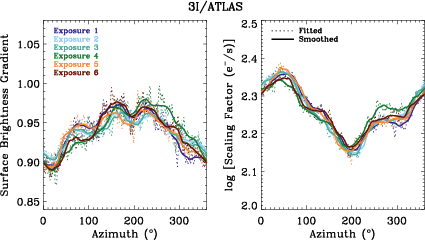
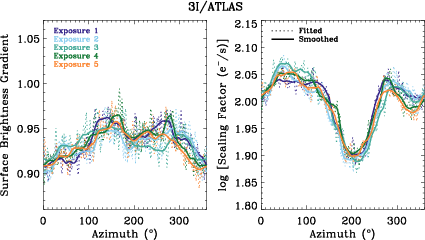
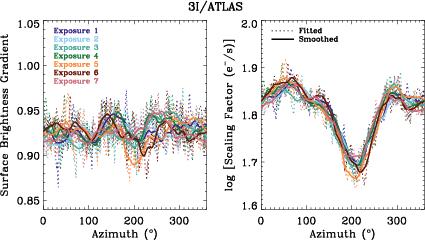
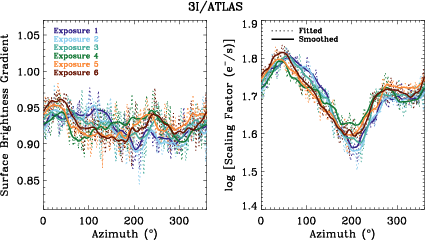
- Azimuth: The angle around the photocenter defining direction in the image plane. "Best-fit parameters for the surface brightness profile of the coma as functions of azimuth"
- Barbara A. Mikulski Archive for Space Telescopes (MAST): STScI’s archive for HST and other mission data. "retrieved from the Barbara A. Mikulski Archive for Space Telescopes (MAST) site"
- Charge transfer efficiency (CTE): The efficiency with which CCD pixels transfer charge during readout; degradation causes signal loss. "The charge transfer efficiency (CTE) of the UVIS channel degrades over time"
- Collimation coefficient: A parameter (κ) quantifying how directional the outgassing is, from isotropic (0) to perfectly collimated (1). "The collimation coefficient of activity was assumed to be ."
- Coma: The diffuse envelope of gas and dust surrounding a comet’s nucleus. "The bright and centrally condensed coma of 3I precluded direct measurement of the nucleus."
- Convolution: A mathematical operation combining a model with the instrument PSF to simulate observed images. "The nucleus + coma model is convolved with the instrument PSF"
- Director's Discretionary (DD) program: HST time allocated at the director’s discretion for rapid or high-priority observations. "under the Director's Discretionary (DD) program 18152."
- Eccentricity: An orbital parameter measuring deviation from circularity; values > 1 imply hyperbolic trajectories. "with an eccentricity of ."
- E-folding width: The characteristic angular scale over which an exponential effect decreases by a factor of e. "characterised by an -folding width of $3\degr \pm 1\degr$"
- F350LP filter: A broad long-pass optical filter on HST WFC3/UVIS used to maximize sensitivity. "Data were acquired through the broadband F350LP filter"
- FWHM: Full width at half maximum; the width of a profile at half of its peak intensity. "a full-width-half maximum (FWHM) of 4758 \AA"
- Geocentric distance: The distance from Earth to the object. "lower spatial resolution at a greater (3.0 au) geocentric distance"
- Geometric albedo: The fraction of incident light reflected by an object at zero phase angle in a specified band. "V-band geometric albedo, "
- Heliocentric distance: The distance from the Sun to the object. "heliocentric distances (), HST-centric distances (), and phase angle ()"
- HST-centric distance: The distance from the Hubble Space Telescope to the target during observations. "heliocentric distances (), HST-centric distances (), and phase angle ()"
- Hyperbolic: Describing an unbound trajectory with eccentricity greater than one. "Its trajectory is significantly more hyperbolic with respect to the Sun"
- Image Reduction and Analysis Facility (IRAF): A legacy software suite for astronomical data processing. "Image Reduction and Analysis Facility \citep[{\tt IRAF};]"
- J2000 equatorial coordinate system: The standard celestial reference frame with equator and equinox defined at epoch J2000. "in the J2000 equatorial coordinate system"
- Laplacian cosmic-ray rejection algorithm: A method to detect and remove cosmic-ray hits using Laplacian filtering. "Cosmic rays were eliminated using the Laplacian cosmic-ray rejection algorithm {\tt L.A.Cosmic}"
- Levenberg-Marquardt algorithm: A nonlinear least-squares optimization technique for fitting models to data. "utilised the Levenberg-Marquardt algorithm via {\tt MPFIT}"
- Linear phase slope: The rate at which brightness changes per degree of phase angle in a linear phase function. "determined a linear phase slope of mag degree for the coma dust."
- Linear-exponential phase function: A scattering law combining a linear term with an exponential opposition surge. "modified linear-exponential phase function from \citet{Rosenbush2002}:"
- Nongravitational effect: Acceleration of a comet due to anisotropic outgassing rather than gravity. "reported nongravitational effect"
- Nucleus extraction technique: A method to separate the nucleus signal from the surrounding coma in imaging data. "achieved by applying the nucleus extraction technique to our Hubble Space Telescope (HST) observations"
- Opposition effect: Brightness enhancement observed near zero phase angle. "Opposition Effect"
- Opposition surge: The magnitude of the opposition effect; a sudden brightening near exact opposition. "identified a significant opposition surge of mag with a width of $3\degr \pm 1\degr$"
- Orbital plane angle: The angle indicating the observer’s elevation relative to the object’s orbital plane. "Orbital plane angle. Positive values indicate HST being above the orbital plane of 3I."
- Outgassing: Emission of gas from a comet’s nucleus, typically driven by sublimation. "distinct outgassing behaviour"
- Phase angle: The Sun–object–observer angle that governs scattering geometry and brightness. "phase angle ()"
- Phase function: The brightness correction as a function of phase angle. "deviating from the trend predicted by the purely linear phase function"
- Photocenter: The center of light distribution of the observed object in an image. "at the photocenter of 3I"
- Point-spread function (PSF): The instrument’s response to a point source, used to model image blur. "point-spread function (PSF, denoted ) of the WFC3 camera"
- Polarimetry: Measurement of light polarization to infer properties of scattering particles and surfaces. "utilising various techniques including imaging, spectroscopy, and polarimetry."
- Poisson statistics: A noise model appropriate for photon counting where variance equals the mean. "we assigned a weighting map based on Poisson statistics"
- Production rate: The number of molecules emitted per second by the comet (Qgas). "the molecular production rate and the outflow speed"
- PSF photometry: Measuring flux by fitting a PSF model to unresolved sources. "We next performed PSF photometry on the residual signal"
- Radial–transverse–normal (RTN) components: Orthogonal components in the orbital frame used to express accelerations. "the radial, transverse, and normal (RTN) components of the nongravitational parameters"
- Solar elongation: The angle between the Sun and the target as seen by the observer. "Solar elongation."
- Sublimation: Phase transition from solid to gas that drives cometary activity. "which was later overtaken by HO sublimation when closer to the Sun"
- Surface brightness profile: The radial distribution of brightness in the coma or image. "surface brightness profile of the coma"
- TinyTim: A software package to generate HST PSFs for modeling and analysis. "using the {\tt TinyTim} package"
- True anomaly: The angle along an orbit from perihelion to the object’s current position. "True anomaly of the heliocentric orbit."
- UVIS: The Ultraviolet–Visible channel of HST’s WFC3 instrument. "the UVIS channel of the Wide Field Camera 3 (WFC3) camera."
- WFC3: The Wide Field Camera 3 instrument on HST. "Wide Field Camera 3 (WFC3) camera."
Collections
Sign up for free to add this paper to one or more collections.