Critical Evaluation of Studies Alleging Evidence for Technosignatures in the POSS1-E Photographic Plates
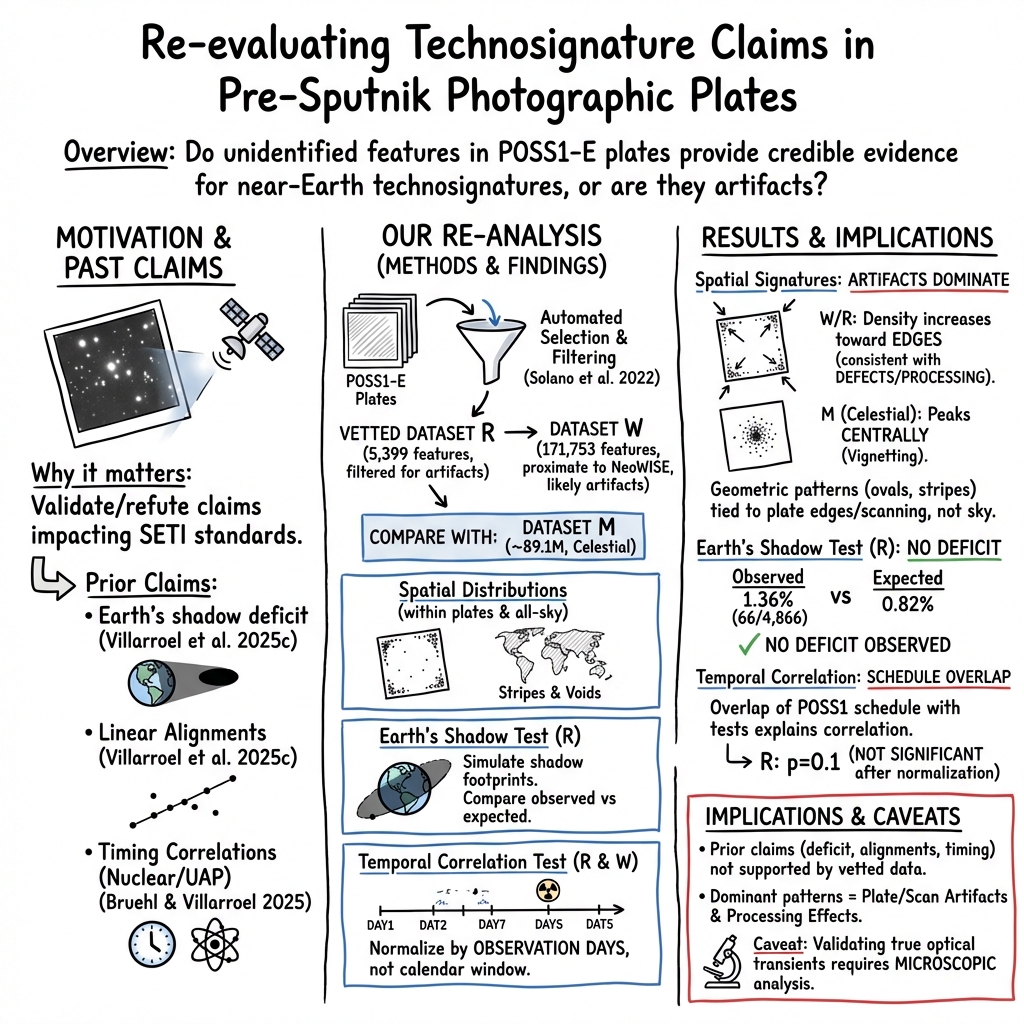
Abstract: Recent studies by B. Villarroel and colleagues have assembled and analyzed datasets of unidentified features measured from digital scans of photographic plates captured by the first-epoch Palomar Observatory Sky Survey (POSS1) in the pre-Sputnik era. These studies have called attention to (i) a purported deficit of features within Earth's shadow; (ii) the sporadic presence of linear clusters; and (iii) a positive correlation between the timing of feature observations and nuclear tests as well as Unidentified Aerial Phenomena (UAP) sighting reports. These observations were cited as evidence that some fraction of the unidentified features represent glinting artificial objects near Earth. We have examined these claims using two related, previously published datasets. When analyzing the most vetted of these, we do not observe the reported deficit in the terrestrial shadow. We determine that a third of the features in the reported linear clusters were not confidently distinguished from catalog stars. We find that the reported correlation between the timing of feature observations and nuclear tests becomes insignificant after properly normalizing by the number of observation days, and is almost completely determined by the observation schedule of the Palomar telescope. We uncover important inconsistencies in the definitions of the datasets used in these studies, as well as the use of unvalidated datasets containing catalog stars, scan artifacts, and plate defects. It has not been shown that any of the features in these datasets represent optical transients. We examine the spatial distribution of the plate-derived features, finding an overall gradual increase in number density toward the corners and edges of plates, as well as examples of (i) empty north-south strips that span multiple plates; (ii) clusters and voids having geometric shapes; and (iii) amorphous clusters.
Paper Prompts
Sign up for free to create and run prompts on this paper using GPT-5.
Top Community Prompts
Explain it Like I'm 14
Overview
This paper takes a careful look at claims that old sky photos from the 1950s might show signs of technology near Earth—like sunlight reflecting off artificial satellites before the space age began. The authors examine whether strange “features” seen on these photos are real flashes in the sky or just mistakes caused by the plates, the scanners, or known stars. In short, they find that the earlier claims don’t hold up when the data is checked more rigorously.
Key Questions the Paper Tries to Answer
To make the science simple, think of the sky photos as a giant old photo album. The big questions are:
- Are the odd bright spots on these photos real sky events (like quick flashes), or are they smudges, dust, or known stars?
- Is there a real drop in these spots inside Earth’s shadow (which would support the idea of glinting objects near Earth)?
- Do the dates when these spots were recorded match up with nuclear test dates or reported UAP (Unidentified Aerial/Anomalous Phenomena) sightings in a meaningful way?
- Do patterns like straight-line clusters of spots mean something real—or are they just chance or artifacts?
How the Authors Investigated (Methods in Everyday Language)
The authors used several sets of data made from digital scans of the Palomar Observatory Sky Survey (POSS I) photographic plates, taken between 1949 and 1958:
- Think of the plates as old glass negatives of the night sky.
- When these plates were scanned decades later, extra “fake” spots could appear from dust, scratches, scanner issues, or flaws in the photo material itself (called “emulsion defects”).
They focused on three key datasets:
- A carefully cleaned dataset (“R”) where known stars and many scanner-related artifacts were removed. This is the most trustworthy set.
- A larger, less filtered dataset (“S”) and a subset near infrared-star positions (“W”). These can accidentally include lots of spurious spots (like dust or plate flaws) because they’re less strict.
- They also compared to a very reliable catalog (“MAPS”) that only kept spots seen in both red and blue photos—basically cross-checking to ensure they’re real sky objects.
To test claims, they:
- Checked whether spots were truly missing inside Earth’s shadow areas.
- Recalculated the timing correlations with nuclear tests and UAP reports, making sure to normalize by how many days the telescope actually took photos (so you don’t confuse busy observing periods with real effects).
- Looked closely at how spots are spread across each plate—do they cluster near edges or in shapes that look unnatural for stars?
- Reviewed decades of past work searching for quick optical flashes (optical transients) on photographic plates from gamma-ray bursts (GRBs). Those searches showed how easily plate defects can imitate real stars or flashes.
Technical terms explained simply:
- Optical transient: A short-lived flash of light in the sky.
- Emulsion defect: A tiny flaw in the photographic material that can look like a star.
- Scan artifact: A fake spot created when the plate was digitized (like dust on the scanner).
- Catalog star: A star already listed in reliable star maps; if a spot is within a few arcseconds of one, it’s probably the same star.
- Earth’s shadow: The region of space where the Earth blocks sunlight; glinting objects should be less visible here.
- Normalizing by observation days: Adjusting counts to account for how many days the telescope was actually taking pictures, so busier schedules don’t look like “correlations” by mistake.
Main Findings and Why They Matter
Here’s what the authors found when they used the most careful methods and datasets:
- No real deficit in Earth’s shadow
- When using the most vetted dataset (“R”), the supposed drop in spots inside Earth’s shadow disappears. That means there’s no strong evidence that these spots are glinting objects near Earth.
- Many “linear clusters” include known stars
- About a third of the spots in reported straight-line clusters couldn’t be confidently distinguished from catalog stars. If known stars are in the cluster, the cluster isn’t evidence of artificial objects.
- The nuclear test and UAP date correlations fade away
- After properly accounting for how often the telescope was actually observing, the reported timing correlation becomes insignificant.
- The pattern is mostly explained by when the Palomar telescope was scheduled to take photos, not by nuclear tests or UAP reports.
- The datasets used in the earlier claims likely contain lots of artifacts
- In the less filtered datasets, many spots are probably scanner artifacts, plate defects, or stars near catalog positions.
- The definitions of the datasets in the earlier studies were inconsistent or unclear, making the results unreliable.
- The spots don’t look like a natural star distribution
- The number of spots tends to increase toward plate edges and corners.
- Some plates show odd patterns: empty north–south strips, geometric shapes, or blob-like clusters. These are signs you might be looking at plate or scanning issues, not the sky.
- Past GRB searches warn this is hard
- Decades of careful work trying to find quick flashes on plates couldn’t confirm clear optical transients. Plate defects can look very much like stars or flashes, and you need strong validation (like multiple simultaneous photos) to be sure.
Overall, the paper argues that none of the studied datasets have shown convincing evidence of true optical transients, let alone technosignatures.
Implications and Potential Impact
- Be cautious: Old photographic plates are full of ways to fool us—dust, scratches, material defects, scanning errors, and known stars with slight motion or positioning differences.
- Strong evidence needs strong methods: If we’re going to search for technosignatures, we must use well-calibrated instruments, clean datasets, and transparent, consistent methods. We need to validate that a spot is a real short-lived sky event—not just a defect—before looking for patterns or correlations.
- The current claims don’t stand: The earlier suggestions of technosignatures in the 1950s plates don’t hold up under careful re-analysis.
- Future searches should improve: Better validation (like cross-checking multiple independent images, and removing artifacts thoroughly) will make any future technosignature claims more credible and exciting if they appear.
In short, this paper helps set higher standards for evidence in the search for unusual signals in the sky, so that when we do find something truly strange, we can be more confident it’s real.
Knowledge Gaps
Knowledge gaps, limitations, and open questions
Below is a focused list of what remains missing, uncertain, or unexplored, framed as concrete, actionable items for future research.
- Establish whether any Selected POSS1-E Features (SPFs) are genuine optical transients by performing direct validation on physical plates (microscopy, microdensitometry, reflected/transmitted light inspection) and blink tests with simultaneous or near-simultaneous exposures.
- Quantify the rate and morphology of star-like endemic emulsion defects specifically for Kodak 103a-E (the POSS1 emulsion), including spatial dependence across plates (center-to-edge gradients) and inter-plate variability; compare with historical laboratory estimates on other emulsions.
- Determine whether brief optical flashes on long-exposure POSS1 plates are expected to exhibit systematically smaller FWHM than stars; model the point-spread for flashes with realistic durations, seeing, tracking, and angular motion to predict morphology (FWHM, ellipticity, halos, coma).
- Test whether any of the ∼8,000 “spurious” features on plate E0070 (Hambly & Blair 2024) include bona fide optical flashes via targeted physical-plate inspection and multi-epoch checks.
- Characterize which classes of plate artifacts (e.g., static discharge, grain clusters, glass corrosion, backing fragments, dust) produce systematically smaller FWHM than stars and how reliably morphology separates artifacts from flashes.
- Publicly release the full contents and exact construction steps (code, parameters, catalogs, epochs, masks) for the unpublished datasets S, V, V′, V″ (and their overlap with R) to enable reproducibility and independent reanalysis.
- Explain and rectify the inconsistency in reported dataset sizes (e.g., P vs V) and the undocumented subsampling of P to create V; provide a transparent audit trail of all filtering stages.
- Clarify why southern-hemisphere plates were effectively excluded (except one plate) at various stages; reprocess and include southern plates to assess sky-coverage biases in all statistics (shadow tests, clustering, correlations).
- Provide authoritative, plate-level observation logs (date, start/end times, exposure duration, pointing, seeing, transparency, sky brightness, tracking notes) to properly normalize temporal analyses and revisit claimed correlations (nuclear tests, UAP reports).
- Reevaluate the “Earth’s shadow” test using a forward model that incorporates umbra/penumbra geometry, plate exposure timing and pointing, plausible altitude distributions of putative objects, and expected visibility; include statistical power analysis and uncertainty quantification.
- Independently reanalyze the nuclear test and UAP timing correlations using correct observation-day normalization, plate-count weighting, and time-series controls (seasonality, schedule), and report effect sizes with confidence intervals and multiple-testing corrections.
- Quantify the fraction of V that lies within 5″ of known catalog objects (optical/IR) using epoch-corrected positions and proper motion propagation; explicitly estimate contamination by high-proper-motion stars that can evade fixed-radius crossmatches.
- Perform an end-to-end “injection” test: insert synthetic flashes with a range of durations, magnitudes, and apparent motions into raw/scan data; process through the detection pipeline(s) to estimate detection efficiency, localization errors, and false-positive rates.
- Build and validate a supervised classifier (e.g., using FWHM, ellipticity, surface brightness profiles, local background, PSF residuals) trained on labeled artifacts and bona fide stars/galaxies to quantify contamination rates in S/V/R; report cross-validated performance and calibration.
- Investigate the observed intra-plate spatial structures (corner/edge gradients, geometric clusters/voids, north-south strips): correlate their locations with scanner tiling/mosaicking grids, plate-holder/pressure frame geometry, cleaning/swiping patterns, and digitizer hardware artifacts.
- Use spatial point-process tools with edge corrections (Ripley’s K/L, pair-correlation g(r), inhomogeneous Poisson models) to reassess clustering and “linear alignments,” accounting for plate-boundary effects and spatially varying intensity; apply rigorous multiple-hypothesis corrections.
- Recompute reported “linear clusters” with the vetted R dataset and with artifact-aware background models; verify robustness via simulations that incorporate the empirically measured non-uniform intra-plate intensity fields.
- Quantify the impact of ambiguous plate assignment in overlapping fields on per-plate counts and spatial analyses; adopt formal probabilistic assignment or perform overlap-aware joint modeling.
- Assess selection biases introduced by using NeoWISE positions to sample S (dataset W): model NeoWISE sky-density variations (ecliptic latitude dependence, coverage inhomogeneities) and determine whether they can spuriously induce plate-boundary-correlated structures when combined with 5″ crossmatch radii.
- Cross-match R SPFs against POSS1-O (blue) and other epochal/colour surveys with appropriate epoch corrections to identify persistent sources vs one-off detections; report the fraction appearing in both bands (indicative of celestial sources).
- Analyze brightness and color (where available) distributions of SPFs and compare to stars and known artifact populations; test whether flux distributions or radial profiles distinguish artifacts from genuine transients.
- Examine repeatability of SPFs at the same detector coordinates across different fields/epochs to identify plate-level or scanner-level fixed defects (e.g., recurring at same physical plate or scanner coordinates).
- Obtain and analyze plate handling/access logs and storage histories to correlate artifact densities with handling frequency, age-related degradation, and environmental conditions.
- Independently re-scan a representative subset of original or copy-positive POSS1 plates with modern, calibrated scanners to isolate scanner-induced artifacts and validate DSS vs SuperCOSMOS discrepancies.
- Provide a complete count and description of the initial “A” dataset (pre-filter size, per-plate counts) to enable accurate attrition accounting through all filtering stages and to infer base rates of candidate detections.
- Quantitatively estimate expected rates for alternative non-anthropogenic transient sources (meteors, aircraft, satellites post-1957, stellar flares) during POSS1 exposures and compare to observed SPF rates, with uncertainties.
- Pre-register analysis plans and non-circular validation criteria (e.g., artifact rejection independent of hypothesized technosignature signals) to avoid using hypothesized consequences to justify data validity.
Practical Applications
Immediate Applications
The paper’s findings and re-analysis suggest several practical steps and tools that can be deployed now to improve research quality, data pipelines, and decision-making across sectors:
- Robust validation pipeline for archival astronomical plates
- Sectors: astronomy/space science; software/data engineering in scientific imaging; cultural heritage digitization
- What: Implement the paper’s recommended pipeline: (i) aggressive cross-matching to multiple catalogs (Gaia, Pan-STARRS, NeoWISE); (ii) scan-artifact filtering via cross-comparison of independent digitizations (DSS vs. SuperCOSMOS); (iii) morphology-based vetting (e.g., FWHM distributions); (iv) manual audit of small samples; (v) transparent dataset definitions with sizes at each stage.
- Tools/Workflows: “Cross-Scan Artifact Filter” module; “Catalog Cross-Match + 5″ Buffer” step; “Morphology QA” summary reports; dataset lineage manifests.
- Assumptions/Dependencies: Access to multiple independent scans; up-to-date catalogs; complete plate metadata.
- Schedule-aware normalization for correlation studies
- Sectors: astronomy/SETI/UAP research; data science; policy analysis
- What: Normalize event detections by actual observation days/exposure time before correlating with exogenous events (e.g., nuclear tests), as the paper shows apparent correlations can be driven by telescope schedules.
- Tools/Workflows: “Schedule-Aware Correlation Analyzer” that ingests observation logs and exposure windows, producing normalized time series and sensitivity analyses.
- Assumptions/Dependencies: Accurate observation schedules and exposure metadata; reproducible definitions of “observation day.”
- Spatial artifact diagnostics for scanned imagery
- Sectors: astronomy; cultural heritage imaging; industrial film digitization; quality control (QC)
- What: Deploy spatial tests used or implied in the paper—e.g., edge/corner density maps, nearest-neighbor statistics (Clark–Evans ratio), plate-center distance profiles—to detect nonuniform patterns indicative of artifacts (e.g., edge fingerprints, debris).
- Tools/Workflows: “Plate QA Dashboard” with heatmaps and nearest-neighbor metrics; automated alerts for geometric clusters/voids.
- Assumptions/Dependencies: Sufficient counts per plate; consistent coordinate registration; plate boundary geometry.
- Ambiguity and provenance linting for datasets in publications
- Sectors: academic publishing; research data management
- What: Enforce clear, consistent dataset definitions and sizes across manuscripts and supplements, preventing ambiguous subsets (like the paper’s critique of “V”, “V′”, “V″”).
- Tools/Workflows: “Provenance & Subset Linter” for manuscripts; checklist requiring subset equations, sizes, and exclusion rules.
- Assumptions/Dependencies: Willingness of journals and authors to adopt checklists; access to supplemental data.
- Positive-control comparison against validated celestial catalogs
- Sectors: astronomy; data science
- What: Benchmark suspected transient/“unidentified” detections against a gold-standard celestial set (e.g., MAPS E∩O detections) to separate astrophysical gradients (e.g., Galactic plane) from plate/scan artifacts.
- Tools/Workflows: “Control-Set Overlay” routines that compare spatial distributions and plate-by-plate counts.
- Assumptions/Dependencies: Availability of independent, high-confidence catalogs; matched sky coverage.
- Reproducible plate assignment and de-duplication
- Sectors: astronomy data pipelines
- What: Use nearest plate-center assignment and overlap handling (as the paper demonstrates) to unambiguously link detections to plates and avoid double-counting in overlap zones.
- Tools/Workflows: “Plate Resolver” library with overlap-aware heuristics; de-duplication rules.
- Assumptions/Dependencies: Accurate plate footprints and centers; consistent sky projection.
- Education modules on spurious correlations and artifact detection
- Sectors: higher education; research training; citizen science
- What: Case-based curricula illustrating how observation schedules and scanning artifacts induce false signals; exercises reproducing the paper’s re-analyses using public datasets (R and W).
- Tools/Workflows: Jupyter notebooks; small open datasets (R, W, MAPS); assessment rubrics.
- Assumptions/Dependencies: Public dataset access; instructor capacity.
- Policy guidance for UAP/SETI programs
- Sectors: government research agencies; funding bodies; program management
- What: Require calibrated instruments, rigorous validation, independent replication, and schedule-aware normalization before claims of technosignatures; discourage circular reasoning and unvalidated datasets.
- Tools/Workflows: Programmatic data standards; pre-registration templates; independent data audits.
- Assumptions/Dependencies: Policy adoption; resources for audits.
- Imaging QC in adjacent domains (quick win)
- Sectors: medical imaging, remote sensing, manufacturing QC
- What: Port spatial nonuniformity diagnostics (edge/corner density trends, nearest-neighbor metrics) to flag scanner- or process-induced artifacts in film/plate-like modalities.
- Tools/Workflows: QC plug-ins for PACS/LIMS/remote-sensing pipelines.
- Assumptions/Dependencies: Domain adaptation; validation datasets.
- Public communication and media literacy around correlational claims
- Sectors: science communication; media; education
- What: Develop concise guidelines explaining why apparent correlations can vanish after proper normalization and artifact control.
- Tools/Workflows: Infographics; newsroom checklists; educator guides.
- Assumptions/Dependencies: Engagement by communicators and educators.
Long-Term Applications
Several deeper innovations and infrastructure investments suggested by the paper would require further research, scaling, or development:
- Machine learning for plate-level artifact vs. transient discrimination
- Sectors: astronomy; computer vision; archival sciences
- What: Train models using high-resolution scans, microdensitometry, and labeled examples to distinguish emulsion defects, scan debris, and true optical transients—building on morphology insights (e.g., FWHM differences) while avoiding overfitting.
- Tools/Workflows: Multi-modal training datasets (transmitted/reflected light, microdensitometry); active learning with expert labels.
- Assumptions/Dependencies: Access to physical plates; large, expertly labeled corpora; standardized scanning protocols.
- Federated cross-scan archival platform
- Sectors: astronomical archives; research cyberinfrastructure
- What: Integrate DSS, SuperCOSMOS, MAPS (and future scans) into a system that automatically cross-compares scans of the same field/plate to flag scan-specific and endemic artifacts at scale.
- Tools/Workflows: Cross-scan alignment, de-duplication, and differencing services; provenance-aware storage and APIs.
- Assumptions/Dependencies: Archive cooperation; funding; uniform metadata standards.
- Standardized provenance and dataset-definition ontology
- Sectors: scholarly communication; research data management
- What: Community standards for naming, defining, and versioning subsets (e.g., A, S, W, P, R, V) with machine-readable lineage, enabling automated consistency checks across papers and code.
- Tools/Workflows: Ontology schemas; repository badges; journal requirements.
- Assumptions/Dependencies: Community buy-in; toolchain integration.
- Laboratory characterization of emulsion defect populations
- Sectors: materials science; astronomy
- What: Reproduce historical emulsion conditions and development workflows to quantify defect rates and morphologies (including edge/corner gradients), creating priors for archival analyses.
- Tools/Workflows: Controlled experiments; public defect libraries; simulators for synthetic data augmentation.
- Assumptions/Dependencies: Access to or replication of historical emulsions; laboratory capacity.
- Next-generation transient/technosignature observatories and workflows
- Sectors: SETI/UAP research; optical instrumentation; robotics
- What: Multi-station, synchronized, multi-band systems with blink tests, triangulation, and cross-modal sensing (optical/IR/radar), plus end-to-end vetting pipelines that implement the paper’s evidential standards.
- Tools/Workflows: Time-synchronized acquisition; calibration and QA; automated hypothesis testing with null controls.
- Assumptions/Dependencies: Funding; site networks; robust calibration protocols; data sharing agreements.
- Generalized schedule- and effort-aware correlation frameworks
- Sectors: epidemiology, economics, Earth observation, A/B testing
- What: Statistical frameworks and open-source software that normalize event counts by observation effort/schedule and instrument sensitivity, preventing spurious associations in opportunistic datasets.
- Tools/Workflows: Hierarchical models; exposure-offset GLMs; effort-aware time-series packages.
- Assumptions/Dependencies: Access to exposure/effort metadata; domain-specific validation.
- Cross-domain imaging artifact taxonomies and detectors
- Sectors: medical imaging; semiconductor inspection; aerospace NDT
- What: Build shared taxonomies and detectors for artifact patterns that mimic real signals (e.g., star-like defects), adapted from plate-emulsion insights to other substrates.
- Tools/Workflows: Domain-specific training sets; standardized QC benchmarks.
- Assumptions/Dependencies: Cross-industry collaboration; data sharing.
- Community reproducibility benchmarks for archival transient searches
- Sectors: astronomy; open science
- What: Public leaderboards and benchmark tasks using vetted datasets (e.g., R, MAPS subsets) to evaluate transient-detection and artifact-rejection algorithms under transparent metrics.
- Tools/Workflows: Data hosting; evaluation suites; reproducibility badges.
- Assumptions/Dependencies: Curated datasets; governance for benchmarks.
- Policy frameworks for high-claim, low-signal investigations
- Sectors: research oversight; funding agencies
- What: Develop policy templates for investigations prone to spurious signals (e.g., technosignatures), including pre-registration, independent replication requirements, and mandatory public data release.
- Tools/Workflows: Compliance checklists; audit trails; registries.
- Assumptions/Dependencies: Institutional adoption; enforcement mechanisms.
- Training and certification for archival imaging analysts
- Sectors: archives; professional education
- What: Certification programs covering artifact taxonomy, spatial diagnostics, schedule normalization, and provenance management derived from the paper’s critiques.
- Tools/Workflows: Courseware; assessments; continuing education credits.
- Assumptions/Dependencies: Accreditation bodies; sustained demand.
These applications collectively translate the paper’s core contributions—rigorous validation, artifact-aware spatial analysis, schedule-aware normalization, and transparent dataset provenance—into concrete improvements for current and future research, tools, and policies.
Glossary
- AASTeX: A LaTeX class for formatting astronomical manuscripts for AAS journals. "Typeset using LATEX twocolumn style in AASTeX7.0.1."
- Blink test: A comparative viewing technique that rapidly alternates images to spot changes, aiding transient detection. "Ideally, a blink test was performed (which finds differences between two or more simultaneous pho- tographs containing the same candidate)."
- Clark–Evans ratio: A spatial statistics measure comparing observed nearest-neighbor distances to those expected under randomness to detect clustering or dispersion. "we have calculated the Clark-Evans ratio (p) for each plate (P. J. Clark & F. C. Evans 1954)."
- Complete spatial randomness (CSR): The idealized random spatial pattern generated by a homogeneous Poisson process on an infinite domain. "The special case is that of complete spatial randomness (CSR), defined as the spatial distribution resulting from a homogeneous Poisson point process on an infinite domain."
- Coma distortion: An optical aberration causing off-axis point sources to appear comet-like, used as evidence of an optical path. "(ii) coma distortion (evidence of optical path)"
- Copy negative (glass copy negative): A duplicate photographic plate created from a copy positive, used for scanning and archival work. "two indepen- dent sets of glass copy negative plates made from a single set of glass copy positive plates"
- Cumulative distribution function (CDF): A function showing the cumulative proportion of observations up to a given value. "Cumulative distribution function of SPF counts as a function of the total fraction of plates"
- Declination: The celestial coordinate measuring angular distance north or south of the celestial equator. "covered the whole sky north of declination -33º."
- Digital Sky Survey (DSS): A digitized collection of sky survey photographic plates managed by STScI. "the Space Telescope Science Institute's Digital Sky Survey5 (DSS)"
- Digitization-related artifacts: Spurious features introduced during scanning, such as dust or debris images. "digitization- related artifacts (such as imaged dust or loose emulsion particles)"
- Emulsion defects: Flaws within the photographic emulsion that can mimic astronomical sources. "endemic emulsion defect that creates a star-like false image"
- Full-width at half maximum (FWHM): A measure of the width of a point spread function or profile at half its peak value. "exhibit a smaller full-width at half max- imum (FWHM) on average."
- Gaia DR3: The third major data release from ESA’s Gaia mission, providing precise astrometry and photometry. "Gaia DR3 (A. Vallenari et al. 2023)"
- Galactic plane: The plane of the Milky Way’s disk where star densities are highest. "the Galac- tic plane was also occluded (|b| > 20°)"
- Gamma ray bursts (GRBs): Brief, intense cosmic gamma-ray flashes associated with energetic astrophysical events. "photographic plates corresponding to gamma ray bursts (GRBs)"
- MAPS (Minnesota Automated Plate Scanner): A project that digitized POSS plates and cataloged objects detected consistently across bands. "the Minnesota Automated Plate Scanner (MAPS) project"
- Microdensitometry: Measurement of optical density variations on photographic plates to analyze image profiles. "microdensitom- etry (to obtain photodensity image profiles)"
- NeoWISE: An infrared all-sky survey (WISE mission’s reactivation) providing catalogs of IR sources. "Neo- WISE infrared catalog objects (A. Mainzer et al. 2011)"
- Number density: The count of objects per unit area (or volume), used to characterize spatial distributions. "finding an overall gradual increase in number density toward the corners and edges of plates"
- Optical counterpart: A visible-light emission associated with a source detected in another band (e.g., gamma rays). "the first optical flash counterpart of a gamma-ray burst (GRB)"
- Optical transients (OTs): Short-lived optical phenomena that appear and fade on observational timescales. "optical transients (OTs)"
- Palomar Observatory Sky Survey (POSS1): A mid-20th century photographic survey of the northern sky conducted at Palomar Observatory. "first-epoch Palomar Observatory Sky Survey (POSS1, 1949-1957)"
- Pan-STARRS DR2: A public data release of wide-field optical imaging and catalogs from the Pan-STARRS surveys. "Pan-STARRS DR2 (K. C. Chambers et al. 2019)"
- Photodensity image profiles: Intensity profiles derived from plate densities to analyze object shapes and structures. "microdensitom- etry (to obtain photodensity image profiles)"
- Photographic plate emulsion (Kodak 103a-E): The photosensitive layer on astronomical plates; Kodak 103a-E is a red-sensitive emulsion type. "the red-sensitive Kodak 103a-E plate emul- sion"
- Poisson point process: A stochastic process generating points independently and uniformly at random in space. "referring to the spatial distribution resulting from a Poisson point process"
- POSS1-E: The red-band set of POSS I plates/images. "POSS1-E (red band)"
- POSS1-O: The blue-band set of POSS I plates/images. "POSS1-O (blue band)"
- Proper motion: The apparent angular motion of stars across the sky over time, relative to distant background objects. "accounting for proper motion between surveys"
- Search for Extraterrestrial Intelligence (SETI): Scientific efforts to detect evidence of technologically advanced extraterrestrial life. "Search for Ex- traterrestrial Intelligence (SETI)"
- SuperCOSMOS: A survey that digitized photographic sky plates with its own scanning pipeline and catalogs. "the SuperCOSMOS survey (N. C. Hambly et al. 2001)"
- Technosignatures: Detectable indicators of technology from non-human (potentially extraterrestrial) sources. "searching for novel technosignatures within the Solar System"
- Earth's shadow (terrestrial shadow): The region of space behind Earth relative to the Sun where direct sunlight is blocked. "deficit of features in the Earth's shadow"
- Unidentified Aerial Phenomena (UAP): Observed aerial events lacking immediate conventional explanations. "Unidentified Aerial Phenom- ena or Unidentified Anomalous Phenom- ena (UAP)"
- Uniform-random distribution (spatially): A point distribution where locations are independent and uniformly random across a region. "we define the phrase "spa- tially uniform-random distribution""
Collections
Sign up for free to add this paper to one or more collections.