Fel's Conjecture on Syzygies of Numerical Semigroups
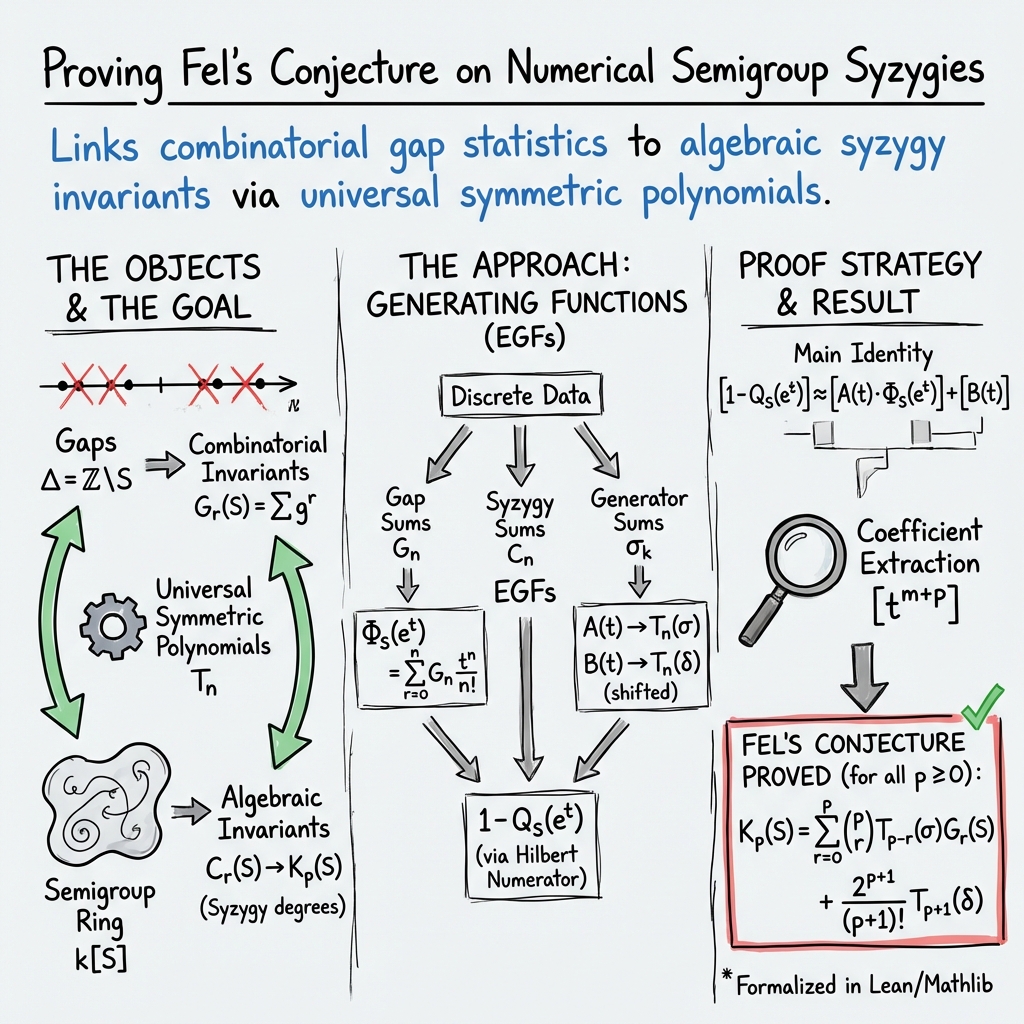
Abstract: Let $S=\langle d_1,\dots,d_m\rangle$ be a numerical semigroup and $k[S]$ its semigroup ring. The Hilbert numerator of $k[S]$ determines normalized alternating syzygy power sums $K_p(S)$ encoding alternating power sums of syzygy degrees. Fel conjectured an explicit formula for $K_p(S)$, for all $p\ge 0$, in terms of the gap power sums $G_r(S)=\sum_{g\notin S} gr$ and universal symmetric polynomials $T_n$ evaluated at the generator power sums $σ_k=\sum_i d_ik$ (and $δ_k=(σ_k-1)/2k$). We prove Fel's conjecture via exponential generating functions and coefficient extraction, solating the universal identities for $T_n$ needed for the derivation. The argument is fully formalized in Lean/Mathlib, and was produced automatically by AxiomProver from a natural-language statement of the conjecture.
Paper Prompts
Sign up for free to create and run prompts on this paper using GPT-5.
Top Community Prompts
Explain it Like I'm 14
What is this paper about?
This paper studies a special kind of number set called a numerical semigroup. Think of a numerical semigroup as all the numbers you can build by adding together some “starter” numbers over and over. For example, with starters 3 and 5, you can make 0, 3, 5, 6, 8, 9, 10, 11, … but not 1, 2, 4, or 7. The numbers you can’t make are called “gaps.”
The paper proves a formula (called Fel’s Conjecture) that links:
- the pattern of these gaps, and
- certain hidden “relationships” among the starters (called syzygies), using a family of special polynomials named Tₙ.
It also shows the proof was fully checked by a computer proof assistant (Lean), and was automatically generated from natural-language input by an AI system (AxiomProver).
What questions does it ask?
Here are the main questions the paper answers:
- If you look at the hidden relationships among the starter numbers (syzygies) and measure them in a certain way, can you predict those measurements from the gaps?
- Is there a single, clean formula—using the gap sums and the universal polynomials Tₙ—that works for all cases?
- Can we prove this formula for every situation, not just small examples?
- Can an AI system produce a complete, formally verified proof of this mathematical result?
How did the authors try to answer them?
The authors turn the problem into a kind of “math machine” setup using generating functions. You can think of a generating function as a compact way to store an entire sequence of numbers in one expression—like a barcode for math sequences.
To make the argument work smoothly, they use the following steps:
- They translate the data about the semigroup into generating functions:
- A function recording which numbers are in S (the semigroup) is called the Hilbert series. Its “numerator” (a polynomial) encodes the syzygies.
- A function recording the gaps is the “gap polynomial,” which turns gaps into a neat series.
- They package the special polynomials Tₙ inside two generating functions, called A(t) and B(t). These are designed so that the coefficients of A(t) and B(t) are exactly the Tₙ you need.
- They switch variables (from z to et) and carefully compare coefficients—this is like aligning two barcodes and checking that each stripe matches.
- Finally, they extract the exact formula for the quantities K_p (which measure the syzygies) in terms of the gap sums G_r and the Tₙ polynomials.
As a bonus, they formalized every step in Lean (a proof-checking system). The Lean code was generated by AxiomProver, an AI tool that turns a plain-English math problem into a formal, verified proof.
What did they find?
They prove Fel’s Conjecture for all p ≥ 0. In simple terms:
- The “syzygy measurements” K_p for a numerical semigroup S can always be written as a clean combination of:
- gap power sums G_r(S) (add up gr over all gaps g), and
- universal symmetric polynomials Tₙ evaluated on simple summaries of the starters (like σₖ = sum of dᵢk and δₖ = (σₖ − 1)/2k).
Very loosely, the final formula says:
- K_p(S) equals a weighted sum over r from 0 to p of T_{p−r}(σ) times G_r(S), plus a correction term built from T_{p+1}(δ).
In math form:
- K_p(S) = Σ{r=0}{p} (p choose r) * T{p−r}(σ) * G_r(S) + (2{p+1}/(p+1)) * T_{p+1}(δ).
This ties together the “what you can’t make” (gaps) with the “hidden equations” among the things you can make (syzygies), using the same family of universal polynomials.
Why is this important?
- It closes a known conjecture: The result confirms Fel’s Conjecture in full generality.
- It builds a bridge: It connects number theory (gaps and partitions of numbers) with algebra (syzygies and Hilbert series) through universal polynomials Tₙ.
- It provides tools: With this formula, researchers can compute K_p from gap data and generator sums more directly.
- It shows AI can help: The proof was fully formalized and verified in Lean, and was produced automatically by AxiomProver from a natural-language description. That’s a strong step toward trustworthy, AI-assisted mathematical research.
- It hints at deeper links: The same Tₙ polynomials appear in other areas (restricted partition functions, zig-zag numbers, and Ramanujan’s q-series), suggesting a unifying theme across different parts of mathematics.
A friendly mental picture
- Starters: the basic building blocks (like 3 and 5) you can add to make your number set.
- Gaps: the numbers you can’t make with those starters.
- Syzygies: hidden rules among the starters (like “if you combine them this way, you get the same result as combining them that way”).
- Generating functions: a compact “barcode” that encodes a whole sequence of numbers.
- Tₙ polynomials: universal recipes that work the same way no matter how many starters you have, as long as you feed them the right summary of the starters.
By tying all these together, the paper shows that the shape of the gaps and the shape of the hidden rules are two sides of the same coin—and now we have a precise formula to move between them.
Knowledge Gaps
Knowledge gaps, limitations, and open questions
Below is a focused list of the paper’s unresolved issues—items that are missing, uncertain, or left unexplored, stated concretely to guide future research.
- Clarify the “morally correct” definition of alternating syzygy power sums: the paper uses an ad hoc coefficient-extraction definition of from that bypasses partial Betti numbers and syzygy modules. Provide a rigorous bridge proving equivalence with the alternating sums of the true syzygy degrees arising from a minimal free resolution of .
- Minimal generating set requirement: the main formula is stated for with , but numerical semigroups have a unique minimal generating set. Determine whether the formula depends on using the minimal generating set and prove invariance (or give corrections) under redundant generators.
- Domain/generalization scope: the proof is specific to numerical semigroups (one-dimensional monomial subrings of ). Investigate extensions to:
- affine semigroups in (multigraded semigroup rings),
- more general toric/monomial rings of higher dimension,
- semigroup gluing and other constructions (e.g., telescopic, complete intersection) and their impact on .
- Explicit formulas for gap power sums : the result expresses in terms of , but computing generally requires the full gap set. Develop explicit, efficient formulas or bounds for in terms of the generators (e.g., via Apéry sets or Frobenius-type invariants) to make the formula computationally usable at scale.
- Algorithmic complexity and practical computation: quantify the complexity of computing from and give algorithms that avoid enumerating all gaps. Provide benchmarks or methods (symbolic or numeric) exploiting the universal polynomials and known structure of .
- Structural consequences for classical invariants: analyze how relates to the Frobenius number , genus , type, embedding dimension, and symmetry/pseudo-symmetry properties. Identify exact identities, inequalities, or asymptotic relations connecting to these invariants.
- Positivity/integrality and arithmetic properties: study the arithmetic nature of and / (integrality, denominators, positivity, sign patterns). Determine conditions under which is nonnegative, its growth rates, and whether coefficients of admit combinatorial interpretations.
- Basis dependence of : is presented in the power-sum basis . Develop expansions and identities in other symmetric-function bases (elementary , complete , Schur) and characterize structural recurrences that might simplify computation.
- Bernoulli structure of : the factor suggests Bernoulli-number involvement. Derive closed-form expansions for in terms of Bernoulli numbers/polynomials and , including exact coefficient formulas and integrality criteria.
- Families with special structure: for symmetric or complete-intersection numerical semigroups, simplifies. Systematically classify families where reduces to closed forms and prove general theorems akin to the worked examples (e.g., and symmetric cases).
- Conceptual explanation beyond generating functions: provide a geometric or homological explanation for why alternating syzygy power sums are governed by gaps and (e.g., via Apéry sets, semigroup cohomology, or a functorial interpretation linking and ).
- Formal power series rigor: the proof uses formal substitutions and symbolic variables satisfying power-sum identities (with a note that “one should really use infinitely many variables”). Supply a complete algebraic framework (e.g., in the -ring of symmetric functions or plethystic formalism) that justifies these steps without heuristic shortcuts.
- Characteristic and base field issues: while suggests characteristic-independence for Hilbert series, syzygy phenomena can be subtle in positive characteristic. State and prove characteristic assumptions under which the formula holds unchanged.
- Behavior under semigroup operations: determine how transforms under standard operations (gluing, intersection, numerical duplication, shifting, and blowups). Prove transfer principles or invariance/transform identities.
- Large- asymptotics: analyze the asymptotic behavior of as (e.g., via saddle-point methods on generating functions), including dependence on , , and the distribution of gaps.
- Connection to quasimodular forms: the paper recalls links between and Ramanujan’s , but does not leverage them for semigroups. Investigate whether modular/quasimodular structures yield new identities or computational shortcuts for .
- Verification and robustness of the formalization: the Lean formalization is claimed but version-specific and not dissected. Provide a detailed formal proof outline, lemma inventory, and robustness checks across Lean/Mathlib versions, including independent replication and proof-term stability.
- Editorial/typographical precision: numerous malformed LaTeX macros and equations (e.g., missing braces and delimiters) obscure exact identities. Produce a corrected, typeset-verified version to ensure unambiguous mathematical statements and reproducibility.
Practical Applications
Practical Applications of the Paper’s Findings and Methods
The paper proves Fel’s conjecture, giving closed-form expressions for numerical semigroup syzygy power sums via gap power sums and universal symmetric polynomials, and demonstrates an end-to-end Lean formalization generated by AxiomProver. Below are actionable applications grouped by deployment horizon, with links to sectors, tools, and dependencies.
Immediate Applications
- Numerical semigroup invariant computation (academia, software)
- Use case: Compute alternating syzygy power sums
C_{m+p}(S)and normalized invariantsK_p(S)directly from gap sumsG_rand generator power sumsσ_kwithout constructing minimal free resolutions. - Tools/workflows: Implement
A(t)andB(t)exponential generating function evaluators; evaluateT_n(σ)andT_n(δ); integrate into SageMath/Macaulay2 packages for semigroups and monomial rings. Provide a CLI that takes generatorsd_i, computesΔ,G_r,σ_k,δ_k, and outputsK_p(S). - Assumptions/dependencies:
gcd(d_i)=1, robust gap-set computation (Frobenius number algorithms), potentially large integer arithmetic. The formulas rely on the paper’s Theorem confirming Fel’s conjecture.
- Use case: Compute alternating syzygy power sums
- Faster diagnostics for semigroup rings and toric ideals (academia, software)
- Use case: Replace expensive resolution computations with closed-form invariants to screen monomial curve/tori candidates (e.g., symmetry checks, Betti number heuristics via syzygy power patterns).
- Tools/workflows: Add
K_p(S)-based heuristics to algebraic geometry/commutative algebra CAS workflows. - Assumptions/dependencies: Invariants capture global features but do not replace full resolutions when detailed structure is required.
- Restricted partition function improvements (academia, software)
- Use case: Leverage the
T_nmachinery and its connection to Sylvester waves to compute/approximate restricted partition countsW(s, d_•)more efficiently. - Tools/workflows: Implement
T_n-based polynomial evaluation for coefficients inW_1; integrate as acceleration routines for integer partition modules. - Assumptions/dependencies: Accuracy relies on the
T_nidentities and the established correspondence to Sylvester wave coefficients; performance gains are problem-size dependent.
- Use case: Leverage the
- Coding theory pre-screening via Weierstrass semigroups (industry: communications; academia)
- Use case: For algebraic-geometry codes, quickly estimate parameters using gap sets and derived invariants (e.g., genus
G_0, higher momentsG_r) associated with Weierstrass semigroups at rational points, to prioritize curves/codes. - Tools/workflows: Pipeline that ingests curve data → computes Weierstrass semigroups → evaluates
G_randK_p(S)→ ranks candidate constructions. - Assumptions/dependencies: Mapping from these invariants to code performance is heuristic; rigorous bounds require more structure (e.g., order bounds, Feng–Rao distances).
- Use case: For algebraic-geometry codes, quickly estimate parameters using gap sets and derived invariants (e.g., genus
- Lean-proof artifacts for reproducible mathematics (academia; policy)
- Use case: Adopt the paper’s Lean 4 artifacts as a template to publish machine-verified proofs alongside human-readable papers, improving transparency and reproducibility.
- Tools/workflows: Lean 4.26.0 + Mathlib; CI pipelines that compile and check proof artifacts; archive DOIs linking formal code to publications.
- Assumptions/dependencies: Versioning stability of Lean/Mathlib; community conventions for artifact review and curation.
- Natural-language-to-formal proof pilot deployments (software, academia)
- Use case: Employ the AxiomProver approach for well-scoped problems whose proof techniques are combinatorial/symbolic (e.g., generating functions, coefficient extraction).
- Tools/workflows: Author problem statements with precise definitions, provide environment constraints, run automated formalization, review Lean outputs.
- Assumptions/dependencies: Current coverage of Mathlib; problem domains compatible with existing libraries; human-in-the-loop validation.
- Educational modules and interactive notebooks (education)
- Use case: Create teaching materials for generating functions, symmetric polynomials, and semigroups that reproduce
K_p(S)computations and Lean proofs. - Tools/workflows: Jupyter/SageMath notebooks implementing
A(t),B(t),T_n; Lean scripts with guided exercises; visualization ofΔ,G_r, and syzygy degrees. - Assumptions/dependencies: Student familiarity with basic algebra/combinatorics; computational environment setup.
- Use case: Create teaching materials for generating functions, symmetric polynomials, and semigroups that reproduce
Long-Term Applications
- End-to-end formalization pipelines for mathematical research (software, academia, policy)
- Use case: Scale the AxiomProver-style workflow to broader domains (algebraic geometry, number theory, combinatorics), establishing standards for machine-verifiable research dissemination.
- Tools/products: “Proof-as-a-Service” platforms; journal integrations that mandate/encourage formal artifacts; knowledge bases linking lemmas across fields.
- Assumptions/dependencies: Expanded Mathlib coverage; robust NL-to-formal tooling; community adoption; governance and curation models.
- Formal verification in safety-critical software/hardware (software, robotics, finance)
- Use case: Adapt NL-to-Lean pipelines to verify arithmetic kernels, combinatorial schedulers, or cryptographic primitives where identities akin to those in generating-function proofs are central.
- Tools/workflows: Domain-specific libraries in Lean; connectors from specs to formal proofs; certification processes.
- Assumptions/dependencies: Domain libraries, performance of proof search, certified toolchains, regulatory acceptance.
- Automated discovery of combinatorial identities and algorithms (software, academia)
- Use case: Generalize the paper’s coefficient-extraction method to auto-conjecture/prove identities across restricted partitions, lattice paths, and quasimodular forms, yielding new algorithms.
- Tools/products: “GF Prover” engines that manipulate EGFs/OGFs symbolically; integration with CAS for hybrid compute/prove loops.
- Assumptions/dependencies: Rich identity corpora; heuristic guidance for search; scalable proof synthesis.
- Improved design and analysis of AG codes via semigroup invariants (communications, academia)
- Use case: Use advanced invariants (
K_p,G_r,T_n) to refine code parameter predictions (distance, decoding radii) and optimize constructions on curves with favorable Weierstrass semigroups. - Tools/workflows: Code construction toolchains augmented with semigroup analytics; optimization loops informed by invariant patterns.
- Assumptions/dependencies: Deeper theoretical bridges from invariants to performance metrics; empirical validation; computational feasibility for large instances.
- Use case: Use advanced invariants (
- Cross-disciplinary applications of quasimodular forms (academia, potentially physics)
- Use case: Explore
T_n’s appearance in Ramanujan’sU_{2n}(q)series for links to enumerative geometry or string-theoretic counts; develop computational pipelines using theΩ(X)andY_n(q)constructs. - Tools/workflows: Quasimodular form libraries; symmetric-function avatars for
Y_n; data-driven conjecture generation. - Assumptions/dependencies: Field-specific hypotheses; high-precision q-series computation; theoretical consolidation across disciplines.
- Use case: Explore
- Operations research heuristics inspired by semigroup gap statistics (industry: logistics/finance; academia)
- Use case: Leverage gap power sums and coin-problem analogies to build heuristics/approximations for knapsack/packing variants and resource allocation under discrete constraints.
- Tools/workflows: Feature-engineered models incorporating gap statistics; simulation-based tuning; hybrid optimization.
- Assumptions/dependencies: Empirical effectiveness; mapping from abstract invariants to practical objective/constraint landscapes; problem-specific adaptations.
- Standards and policy for verifiable scientific reporting (policy, academia)
- Use case: Establish guidelines where mathematical results include machine-checkable artifacts, versioned environments, and continuous verification, enhancing trust and reproducibility.
- Tools/products: Policy frameworks, repository infrastructures, artifact evaluation rubrics.
- Assumptions/dependencies: Community buy-in; funding for infrastructure; interoperability across tooling ecosystems.
Each application’s feasibility depends on available computational tools (SageMath/Macaulay2, Lean/Mathlib), problem domain alignment, performance of formalization engines (AxiomProver), and the maturity of theoretical bridges (e.g., from semigroup invariants to coding-theory performance).
Glossary
- Additive number theory: A branch of number theory concerned with the additive properties of integers and sets of integers. "Numerical semigroups form a classical meeting point of additive number theory and commutative algebra."
- Alternating power sums: Sums of powers with alternating signs, here formed from the degrees of syzygies. "encoding alternating power sums of syzygy degrees."
- AxiomProver: An AI system that automatically generates and verifies formal mathematical proofs. "The argument is fully formalized in Lean/Mathlib, and was produced automatically by AxiomProver from a natural-language statement of the conjecture."
- Bernoulli umbra: A symbolic device where powers encode Bernoulli numbers, satisfying . "with each denoting a Bernoulli umbra, meaning ."
- Betti numbers: Integers that count ranks of modules in a minimal free resolution; here the partial Betti numbers of the semigroup ring. "where are called the partial Betti numbers"
- Coefficient extraction: The technique of reading coefficients from generating functions to recover sequence terms. "via exponential generating functions and coefficient extraction, isolating the universal identities for needed for the derivation."
- Commutative algebra: The study of commutative rings, modules, and related structures. "Numerical semigroups form a classical meeting point of additive number theory and commutative algebra."
- Exponential generating function: A generating function of the form , used to encode sequences. "We prefer to rewrite \eqref{eq:felT} more compactly as an exponential generating function."
- Frobenius-type problems: Problems concerning the largest integer not representable by given positive integers and related generalizations. "links numerical semigroups to topics such as Frobenius-type problems, restricted partition functions, and toric/monomial methods."
- Gap power sums: Sums of powers over the gaps of a numerical semigroup, . "in terms of the gap power sums "
- Gap set: The finite set of nonnegative integers not belonging to a numerical semigroup. "denote the gap set (finite by definition)."
- Graded domain: An integral domain equipped with a grading compatible with multiplication. "is a one-dimensional graded domain whose Hilbert series records"
- Graded free resolutions: Exact sequences of graded free modules resolving a module or ring. "The interplay between gaps, Hilbert series, and graded free resolutions"
- Hilbert numerator: The numerator polynomial in the rational expression of a Hilbert series. "for some polynomial $Q_S(z) \in \ZZ[z]$, called the Hilbert numerator of ."
- Hilbert series: A generating function that encodes graded dimensions or counts of algebraic structures. "The Hilbert series for is defined as the ordinary generating function ."
- Lean/Mathlib: The Lean theorem prover and its community mathematics library used for formal verification. "The argument is fully formalized in Lean/Mathlib"
- Numerical semigroup: An additive submonoid of the nonnegative integers with finite complement. "Let be a numerical semigroup"
- Ordinary generating function: A generating function of the form . "The Hilbert series for is defined as the ordinary generating function ."
- Quasimodular form: A generalization of modular forms that allow certain additional terms in their transformation behavior. "which is a weight $2n$ quasimodular form \cite{ref:bcss}."
- Ramanujan's q-series: A series in the variable studied by Ramanujan with deep modular and combinatorial properties. "Consider Ramanujan's -series"
- Restricted partition function: The number of integer partitions of using prescribed parts . "denote the restricted partition function (that is, the number of integer partitions of into )."
- Semigroup ring: A ring constructed from a semigroup, here . "The semigroup ring "
- Sylvester waves: Components in Sylvester’s decomposition of the restricted partition function indexed by . "Sylvester \cite{ref:sylvester} decomposes as the sum of so-called Sylvester waves :"
- Syzygies: Relations among generators of a module; their degrees appear in graded resolutions. "and the are called the degrees of syzygies, as defined in \cite[\S2]{ref:fel0}."
- Theta function: A special function with modular properties; here of weight $1/2$. "where is the weight $1/2$ theta function."
- Toric/monomial methods: Techniques from toric geometry and monomial ideals used in combinatorial and commutative algebra. "and toric/monomial methods."
- Universal symmetric polynomials: Symmetric polynomials that arise uniformly across different contexts. "and universal symmetric polynomials ."
- Zig-zag numbers: The tangent (Euler) numbers appearing in expansions like . "related to the tangent/zig-zag numbers , satisfying"
Collections
Sign up for free to add this paper to one or more collections.