- The paper introduces a novel SDE framework that integrates ODE-based physical laws as an inductive bias for enhanced causal graph recovery.
- The method leverages sparsity-inducing MLE for parameter estimation, yielding higher true positive rates and lower false discovery rates in dynamical systems.
- The approach demonstrates robustness in handling cycles and feedback loops, offering improved identifiability in complex systems.
Physics as the Inductive Bias for Causal Discovery
Introduction
The paper "Physics as the Inductive Bias for Causal Discovery" (2602.04907) proposes a novel framework that integrates partial physical knowledge to improve causal discovery in dynamical systems. Leveraging the structure imparted by known physical laws, this framework aims to enhance identifiability and robustness beyond what purely data-driven methods can achieve. The authors model system evolution as a stochastic differential equation (SDE), incorporating known ordinary differential equations (ODEs) as drift terms and unknown causal influences as diffusion terms. The proposed approach provides theoretical guarantees for recovering causal graphs under mild conditions and demonstrates empirical superiority over current state-of-the-art methods.
Methodology
The key innovation lies in using physics-based ODEs as an inductive bias within causal discovery tasks, particularly for systems where feedback loops, cyclic interactions, and non-stationary trends challenge conventional paradigms. This approach contrasts sharply with existing methods based on acyclic assumptions or equilibrium models, which fail to capture the inherent dynamics of many real-world processes. By embedding known mechanistic dynamics within SDEs, the authors enhance parameter estimation and causal graph recovery, thereby improving the stability and physical consistency of inferred causal structures.
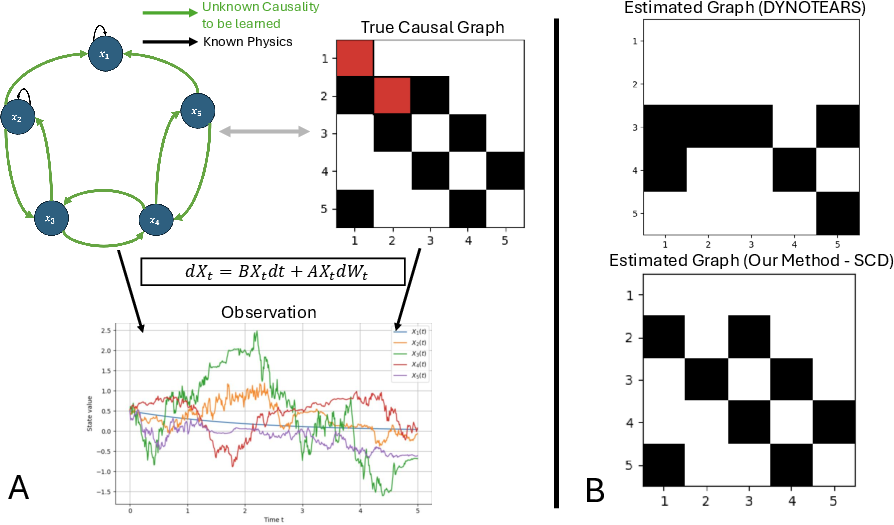
Figure 1: A motivating example of causal discovery under partially known physics.
Theoretical Contributions
The paper introduces a scalable maximum likelihood estimation (MLE) algorithm leveraging sparsity-inducing techniques for efficient parameter estimation. This method exploits the causal graph structure inherent in the system dynamics, facilitating robust recovery of causal relationships. The authors provide theoretical proofs guaranteeing high-probability recovery of the true causal graph given adequate sample sizes and regularization parameters. These results affirm the soundness of using stochastic models as a bridge between mechanistic constraints and statistical learning in complex systems.
Experimental Results
Empirical validation is conducted on diverse dynamical systems with known ODE components and hidden causal interactions. The experiments show that the proposed SDE-based framework significantly enhances causal graph recovery with lower false discovery rates and higher true positive rates compared to four baseline methods. This improvement is particularly pronounced in scenarios featuring cycles and feedback loops, where traditional methods underperform due to assumption mismatches.
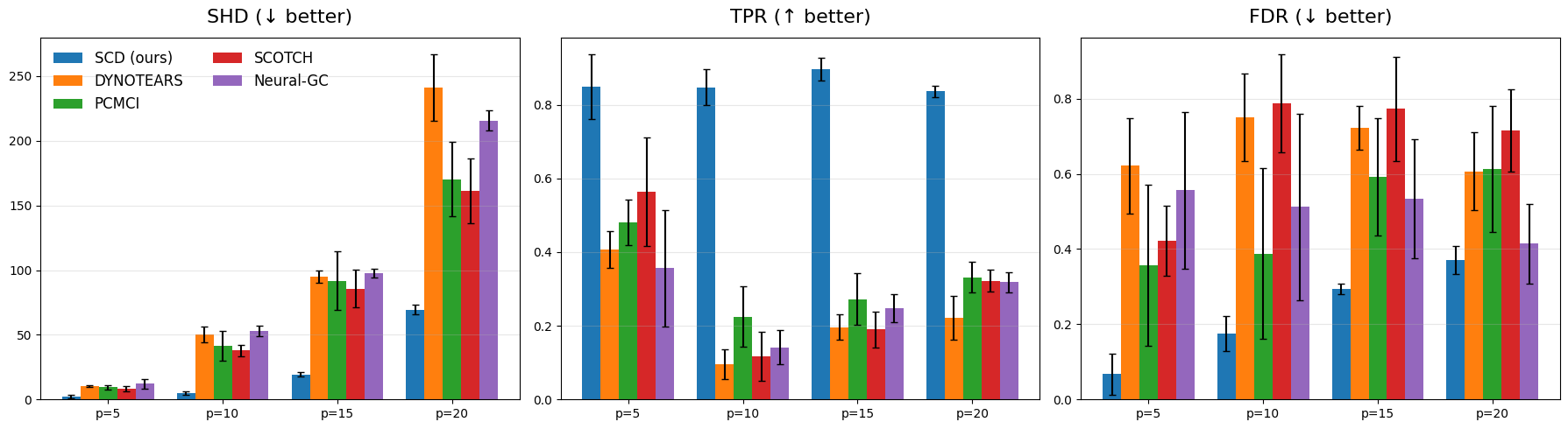
Figure 2: Results on DAGs (stable system): mean/std over 10 runs (SHD, TPR, FDR).
Implications and Future Work
The integration of ODEs enriches causal discovery by providing a mechanistic context, facilitating more accurate modeling of non-linear interactions and dependencies. This approach offers a promising avenue for advancing causal reasoning in fields like neuroscience, climate science, and biology, where systems exhibit complex interdependencies grounded in physical laws.
Looking forward, the authors suggest several potential extensions, including exploring partial differential equations (PDEs) to capture spatial-temporal dynamics and enhancing the framework's applicability to non-stationary datasets with complex noise structures. Further research could expand the use of mechanistic models as a foundational element in causal inference, promoting more nuanced understandings of intricate system behaviors across scientific domains.
Conclusion
The paper presents a significant methodological advancement by systematically integrating physical laws into causal discovery processes, thereby offering improved accuracy and reliability over traditional methods. By embedding known dynamics within stochastic models, the proposed framework showcases the potential of physics-informed approaches to enhance causal understanding in highly interconnected systems. This work opens new pathways for integrating mechanistic insights into data-driven causal inference, paving the way for more robust and interpretative models in various scientific disciplines.