A Thermodynamic Theory of Learning Part II: Critical Period Closure and Continual Learning Failure
Abstract: Learning performed over finite time is inherently irreversible. In Part~I of this series, we modeled learning as a transport process in the space of parameter distributions and derived the Epistemic Speed Limit (ESL), which lower-bounds entropy production under finite-time dynamics. In this work (Part~II), we show that irreversibility imposes a geometric restriction on future adaptability through the compositional structure of learning dynamics. Successive learning phases compose multiplicatively as transport maps, and their Jacobians form a semigroup whose rank and singular values are submultiplicative. As a result, dynamically usable degrees of reconfiguration can only decrease under composition. We formalize the remaining adaptability of a model in terms of compatible effective rank, defined as the log-volume of task-preserving directions that remain dynamically accessible. Although task performance may remain unchanged, finite-time learning can progressively reduce this reconfiguration capacity. We prove a capacity-threshold criterion for continual learning: let m_B denote the stable rank of the Hessian of a new task B restricted to the task-preserving manifold of a previously learned task A. If m_B exceeds the residual compatible effective rank, then task B is trajectory-level incompatible with task A; any sufficient adaptation necessarily induces forgetting. Thus catastrophic forgetting arises not from the absence of multi-task solutions, but from irreversible loss of reconfiguration capacity under compositional learning dynamics. This establishes a trajectory-level capacity limit for continual learning.
Paper Prompts
Sign up for free to create and run prompts on this paper using GPT-5.
Top Community Prompts
Explain it Like I'm 14
What is this paper about?
This paper looks at why “continual learning” often fails. Continual learning means teaching a system (like a neural network) new tasks one after another without making it forget the old ones. The author argues that forgetting isn’t just about the model being too small or badly designed. Instead, the way we learn over finite time gradually removes the model’s ability to safely change its internal settings later. This shrinking “flexibility” creates a point where any attempt to learn something new will make the model forget something old.
What questions are they asking?
They ask three simple questions:
- How does the step-by-step process of learning limit what a model can still change in the future?
- Can we measure how much “safe flexibility” the model has left after learning a task?
- Is there a clear rule that tells us when learning a new task will inevitably cause forgetting of a previous task?
How did they study it? (Plain-language method and ideas)
Think of learning like moving through a big room filled with knobs (the model’s parameters). Each learning phase moves you from one place to another by turning these knobs in a certain way. The paper studies the geometry of these moves.
Here are the key ideas, in everyday terms:
- Transport map: Imagine a set of instructions that takes your current knob settings to new ones. Each learning phase is one of these instruction sets.
- Composition: When you learn tasks in sequence, you stack these instruction sets. The later moves apply on top of the earlier moves. If an earlier move squashed some directions (made some knobs hard to turn), later moves can’t magically unsquash them just by stacking more instructions.
- Jacobian and rank: The Jacobian is a way to track how small changes at the start turn into changes at the end. Its “rank” is like the number of independent directions you can still use to change things. If the rank goes down, you have fewer directions to adjust.
- Effective rank (log-volume): Instead of just counting directions, the paper measures how “big” the space of usable directions is by looking at how much the learning steps stretch or squeeze different directions. Imagine having a rubber sheet representing all the ways you can change your model without causing damage; effective rank measures how much that sheet has shrunk. Smaller sheet = fewer safe ways to reconfigure the model.
- Task-preserving manifold (safe zone): For a learned task A, there’s a set of directions you can move along that don’t harm performance on A. Think of this as a safe zone where you can reshape the model’s internals without breaking A.
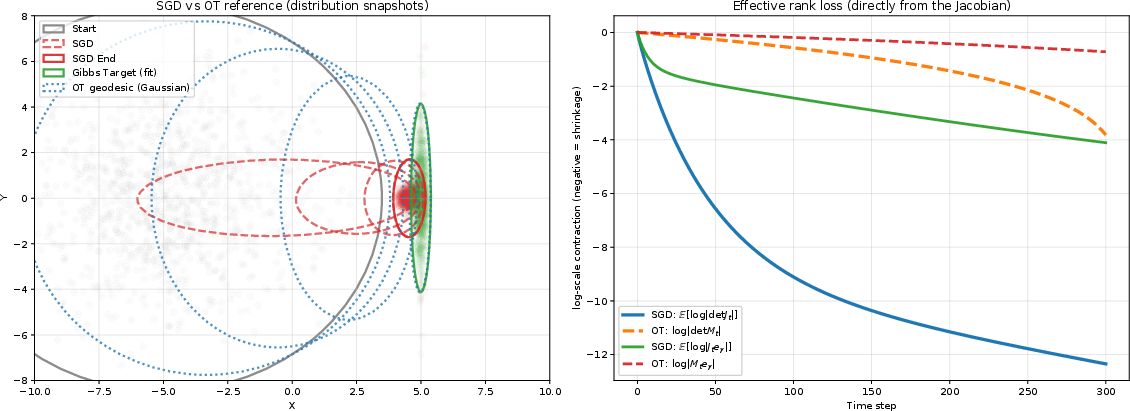
- Excess dissipation (doing extra twisting): From Part I, there’s a “speed limit” that says the minimum effort needed to move from one state to another. Real learning (like SGD over finite time) usually spends extra effort. That extra effort acts like twisting and squeezing the rubber sheet more than necessary, shrinking the safe zone.
- New task’s demand (stable rank of curvature): The new task B “curves” the landscape in certain directions. The paper uses a number called m_B (stable rank of the Hessian restricted to the safe zone for A) to describe how many independent directions B needs you to adjust inside that safe zone. Bigger m_B means B needs more room to move.
What did they find and why is it important?
Main findings, simply stated:
- Learning steps multiply: When you learn tasks one after another, each phase gets applied on top of the last. If an earlier phase squeezed the model’s flexibility in some directions, later phases cannot undo that squeeze just by ordinary learning. The usable directions shrink over time.
- Effective rank goes down over time: Because real training has “excess dissipation,” it tends to squeeze different directions unevenly. This gradually reduces the effective rank—the “log-volume” of safe directions you have left to reconfigure the model without harming past tasks.
- Capacity threshold rule: There’s a clear condition for when forgetting is unavoidable. If the new task B needs more independent directions (m_B) than your remaining safe flexibility (compatible effective rank) inside the old task A’s safe zone, then learning B without harming A is impossible. In other words, if B asks for a bigger room than the rubber sheet you’ve got left, you must step outside the safe zone and will forget A.
- Critical period closure: As learning continues, the safe flexibility can shrink to the point where adding new tasks becomes impossible without causing damage. This feels like a “critical period” ending: after enough squeezing, the model becomes too rigid to learn new things safely.
Why this matters:
- It explains catastrophic forgetting as a geometric, dynamical effect: not because multi-task solutions don’t exist, but because the learning process itself gradually removes the ability to reach those solutions safely.
- It suggests we need to design learning dynamics (not just objectives) that preserve directional diversity and avoid excessive early squeezing.
What does this mean for the future?
Implications and potential impact:
- To make continual learning work, we should protect the model’s “safe flexibility” during training. That could mean:
- Keeping updates diverse so we don’t squeeze the same directions over and over.
- Reducing “excess dissipation,” especially early on, so the rubber sheet doesn’t shrink too fast.
- Using methods (like replay) that keep task-equivalent directions active, preserving the safe zone.
- Considering architectures that separate tasks into modules, so squeezing in one place doesn’t ruin everything.
- The paper doesn’t propose a new algorithm; it gives a theory that tells us why certain methods help and where they might fail. It reframes the problem: the key is managing the geometry of learning over time so that enough reconfiguration capacity remains for future tasks.
In short: Continual learning fails when earlier training uses up the model’s safe room to move. The paper shows how and why this happens, and gives a clear threshold for when forgetting is unavoidable. This guides us to design training processes that preserve flexibility, not just performance on the current task.
Knowledge Gaps
Knowledge gaps, limitations, and open questions
Below is a concrete, action-oriented list of unresolved issues and open problems highlighted or implied by the paper. Each item pinpoints what is missing or uncertain and suggests where future work could make progress.
- Coordinate dependence of the “effective rank” capacity measure: depends on the parameterization and scaling of . A coordinate- (or metric-) invariant formulation (e.g., via the Fisher information or a natural gradient metric) is not provided, making comparisons across models and layers ambiguous.
- Dimensional mismatch in the capacity threshold: the inequality compares a dimension-like stable rank () to a log-volume proxy (a dimensionless scale of singular-value products). A principled normalization or alternative capacity measure with matching units is not specified, and constants/factors needed to make this a rigorous threshold are not derived.
- Missing rigorous link between entropy production and rank contraction: no formal inequality connects total/excess dissipation (, ) to the contraction of or its compatible variant. Establishing quantitative bounds of the form “dissipation budget ⇒ maximum log-volume loss” remains open.
- Monotonicity of compatible effective rank: the paper asserts that is non-increasing under composition, but conditions ensuring this (especially under stochastic, discrete-time updates or when some singular values can expand) are not proved. Counterexamples or sufficient conditions (e.g., contractive drift, bounded noise anisotropy) are not characterized.
- Claimed exponential decay of effective rank lacks proof: the text states that finite-time dissipation induces exponential decay of effective rank, but no theorem or rate bound relating decay to or is presented.
- Stochastic composition and expectations: for random transport maps, the stepwise composition holds pathwise, but it is unclear under which conditions submultiplicativity and rank/volume monotonicity persist after taking expectations over and .
- Existence and computability of the task-preserving manifold and projector : assumptions that is a smooth manifold with a well-defined tangent projector are strong in modern deep networks (non-smooth activations, parameter non-identifiability). Practical procedures to approximate and are not given.
- Choice of via Hessian stable rank: relying on (local Hessian restricted to ) to measure task ’s “reconfiguration dimension” is sensitive to non-convexity, negative curvature, and noise. Whether alternative metrics (e.g., Fisher, Gauss–Newton, NTK) yield more robust and predictive capacity estimates is not explored.
- Locality vs. global adaptation: is local; continual learning may require non-local moves. How to define a global or path-based “reconfiguration demand” for compatible with the theory remains open.
- Sufficiency conditions are missing: Theorem 1 gives a one-sided impossibility result ( ⇒ forgetting). Conditions under which is sufficient (with a realizable learning dynamics achieving no forgetting) are not provided, despite the conclusion claiming “necessary and sufficient” conditions.
- Forgetting without strong convexity: performance degradation is quantified using transverse -strong convexity near , which rarely holds globally in deep networks. Bounds for forgetting in general non-convex settings, or using alternative regularity (e.g., error growth under PL or Kurdyka–Łojasiewicz conditions), are not developed.
- Regularization of degenerate directions: if some singular values of are exactly zero (due to symmetries or parameter non-identifiability), and , collapsing the capacity measure. A robust, regularized definition (e.g., thresholded log-det, soft-rank) is needed to avoid pathological conclusions.
- Parameterization invariances and scale symmetries: layer rescaling and other symmetries change and while leaving function-level behavior invariant. A pullback metric or gauge-fixing strategy to make capacity estimates invariant is not specified.
- Discrete-time optimizers and non-gradient dynamics: the analysis uses gradient-flow and Fokker–Planck intuitions; extensions to momentum, Adam, normalization layers, and other practical update rules (with non-trivial Jacobian spectra) are not formalized.
- Effect of noise and “temperature” schedules: how injected noise levels or simulated annealing schedules affect and delay/advance “critical period closure” is qualitatively discussed but lacks quantitative predictions or optimal-control formulations.
- Expansion dynamics and reopening capacity: the text notes lost directions “cannot be restored without additional expansion dynamics,” but does not quantify the minimal dissipation required to reopen collapsed directions or trade-offs between expansion and forgetting.
- Architectural expansion and changing dimensionality: when adding parameters (modular growth), and change; how and the threshold condition transform under dimension-increasing maps is not analyzed.
- Coordination with replay and interleaving: while replay is argued to preserve “support,” there is no model predicting how replay frequency/size affects over tasks, nor analysis of interleaved/multi-task training on capacity evolution.
- Practical estimation procedures: how to estimate and in large-scale networks with tractable, sample-efficient algorithms (e.g., using Hessian/gradient-covariance sketches, randomized log-det estimators), and how accurate these proxies are, is left open.
- Statistical guarantees and concentration: links between ensemble-level quantities (expectations over and ) and per-run behavior of a single model are not derived. Conditions under which ensemble statements concentrate for individual trajectories are missing.
- Data-manifold vs. parameter-manifold geometry: the theory is parameter-space based. How data-manifold structure, representational geometry, and function-space distances map to -level contraction and the proposed capacity measures is not addressed.
- Interaction with generalization: preserving task-preserving support could trade off with generalization. The paper does not analyze how correlates with test error or robustness.
- Order and schedule sensitivity: the theory suggests task order matters, but no formal results quantify worst-case/average-case capacity loss as a function of task sequence or dissipation allocation across phases.
- ESL-to-Jacobian connection: the Wasserstein-based Epistemic Speed Limit bounds endpoint reachability, but a concrete bridge to per-step singular value dynamics (e.g., bounds on in terms of distances and dissipation) is not established.
- Handling non-smooth losses/activations: results assume twice differentiability in places; extensions to ReLU-like networks and subdifferential calculus compatible with the capacity threshold are not provided.
- “Interaction terms” in log-det composition: the discussion mentions interaction terms when composing Jacobians but does not bound them (e.g., via inequalities on products of singular values). Sharp, usable bounds are lacking.
- Experimental validation blueprint: although proxies are suggested, the paper does not present protocols, metrics, and hypotheses that would allow clear empirical falsification/verification of critical period closure and capacity thresholds.
- Clarification of claims of necessity/sufficiency: the conclusion states “necessary and sufficient conditions,” but only a one-sided threshold theorem is shown. Precisely formulating and proving the complementary direction remains open.
Practical Applications
Immediate Applications
Below are actionable applications that can be deployed now, leveraging the paper’s findings on compositional contraction, compatible effective rank, and the thermodynamic Epistemic Speed Limit (ESL).
- Capacity-aware training dashboards — Software/ML, Robotics, Finance, Healthcare Tools/products/workflows: “Plasticity Budget” monitors that track empirical proxies for compatible effective rank (e.g., Hessian/Fisher spectra, gradient covariance effective rank, participation ratio), plus drift indicators of reachable-set contraction. Assumptions/dependencies: Requires scalable spectral estimation; task-preserving subspace is approximated via proxies (e.g., Fisher nullspace, EWC importance, replay-gradient span). Adds training-time telemetry and compute overhead.
- Compatibility pre-check before updates (mB vs residual capacity) — MLOps, Safety-critical deployment (healthcare devices, autonomous robots), Finance trading models Tools/products/workflows: A “Compatibility Tester” that estimates the stable rank mB of the new task (via Hessian/Fisher restricted to an approximated task-preserving subspace) and compares it to residual compatible effective rank to decide: proceed, expand architecture, or accept controlled forgetting. Assumptions/dependencies: Local Hessian/Fisher estimation must be reliable; subspace restriction is approximate; condition is local and threshold-like (not globally exact).
- Diversity-aware replay policies — Software/ML, On-device learning, Personalization Tools/products/workflows: Replay scheduling that maximizes gradient diversity (measured by gradient covariance rank) to preserve task-equivariant directions and slow support collapse; small but strategically curated buffers. Assumptions/dependencies: Access to prior data or synthetic replay; privacy and storage constraints; proxy measures correlate with compatible effective rank.
- Early-phase training schedules to reduce excess dissipation — Software/ML, Robotics Tools/products/workflows: Optimizer and hyperparameter schedules that mitigate anisotropic contraction early (e.g., cautious learning rates, adaptive gradient clipping in weakly constrained modes, temperature/noise schedules, orthogonal gradient components). Assumptions/dependencies: Trade-offs with convergence speed; requires monitoring contraction proxies; benefits are empirical (structural rationale provided by the paper).
- Optimizer plugins for spectral equalization — Software/ML frameworks Tools/products/workflows: Plugins that reduce directional contraction (e.g., K-FAC with damping tuned to preserve small-curvature modes, orthogonalization of updates across tasks, per-mode normalization). Assumptions/dependencies: Integration with major frameworks; needs validation that reduced anisotropy preserves adaptability without harming final task performance.
- Capacity-aware task routing and modular expansion — Software/ML, Robotics Tools/products/workflows: Dynamic allocation of new modules or parameter subspaces when a capacity threshold is approached; gating/routers minimize interference across tasks. Assumptions/dependencies: Architectural flexibility; slight overhead and reduced parameter sharing; threshold estimates inform when to expand.
- Production monitoring of critical period closure — MLOps, Personalization Tools/products/workflows: Live telemetry of effective rank proxies and dissipation budgets to trigger consolidation, replay, or freezing; alerts when reachable-set contraction accelerates. Assumptions/dependencies: Access to gradients/Hessians in production; policy for intervention; acceptable latency/compute.
- Evaluation protocols adding adaptability metrics — Academia, Industry benchmarking Tools/products/workflows: Benchmarks that report plasticity budget usage, effective rank decay, and compatibility checks alongside accuracy; “adaptability scorecards.” Assumptions/dependencies: Agreement on proxy metrics; shared tooling for spectral estimation; reproducibility standards.
Long-Term Applications
The following applications require further research, scaling, or development to mature, but they are directly motivated by the paper’s theory of compositional irreversibility and capacity thresholds.
- Volume-preserving or divergence-constrained optimizers — Software/ML, Robotics Tools/products/workflows: Optimizers that explicitly control Jacobian contraction (e.g., approximate volume-preserving updates in task-preserving subspaces), enforcing an “entropy/volume floor.” Assumptions/dependencies: Practical estimation of Jacobian determinants or robust proxies; algorithmic efficiency and stability at scale.
- Thermodynamics-aware parameter flows — Software/ML research Tools/products/workflows: Training pipelines that model learning as parameter-distribution flows (e.g., normalizing-flow-based parameter updates) tuned to minimize excess dissipation and preserve reconfiguration capacity. Assumptions/dependencies: New frameworks for ensemble-level training; computational cost; theoretical–empirical alignment with ESL constraints.
- Certified continual learning with capacity guarantees — Regulated AI (Healthcare, Finance), Policy Tools/products/workflows: Formal certificates that mB ≤ residual compatible effective rank before deployment; risk scoring tied to dissipation budgets and reachability constraints. Assumptions/dependencies: Reliable capacity estimation; regulatory acceptance; standardized procedures; extensions for nonconvex, large-scale models.
- Automated curriculum and task scheduling by plasticity budget — Education (adaptive tutors), Enterprise ML, Robotics Tools/products/workflows: Schedulers that order tasks to minimize early anisotropic contraction, match task curvature profiles to residual capacity, and time replay/consolidation to keep support open longer. Assumptions/dependencies: Estimating task curvature/stable rank from limited data; online adjustment; multi-objective trade-offs (accuracy vs adaptability).
- Hardware–optimizer co-design for plasticity control — Energy, Semiconductors Tools/products/workflows: Accelerators offering tunable noise/temperature and update isotropy controls to manage dissipation pathways; firmware APIs that maintain a volume floor in critical modes. Assumptions/dependencies: Hardware support for stochastic control; joint optimization of energy, speed, and plasticity; standard interfaces to ML frameworks.
- Lifelong personal assistants with managed critical periods — Consumer software Tools/products/workflows: “Plasticity managers” that open/close learning windows, orchestrate replay of prior preferences, and prevent irreversible support loss while continually adapting. Assumptions/dependencies: Privacy-preserving replay; UX acceptance of consolidation cycles; robust proxy monitoring for compatible effective rank.
- Digital therapeutics and neuro-inspired training programs — Healthcare Tools/products/workflows: Protocols that translate critical period management to digital therapy (e.g., timing adaptation/consolidation), informed by dissipation and support-preservation principles. Assumptions/dependencies: Clinical validation; cross-disciplinary collaboration; careful bridging from computational theory to human learning.
- Standardization of “task complexity index” and reachability metrics — Policy, Standards bodies, Academia Tools/products/workflows: Sector-wide definitions for mB-like complexity and effective-rank proxies; reporting requirements for continual-update systems; best-practice guidelines for plasticity budgets. Assumptions/dependencies: Consensus-building; tooling that is accurate and scalable; alignment with compliance frameworks.
Glossary
- Anisotropic contraction: Non-uniform shrinking of different directions in parameter space induced by the dynamics; it selectively reduces certain degrees of freedom. "Practical finite-time learning (solid curve) deviates from this geodesic path, inducing additional anisotropic contraction." - Catastrophic forgetting: Rapid loss of performance on previously learned tasks when adapting to new tasks in sequence. "Thus catastrophic forgetting arises not from the absence of multi-task solutions, but from irreversible loss of reconfiguration capacity under compositional learning dynamics." - Compatible effective rank: The effective rank restricted to task-preserving directions, measuring the log-volume of dynamically accessible reconfiguration directions that do not degrade a prior task. "We formalize the remaining adaptability of a model in terms of compatible effective rank, defined as the log-volume of task-preserving directions that remain dynamically accessible." - Compatible reconfiguration dimension: An effective dimensionality of the curvature demands of a new task within the task-preserving subspace of a prior task, quantified via stable rank. "We define the compatible reconfiguration dimension as the stable rank" - Critical period closure: A threshold phenomenon where accumulated contraction leaves insufficient reconfiguration capacity to learn additional tasks without forgetting. "We refer to the resulting threshold phenomenon as critical period closure in reconfiguration capacity:" - Effective rank: A measure of Jacobian log-volume capturing multiplicative contraction of independent directions, defined via the average log of singular values. "We define effective rank as a measure of Jacobian log-volume contraction." - Entropy production: Thermodynamic dissipation incurred along a learning trajectory, reflecting irreversibility of finite-time learning. "derived the Epistemic Speed Limit (ESL), which lower-bounds entropy production under finite-time dynamics." - Epistemic Speed Limit (ESL): A bound relating entropy production to transport distance, constraining how fast learning trajectories can move in distribution space. "derived the Epistemic Speed Limit (ESL), which lower-bounds entropy production under finite-time dynamics." - Excess dissipation: Additional entropy production beyond the endpoint free-energy difference caused by finite-time, non-optimal transport. "where $\Sigma^{\mathrm{ex} \ge 0$ denotes excess dissipation arising from finite-time, non-optimal transport." - Fisher information matrix: A curvature-based matrix of a distribution or model capturing parameter sensitivity; used as a proxy for anisotropic contraction. "First, the spectrum of the Hessian or Fisher information matrix can reveal anisotropic contraction" - Free-energy functional: The expected objective minus temperature times entropy, serving as a Lyapunov function for the distribution dynamics. "The free-energy functional acts as a Lyapunov function for Wasserstein gradient-flow dynamics" - Gibbs target: The equilibrium (Boltzmann–Gibbs) distribution toward which idealized learning dynamics may converge. "While both trajectories approach the same Gibbs target, their transport maps differ substantially." - Hessian: The matrix of second derivatives of a task objective, encoding local curvature and used to define stable rank requirements. "let denote the stable rank of the Hessian of a new task restricted to the task-preserving manifold of a previously learned task ." - Jacobian: The derivative of the transport map with respect to initial parameters, describing propagation of infinitesimal perturbations. "Successive learning phases compose multiplicatively as transport maps, and their Jacobians form a semigroup whose rank and singular values are submultiplicative." - Log-volume contraction: Reduction in the logarithm of the Jacobian volume (e.g., log det of ), indicating collapse of accessible directions. "We define effective rank as a measure of Jacobian log-volume contraction." - Lyapunov function: A function that decreases monotonically along trajectories, certifying stability of the dynamics. "The free-energy functional acts as a Lyapunov function for Wasserstein gradient-flow dynamics" - Optimal transport: The theory of transporting probability mass with minimal cost in Wasserstein space; provides the geometric reference for learning trajectories. "For background on optimal transport and Wasserstein geometry, see \cite{Villani2009}." - Participation ratio: An effective dimensionality measure derived from spectral contributions (e.g., of gradient covariance), used to estimate accessible directions. "the effective rank or participation ratio of gradient covariance matrices may provide a practical estimate of dynamically accessible directions." - Semigroup: An algebraic structure where composition is associative; here, the set of transport maps under composition. "their Jacobians form a semigroup whose rank and singular values are submultiplicative." - Stable rank: A scale-invariant effective dimension defined as the squared Frobenius norm divided by the squared spectral norm of a matrix. "let denote the stable rank of the Hessian of a new task " - Stochastic thermodynamics: A framework for thermodynamic quantities (like entropy production) in systems with randomness. "The notion of entropy production and its non-negativity follow the standard framework of stochastic thermodynamics" - Submultiplicative: A property where the measure of a product is at most the product of measures; e.g., for ranks and singular values under composition. "rank and singular values are submultiplicative." - Task-preserving manifold: The near-optimal set of parameters for a task with directions that do not degrade performance. "restricted to the task-preserving manifold of a previously learned task ." - Task-preserving support: The structural degrees of freedom within the task-preserving manifold that remain dynamically accessible for future reconfiguration. "We refer to this structural freedom as task-preserving support." - Transport map: The mapping induced by learning that moves parameters (or their distribution) from initial to later states. "Each phase of learning transforms parameters through a transport map, and successive learning phases compose multiplicatively." - Wasserstein ball: A set of distributions within a fixed Wasserstein distance from a center distribution, constraining reachable endpoints under a dissipation budget. "Thus bounded dissipation restricts reachable endpoints to a Wasserstein ball ." - Wasserstein distance: A metric on probability distributions defined via optimal transport cost, used to bound trajectory displacement. "lower-bounds the total entropy production along a learning trajectory by the squared Wasserstein distance between endpoint distributions." - Wasserstein geometry: The geometric framework of probability distributions under the Wasserstein metric, linking optimal transport and learning dynamics. "For background on optimal transport and Wasserstein geometry, see \cite{Villani2009}." - Wasserstein gradient-flow dynamics: Evolution of parameter distributions as gradient flow in Wasserstein space driven by free energy. "acts as a Lyapunov function for Wasserstein gradient-flow dynamics"
Collections
Sign up for free to add this paper to one or more collections.