- The paper demonstrates that over 96% of permissively labeled AI artifacts omit required license text and copyright notices, compromising legal reuse.
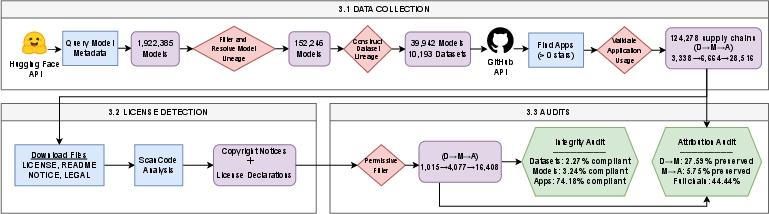
- It employs a multi-stage empirical audit across 124,278 supply chains, revealing stark compliance differences between platforms like GitHub and Hugging Face.
- The study highlights that severe attribution loss in chain transitions undermines legal traceability and increases potential legal risks for users.
Permissive-Washing in the Open AI Supply Chain: A Large-Scale Audit of License Integrity
Introduction
The widespread adoption of permissive open-source licensing (MIT, Apache-2.0, BSD-3-Clause) underpins much of the open AI ecosystem, with these formulations signaling broad rights to use, modify, and redistribute foundational artifacts—datasets, models, and downstream applications. However, these permissive signals rely not just on labels but on strict conditions: the accompanying license text, copyright notices, and the preservation of attribution across the supply chain. The paper "Permissive-Washing in the Open AI Supply Chain: A Large-Scale Audit of License Integrity" (2602.08816) identifies and systematically quantifies a widespread breakdown in these basic compliance duties. The authors define "permissive washing" as the phenomenon by which AI artifacts are labeled with permissive licenses as metadata but fail to include the necessary legal payload to substantiate those rights.
Methodology Overview
The study executes a precise, multi-stage empirical audit to quantify license integrity and attribution propagation across AI supply chains. Three key phases structure the methodology:
This methodology enables anomaly quantification at the artifact, supply-chain, and organizational level, while stratifying compliance failures across ecosystem actors.
Key Findings
License Integrity Deficiencies
The main finding is that over 96% of permissively labeled datasets and models omit one or both elements (license text and copyright notice) necessary for legal reuse under the declared terms. Specifically, only 3.5% of datasets and 4.2% of models contain the required license text; full compliance (text plus rights-holder notice) is found in a mere 2.3% of datasets and 3.2% of models. In contrast, downstream applications on GitHub show 74.2% compliance, demonstrating a sharp compliance gradient between traditional software and model/dataset artifacts.
Strong empirical claims:
- 96.5% of datasets and 95.8% of models on Hugging Face lack the full license text.
- Only 2.3% of datasets and 3.2% of models are fully compliant.
- Even among major, verified organizations, compliance is nearly non-existent (<2%).
These results demonstrate the systemic nature of the payload gap, in which the mere presence of a permissive label is a poor proxy for legal usability.
Attribution Non-propagation
The attribution audit evaluates whether, assuming file-level compliance upstream, required attributions propagate downstream. Attribution loss is acute:
- Only 27.59% of dataset-to-model transitions preserve upstream dataset notices.
- A strikingly low 5.75% of model-to-application transitions preserve model attribution.
- Just 6.38% of applications retain any linked upstream attribution trace.
Thus, even in the rare cases where upstream artifacts are compliant, the vast majority of downstream integration events lose required attributions, undermining legal traceability for end users.
The study highlights a distinct divide between GitHub (software-first) and Hugging Face (model/dataset-first) in terms of license file presence. While GitHub enforces file-based conventions, Hugging Face artifacts overwhelmingly place license information within README or metadata, which is not sufficient for compliance under the operative terms of permissive licenses.
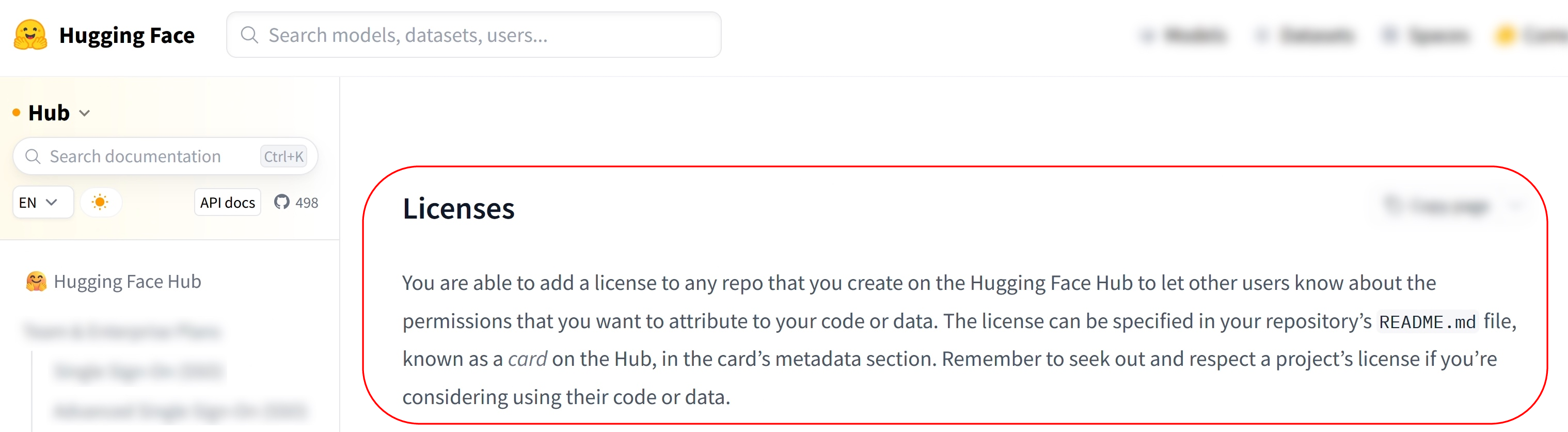
Figure 2: Official Hugging Face documentation on license specification demonstrates the gap between metadata conventions and license file requirements.
Compounding Traceability Failures
The compounding attrition through the supply chain—starting from over 1.9 million Hugging Face models to roughly 124,000 complete, traceable supply chains—reveals that a significant portion of the open AI model landscape lacks any provenance or license documentation, further concentrating both legal ambiguity and practical non-compliance.
Legal and Ecosystem Implications
The findings have far-reaching legal and technical implications:
- Verified Rights Deficit: Without attached license text and proper attribution, downstream users are exposed to the full scope of default copyright, with no operational safe harbor even when the artifact claims a permissive license.
- Attribution-breakdown: The inability to propagate (and thus satisfy) even minimal notice-preservation conditions jeopardizes the legal standing of all downstream redistribution, especially as models are further fine-tuned and incorporated in applications.
- Platform Governance Failures: Platform affordances and design (file-based vs metadata-based) directly shape compliance practices, and in the current Hugging Face-centered ecosystem, perpetuate widespread non-compliance.
- Escalating Legal Risk: With the rapid evolution of AI copyright case law and regulatory actions, the absence of file-based documentation makes fair use defenses or compliance demonstration costly and fragile, exacerbating risk for individual and organizational actors.
Theoretical and Practical Implications for AI and Software Supply Chains
This study's evidence accentuates a critical divergence from established open source software compliance culture—where tooling, audits, and enforcement center on file-level payloads—toward a metadata-focused paradigm in the AI domain, leaving compliance tooling mostly inapplicable. Automated SBOMs, SPDX and emerging ML license analyzers (e.g., ModelGo) presuppose payload-grounded data, which is systematically absent from most modern models and datasets. As a result, even advanced toolchains for compliance and conflict detection cannot function, and AI supply chains cannot reliably propagate legal obligations or demonstrate conformance.
Prospective Remedies and Future Directions
This analysis motivates several lines for technical and governance intervention:
- Mandate LICENSE/NOTICE Payloads: Model and dataset repositories should enforce the inclusion of full LICENSE and attribution notices as a mandatory condition for publication.
- Update Platform UX: Model hubs should transition from metadata-only representations of legal status to file-anchored compliance, with automated auditing at upload and badge-based stratification of compliance status.
- Tooling Extensions: Compliance and provenance tools for AI need extensions that bridge the gap between README/metadata and operable legal documentation (see SPDX AI profile developments).
- Lifecycle Tracing: Combining AI-powered tracing (e.g., NEXUS [Kim et al., 2025]) with enforced documentation at every transformation step is required to restore provable lineage and compliance in the supply chain.
Additionally, institutional actors and foundation initiatives should use these findings to realign their governance, incentivizing payload completeness as a central condition for open AI practice.
Conclusion
The empirical analysis in "Permissive-Washing in the Open AI Supply Chain" demonstrates that the overwhelming majority of open AI artifacts fail minimum license compliance requirements, rendering most permissive labels legally unreliable for downstream use. The breakdown is structural and persistent, shaped by platform design and ecosystem norms. Repairing this compliance and traceability deficit will necessitate cross-disciplinary, platform, and community efforts to restore a payload-grounded approach to licensing, provenance, and legal risk management in open AI development.
The released audit dataset and pipeline lay the foundation for future canonical compliance audits and interventions, underpinning work toward a more verifiable, accountable, and legally robust AI supply chain.
References
Jewitt, J., Rajbahadur, G. K., Li, H., Adams, B., & Hassan, A. E. "Permissive-Washing in the Open AI Supply Chain: A Large-Scale Audit of License Integrity" (2602.08816).