- The paper rigorously proves that minimal single-qubit repeated-interaction protocols cannot achieve refrigeration, as the system’s ground-state population remains below that of the cold bath.
- It derives closed-form, non-perturbative solutions for steady-state dynamics, revealing population oscillations and the decay of system coherence under arbitrary interaction strengths.
- Numerical and analytical results confirm that, despite strong coupling, minimal models inherently forbid net engine work, establishing sharp thermodynamic constraints.
Impossibility Results for Minimal Qubit Repeated-Interaction Quantum Thermal Machines
Introduction and Model Architecture
This paper establishes generic thermodynamic bounds for the operation of quantum thermal machines based on a minimal repeated-interaction (RI) protocol with a single qubit as the working substance. Within this framework, the system qubit interacts alternately or simultaneously with ancilla qubits serving as hot and cold baths. The repeated collisions can be arbitrarily strong and of finite duration, exceeding the typical constraints of weak-coupling and short-time (stroboscopic) Lindblad limits. The two canonical architectures are: (i) the alternating-coupling model, where the system undergoes sequential collisions with hot and cold ancillas, and (ii) the simultaneous-coupling model, where both ancillas interact with the qubit in each collision event.
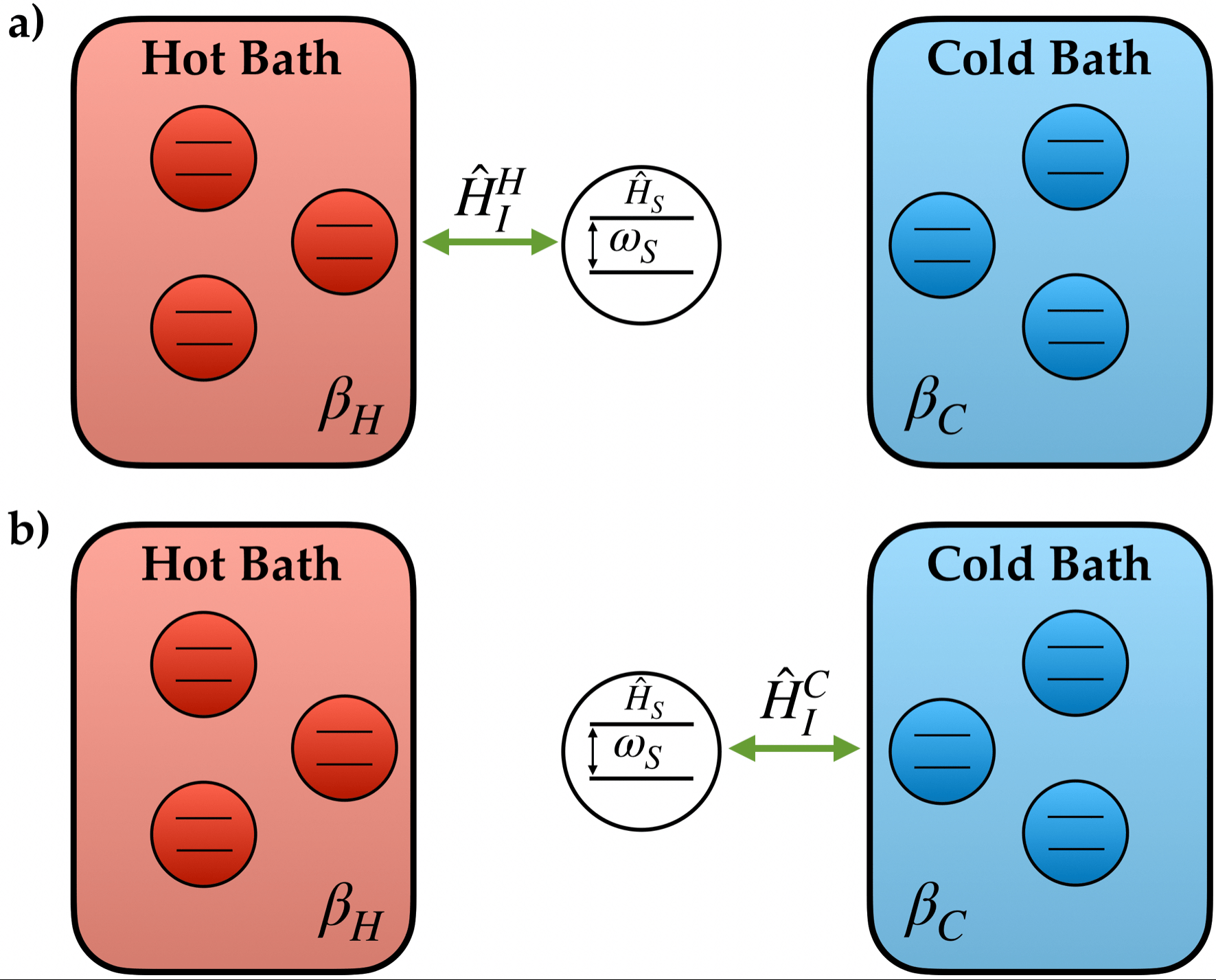
Figure 1: Alternating model for a quantum thermal machine. A two-level system (H^S) collides alternately with hot and cold ancillas.
This formalism is motivated by the need for physically explicit, Markovian, yet non-perturbative descriptions of open-system quantum thermodynamics. It also circumscribes the minimum setting capable of harnessing quantum resources—such as coherence and strong coupling—in the context of nanoscale thermal device design.
Exact Solution of the Alternating-Coupling Model
A major technical contribution is the derivation of closed-form, fully non-perturbative expressions for the system state and thermodynamic flows in the steady-state limit cycle under arbitrary interaction strengths and collision times. The authors analytically solve for the asymptotic population and show that system coherences are generically extinguished over time. This steady-state solution enables detailed probing of system relaxation, dynamical bounds, and thermodynamic functions.
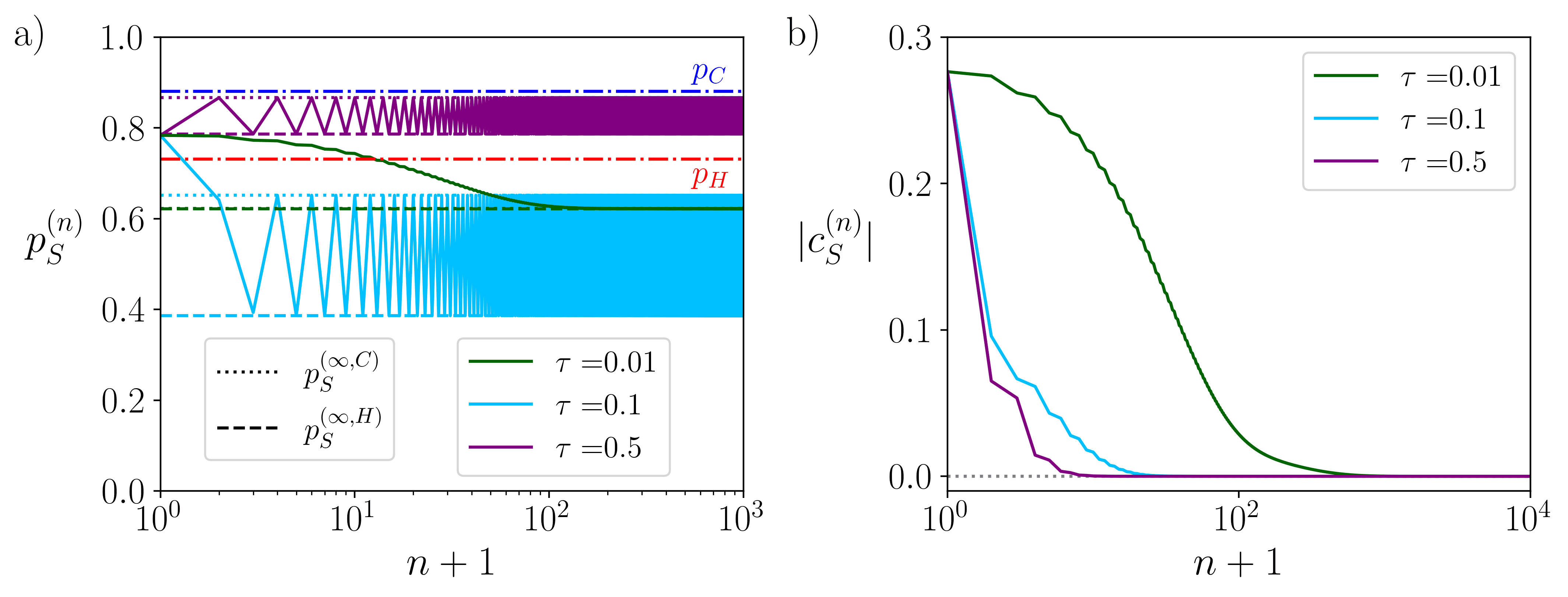
Figure 2: Relaxation dynamics toward the limit cycle, alternately approaching pS(∞,C) and pS(∞,H), forming a two-point steady-state oscillation.
An explicit formula for post-collision ground state occupations is obtained, showing population oscillations with respect to both the coupling strength and the interaction duration. Furthermore, analytical limits and symmetry considerations are developed, demonstrating, for example, that short collisions produce complete population averaging, while large interactions yield nontrivial oscillations in the steady-state population.
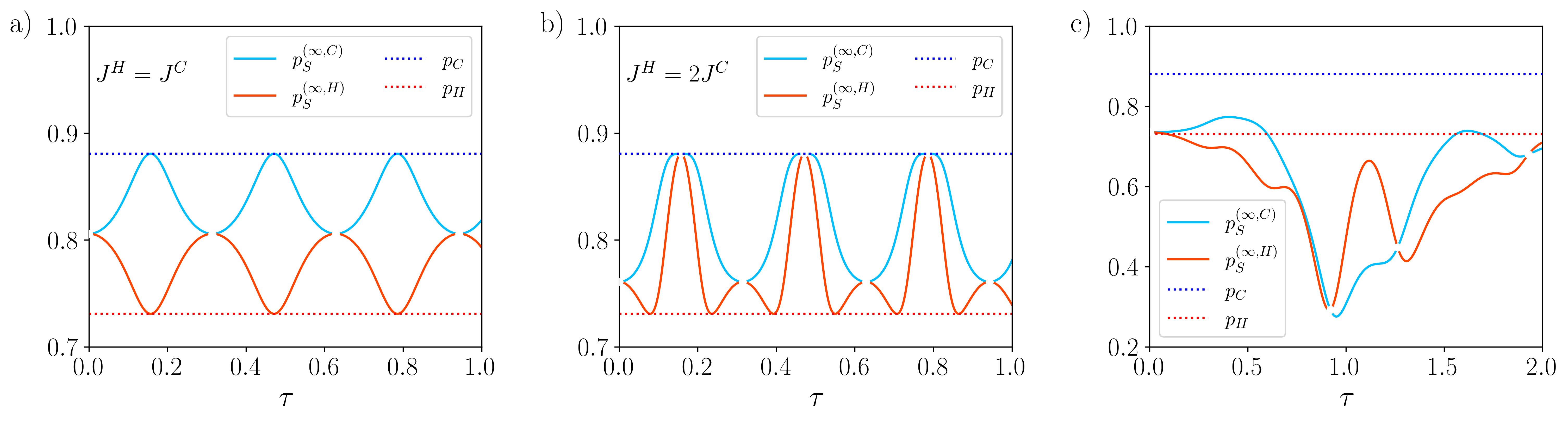
Figure 3: Ground-state population in the limit cycle as a function of collision time τ, showing dependence on coupling symmetry and strength.
No-go Theorem for Refrigeration and Engine Operation
A principal result is a rigorous proof that refrigeration is fundamentally precluded in all such minimal RI models. The system qubit’s ground-state population following interaction with the cold ancilla is always less than or equal to that of the bath itself, for any interaction parameters or collision time,
pS(∞,C)≤pC.
This yields an effective temperature for the system that is always higher than the cold bath, barring the extraction of heat and negating the possibility of refrigerator action. The proof generalizes across nontrivial parameter regimes; supplemental numerical evidence confirms that the result is robust to the inclusion of work strokes via anisotropic interactions.
Correspondingly, the analysis reveals that, although positive work may be produced locally (for instance, at the hot contact), the total work per two-stroke cycle is always non-positive:
W(∞)=WC(∞)+WH(∞)≤0,
excluding net engine operation under any parameter choice. The work exchange is fundamentally limited by the structure of energy transfer inherent to the RI process and the absence of persistent quantum coherence in the steady state.
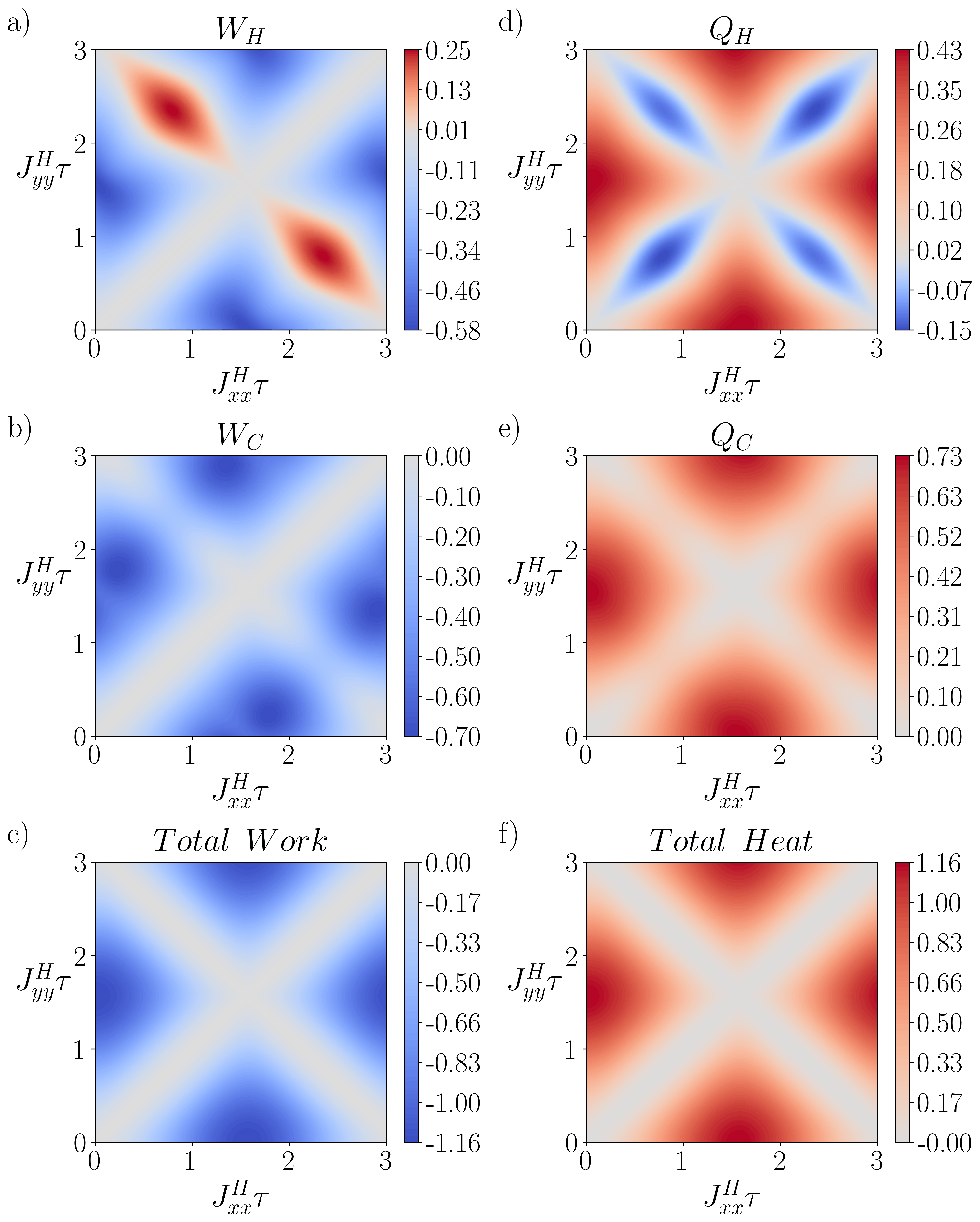
Figure 4: Local work and heat flows at hot and cold contacts as a function of interaction parameters, highlighting the restricted and antisymmetric work/heat distribution.
These impossibility results constitute a sharp contradiction to some prior expectations of quantum advantage under strong coupling or non-Lindbladian dynamics. In all cases, the repeated-interaction protocol with a single qubit, memoryless ancillas, and arbitrary coupling fails to act as either refrigerator or engine, even off the weak-coupling or short-cycle limits.
Thermal Transport and Strong Coupling Features
Aside from the no-go theorems, the paper develops exact expressions for heat conduction in the absence of work. The RI collision setting yields a highly nontrivial, periodic heat current as a function of both coupling strength and collision duration:
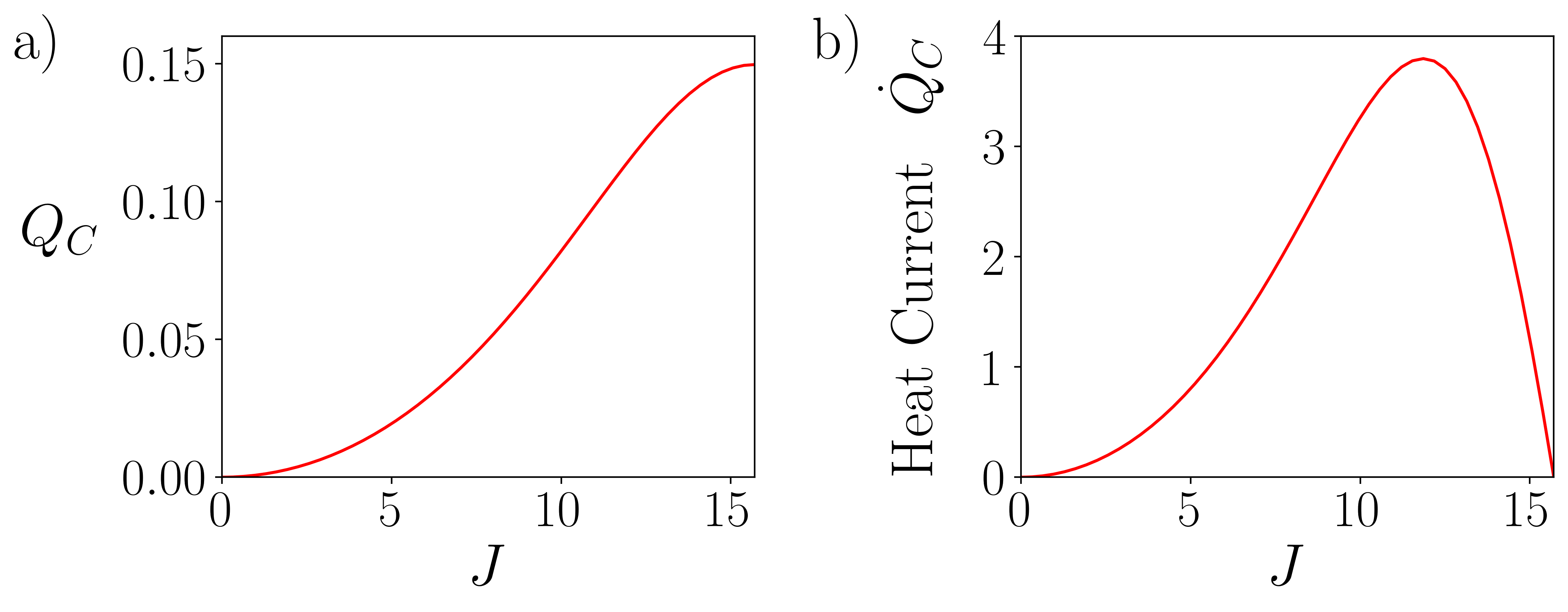
Figure 5: (a) Heat dissipated to the cold ancilla per collision and (b) corresponding heat current, exhibiting a pronounced turnover and suppression at both weak and strong coupling.
This turnover behavior and dynamic suppression—ultimately vanishing in the ultrastrong-coupling regime—parallels similar phenomena observed in spin-boson and other system-bath strong-coupling models, but emerges here in a setting with explicit, finite-size ancilla baths and strong, nonperturbative repeated interactions. Heat transport is also found to be strictly unidirectional, from hot to cold, as demanded by the model’s population constraints.
Simultaneous-Coupling Model and Perturbative Analysis
The authors extend their findings to a simultaneous-coupling architecture, where the qubit interacts with both hot and cold ancillas during each collision. While a complete closed-form solution is tractable only in limiting cases, a Dyson series is employed in the short-collision-time regime, revealing that this model converges exactly to the alternating-coupling result in the stroboscopic limit.
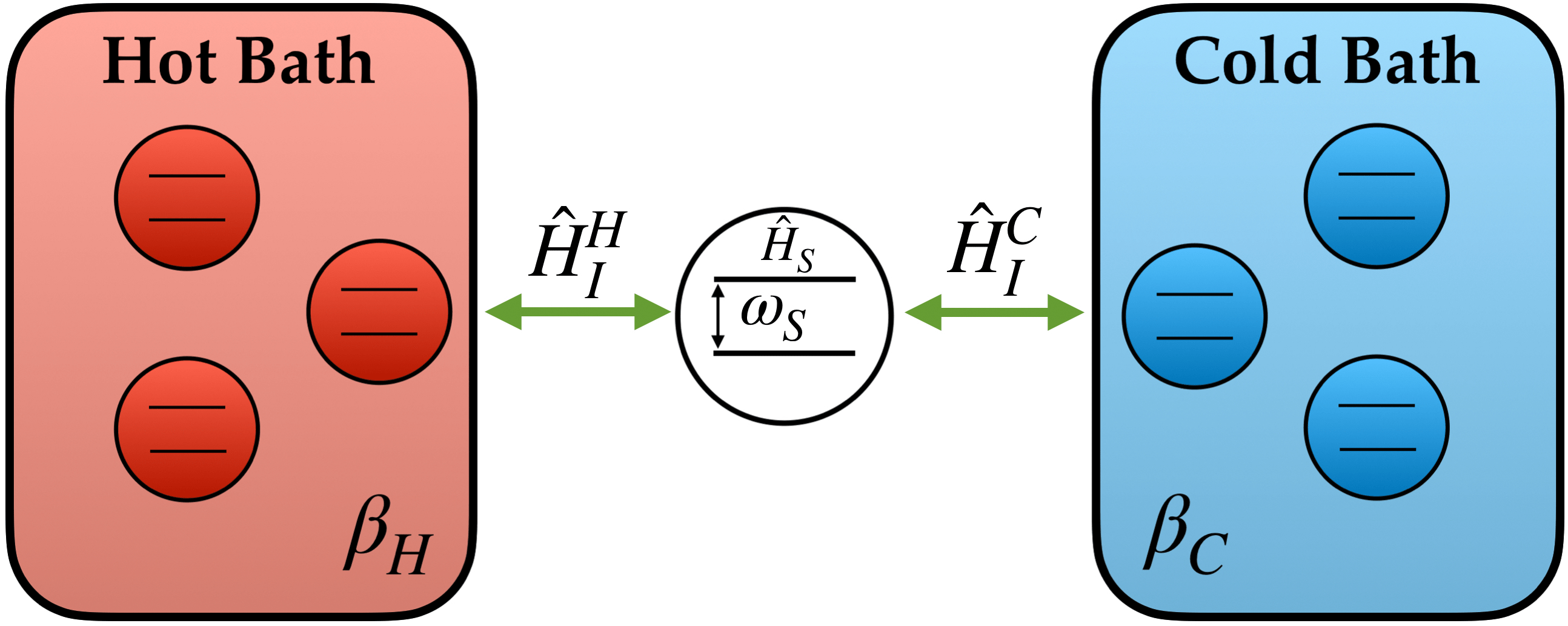
Figure 6: Simultaneous-coupling quantum thermal machine schematic: both baths interact concurrently with the system qubit.
Numerical studies supplement the analytic expansions, showing that the qualitative no-go results persist. Locally positive work and nonzero directional heat flows are achievable, but the total work extracted in any protocol configuration remains nonpositive. Simulations support conjectures that the impossibility constraints proven analytically are universal across parameter regimes.
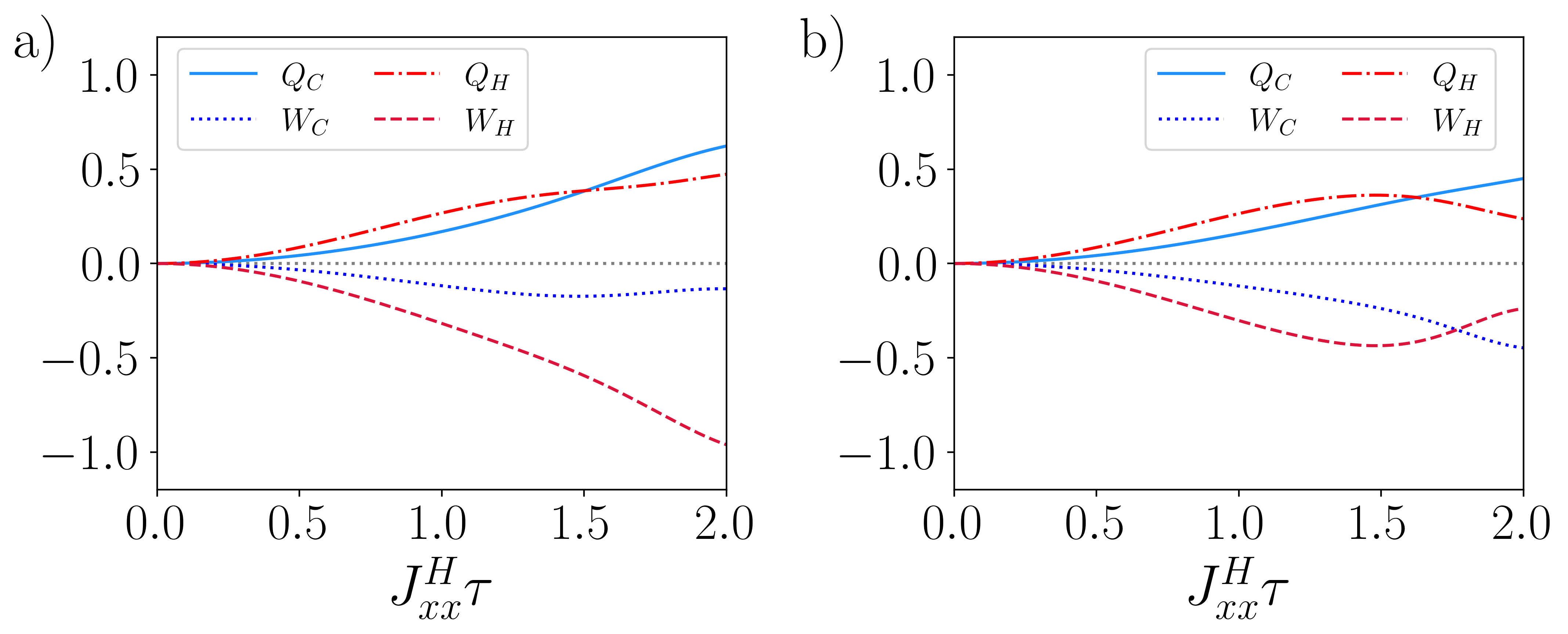
Figure 7: Thermodynamic functions vs. coupling strength for both alternating and simultaneous models; the turnover and impossibility behaviors are robust across protocols.
Implications and Future Perspectives
This work establishes unambiguous fundamental bounds for quantum thermal device design at the minimal scale—specifically, a single-qubit working medium with Markovian, repeated-interaction baths. The explicit demonstration of strict thermodynamic limitations, regardless of coupling strength, interaction time, or protocol symmetry, indicates that non-Markovian bath structure, ancilla correlations, multilevel systems, or explicit separation of work and heat strokes are minimal requirements for functional quantum thermal devices.
These results clarify several points:
- Quantum resources such as strong coupling or system-bath mixing do not generically enable violation of classical thermodynamic limits in minimal Markovian setups.
- Memoryless, uncorrelated ancillas (bath qubits) preserve strict population—thus temperature—orderings, precluding refrigeration.
- Robust engine operation in any stroke-based protocol with such a minimal model is impossible, with the underlying mechanism traced to the persistent cancellation of work across cycles.
- The RI framework remains a valuable testbed for exploring the minimum physical requirements for the emergence of quantum thermodynamic machines, by adding complexity such as bath coherence, multilevel working fluids, or correlated ancilla statistics.
There are direct implications for quantum thermodynamic simulations on digital hardware, and for the feasibility of proposed quantum refrigerators or heat engines utilizing repeated-interaction models at the single-qubit level.
Conclusion
By means of a rigorous, nonperturbative, and comprehensive treatment, this work establishes the impossibility of either refrigeration or engine operation in the minimal single-qubit RI paradigm, under both alternating and simultaneous interaction protocols. The analytic and numerical results delineate sharp, unconditional thermodynamic limits and provide guidance for future extensions required to approach the theoretical performance bounds posited for quantum thermal devices.
(2602.18300)