- The paper demonstrates a novel framework that adapts the string method to score functions in diffusion models to compute transition paths and principal curves.
- It contrasts deterministic transport with finite-temperature dynamics to reveal the trade-off between high likelihood and perceptual realism in generated samples.
- The methodology is validated through applications such as protein conformational changes, providing a pragmatic tool for exploring high-dimensional learned distributions.
Probing the Geometry of Diffusion Models with the String Method
Introduction
"Probing the Geometry of Diffusion Models with the String Method" (2602.22122) establishes a rigorous pathway-based framework for interrogating the geometry induced by the score of pretrained diffusion models. The work adapts the string method—traditionally used for finding transition paths in physical and chemical systems—to operate directly on the learned score function of generative models, enabling the computation of continuous curves (strings) connecting two data points or modes within a high-dimensional data manifold.
The central contribution is the controlled interpolation between three regimes: deterministic transport (pure generative sampling), zero-temperature string evolution to compute minimum energy paths (MEPs), and finite-temperature string dynamics that recover principal curves accounting for both energy and entropy. This stratification enables detailed analysis of the interplay between likelihood maximization, entropy, and perceptual sample quality, clarifying paradoxes such as the "likelihood-realism" gap in diffusion models.
Methodological Framework
The string method is formulated for time-dependent, implicitly defined energy landscapes, as opposed to the explicit, static potentials assumed in its classical applications. The approach is agnostic to model architecture, requiring only access to the time-dependent learned score st(x) and transport vector field bt(x) that underpin contemporary diffusion models.
A string (discrete curve of N+1 points in the data space) is evolved under a parameterized dynamic determined by
ϕ˙t(s)=bt(ϕt(s))+γt2st(ϕt(s))+λt(s)∂sϕt(s),
with λt enforcing arc-length parametrization. This formulation allows three operational regimes:
- Pure Transport (Sampling Flow): γt=0. The string evolves only under bt, producing morphs that map out generative trajectories but lack geometric invariance with respect to the score.
- Minimum Energy Paths (MEPs): Dominant γt drives the string along ∇logρt, locating maximum-likelihood (mode-connecting) trajectories—classically associated with reaction coordinates and transition states.
- Principal Curves (Finite Temperature, T>0): By running a finite-temperature stochastic process (Langevin dynamics) along the string, one balances between energy minimization and entropic spreading, producing principal curves representative of the typical set in high-dimensional distributions.
The connection to the learned distribution’s modal structure is leveraged: MEPs traverse likelihood maxima, while principal curves (with T>0) trace high-probability, perceptually plausible regions that align with the distribution’s typical set.
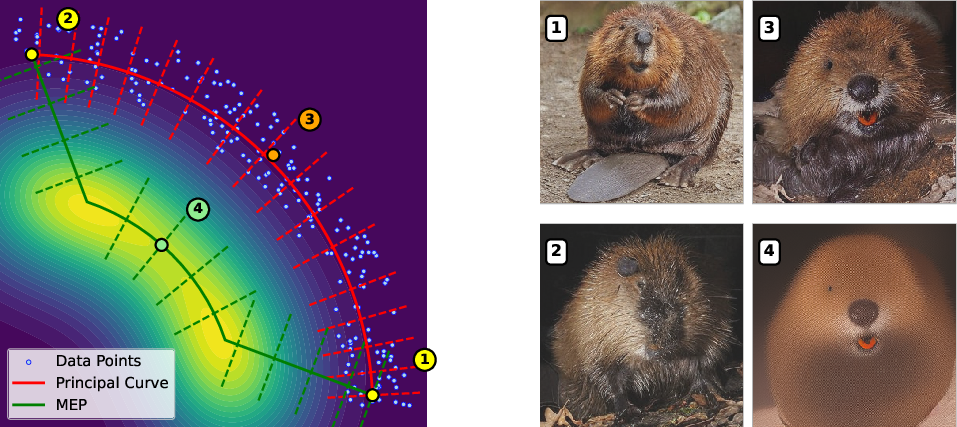
Figure 1: Schematic and empirical illustration of the likelihood-realism paradox; the MEP traverses a high-likelihood mode that is visually implausible, whereas the principal curve remains within the typical set.
Likelihood-Realism Paradox and Empirical Analysis
A pivotal empirical result is that MEPs, while maximizing likelihood, consistently pass through visually unrealistic "cartoon" regions (low probability mass, but peaked density), validating recent observations that likelihood maximization can yield out-of-distribution or semantically empty samples in diffusion models. This phenomenon—rooted in the concentration of measure in high-dimensional settings—persists across model architectures and domains.
The introduction of entropy via the finite-temperature string method realigns the pathway to the typical set, thus producing morphs of high perceptual quality. The controlled tuning of γ (score weight) and T (temperature) systematically traverses the spectrum from MEP-like (cartoon, high likelihood) to principal-curve-like (realistic, typical) intermediates.
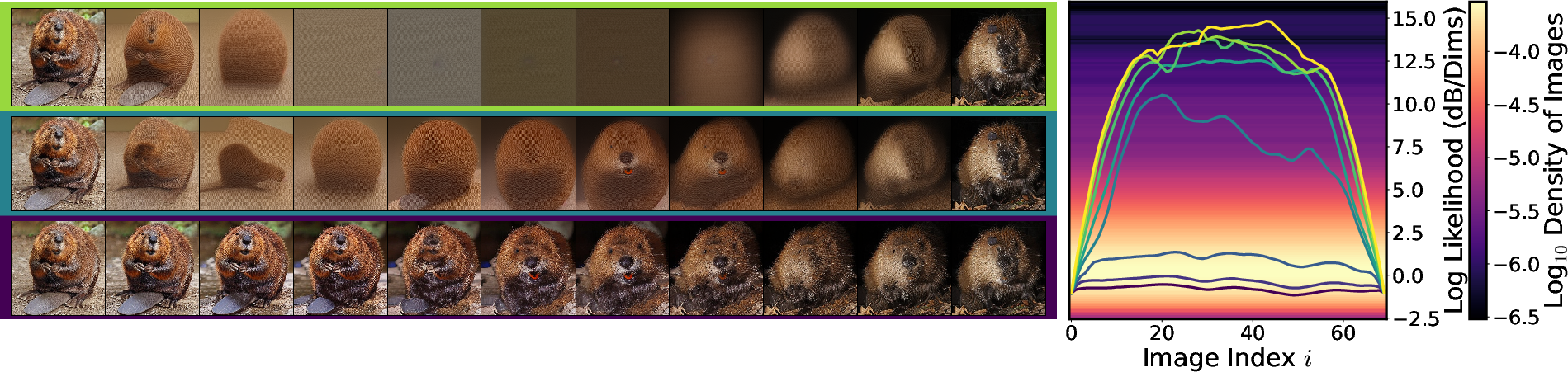
Figure 2: Varying γ demonstrates that increasing score guidance transitions the path through increasingly abstract, high-likelihood intermediates; small γ recovers visually plausible morphs.
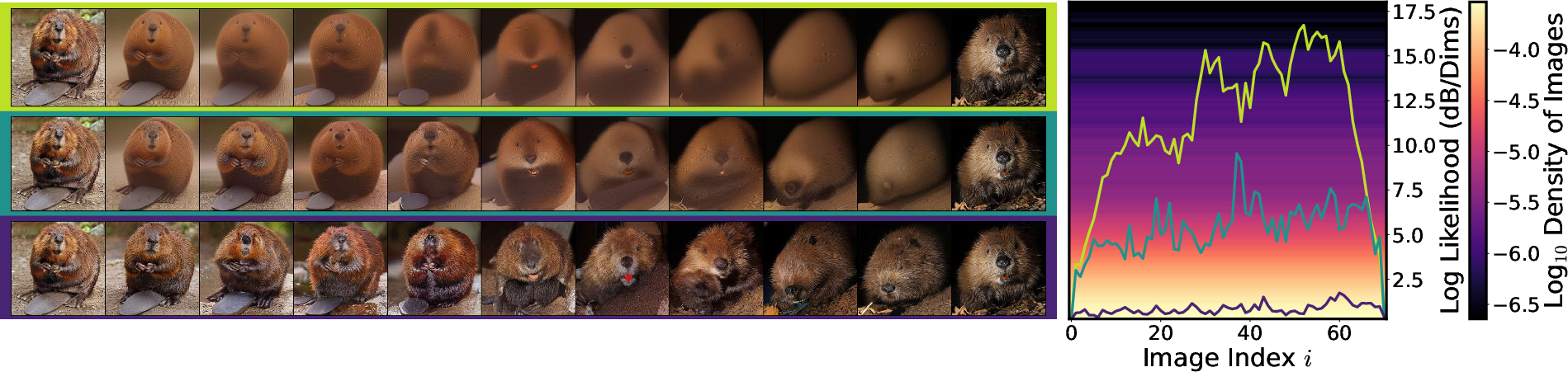
Figure 3: Effect of increasing T: low T yields cartoonish MEP-like paths, while high T (principal curve) produces realistic transitions aligned with the data’s distributional structure.
Likelihood analysis demonstrates quantitatively that MEP intermediates possess log-likelihoods exceeding those realizable by real data, signifying their placement outside the typical data manifold.
Principal Curves via Score-Based Dynamics
The principal curve regime is operationalized by associating local walkers (Markov processes restricted by Voronoi projection) to discretized points on the string; exchange between their empirical average and string position is mediated by exponential moving average smoothing. The walkers’ evolution under the full SDE, plus rejection sampling to maintain locality, robustly ensures the string tracks the distribution’s principal curve at fixed temperature.
The self-consistency property—a principal curve at s equals the conditional mean of the data in its Voronoi cell—is strictly enforced by this protocol, and the algorithm’s practical implementation does not require retraining or access beyond pretrained st and bt.

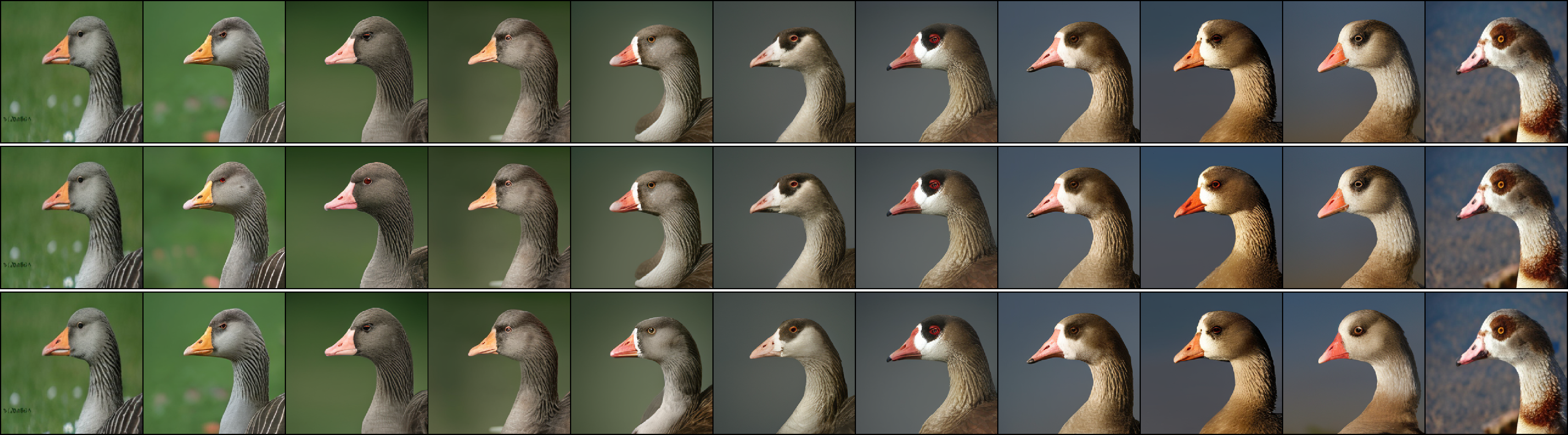
Figure 4: Principal curve between two "goose" class images exhibits smooth morphing via entropic averaging, while panels below showcase the subtle entropic variability among walkers at fixed s.
The approach is generalized to SE(3)- and SO(3)-equivariant diffusion models for protein structure. The string method, applied to protein folding or conformational rearrangement, computes realistic and physically plausible pathways even in the absence of explicit energy functions or mechanistic models—surpassing sampling-only generative approaches that cannot capture transition paths.

Figure 5: Computed transition in Adenylate Kinase between crystallographically determined open and closed states; intermediates avoid steric clashes and preserve secondary structure.
(Figure 6 and Figure 7)
Figure 6: Folding pathway of BBA; initial pure transport string is suboptimal, while the MEP achieves lower free energy and realistic intermediates.
Figure 7: Analogous result for Chignolin, confirming that the classical MEP via the string method captures essential folding intermediates.
Significantly, the practical utility of this methodology arises in settings where rare state transitions (e.g., protein folding, large-scale conformational changes) are fundamentally important, and equilibrium or brute-force dynamical simulators are intractable.
Theoretical and Practical Implications
Formally, the study probes high-dimensional generative distributions’ topological structure and elucidates the pitfalls of naïve interpolation (e.g., straight lines in latent space). Pure transport is shown to lack geometric invariance, rendering its use artifact-prone for geometric analysis. MEPs are theoretically robust for barriers but are not statistically typical. Principal curves offer entropy-sensitive, semantically coherent trajectories that, in high dimensions, are essential for meaningful analysis.
This work repositions the string method as a diagnostic and analytic tool for generative modeling: not only for sample generation, but for mode identification, barrier characterization, and mapping of learned manifolds’ connectivity structure—directly from existing models.
Future Directions
Potential research avenues include scaling to even higher-dimensional and multimodal architectures (e.g., text-conditioned models), deeper theoretical analysis of convergence and error in score-based pathfinding, and integration with conditional or guided sampling. The fusion of transition path computation with generative sampling opens the door for systematic exploration of rare or functionally significant events in scientific domains (e.g., robust pathway identification in molecular design, flexible planning in robotics, etc).
Conclusion
This study formalizes the use of the string method on learned generative models, offering strict geometric definitions for paths—MEPs and principal curves—and revealing the critical role of entropy in generating perceptually plausible, statistically typical transitions. The findings clarify the limitations of likelihood-based analysis in high dimensions and provide a practical tool for exploring the geometry of diffusion models without retraining. The proposed framework has direct applications in computational physics, biology, and generative AI, and suggests that true understanding of high-dimensional learned distributions necessitates entropy-aware geometric tools.