- The paper presents a novel pipeline that decouples internal coherence from cognitive availability to sample research directions unlikely to emerge from standard LLM ideation.
- It details a methodology that atomizes paper content into 'idea atoms', clusters them semantically, and uses autoregressive models to evaluate internal coherence.
- Empirical results show the Alien sampler outperforms LLM baselines in diversity, novelty, and atom overlap, indicating its potential for generating unconventional research ideas.
Alien Science: Sampling Coherent but Cognitively Unavailable Research Directions from Idea Atoms
Introduction and Motivation
The paper "Alien Science: Sampling Coherent but Cognitively Unavailable Research Directions from Idea Atoms" (2603.01092) confronts a persistent limitation in LLM-driven ideation: while advanced LLMs reliably generate plausible outputs through recombination and interpolation of familiar content, they rarely produce genuinely non-obvious research directions—those coherent ideas that reside outside the cognitive reach of the typical practitioner. This is not solely a consequence of modeling capacity, but a structural artifact of likelihood-maximized text prediction, which biases generation toward common conceptual trajectories. The authors formalize the notion of "cognitive availability"—the propensity for an idea to be considered readily accessible based on a researcher's prior work and background—and propose a pipeline explicitly designed to sample research directions high in coherence but low in cognitive availability.
Methodology: Idea Atomization and Alien Sampling
The pipeline begins with the distillation of paper content into granular, recombinable conceptual units, eschewing redundant or narrative scaffolding. These units are clustered via HDBSCAN on semantic embeddings into a shared vocabulary of "idea atoms," each representing a recurring conceptual motif across the literature. Canonical descriptions are generated for each atom via LLMs. Thus, papers are mapped to sparse sets of idea atoms, which serve as discrete tokens for subsequent modeling.
A coherence model C(⋅) is trained autoregressively (GPT-2 architecture) over sequences of atoms, capturing the conditional probability that a given atom combination constitutes a feasible research direction. This score quantifies internal compatibility, learned from patterns of co-occurrence in real research.
The cognitive availability model A(⋅) is trained similarly, but on atom sets grouped by researcher profile (derived from authorship in the corpus), estimating the marginal probability that a typical researcher would propose a given combination of atoms. This model operationalizes the notion that combinations rarely surfaced by overlap in researcher profiles are cognitively unavailable.
Alien research directions are sampled by maximizing coherence and minimizing availability, with selection refined by Reciprocal Rank Fusion.
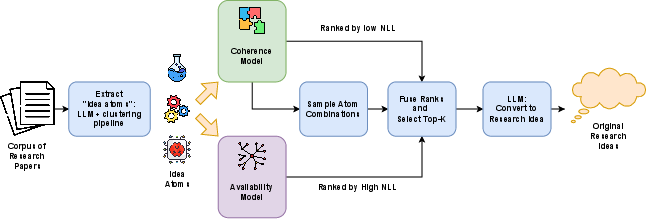
Figure 1: Overview of the Alien Science Sampling pipeline, demonstrating atom distillation, coherence modeling, availability modeling, and alien direction sampling.
Representation Validation: Conceptual Units and Atom Fidelity
Extensive experiments validate the appropriateness of the atomization layer:
- Conceptual Units: LLM-based reconstruction from conceptual units achieves near-perfect preservation of core paper content. This demonstrates that the extraction process captures the essential technical contributions without extraneous detail.
- Idea Atoms: Representing papers via clustered atoms results in reduced but substantial reconstruction fidelity, confirming that atoms are genuinely transferable across papers and not simply paraphrased memorization.
Reconstruction quality scales with the number of atoms per paper, with noisy atoms (unclustered, paper-specific units) recuperating lost fidelity but not included in downstream modeling to maintain transferability.
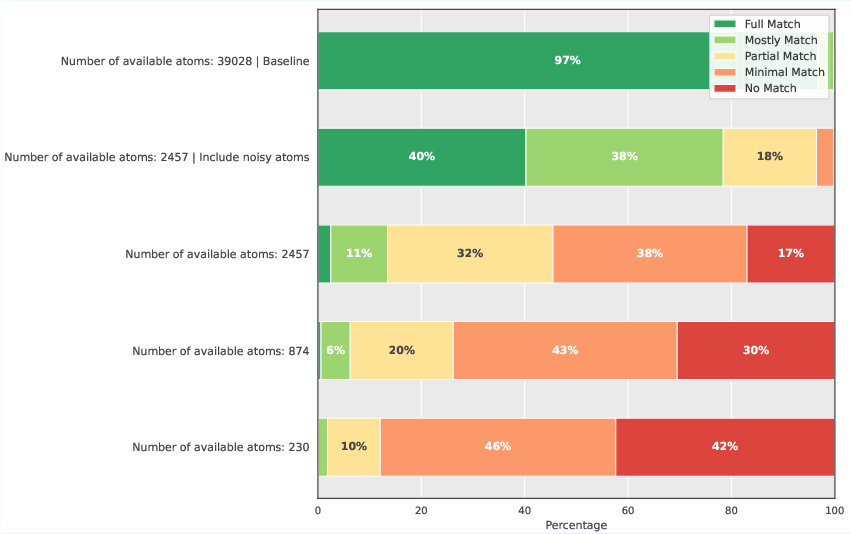
Figure 2: Distribution of reconstruction ratings across conditions, illustrating the fidelity of conceptual units and the trade-off in atom-only and noisy-atom representations.

Figure 3: Relationship between the number of atoms per paper and reconstruction quality, highlighting improved fidelity as atom count increases.
Stability analysis reveals highly deterministic reconstructions, with average cosine similarity of 0.92 across multiple generations for the same atom combination, indicating the decoder's consistent mapping from atom sets to blog-style ideas.
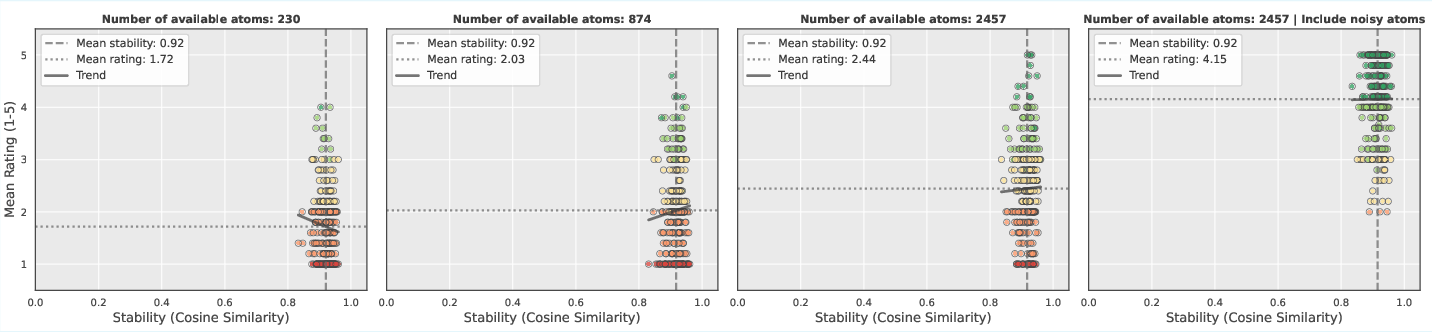
Figure 4: Stability of reconstruction against quality, showing the deterministic nature of the atom-to-idea mapping.
Alien Sampler Evaluation: Diversity, Novelty, and Coherence
The pipeline is benchmarked against random sampling and leading LLMs (Claude 4.5 Opus, Gemini 3 Pro). Key findings include:
- Diversity: The Alien sampler achieves coverage and distribution across atoms comparable to random sampling, while LLMs show severe concentration on a restricted subset of atoms and exhibit strong domain biases, reinforcing prior findings regarding collective diversity collapse in generative models.
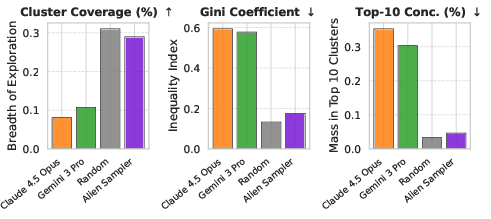
Figure 5: Diversity comparison across methods, demonstrating broad atom usage by Alien sampler versus concentration by LLMs.
- Novelty: Generated blog posts from alien-sampled atom sets exhibit significantly greater embedding distance from ground-truth corpus blog posts relative to LLM baselines, indicating exploration of genuinely novel conceptual regions rather than mere permutation of popular topics. Statistical significance is established for increased novelty compared to Gemini (with moderate effect size) and Claude (with small effect size).
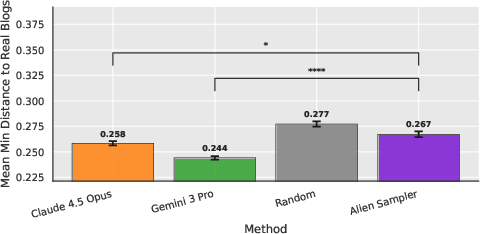
Figure 6: Cosine distance to nearest blog post, with Alien sampler consistently producing greater novelty than baseline LLMs.
- Conceptual Coverage: UMAP projection confirms the Alien sampler's expansion into underexplored thematic regions, while LLM baselines cluster tightly around prevalent topics in LLM reasoning, indicating limited conceptual reach and reinforcing the diversity analysis.
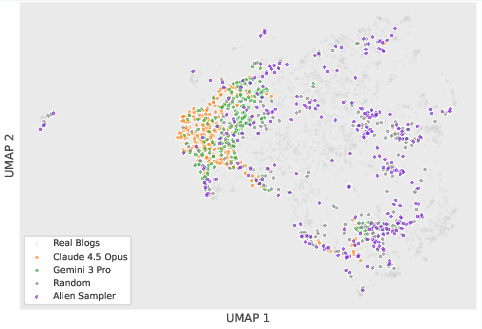
Figure 7: UMAP projection of generated blog posts, with Alien sampler dispersing broadly in embedding space.
- Coherence: Atom overlap with ground-truth papers is highest for Alien-sampled sets, confirming the model's capacity to generate combinations with established internal compatibility while simultaneously maintaining low availability.
Numerical results highlight:
- Alien sampler achieves Max Intersection of 1.66 atoms (random: 1.01), Max Jaccard similarity of 0.433 (random: 0.307); LLM baselines fall between random and Alien.
Implications and Prospects
The decoupling of coherence from cognitive availability constitutes a principled approach to searching for research directions in the blind spots of collective human expertise. The methodology enables deliberate sampling of ideas that are internally viable but unlikely to emerge from the typical intersection of researcher backgrounds. Such directions may serve as precursors to impactful research otherwise neglected due to entrenched disciplinary paradigms.
Limitations include the constraint that the atom vocabulary is fixed—precluding the emergence of entirely novel primitives—and reliance on published text to approximate cognitive salience, potentially omitting tacit expertise. Dynamic vocabulary expansion, more granular researcher representations, and integration of human evaluation are natural avenues for advancement.
Practically, alien science sampling can augment human ideation pipelines as a complement rather than a substitute: surfacing unconventional combinations for expert validation, cross-pollinating disciplines, and probing the boundaries of research feasibility. Theoretically, these models provoke inquiry into the structural limits of LLM-based discovery and the role of community structure in shaping scientific exploration.
Conclusion
By explicitly modeling cognitive availability and leveraging a compositional atomization layer, the Alien Science pipeline addresses a systemic bias in LLM ideation—avoiding the gravitational pull toward familiar combinations and enabling targeted sampling of coherent, cognitively unavailable research directions. This framework overcomes the diversity bottleneck observed in generative systems and lays groundwork for AI-powered exploration of the latent spaces in scientific inquiry.