Trident: Adaptive Scheduling for Heterogeneous Multimodal Data Pipelines
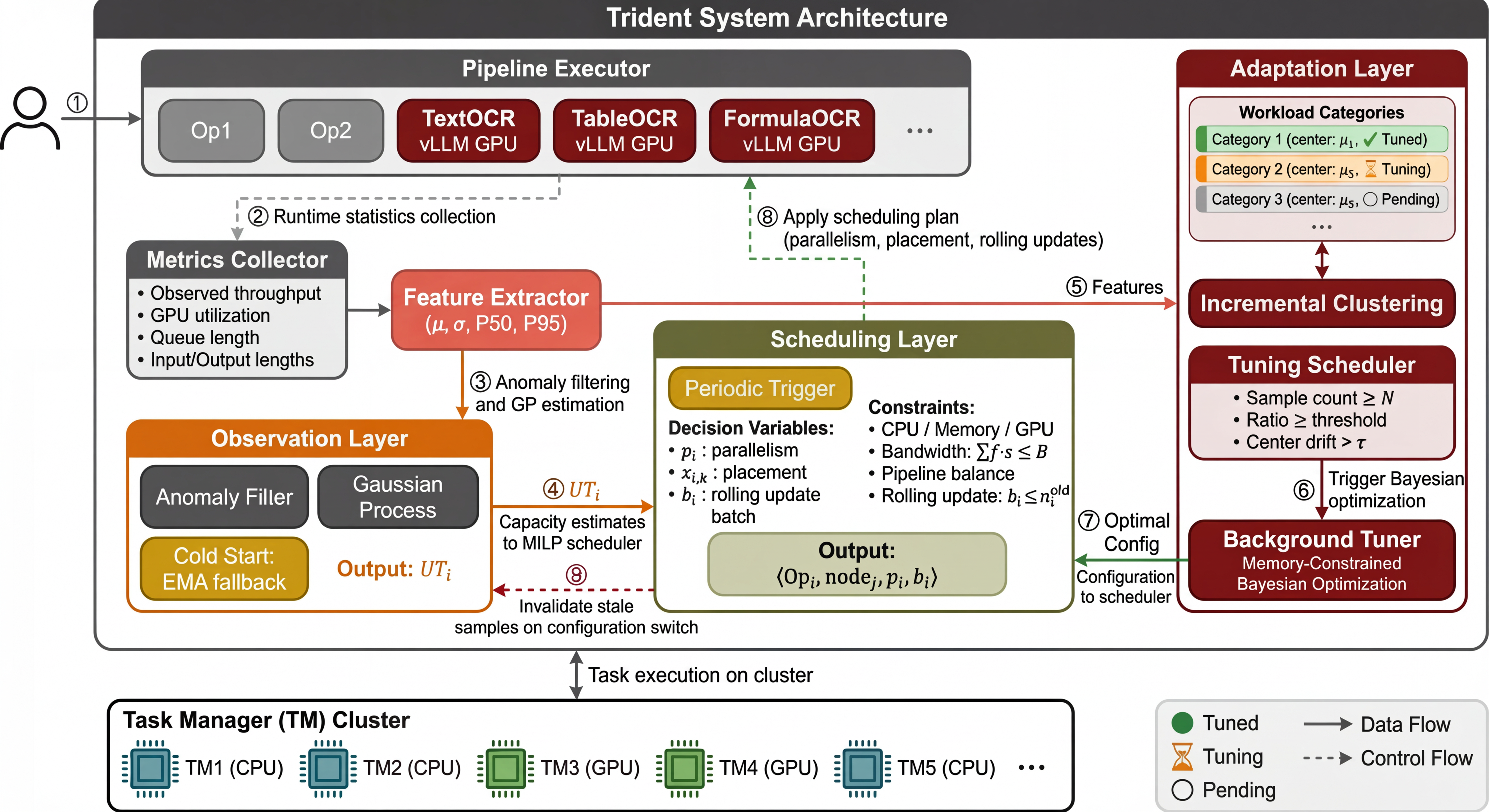
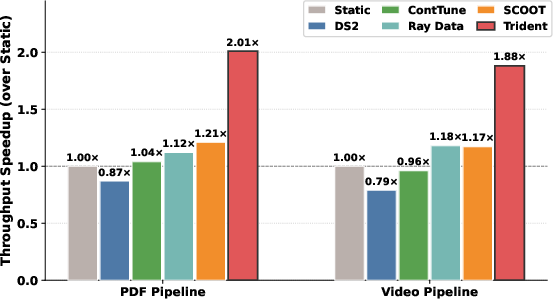
Abstract: The rapid adoption of LLMs and multimodal foundation models has made multimodal data preparation pipelines critical AI infrastructure. These pipelines interleave CPU-heavy preprocessing with accelerator-backed (GPU/NPU/TPU) inference and produce massive intermediate artifacts. Achieving high throughput is difficult because workloads are highly non-stationary: regime shifts, input-dependent inference, and transient memory spikes cause rapid performance fluctuations and out-of-memory (OOM) failures. Existing schedulers typically rely on threshold-based autoscaling or assume synchronous, homogeneous operators, leading to poor efficiency. We present Trident, an adaptive scheduling framework for heterogeneous multimodal pipelines on fixed-resource clusters. Trident closes the loop across three coupled layers: (i) an observation layer that estimates per-operator sustainable throughput for asynchronous operators via Gaussian Process regression with anomaly filtering; (ii) an adaptation layer that detects workload shifts online and performs memory-constrained Bayesian optimization to recommend OOM-safe configurations; and (iii) a scheduling layer that solves a mixed-integer linear program to jointly optimize operator parallelism, placement, and configuration transitions under heterogeneous compute and bandwidth constraints, accounting for cold-start overhead via rolling updates. Decisions trigger sample invalidation and model refresh to keep estimates consistent with the active configuration. Implemented on Ray Data, Trident improves end-to-end throughput by up to 2.01x on a document curation (PDF) pipeline and 1.88x on a video curation pipeline over a static baseline, with low overhead suitable for online re-optimization.
Paper Prompts
Sign up for free to create and run prompts on this paper using GPT-5.
Top Community Prompts
Knowledge Gaps
Knowledge gaps, limitations, and open questions
The paper proposes a promising closed-loop scheduler for heterogeneous multimodal pipelines, but several aspects remain underexplored or unclear. Future work could address the following gaps:
- Scalability beyond linear pipelines: the MILP and flow constraints assume a linear DAG; how to extend to general DAGs with branches, joins, side-outputs, and feedback loops while keeping solve times tractable.
- MILP scalability and overhead: lack of analysis on solve time, convergence, and memory footprint as the number of operators, nodes, and placement variables grows (e.g., w_{i,k,l} scales as O(nK2)).
- Network modeling fidelity: the objective uses a single per-node egress bound (E_max), ignoring link-/rack-level topology, oversubscription, and contention; how to incorporate realistic network graphs and link-capacity constraints.
- Data amplification estimation error: D_i is tracked with exponential smoothing; no treatment of high-variance amplification (e.g., variable frames per video) or tail-aware/worst-case safeguards to prevent under-provisioning and network saturation.
- Placement-transition coupling: rolling updates (b_i) are decoupled from node placement (x_{i,k}); there is no policy to choose which specific instances/nodes to restart to minimize transient throughput loss or network hot spots.
- Resource modeling granularity: each instance consumes integer resources (CPU cores, whole GPUs); no support for fractional CPU, simultaneous multi-process GPU sharing, MIG partitions, or multi-GPU operators.
- Memory interference across co-located operators: the BO constraint treats peak memory per operator instance in isolation; cross-operator VRAM contention and allocator fragmentation on shared devices are not modeled.
- Safety guarantees for memory-constrained BO: PoF-based constrained EI still permits OOM when the surrogate is miscalibrated; no worst-case or high-probability safety guarantees (e.g., SAFEOpt-style) are provided.
- Cold-start overhead uncertainty: h_i{cold} is assumed known and constant, but real warm-up time varies with caching and workload; how to estimate and adapt this online without biasing MILP decisions.
- Observation layer feature adequacy: throughput GP uses low-dimensional summary features (e.g., mean/std of token lengths); no evidence these suffice for heavy-tailed or multimodal inputs (e.g., bursty long outputs in autoregressive decoding).
- Uncertainty calibration of the GP: no evaluation that predictive variances are calibrated, which is critical for anomaly filtering and safe BO; methods for calibration or alternative models (e.g., deep kernel GPs) are not discussed.
- Anomaly filtering thresholds: τ_u (utilization), τ_z (z-score), and queue heuristics are fixed but not derived or adapted; risk of misclassifying transient dynamics as anomalies or letting confounders through.
- Cold-start bias in capacity estimates: reliance on EMA before n_min valid samples may mislead early MILP rounds; no adaptive mechanism to limit schedule changes under high model uncertainty.
- Feedback stability of the closed loop: no control-theoretic analysis or empirical study of oscillations/limit cycles induced by coupling among observation, adaptation, and scheduling layers under non-stationary loads.
- Interaction with asynchronous batching: UT_i is treated as a per-instance scalar, but dynamic batching in inference frameworks makes throughput arrival-rate dependent; no explicit fixed-point or queueing analysis to resolve this circular dependence.
- Latency and QoS objectives: the system optimizes throughput alone; no support for latency constraints, tail distributions, or fairness across data classes or stages, which may be important in curation workflows.
- Exploration overhead during tuning: online BO evaluations may depress throughput and cause backpressure; there is no budgeted or throttled exploration policy tied to pipeline health or queue states.
- Multi-operator joint tuning: configuration optimization occurs per operator/cluster; potential cross-operator interactions (e.g., upstream batch size affecting downstream memory/throughput) are not explored with joint or coordinated BO.
- Robustness to abrupt regime shifts: when workload abruptly changes (e.g., extreme long videos), how quickly clustering detects it and how the system avoids unsafe configurations during the detection lag is not evaluated.
- Cluster management and preemption: the approach assumes fixed-resource, dedicated clusters; no handling of multi-tenant interference, preemption, or background load fluctuations common in shared clusters.
- Failure handling and recovery: beyond OOM restarts, there is no discussion of operator crashes, partial failures, exactly-once processing, or how the MILP and observation layer recover without destabilizing the loop.
- Storage and I/O bottlenecks: scheduling accounts for compute and network but not disk I/O, object-store throughput, or local scratch constraints, which often dominate in media pipelines.
- Generalization across accelerators: assumptions about utilization and memory telemetry may not hold uniformly across GPU, TPU, NPU vendors; portability and instrumentation gaps remain unspecified.
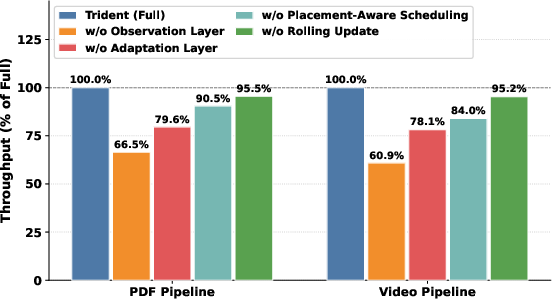
- Evaluation breadth and reproducibility: limited details on datasets, workload variability, baselines, ablations per layer, statistical significance, and solver overhead; lack of open-sourced artifacts to reproduce the claimed 1.88–2.01× gains.
- Sensitivity analyses: no study of how τ_d (clustering), γ (decay), η (feasibility gate), Δ_i (memory margin), L_max, and T_sched impact stability, throughput, and OOM rate.
- Handling of minority clusters: scheduling targets the “dominant” cluster; impact on tail or minority workloads (e.g., very long documents) and potential quality or fairness regressions are unaddressed.
- DAG-wide capacity modeling: the observation layer models per-operator capacity but not end-to-end queueing interactions; absence of a learned or analytical network-of-queues model to provide more reliable throughput predictions.
- Online learning drift and forgetting: sliding-window/inducing-point management may forget rare but important regimes; no mechanism to retain safety-relevant knowledge (e.g., previously unsafe configurations) long-term.
- Node- and link-level telemetry integration: E_max is optimized but how actual network counters inform the model or close the loop (e.g., detecting saturation/microbursts) is not described.
- Energy and cost awareness: the objective has no energy, power, or monetary-cost component; opportunity for multi-objective optimization (throughput vs. energy/carbon) is left unexplored.
Collections
Sign up for free to add this paper to one or more collections.

