Quantum Dynamics of the Schwarzschild Interior in Ashtekar-Barbero Variables with Minimal Length Effects
Published 11 Mar 2026 in gr-qc and hep-th | (2603.10297v1)
Abstract: We study the quantum dynamics of the Schwarzschild interior in the Ashtekar-Barbero formulation, focusing on the fate of the classical singularity and the annihilation-to-nothing scenario. Using minisuperspace Wheeler-DeWitt quantization, we first analyze the standard Schrödinger representation and show that the annihilation-to-nothing behavior appears only for a specific choice of factor ordering and is not generic. We then introduce a generalized uncertainty principle (GUP), which induces minimal-length effects through a deformation of the canonical algebra. Solving the modified Wheeler-DeWitt equation and constructing Gaussian wave packets localized at the horizon, we find that the annihilation-to-nothing behavior is suppressed once the GUP corrections are included. Our results indicate that minimal-length effects qualitatively alter the quantum interior dynamics and challenge the robustness of this scenario as a mechanism for singularity resolution.
The paper demonstrates that the annihilation-to-nothing scenario for singularity resolution critically depends on the chosen factor-ordering in quantization.
The paper employs Ashtekar–Barbero variables within a minisuperspace framework and utilizes Bessel function solutions to examine quantum probability densities.
The paper shows that introducing GUP-induced minimal-length corrections suppresses the annihilation feature, questioning the UV robustness of standard singularity resolution mechanisms.
Quantum Dynamics of the Schwarzschild Interior in Ashtekar-Barbero Variables with Minimal Length Effects
Introduction and Motivation
The quantum resolution of black hole singularities is a central question in canonical quantum gravity. The Schwarzschild interior, by virtue of its isometry to the Kantowski–Sachs cosmological model, serves as an archetype for probing the fate of classical singularities via minisuperspace quantization techniques. Recent proposals, such as the “annihilation-to-nothing” scenario, suggest quantum wave packets corresponding to classical trajectories with opposing time orientations mutually cancel, forestalling the singularity and eliminating the interior spacetime (“nothingness”). However, robustness of this scenario—especially under ultraviolet (UV) modifications inspired by quantum gravity—is unsettled.
This work systematically studies the quantum dynamics of the Schwarzschild interior within the Ashtekar–Barbero variable framework. The focus is twofold: (1) to analyze quantization ambiguities and their effect on singularity resolution in the standard Wheeler–DeWitt context, and (2) to incorporate minimal-length corrections using generalized uncertainty principle (GUP) deformation, thereby introducing UV physics anticipated from quantum gravity. The practical and conceptual implications for singularity resolution mechanisms are critically assessed.
Minisuperspace Quantization and the Annihilation-to-Nothing Scenario
A minisuperspace reduction of the Schwarzschild interior leads to a (1+1)-dimensional system where the Wheeler–DeWitt equation governs the quantum state. Classical singularity (pc→0) and horizon (pb→0,pc→rs2) correspond to well-defined limits in the reduced phase space.
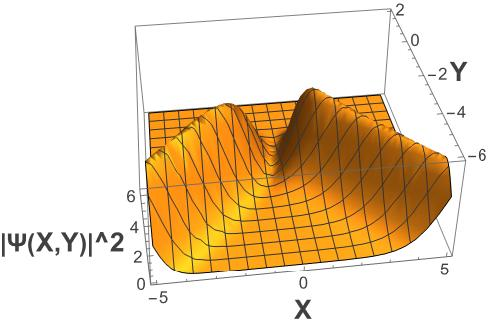
The “annihilation-to-nothing” scenario emerges from specific wave packet constructions. By selecting an appropriate superposition of mode solutions aligned with the classical horizon, the quantum probability density exhibits mutual annihilation of branches (Fig. 1).
Figure 1: Probability density of the wave function for C=σ=rs=1. Mutual annihilation suppresses probability density at the would-be singularity.
However, this phenomenon critically depends on quantization choices—specifically factor ordering—within the Wheeler–DeWitt framework. The Ashtekar–Barbero formalism, which naturally interfaces with LQG, introduces new representations and highlights the sensitivity of semiclassical outcomes to quantization ambiguities.
Recasting the Schwarzschild interior dynamics in Ashtekar–Barbero variables (b,pb),(c,pc), the authors formulate the reduced Hamiltonian constraint and apply canonical quantization with a general ordering parameter a. The resulting Wheeler–DeWitt equation admits separable solutions, expressible in terms of Bessel functions and encoded by a continuous separation constant k.
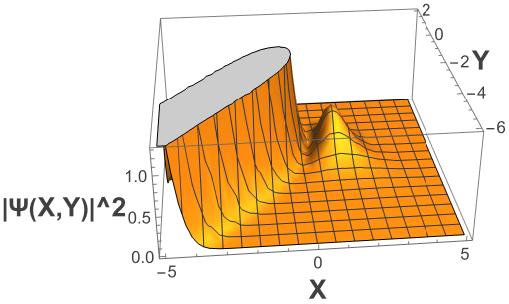
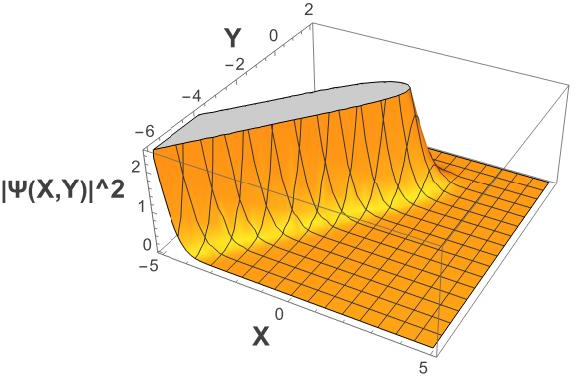
The physical content of wave packets constructed from these solutions depends strongly on the ordering parameter a. For the value a=5/6, the canonical wave packet recovers the time-symmetric annihilation-to-nothing profile akin to previous metric-formulation results. Variations in ordering (a=1, a=2) yield markedly distinct probability profiles:
Figure 2: Probability density for a=1,C=σ=γ′=1; the annihilation feature is distorted and lacks clear time symmetry.
Figure 3: Probability density for a=2,C=σ=γ′=1; the characteristic annihilation is absent.
For a=1, the probability density remains asymmetric with respect to time orientation, undermining a mutually annihilating interpretation. For a=2, the annihilation effect vanishes entirely, illustrating that this quantum scenario is non-generic and sensitive to operator-ordering ambiguities inherent in the standard quantization approach.
To model potential UV completions, the canonical commutators are deformed through a GUP, parameterized by βb,βc, which introduces minimal uncertainties—effectively encoding a finite spatial resolution at the Planck scale.
The GUP leads to a nonlinear redefinition of configuration variables: b=(βb)−1tan(βbb0) (similarly for c), mapping canonical variables onto compact domains and altering the structure of the Wheeler–DeWitt equation. Analytical solutions are constructed in terms of generalized hypergeometric functions, and the Fourier-transformed wave packets inherit compact support and nonlinear features.
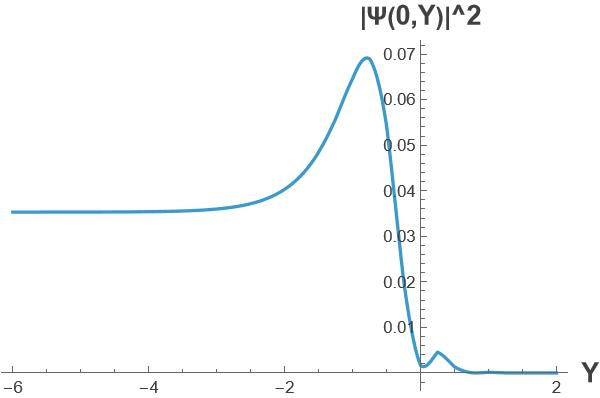
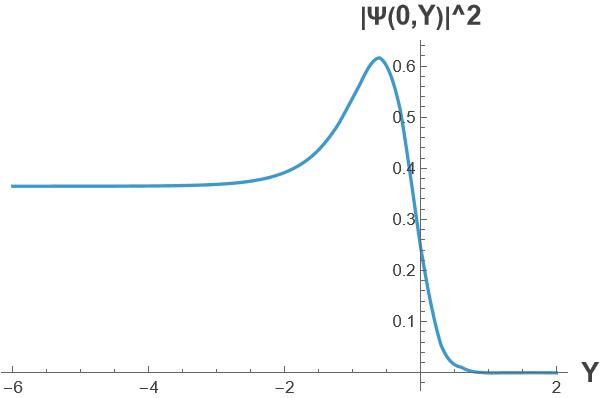
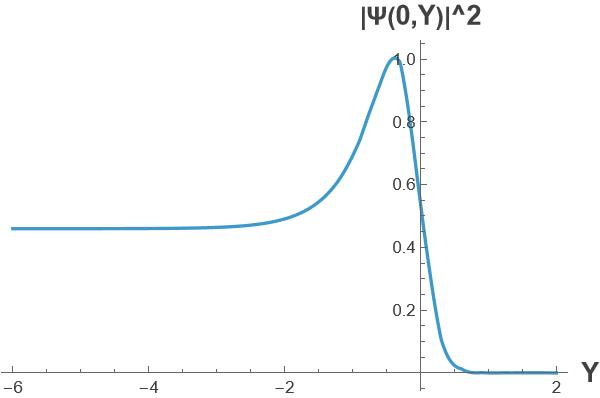
Numerical investigations impose Gaussian boundary conditions at the horizon, constructing packets analogous to the previous section. The resulting probability densities at X=0 for different orderings are:
Figure 4: Probability density for a=5/6,γ=rs/2=2βb=βc=1 under GUP corrections; absence of annihilation behavior.
Figure 5: Probability density for a=1,γ=rs/2=2βb=βc=1; the mutual annihilation feature is suppressed.
Figure 6: Probability density for a=2,γ=rs/2=2βb=βc=1; no evidence for the annihilation-to-nothing mechanism.
Across all tested orderings, the quantum probability density does not exhibit mutual annihilation of classical branches. The GUP-induced minimal-length effects robustly suppress the “annihilation-to-nothing” structure that appeared under standard quantization. This finding holds for all settings of a, implying that the scenario lacks UV robustness when minimal-length physics is taken into account.
Implications, Limitations, and Future Directions
These results have nontrivial implications for quantum black hole physics:
Factor-Ordering Non-Robustness: Apparent quantum singularity resolution via annihilation-to-nothing is not a generic feature of the Ashtekar–Barbero minisuperspace quantization. It relies on fine-tuning of operator ordering.
Ultraviolet Sensitivity: Inclusion of GUP corrections, an effective proxy for quantum gravity UV effects, suppresses the mutual annihilation scenario irrespective of factor ordering. Thus, such proposals cannot be considered robust mechanisms for singularity resolution in more complete quantum gravity theories.
Suppression of Spacetime Creation: The probability density in the quantum regime vanishes for configurations corresponding to classical spacetime, underscoring a possible suppression of geometry creation due to quantum gravitational corrections.
While the study utilizes effective models—minisuperspace truncation, no matter fields, and a phenomenological GUP—the findings clearly caution against drawing conclusions about singularity resolution from canonical minisuperspace quantization alone. The work motivates further scrutiny of curvature expectation values, exploration of fully polymer-quantized (LQG) models, and extensions beyond symmetry-reduced settings.
Conclusion
This analysis demonstrates that the “annihilation-to-nothing” scenario is both factor-ordering dependent and not preserved under UV modifications modeled by generalized uncertainty principles. Minimal-length effects induced by plausible quantum gravity physics qualitatively alter the quantum dynamics of the Schwarzschild interior, suppressing previously conjectured mechanisms for singularity resolution. These results highlight the necessity of incorporating UV-complete frameworks and carefully accounting for quantization ambiguities when evaluating singularity resolution in quantum gravity models.