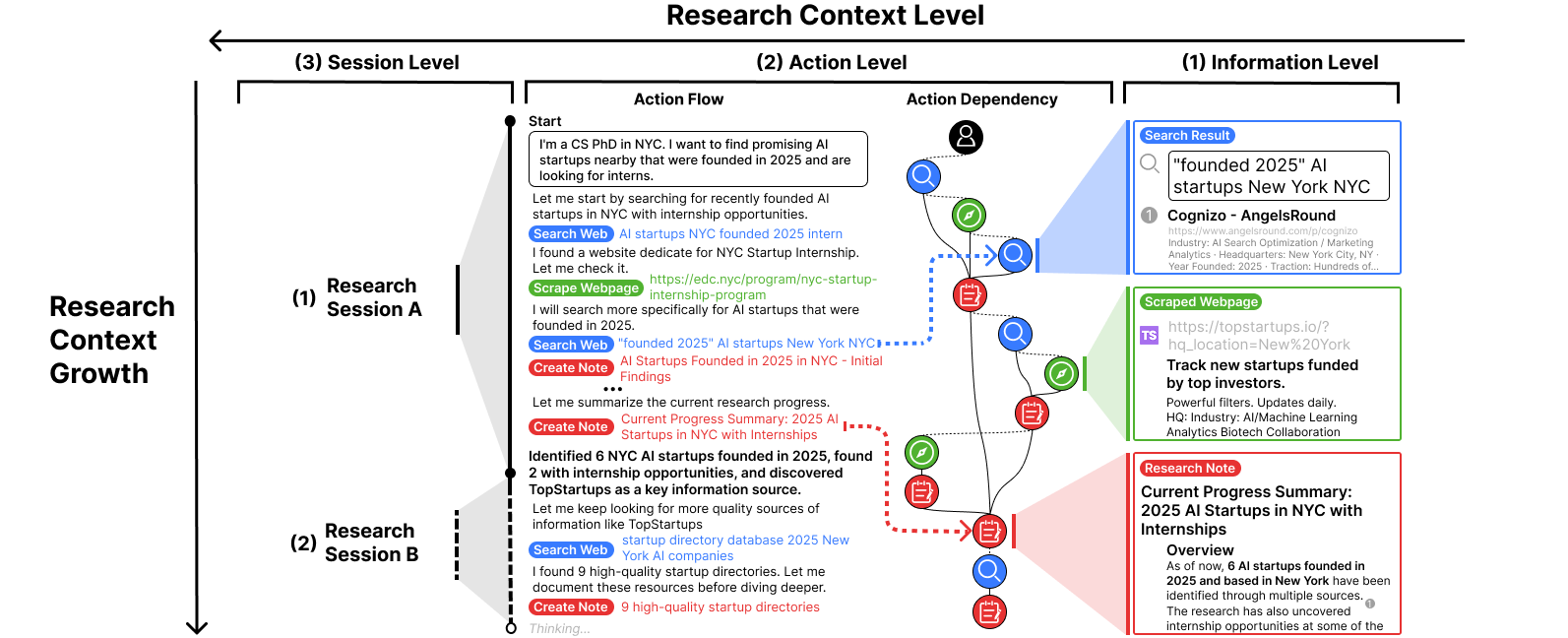
- The paper introduces a hierarchical context management framework that enables active user intervention and transparent evidence backtracing.
- The system combines chat-style, graph-based, and card-style interfaces to support process observability and dynamic context navigation.
- Empirical benchmarks and a structured user study demonstrate high usability and competitive performance compared to state-of-the-art research tools.
Enabling Human-Agent Collaborative Deep Research with InterDeepResearch
Introduction
InterDeepResearch addresses a pivotal gap in current LLM-powered deep research systems: the lack of effective human-agent collaboration in long-horizon, complex information-seeking tasks. Existing deep research tools generally follow an autonomous query-to-report paradigm, relegating users to passive roles and hindering integration of users’ insights, evolving intents, and contextual expertise. This work presents an interactive research system grounded in a hierarchical, actionable research context management framework, supporting dynamic user intervention, macro- and micro-level process observability, and robust context navigation. Through technical benchmarks and a user study, InterDeepResearch demonstrates competitive empirical performance and improved user agency in collaborative research workflows.
Hierarchical Research Context Architecture
At the core of InterDeepResearch is a three-level hierarchical research context architecture: information, actions, and sessions. This design is motivated by formative studies highlighting users’ needs for process observability, real-time steerability, and efficient navigation in massive, interconnected research outputs.
This architecture enables comprehensive process visibility, dynamic context reduction (to mitigate LLM context exhaustion), and evidence backtracing by leveraging explicit action and information dependencies.
Interface Design and Interactive Mechanisms
The InterDeepResearch UI integrates three tightly coupled views, aligning user sensemaking with the system's hierarchical architecture:
- Chat-Style View: Presents research sessions and action flow linearly, suitable for tracking chronological progression and narrative evolution.
- Graph-Based Dependency View: Visualizes research action dependencies, facilitating provenance analysis and micro-level intervention.
- Card-Style Information View: Displays detailed content of research information; supports snippet referencing and focus synchronization across views.
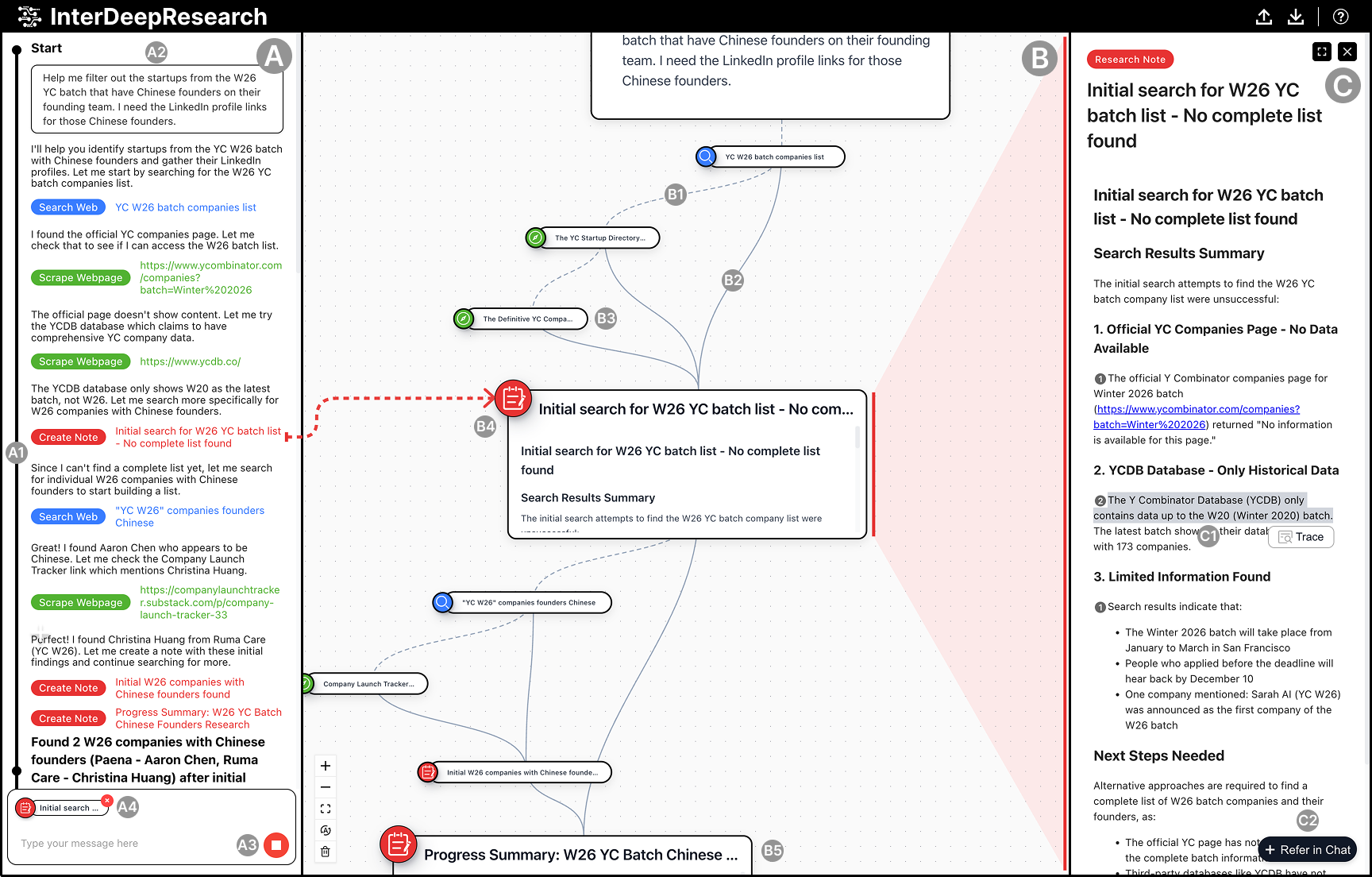
Figure 2: InterDeepResearch interface with three coordinated views: (A) chat-style view for research sessions and research action flow, (B) graph-based view for research action dependencies, and (C) card-style view for detailed research information.
Cross-View Linkage allows users to select any node or information piece, triggering focus and highlighting across all relevant UI components.
Cross-Action Backtrace enables users to trace generated conclusions back to supporting evidence by traversing explicit dependencies, yielding provenance graphs for validation and auditability.
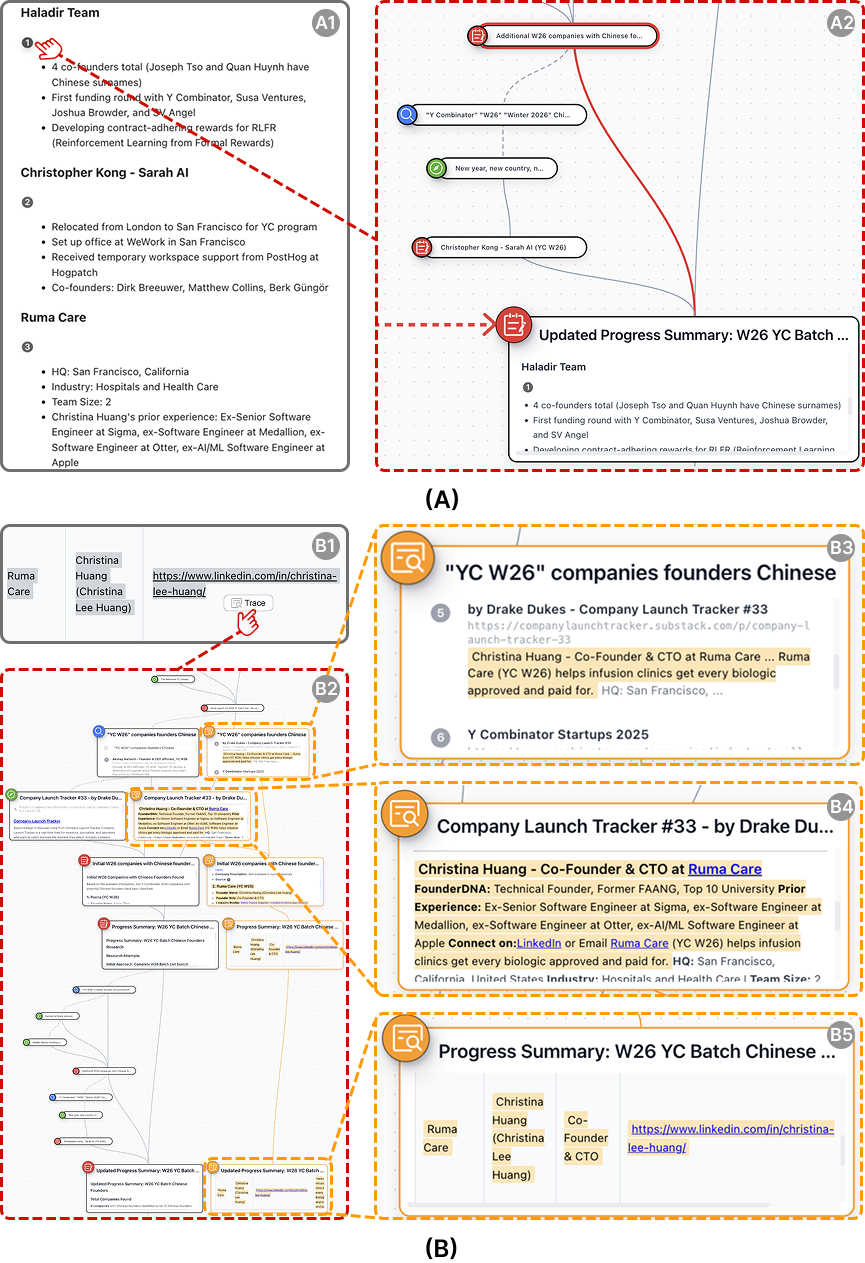
Figure 3: The cross-action backtrace mechanism helps users trace the provenance of generated content.
Technical and Empirical Results
InterDeepResearch demonstrates strong empirical performance on canonical text-based deep research benchmarks, including Xbench-DeepSearch-v1 and Seal-0. In evaluation without user intervention, the system achieves scores on par with or exceeding notable commercial systems such as Perplexity Deep Research and Gemini Deep Research, indicating no degradation in automated information-seeking capability arising from its collaborative framework.
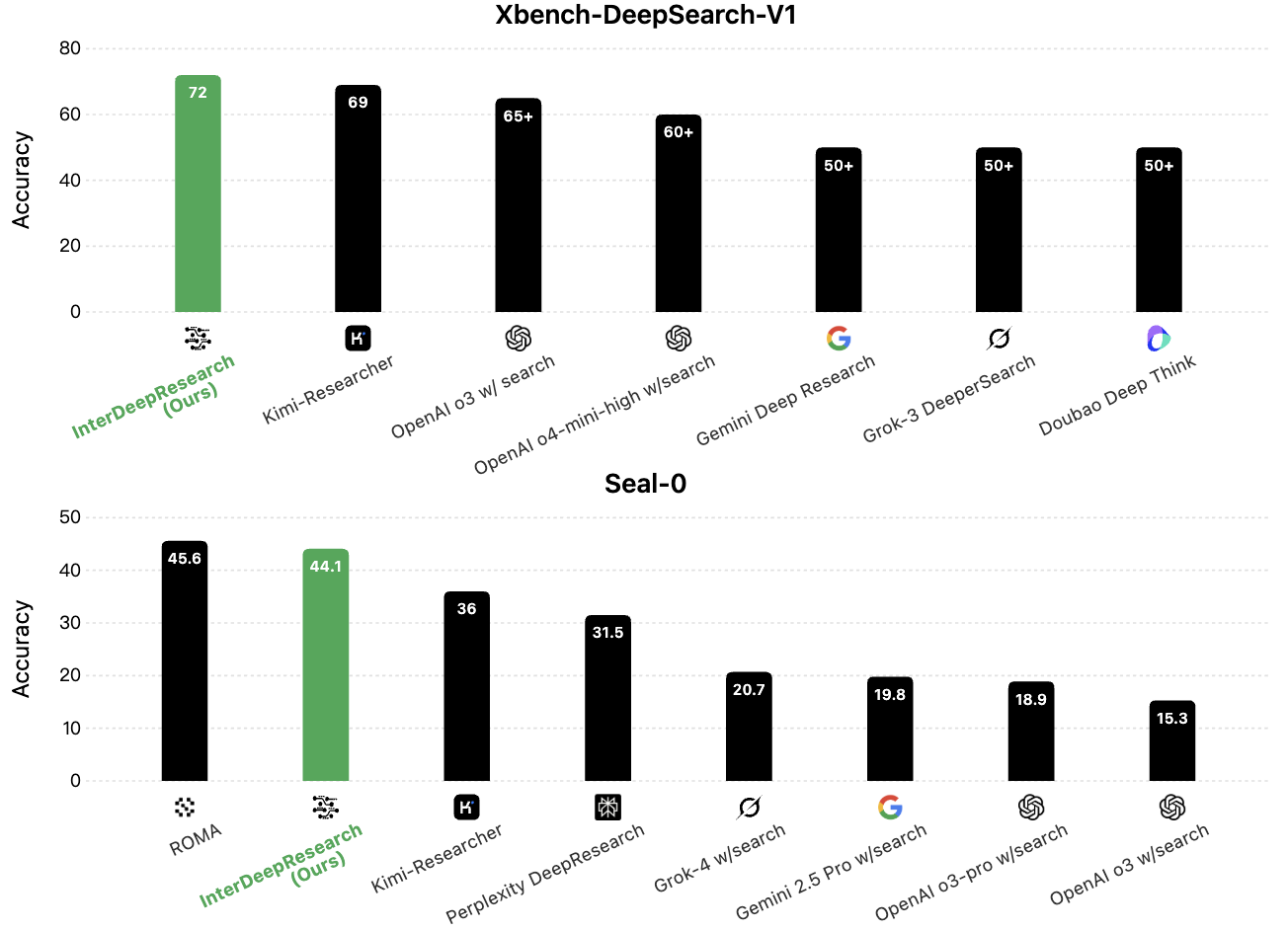
Figure 4: InterDeepResearch achieves competitive performance on existing text-based deep research benchmarks.
User Study and Insights
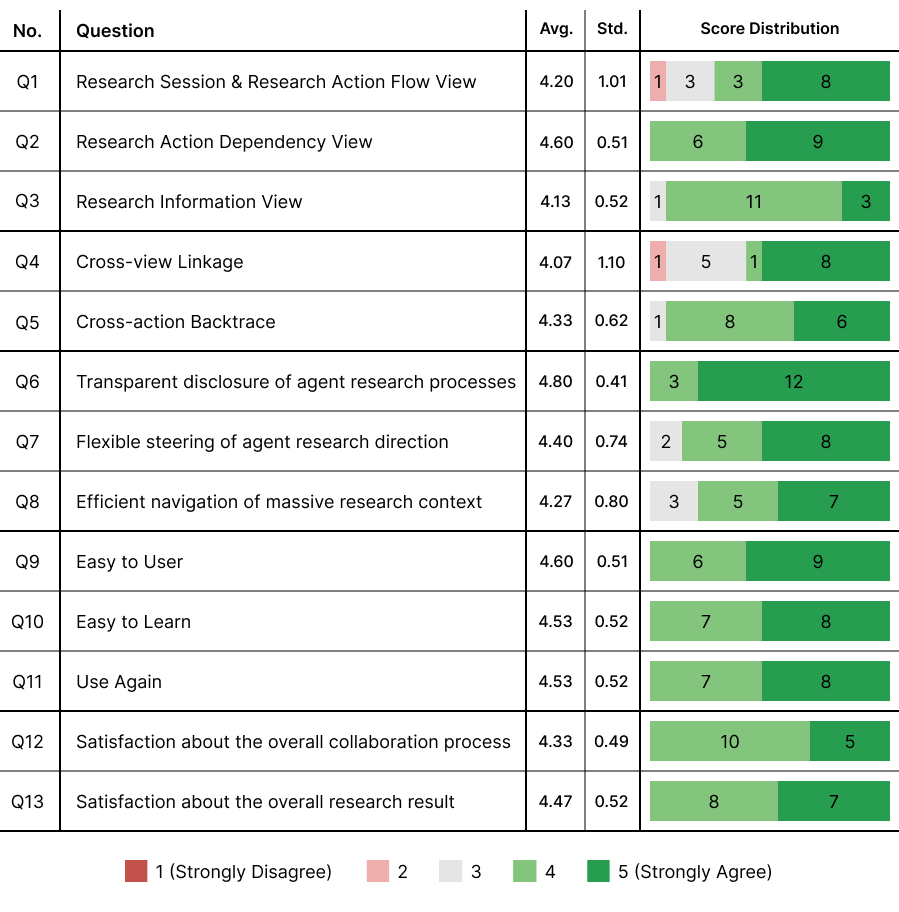
A structured user study with 15 participants—spanning frequent users and developers of deep research agents—validates the system’s effectiveness for human-agent collaborative information seeking. Key findings:
Implications and Future Directions
This work demonstrates that integrating hierarchical context management, coupled views, and interaction mechanisms, enables high-agency, interpretable human-agent collaborative research. By transforming users into active collaborators, the system enhances research reliability, supports dynamic strategy pivots, and significantly improves evidence auditability.
Practical implications include applicability in domains where research accountability, iterative refinement, and context-sensitive exploration are critical (e.g., scientific literature review, business intelligence, and regulated industries). Theoretically, the framework advances design paradigms for future agentic systems by formalizing action/information provenance, user-in-the-loop control, and scalable context management.
Several directions present themselves for future development:
- Adapting interfaces and mechanisms to user-specific workflow patterns via personalization or adaptive UI strategies.
- Incorporating multimodal information and interaction modalities (e.g., voice, visual analytics) to broaden accessibility and cognitive bandwidth.
- Extending to multi-user, multi-agent scenarios with support for branching research threads and richer synchronization/anonymization schemes, addressing emerging demands for collaborative synthesis and parallel exploration.
Conclusion
InterDeepResearch operationalizes human-agent symbiosis in deep research by formalizing hierarchical context, providing actionable process transparency, and empowering dynamic user agency throughout the research lifecycle. It establishes a technical foundation and design template for the next generation of interpretable, steerable, and auditable agentic information-seeking systems, supporting practical deployments and future research into enriched human-AI collaboration (2603.12608).