- The paper presents complete monotonicity and Stieltjes functions as fundamental structures underpinning scattering amplitudes in quantum field theory.
- It rigorously develops positive geometry and spectral representations that constrain Feynman integrals and S-matrix elements.
- Numerical methods like Padé approximants and semidefinite programming validate bootstrap techniques and establish bounds for physical observables.
Positivity Properties of Scattering Amplitudes: Mathematical Structure and Applications
Introduction
The lecture notes "Lecture Notes on Positivity Properties of Scattering Amplitudes" (2603.28454) provide an in-depth exploration of the mathematical framework and physical origins of complete monotonicity (CM) and Stieltjes functions as they arise in quantum field theory (QFT), with particular emphasis on explicit manifestations in physical observables such as Feynman integrals, S-matrix elements, and amplitudes in both general gauge theories and maximally supersymmetric Yang–Mills theory. These structural properties, rooted in classical analysis, are shown to have profound consequences for analytic continuation, bounding, and even the numerical and geometric bootstrap of amplitudes.
Mathematical Structure: Complete Monotonicity and Stieltjes Functions
The basis for the study is the precise definition and classification of CM and Stieltjes functions. A function f is CM on an interval I if (−1)nf(n)(x)≥0 for all n≥0 and x∈I, admitting a Laplace transform representation with positive measure by the Bernstein–Hausdorff–Widder theorem. Stieltjes functions, a subset of CM functions, have a more restrictive canonical spectral integral representation and are characterized by their analyticity and a Herglotz–Nevanlinna property in the cut complex plane, yielding strong control over their analytic structure, locations and type of singularities, and their closure properties.
The notes systematically develop the implications of CM property: convexity, log-convexity, Schur convexity, and the existence of a Newton interpolation series. These features together provide powerful constraints on physical observables that are naturally realized as superpositions of positive measures over elementary kernels—mirroring properties required by unitarity (optical theorem) and causality.
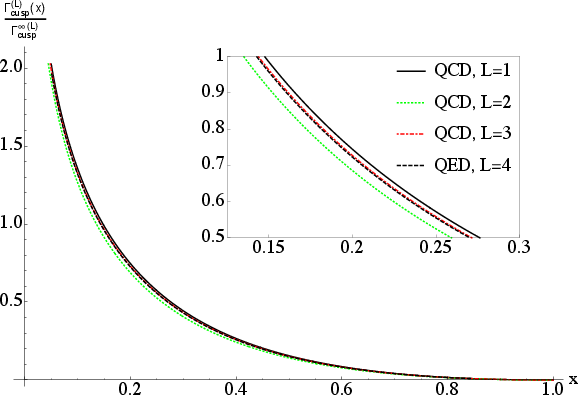
Figure 1: Plot of the angle-dependent cusp anomalous dimension in QCD and QED showing CM behavior as confirmed by perturbative data.
Multivariate Structure and Positive Geometry
The formalism is extended to several variables and convex cones, showing that CM functions are closed under directional derivatives (taken along extremal rays), with the Choquet generalization of Bernstein’s theorem providing integral representations over dual cones. This provides a language to recast amplitude constructions in the context of projective and convex geometry, and to relate the algebraic and geometric duals of physically relevant positive geometries.
Stieltjes functions in several variables are also discussed, with their role in multivalued analytic structure and relation to Padé approximants addressed explicitly.
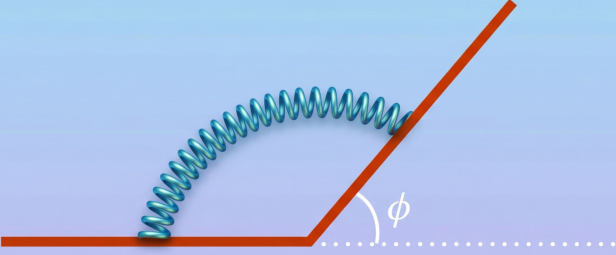
Figure 2: Wilson line with a cusp, whose expectation value furnishes the cusp anomalous dimension, an archetype of CM physical observable.
Manifestations in Physical Observables
Cusp Anomalous Dimension
A paradigmatic example is the perturbative cusp anomalous dimension, which controls the renormalization of Wilson loops and the IR structure of gauge theory amplitudes. Its angle-dependent form is proven to be CM in the Euclidean domain (0,1), with the property verified up to four loops in QED and three loops in QCD and N=4 SYM. The detailed profile is strictly positive, monotonically decreasing, and convex in this domain.
Figure 1: Angle dependence for cusp anomalous dimensions, confirming CM property across different loop orders and gauge theories.
Figure 2: Schematic illustration of the Wilson line with cusp angle ϕ.
Scalar Feynman Integrals
The notes furnish general theorems proving that scalar Feynman integrals in the Euclidean region—where all external invariants are negative or all masses are positive-definite—are CM as a consequence of the structure of the Feynman parameterization, specifically the positivity and linear dependence of the second Symanzik polynomial on kinematic variables. For planar graphs, all kinematic parameters can be chosen independently to preserve CM, while for non-planar cases, conditions on hyperbolicity and positivity of the Symanzik polynomials become subtle.
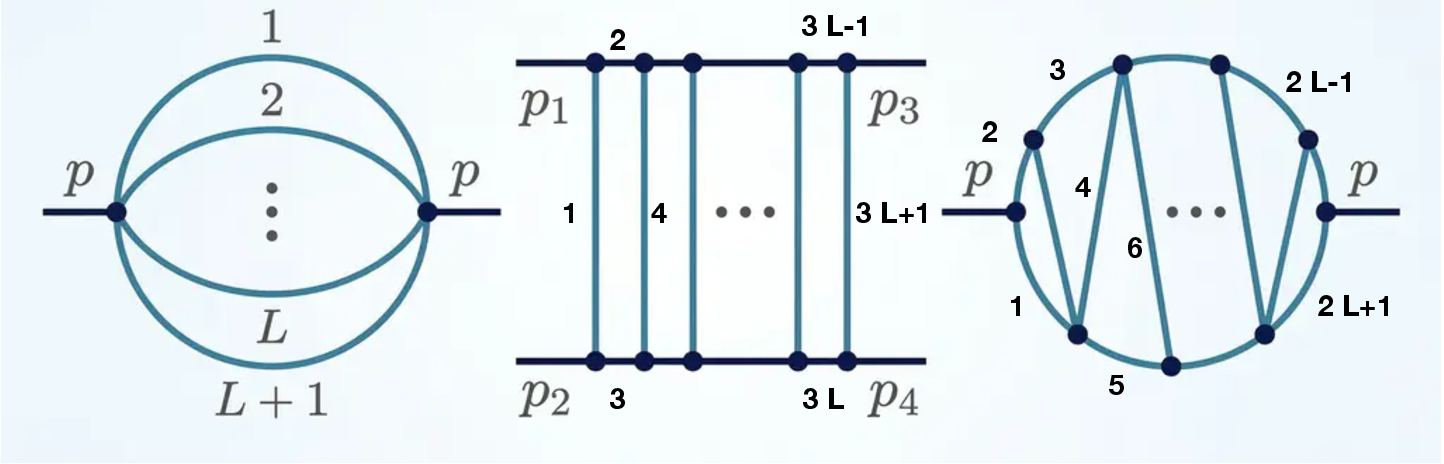
Figure 3: Families of Feynman integrals (banana, box, zig-zag) that are Stieltjes in specific even dimensions, with manifold implications for amplitude positivity.
Stieltjes Structure: Spectral Representations
Unitarity and analyticity often lead S-matrix elements and related correlators to admit spectral representations manifesting the Stieltjes property, e.g., the vacuum polarization function via Källén-Lehmann rep., with positive spectral density grounded in the optical theorem. Numerous instances are produced where unsubtracted or once-subtracted dispersion relations with positive discontinuities imply the Stieltjes structure.
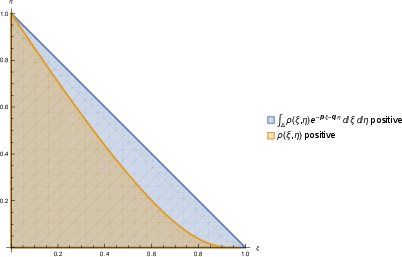
Figure 4: Integration region Δ for the double spectral representation appearing in Coulomb branch amplitudes in N=4 SYM.
Implications for Bootstrap and Analytic S-matrix
A key application of CM and Stieltjes properties is in bounding and constraining S-matrix elements, most notably through Martin's positivity theorems. The notes provide a detailed review of the derivation and implications of Martin’s bounds: inside the Mandelstam triangle, amplitude derivatives of all orders are positive, enforcing a unique global minimum at the symmetric crossing point. The lecture notes emphasize the practical utility of this infinite tower of positivity for non-perturbative amplitude bootstrap, providing both analytic and numerical strategies through linear and semidefinite programming implementations of truncated positivity (Hankel) constraints.
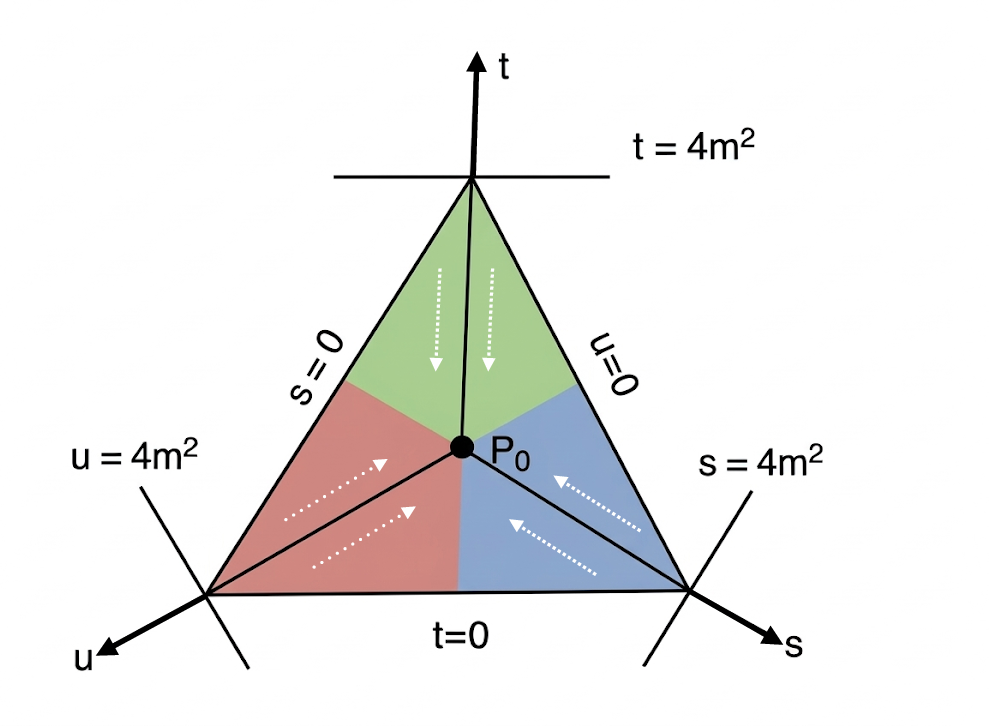
Figure 5: Mandelstam triangle, with colored zones indicating regions where distinct positivity inequalities control the amplitude.
Positive Geometries, Dual Volumes, and Convexity
The deep connection between amplitude positivity and positive geometry is elaborated for both polyhedral and non-polytopal geometries. The canonical form of a positive geometry is interpreted as a volume (or Laplace transform) over a dual region, reconstructing the amplitude as a (potentially weighted) projective volume—an insight that unites both the algebraic and geometric perspectives and suggests powerful generalizations to the amplituhedron and related constructions.
The role of hyperbolic polynomials is emphasized: for a rational function to be CM on a cone, the denominator must be a hyperbolic polynomial. Recent advances yield explicit dual volume measures for complex geometries such as spectrahedra, with measures involving transcendental densities when going beyond polytopes.
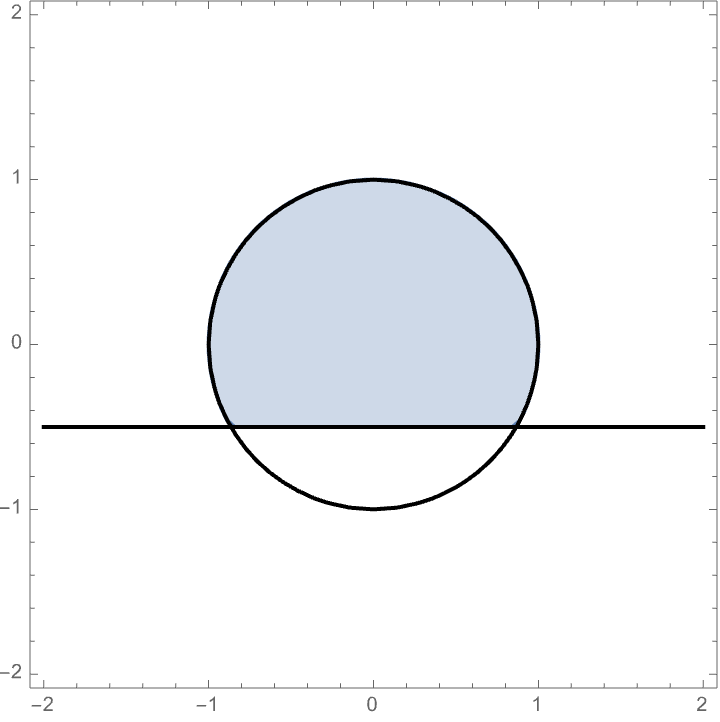
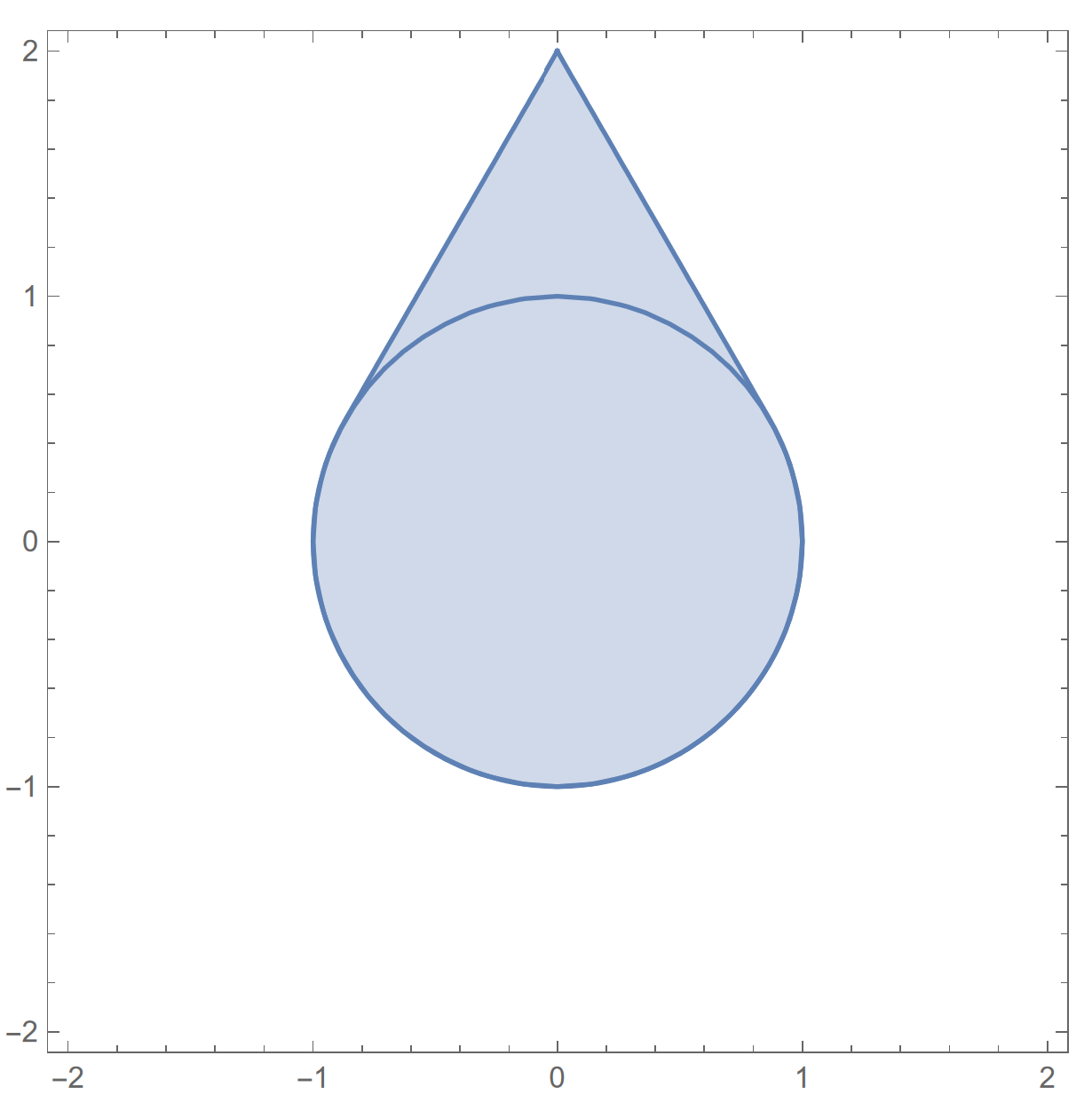
Figure 6: The half-pizza geometry and its projective dual, highlighting the emergence of non-trivial measures for the Laplace dual.
Numerical Methods and Padé Approximation
Given the fact that Feynman integrals and related quantities satisfy CM/Stieltjes properties and ODE systems, powerful numerical bootstrap techniques are presented. By imposing a finite subset of the infinite positivity constraints (e.g., positivity of principal minors of truncated Hankel matrices), numerical upper and lower bounds on amplitude values and their derivatives can be efficiently obtained, even without analytic evaluation.
Padé approximants are especially effective for Stieltjes functions, providing convergent and rigorously monotonic rational approximations across much of the cut I0-plane. This property is shown to be highly efficient: e.g., even 20-loop banana integrals can be numerically evaluated to high accuracy using a small number of moments.
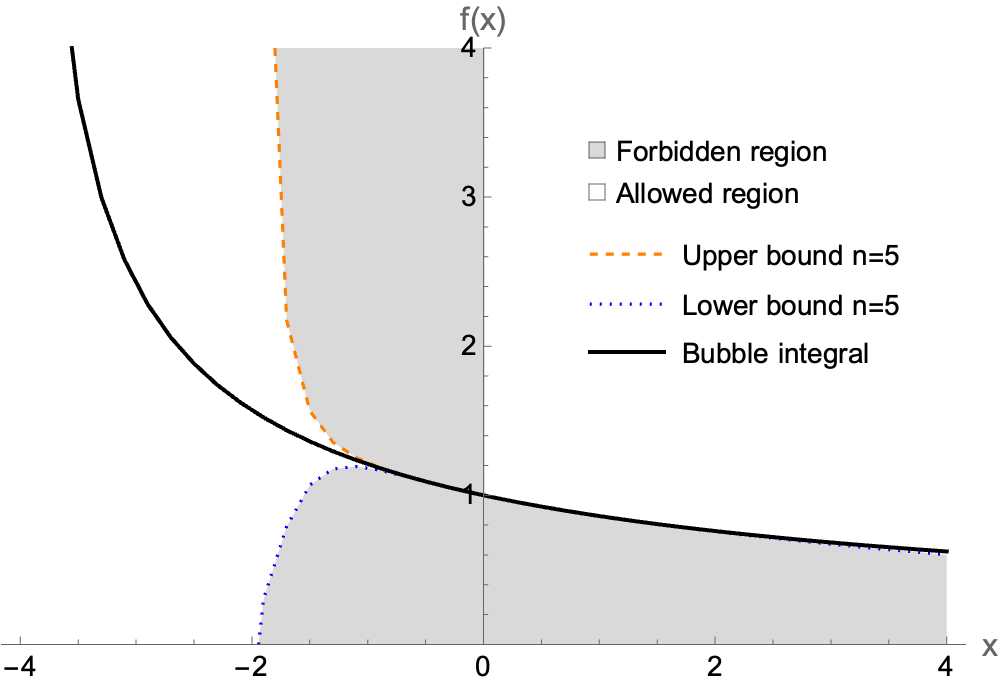
Figure 7: Bounds on the 2D bubble integral from truncated CM constraints, illustrating rapid convergence using convex optimization.
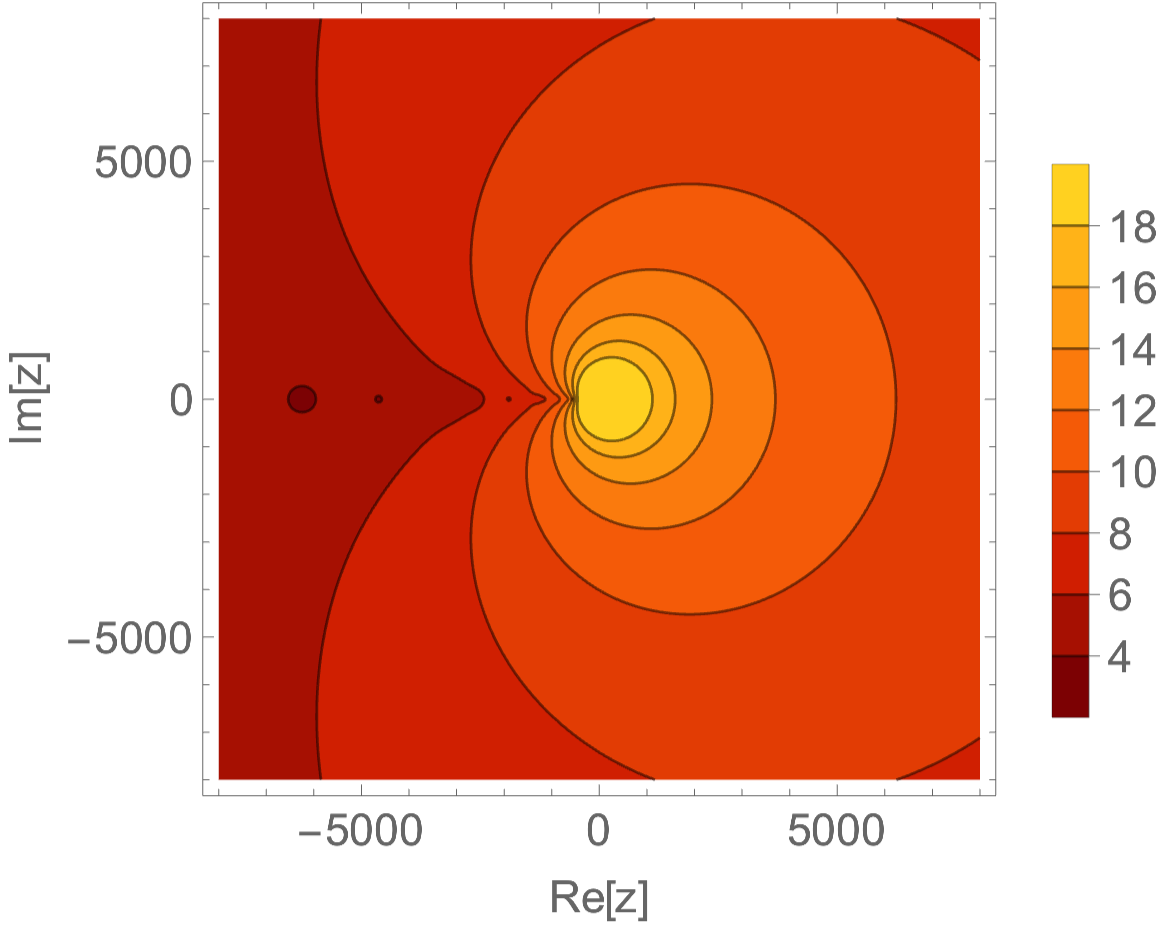
Figure 8: Padé approximants for the 20-loop banana integral; upper and lower approximants agree with high precision throughout the domain.
Theoretical and Practical Implications
The emergence of CM/Stieltjes properties in diverse observables provides a unifying framework for systematic analytic continuation, bounding, and bootstrapping of QFT amplitudes. These properties survive integrating out loop momenta and persist in special kinematic regions fixed by analytic and unitarity requirements. More broadly, the presence of such structure hints at deep connections between quantum field theoretic observables, convex analysis, moment problems, and positive geometry. Establishing and exploiting these connections offers prospects for both analytic and numerical advances in amplitude determination.
Conclusion
The formalism articulated in these lecture notes lays the mathematical and conceptual groundwork for positivity-based constraints in QFT. The demonstration that a wide variety of physically relevant objects exhibit CM and/or Stieltjes properties paves the way for nonperturbative amplitude bootstrapping, systematic error control in rational approximation, and geometric reinterpretations of amplitude structures. The open questions identified include generalizations to non-planar integrals, a full classification of multivariate Stieltjes amplitude regions, and the identification of the geometric measure in dual volume constructions outside the polytope setting. The ubiquity of CM/Stieltjes structure suggests these are not accidental features but consequences of deep physical and geometric principles yet to be fully elucidated.