- The paper introduces a hierarchical dApp-based architecture for real-time edge inference and ISAC, addressing limitations of legacy RAN designs.
- It details an innovative E3 interface and dynamic resource partitioning to enable sub-millisecond data access and high-accuracy sensing.
- Empirical results validate the approach with CRLB analysis and ranging experiments, achieving sub-meter accuracy in challenging conditions.
Programmable Inference and ISAC at the 6GR Edge with dApps: An Expert Analysis
Introduction and Motivation
The transition to 6G architectures is fundamentally reshaping Radio Access Network (RAN) design, coupling integrated sensing and communication (ISAC) and AI-driven inference natively into the edge infrastructure. The paper "Enabling Programmable Inference and ISAC at the 6GR Edge with dApps" (2603.29146) systematically addresses the system-level and architectural limitations that prevent current O-RAN and 3GPP-based RANs from supporting programmable, AI-driven ISAC services. It introduces discrete, software-managed distributed applications (“dApps”) and a hierarchical control framework, enabling real-time inference at the user-plane with explicit data-plane exposure.
The articulation of five key architectural challenges (real-time PHY/MAC data access, end-to-end AI pipelines for ISAC, support for heterogeneous ISAC-enhanced radios, sensing/inference algorithm life-cycle management, and flexible stack configuration) underscores the systemic rigidity of current RANs and prescribes programmable RAN evolution predicated on dApps and open interfaces.
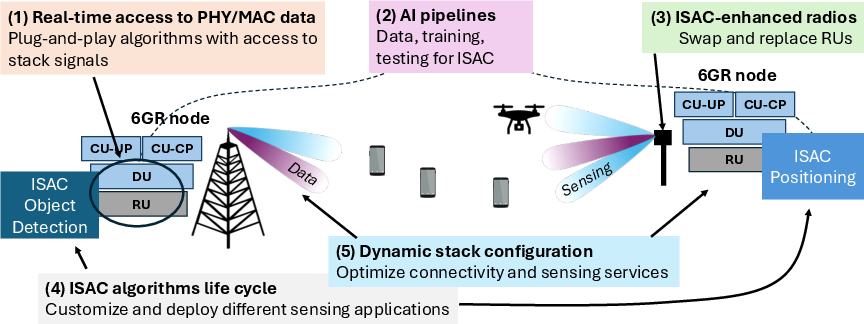
Figure 1: System-level challenges toward enabling programmable ISAC and inference within the 6GR architecture.
O-RAN Limitations and the Need for Programmable ISAC
O-RAN’s control-user plane separation and its hierarchical Near-RT RIC/xApp and Non-RT RIC/rApp architecture are designed for communication-centric optimization. However, as the paper observes, O-RAN lacks native support for real-time user-plane data streaming (e.g., I/Q samples, CSI, SRS) essential for physical-layer sensing and inference. The E2 interface is ill-equipped for the high-rate, low-latency data movement ISAC requires, and present abstractions do not support plug-and-play deployment or dynamic life-cycle management of site-specific sensing/inference functions.
While 3GPP’s ongoing Release 20 study items address waveform and channel model enhancements for ISAC, architectural support for AI workflows, dynamic stack reconfiguration, or algorithm deployment/monitoring pipelines are absent.
Programmable Sensing Architecture with dApps
The central proposal is a two-tier, latency-aware architecture leveraging dApps (software-defined, co-resident with RAN DUs) and a multi-level RIC/SMO orchestrator stack. dApps interface with the RAN user-plane through a new E3 interface at the DU, receiving I/Q samples, CSI, and SRS at sub-millisecond timescales. This realizes real-time, locally-optimized inference and enables multiple independent ISAC-applications (different dApps per topology/algorithm/target) to run in parallel, tightly coupled to the communication stack.
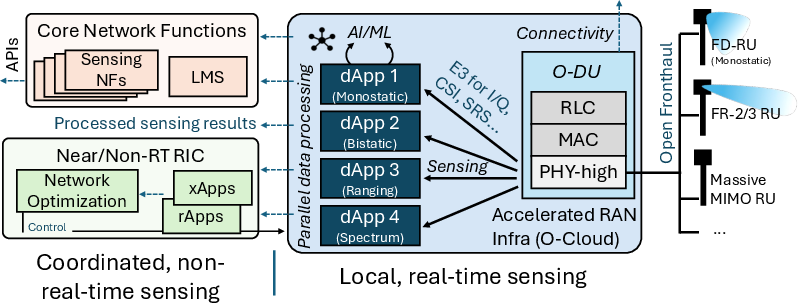
Figure 2: Hierarchical sensing architecture. dApps provide real-time I/Q, CSI, and SRS access at the DU for ISAC tasks; xApps/rApps handle multi-node fusion, policy, and cross-layer coordination.
Central to this design:
- Edge-level sensing and inference: dApps deploy arbitrary AI/ML models (e.g., CNNs for target classification, subspace algorithms for ranging) leveraging HW accelerators (GPU, FPGA) provisioned by O-Cloud.
- Hierarchical processing: dApps perform per-site, low-latency processing, with xApps/rApps at the RIC aggregating information across sites for network-level fusion, collaborative scheduling, and multi-node ISAC tasks.
- Dynamic resource partitioning: O-Cloud enforces resource allocation among communication, sensing, and inference workloads; the ISAC Orchestrator dynamically manages dApp/xApp placement, instantiation, and preemption, responding to demand, policy directives, and resource constraints.
- Security and privacy: Introducing the E3 interface mandates robust access control, isolation, and compliance mechanisms, especially as I/Q-level data exposure can increase the attack surface and privacy risk.
ISAC Algorithm Life-Cycle Management
A key insight is that ISAC functions are site-specific and dynamic, requiring MLOps-like support for data collection, centralized and local training, validation, cataloging, deployment, and continuous performance monitoring/adaptation. The authors describe an ISAC Orchestrator (in the SMO) that automates mapping algorithm requirements to site resources and radio capabilities, with policy-driven, intent-based deployment and continual telemetry-based adaptation.
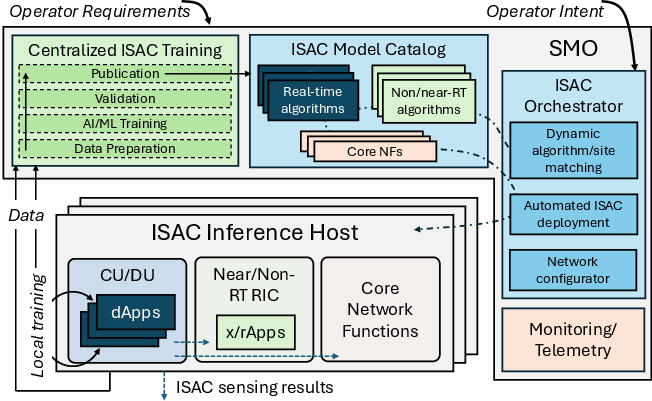
Figure 3: ISAC life-cycle management: centralized training, model cataloging, automated deployment, and performance-driven adaptation orchestrated by the SMO.
This enables not only rapid rollout and update of sensing services but also ensures that HW constraints (e.g., accelerator availability, RU capabilities) and multi-tenancy scenarios are respected, supporting government/commercial separation, privacy requirements, and resource arbitration.
Empirical and Numerical Validation
The paper demonstrates the necessity and effectiveness of E3-based dApp sensing with two quantitative results:
- CRLB-based analysis for monostatic sensing: The range and velocity RMSE for a drone target sharply decrease with increased E3 bandwidth for I/Q transfer, confirming that only site-local, high-throughput user-plane access enables high-accuracy sensing. The required data rate renders offloading to core/cloud infeasible, mandating edge-level dApp inference and motivating new interface design.
- Experimental validation for ranging: Subspace-based ranging algorithms, leveraging dApp access to full CIR data (vs. scalar reporting), are shown to yield sub-meter accuracy that the standard LMF pipeline cannot achieve, especially in heavy multipath or low-SNR regimes.
These results substantiate the core architecture claim: only real-time, user-plane-level observability (with dApps at the DU and E3 interface) can support next-generation ISAC accuracy and latency requirements, and programmatically expands the expressiveness of RAN services.
Implications, Challenges, and Future Directions
The architectural decoupling of sensing/inference from both the communication pipeline and deployment site enables clear separation of concerns, flexibility for third-party value-added services, and new RAN revenue models (e.g., ISAC-as-a-Service, operator-customized environmental sensing). Programmable ISAC also enables closed-loop, AI-driven RAN-optimization, including communication-aware sensing (joint scheduling, beamforming, network selection) and sensing-aware communication (RF environment adaptation, interference prediction, situational awareness).
However, several core challenges remain:
- Multi-node coordination and synchronization: Accurate multi-node ISAC requires ultra-tight time and frequency coordination, robust handoff of measurements, and cross-site data fusion, not yet standardized in O-RAN or 3GPP.
- Resource arbitration and coexistence: On shared O-Cloud (and especially with heterogeneous RU/DU configurations), ISAC workloads compete directly with user-plane traffic for compute/memory/I/O, requiring enforcement frameworks for SLOs and SLAs.
- Security and privacy: The introduction of programmable user-plane access (E3), third-party dApps, and exposure of physical-layer waveforms mandates robust access control, auditing, and compliance strategies—especially given privacy-sensitive inferences possible from raw I/Q data (2603.29146).
- Standardization: There is a clear need for cross-SDO coordination to align 3GPP ISAC specifications (waveform, channel, service APIs) with programmable RAN interfaces (dApps/E3, O-RAN orchestration, multi-vendor interoperability).
Conclusion
The paper constructs a formal, multi-tier architecture for programmable ISAC and inference at the 6GR edge, with dApps as the architectural primitive for real-time, user-plane data access and hierarchical control. It establishes that only such an architecture can achieve the accuracy, flexibility, and manageability demanded by dynamic, AI-driven ISAC use cases envisioned for 6G. Empirical results substantiate that scalar abstraction and control-plane-centric designs are fundamentally inadequate for modern sensing and inference tasks. The articulation of open research challenges—especially in interface abstraction, cross-domain orchestration, and privacy/security—marks a critical roadmap for research and standardization in the evolution toward AI-native, programmable 6G RANs.