- The paper presents a superexponential model (R² = 0.984) showing that satellite numbers could reach a critical shading threshold by March 2031.
- It estimates that 1.8% celestial occlusion by satellites might neutralize the warming effect of a CO₂ doubling, mirroring geoengineering impacts.
- The study discusses the transient and unstable nature of unintended climate intervention amid risks like debris cascades and regulatory challenges.
Satellite Proliferation as an Unintentional Climate Intervention: A Technical Appraisal of "Lots of Shade on Satellite Constellations" (2603.29212)
Introduction
The escalating density of Earth-orbiting satellites has prompted extensive discourse about its adverse consequences, particularly for observational astronomy, environmental stability in low Earth orbit (LEO), and broader geophysical risks. "Lots of Shade on Satellite Constellations" (2603.29212) offers a quantitative assessment of an unconventional hypothesis: the possibility that continued, unchecked satellite deployment may attenuate incoming solar irradiance at a scale sufficient to influence terrestrial radiative balance and, consequently, global temperature trajectories. This review details the methodology, numerical findings, and the speculative but technically grounded implications of this scenario.
Growth Characterization of Satellite Populations
The paper provides a systematic analysis of active satellite statistics from 1956–2026, relying on the curated data from Jonathan’s Space Pages. The satellite population exhibits superexponential, rather than exponential, growth. Logarithmic representations of the time series reveal distinct inflection points incompatible with simple exponential dynamics, necessitating the adoption of a J-curve framework for accurate prediction.
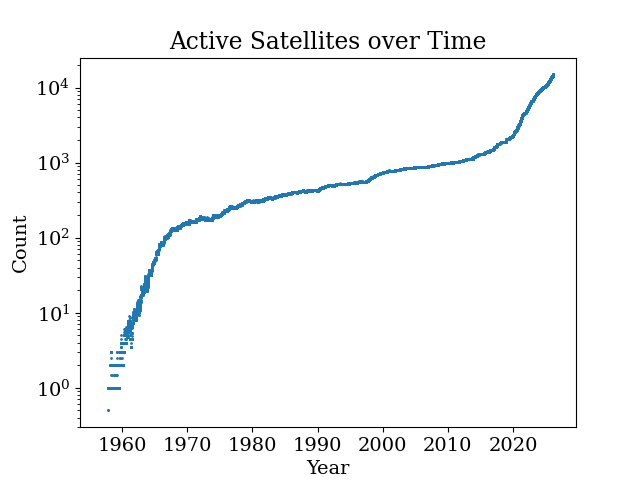
Figure 1: Multiple regime switching in the active satellite time series precludes a single exponential fit.
Through nonlinear regression, the best-fit superexponential function yields R2=0.984, surpassing the exponential's R2=0.964. The corresponding model parameters (A, B, C) allow forward projection of population growth and quantification of geometric sky coverage by the satellite fleet. The model forecasts a singularity-like divergence in deployment rates converging in the early 2030s.
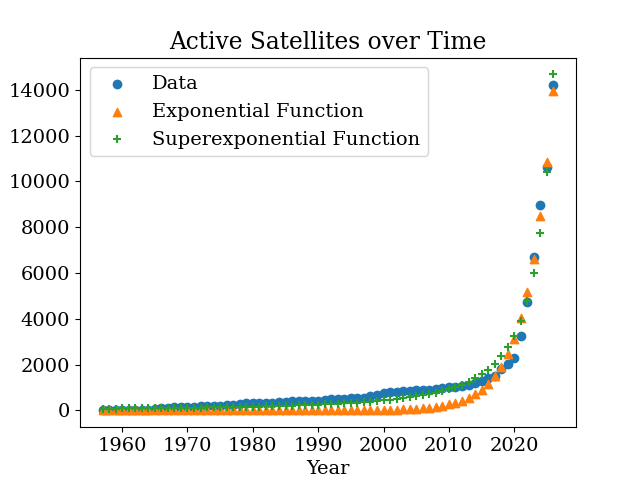
Figure 2: Superexponential modeling (green) provides a superior fit to the rapid late-stage increase in satellite density, compared to exponential (orange) or the empirical time series (blue).
From Satellite Sky Coverage to Radiative Forcing
The core technical claim rests on estimating when the aggregate projected area of satellites could occlude 1.8% of the celestial sphere as viewed from Earth’s surface. The selection of 1.8% is substantiated with reference to radiative forcing calculations from [Govindasamy & Caldeira 2000], which argued that such a reduction in solar flux would approximately nullify the warming effect of a doubling of atmospheric CO2.
Implementing this calculation, the authors assume average Starlink satellite parameters (semi-major axis: 6750 km, cross-sectional area: 5 m²) as representative. The total fractional coverage f is then
f=4πr2Na
where N is the projected satellite count, a area, r orbital radius. Inverting to solve for the time t at which f=0.018 using the superexponential R2=0.9640 gives a convergence on late March 2031 for threshold crossing.
The analysis is conservative insofar as it neglects effects of mutual shadowing, overlap, and variable inclination distributions; thus, the actual photometric shadowing may be lower, but the modeled upper bound is instructive for order-of-magnitude arguments.
Contextualizing with Previous Geoengineering and Orbital Debris Literature
The conceptual parallel to intentional solar geoengineering via orbital sunshades—examined in the literature for controlled climate intervention [Alagoz et al. 2024; Coco et al. 2025; Town et al. 2025]—is explicit. However, the mechanism in focus here is uncoordinated and emergent, rather than engineered. Furthermore, the paper notes (with reference to [Ballard et al. 2025; Thiele et al. 2025]) that such growth in satellite density must be considered alongside collision-induced debris cascades (Kessler Syndrome) and the sharply falling "CRASH Clock" (i.e., mean time to catastrophic collision), implying that the system is likely metastable or transient on relevant timescales.
Additionally, the discussion touches on the increasing injection of metals and aerosols due to frequent reentries, ozone layer perturbation due to both rocket launches and satellite ablation, and the compounding of environmental risks [Revell et al. 2025; Schulz et al. 2021]. These factors underscore the tradeoff between potential cooling via increased albedo and concurrent adverse atmospheric/astronomical impacts.
Numerical Highlights and Claims
- The best-fit superexponential model (R2=0.9641) projects surpassing the critical 1.8% solar flux attenuation threshold in March 2031.
- At modeled growth rates, only several hours separate the attainment of this cooling threshold and 100% sky coverage, underscoring the implausibility of sustained or stable radiative modification through further unchecked satellite expansion.
- The timescale of qualitative system change is extremely rapid, leaving little practical margin for mid-course correction once coverage thresholds are approached.
Implications and Prospective Outlook
Practically, the hypothesis of inadvertent geoengineering via satellite shade is constrained by multiple physical and operational realities: station-keeping requirements, orbital decay, legal and regulatory intervention, and eventual collision-induced ablation. The precise climatological significance of such widespread light attenuation is further modulated by the albedo, reflectivity angles, and temporal distribution of shadow (diurnal and seasonal variations).
Theoretically, the paper highlights an instructive edge case in complex anthropogenic system dynamics—the possibility that one engineered technological externality (satellite proliferation) offsets another (fossil-fuel-driven climate change), but only briefly and with multiple additional collateral consequences.
The analysis anticipates that emergent regime shifts in orbital domain dynamics (e.g., cascading debris events, regulatory clampdown, systemic disruption) will curtail actual realization of a persistent sunshade effect via uncontrolled LEO fleet expansion. Nevertheless, the projections reinforce the need for preemptive cross-domain risk assessment in global technology deployment at planetary scale.
Conclusion
"Lots of Shade on Satellite Constellations" (2603.29212) presents an internally consistent, quantitatively robust estimation that—assuming persistent current trends in LEO satellite deployment—the Earth's received solar flux could be attenuated by a climatically significant margin by 2031. This occurs within an operationally implausible and inherently unstable regime. The scenario underscores the interlinked risks and feedbacks in unchecked technological amplification and raises foundational questions about deliberate versus emergent geoengineering pathways. Future research on orbital population management, climate feedback modeling, and anticipatory governance remains essential to mediate unforeseen planetary-scale impacts.