- The paper introduces a reproducible guideline that operationalizes Labov’s six-category schema for Japanese oral narratives.
- It details a multi-stage annotation pipeline including clause segmentation, micro/macro-level classification, and narrative span detection.
- Empirical evaluation shows high segmentation reliability and moderate labeling agreement, informing future improvements in narrative parsing.
Systematic Labovian-Structural Annotation of Japanese Oral Narratives
Introduction
The paper "Developing a Guideline for the Labovian-Structural Analysis of Oral Narratives in Japanese" (2603.29347) presents the first systematic and reproducible guidelines for applying the Labovian model to Japanese oral narratives. This effort addresses long-standing barriers to structural annotation in Japanese, caused by cross-linguistic divergences in discourse structure and a lack of publicly available, fine-grained annotation protocols. Through adherence to Labov’s six-category schema, integration of micro-structural clause distinctions, and augmentation with explicit rules for Japanese clause segmentation, the work scaffolds robust annotation pipelines for Japanese narrative data, with immediate utility for corpus creation and empirical narrative analysis.
Theoretical Foundation and Motivation
The Labovian model—grounded in sociolinguistics—segments narratives into clauses and functionally classifies them across both micro (Narrative, Free, Restricted) and macro (Abstract, Orientation, Complication, Evaluation, Resolution, Coda) structural levels. Existing computational annotation schemes for English simplify Labov’s categories, neglect micro-structure, or lack reproducibility. In contrast, Japanese narrative research has been hampered by structural features unique to Japanese, such as complex clause chaining, ambiguous clause boundaries, and the grammaticalization of discourse topics.
The guidelines extend prior work by strictly operationalizing Labov’s categories for Japanese, incorporating expansions by Riessman to account for habitual and hypothetical narratives, and encoding explicit protocols for handling Japanese-specific constructions. This work targets oral narratives produced in the context of dementia carer interviews, rendering the framework relevant for qualitative inquiries into personal experience and well-being.
Annotation Pipeline and Guideline Extensions
The annotation pipeline is rigorously multi-stage:
- Clause Segmentation: Each independent clause, as defined in corpus linguistics, is demarcated according to rules sensitive to Japanese syntactic phenomena (e.g., treatment of modifying clauses attached to formal nouns such as "toki" and topic/subject disambiguation).
- Narrative Span Detection: Narratives are decomposed into spans corresponding to Story, Habitual, or Hypothetical narratives, guided by discourse cues, topic shifts, and event structure continuity.
- Micro- and Macro-Level Classification: Each clause is annotated with micro-structural (Narrative, Free, Restricted) and macro-structural (six Labovian categories) labels, following a decision chart tailored to Japanese.
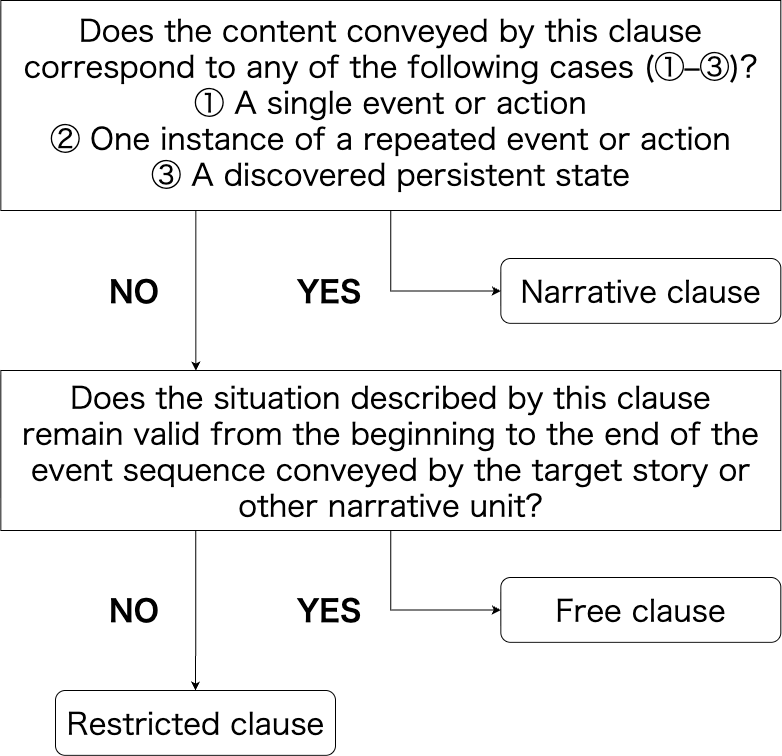
Figure 1: Micro-label determination chart detailing the decision procedure for categorizing narrative clauses in Japanese oral narratives.
The micro-level annotation differentiates eventive content from background and discourse-relevant information with reference to discovery, plot centrality, and temporal scope. Notably, the macro-labeling is extended to habitual narratives, recognizing their structural alignment with episodic storytelling—a feature previously unaddressed in computational annotation of Japanese narratives.
Empirical Results and Inter-Annotator Analysis
The guidelines were evaluated on a corpus of 965 clauses from sixteen Japanese interviews, with three trained annotators. Clause segmentation exhibited high reliability (κ=0.80), demonstrating that the detangling of Japanese clause boundaries is tractable when explicit protocols are enforced. Conversely, micro- and macro-functional labeling yielded only moderate agreement (Krippendorff’s α=0.41—$0.45$). Despite the added granularity, macro-level label agreement was slightly higher than previously reported for English datasets using coarser annotation (α=0.31 for [SaldiasRoy:2020]), indicating the operational utility of the guidelines even under increased category resolution.
Exact-match rates reveal a consistent trend: Narrative and Complication clauses, which have the most straightforward temporal mapping, achieve the highest consistency (0.52 and 0.45, respectively), while categories with inherently ambiguous event–evaluation relationships, such as Restricted, Coda, and Resolution, show low agreement.
Error Analysis and Linguistic Rationale
Segmentation ambiguity arises from the lack of explicit discourse markers in Japanese transcript data (notably, absence of slashes/quotation marks in spontaneous speech), which complicates the isolation of quoted or inserted segments. The annotation process exposed that fine-grained temporal and discourse roles in Japanese do not always map cleanly to Labovian categories, particularly for Restricted clauses (where both event scope and backgroundedness must be inferred).
Resolution and Coda categories are especially problematic due to the fluidity of reference and narration time in narrative closure. Proposals to operationalize these distinctions, such as integrating tense-aspect theory (Reichenbach) or narrative time modeling, are discussed as avenues to systematically disambiguate narrative closure phenomena.
Qualitative Implications and Research Utility
Application interviews revealed that narrative structure and affective valence are interrelated: positive experiences elicit brief, self-contained stories, while hardship elicits longer, recursively elaborated narratives. This points to the value of structural annotation in extracting not only event structure but also the narrative enactment of psychosocial experience. The framework thus supports both corpus-based analysis and qualitative research by providing a principled foundation for segmenting and functionally interpreting narrative components in Japanese.
Theoretical and Practical Implications for Computational Analysis
By releasing the annotation guidelines and highlighting the challenges of reliably segmenting and classifying Japanese oral narratives, the study sets a benchmark for future corpus creation, algorithmic narrative structure detection, and cross-linguistic comparative work. The finding that segmentation reliability outpaces clause-type agreement suggests that progress in automatic narrative parsing for Japanese will depend heavily on refining functional labeling protocols and on the integration of temporally aware, discourse-sensitive classifiers—potentially leveraging LLMs or neural temporal modeling architectures.
Algorithmic advances capable of inferring narrative and reference time, as well as distinguishing evaluative stance in dialogue-rich, clause-chaining Japanese narratives, will directly advance both NLP applications in qualitative analysis and foundational discourse parsing.
Conclusion
This work represents the first systematic, reproducible guideline for Labovian-structural narrative annotation in Japanese (2603.29347). The high agreement in segmentation and moderate but improved agreement in structural labeling validate the applicability of the protocol and point to explicit directions for further refinement, especially around ambiguous narrative elements. The release of the guidelines positions the community to expand large-scale, richly annotated Japanese narrative datasets and to develop both manual and automated tools for robust structural analysis of oral narratives. This will substantially enhance empirical inquiry into narrative structure and meaning in both AI/NLP and qualitative social research contexts.