Hierarchical Battery-Aware Game Algorithm for ISL Power Allocation in LEO Mega-Constellations
Published 31 Mar 2026 in cs.GT | (2603.29506v1)
Abstract: Sustaining high inter-satellite link (ISL) throughput under intermittent solar harvesting is a fundamental challenge for LEO mega-constellations. Existing frameworks impose static power ceilings that ignore real-time battery state and comprehensive onboard power budgets, causing eclipse-period energy crises. Learning-based approaches capture battery dynamics but lack equilibrium guarantees and do not scale beyond small constellations. We propose the Hierarchical Battery-Aware Game (HBAG) algorithm, a unified game-theoretic framework for ISL power allocation that operates identically across finite and megaconstellation regimes. For finite constellations, HBAG converges to a unique variational equilibrium; as constellation size grows, the same distributed update rule converges to the mean field equilibrium without algorithm redesign. Comprehensive experiments on Starlink Shell A (172 satellites) show that HBAG achieves 100% energy sustainability rate (87.4 percentage points improvement over SATFLOW), eliminates eclipse-period battery depletion, maintains flow violation ratio below the 10% industry tolerance, and scales linearly to 5,000 satellites with less than 75 ms per-slot runtime.
The paper introduces HBAG, a battery-aware game algorithm that formulates ISL power allocation as an exact potential game ensuring equilibrium uniqueness.
The method employs a hierarchical primal-dual update scheme, dynamically adjusting satellite power based on real-time battery state and eclipse duration.
Empirical results show that HBAG achieves up to 100% energy sustainability and linear scalability in large LEO mega-constellations.
Hierarchical Battery-Aware Game Algorithm for ISL Power Allocation in LEO Mega-Constellations
Overview and Problem Setting
The paper "Hierarchical Battery-Aware Game Algorithm for ISL Power Allocation in LEO Mega-Constellations" (2603.29506) presents a comprehensive, battery-aware framework for distributed power allocation over inter-satellite links (ISLs) in large-scale LEO constellations. The motivation is the critical mismatch between static ISL power ceilings and the reality of orbital energy intermittency—specifically, eclipse-induced battery exhaustion. Previous schemes either ignore battery dynamics (optimization-based), provide no equilibrium or scalability guarantees (RL-based), or improperly model the underlying inter-satellite competition structure (prior MFG/game-theoretic works).
The central proposal is the HBAG (Hierarchical Battery-Aware Game) algorithm: a unifying, distributed method that remains theoretically optimal in both finite and large-population regimes, supporting seamless scalability from small LEO meshes to mega-constellations comprising thousands of satellites.
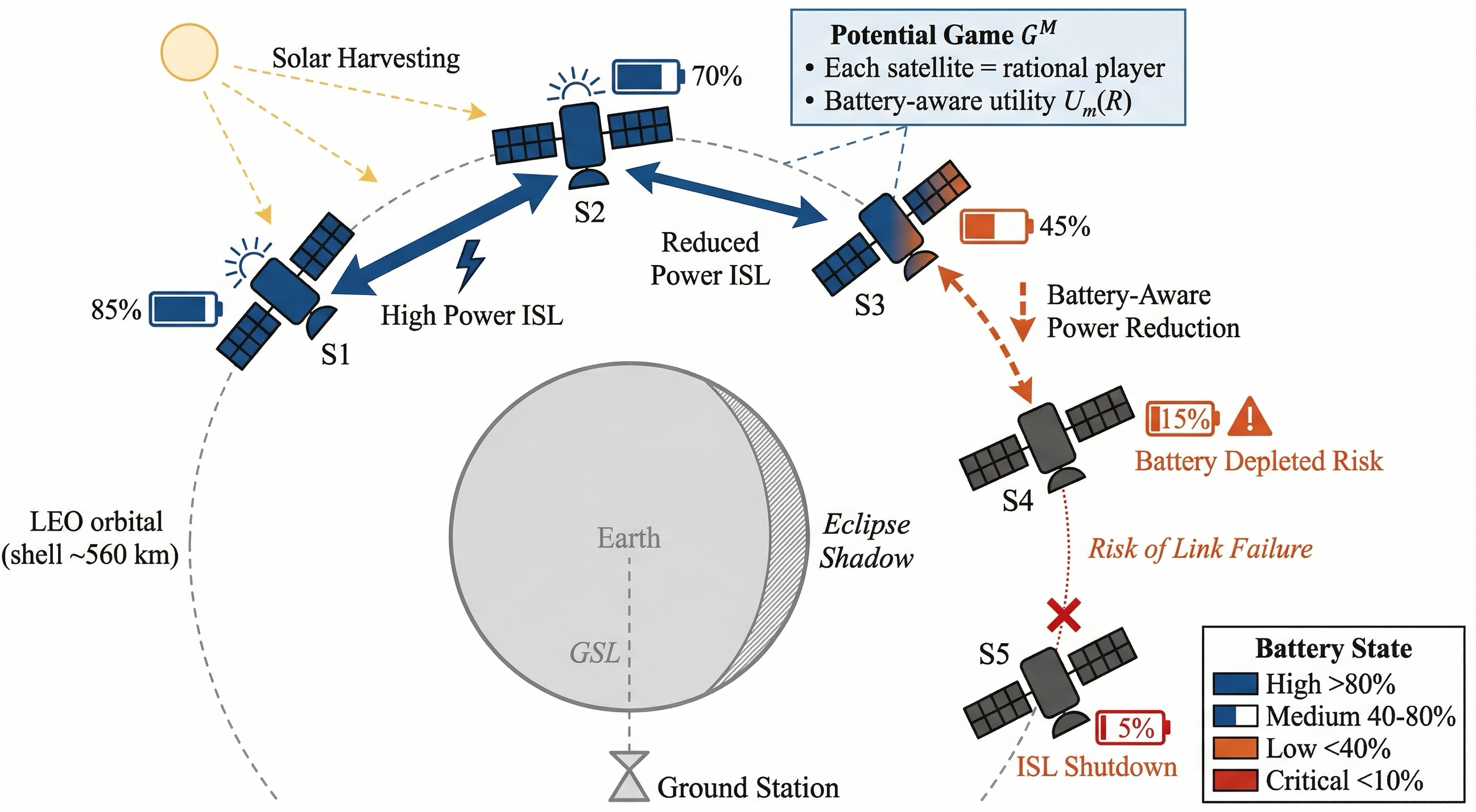
Figure 1: Scenario illustration of battery-aware ISL operation in LEO: illuminated satellites harvest solar energy and maintain high-power links, while eclipse-side satellites reduce power or shut down ISLs as state-of-charge decreases.
Prior Art and Research Gaps
The paper delineates three major research gaps:
Lack of battery-state/cycle awareness: Power ceilings are static or time-invariant, causing uncontrolled battery overdrafts during eclipse. Existing RL methods capture battery transients but fail to generalize and scale to realistic constellation sizes.
Incorrect equilibrium modeling: Prior game-theoretic approaches (e.g., Stackelberg formulations for satellite-user hierarchies) do not address direct inter-satellite ISL competition under energy constraints. Potential game constructions in wireless networks assume fixed feasible sets and neglect time-varying battery coupling.
Absence of unifying scalable algorithms: No previous work provides an equilibrium-driven update rule with proven convergence and performance preservation as system size grows, or quantifies finite-to-mean-field approximation error.
Unified Battery-Aware Game Theoretic Framework
Potential Game Structure and Equilibrium Guarantees
ISL power allocation is formulated as an exact potential game with a soft battery-penalizing utility. The potential function incorporates (i) information throughput, (ii) strict quadratic battery penalty as charge nears its safe floor, and (iii) flow conservation Lagrange multipliers. The penalty diverges near depletion, enforcing practical sustainability.
Strict concavity of the joint potential is established under quasi-static battery dynamics, guaranteeing uniqueness of the variational equilibrium (VE)—a critical property for operational and algorithmic determinism.
Hierarchical Algorithmic Architecture
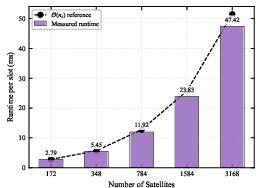
The HBAG algorithm solves the distributed power control subgame with a unified primal-dual update, exploiting timescale separation: battery evolution (orbital period) is orders of magnitude slower than per-slot optimization runtime. The key update is computation of a dynamic, satellite-dependent power bound, Pm,tmax, constraining ISL transmission based on real-time SoC and eclipse duration. The per-slot computational burden is O(nt), unaffected by battery penalty inclusion, ensuring linear scalability with constellation size.
Mean Field Game Limit and Scalability
The authors rigorously connect the finite-player formulation to a mean field game, replacing discrete population interactions with a limiting empirical distribution of battery states. The coupled HJB-FPK system governing the MFG admits a unique equilibrium under deterministic battery dynamics (no diffusion, consistent with orbital solar flux). The finite-to-mean-field approximation rate is quantified: as system size M increases, the equilibrium error decays as O(M−1/4) in strategy space, derived via Wasserstein-1 convergence.
Empirical Validation and Numerical Performance
Eclipse-Period Energy Sustainability
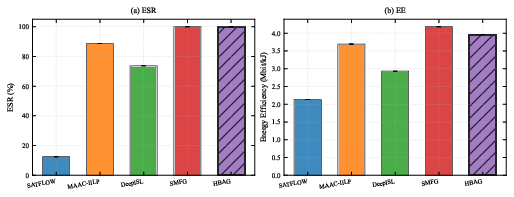
On Starlink Shell A (M=172, θ=0.38 eclipse fraction), HBAG achieves 100% energy sustainability rate (ESR), eliminating all eclipse-induced battery exhaustion events. In contrast, static baselines (SATFLOW-L) exhibit catastrophic ESR collapse (down to 12.6%) due to unmodulated power overdrafts. RL baselines (MAAC-IILP, DeepISL) only partially mitigate depletion due to lack of explicit dynamic power constraints and poor domain transferability at scale.
Figure 2: Performance comparison across five methods: HBAG and SMFG-adapted sustain 100% ESR; SATFLOW-L suffers near-total battery depletion and negligible network sustainability. HBAG nearly matches mean field game energy efficiency.
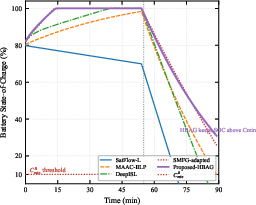
Battery state-of-charge (SOC) evolution traces clearly demonstrate the outperformance: HBAG adaptively throttles ISL power during eclipse to maintain SoC above hard safety margins, in contrast to the unconstrained depletion under static power ceilings.
Figure 3: Battery SOC time series: only HBAG (and SMFG-adapted) prevent eclipse-driven depletion by dynamically adjusting transmit power, while static baselines run batteries to zero.
Robustness and Sensitivity Analysis
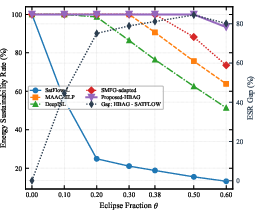
A sweep across eclipse fractions confirms the analytical deviation bound: HBAG maintains ESR ≥93.4% even at extreme (60%) eclipse durations, while SATFLOW-L drops below operational viability (<20%).
Figure 4: ESR as a function of eclipse fraction: Only HBAG provides graceful degradation, saturating at industry-acceptable performance thresholds even under pathological orbital regimes.
Scalability and Convergence
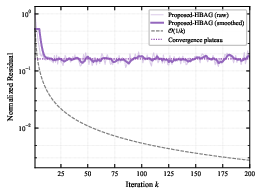
Algorithmic runtime scales linearly with constellation size, with real-time feasibility demonstrated up to M=5000. Convergence analysis confirms the O(1/k) theoretical rate; the finite-to-mean-field numerical gap perfectly matches the predicted O(nt)0 trend.
Ablation: Necessity of Joint Hard/Soft Battery Constraints
An ablation study isolates the effects of (a) dynamic power bound alone, (b) battery penalty alone, and (c) both. Neither mechanism alone achieves the full sustainability+efficiency tradeoff; only their combination (HBAG) hits zero depletion events and optimal flow violation ratios.
Implications and Future Directions
Practical Impact
From a deployment perspective, HBAG's dual real-time enforceability and equilibrium structure are directly relevant for flight software in operational mega-constellations. The computational complexity is tractable for onboard or ground-assisted real-time power scheduling, even as constellation sizes expand to tens of thousands of nodes. Importantly, the solution is robust to orbital perturbations and remains agnostic to specific demand distributions, as long as traffic remains commensurate with physical energy limits.
Theoretical Perspective
The paper's synthesis of potential games (for equilibrium uniqueness) and mean field analysis (for scalability) is broadly extensible to other energy-constrained large-scale multi-agent networks. The explicit demonstration of a smooth finite-to-infinite regime transition—without algorithmic redesign—addresses longstanding concerns about the practical value of MFG theory in real systems.
Future Directions
Generalized Nash Equilibria: Extending the framework to multi-class scenarios with additional constraints/couplings (e.g., class-based bandwidth or hybrid LEO/GEO architectures).
Stochastic Eclipse and Weather: Incorporating stochasticity in solar input (e.g., shadowing, panel degradation, off-nominal eclipses) for greater realism.
Cross-layer Topology Control: Joint treatment of ISL (re)configuration and power allocation over dynamically reconfigurable network layers.
Conclusion
The HBAG framework exemplifies a scalable, equilibrium-based approach to battery-aware ISL power allocation in LEO mega-constellations, merging strict sustainability guarantees with optimal energy efficiency and real-time computational viability. Its contributions in unified algorithmic design, rigorous equilibrium theory, and robust empirical validation establish a new standard for sustainable satellite networking under physical energy constraints (2603.29506).