- The paper demonstrates that proportional coupling reallocates coupling strength based on frequency detuning, inducing an explosive (discontinuous) synchronization transition compared to uniform coupling.
- It reveals that a generalized power-law coupling with an optimal exponent (near p = 2) maximizes the synchronization order parameter and leads to all-or-nothing synchronization.
- Empirical and numerical analyses confirm that the scheme is robust to sparse connections and measurement errors, making it applicable to various physical oscillator networks.
Enhanced Synchronization in Kuramoto Networks via Proportional Coupling
Introduction
The Kuramoto model serves as a foundational paradigm for the study of collective synchronization in networks of coupled phase oscillators. While the classic scenario assumes uniform all-to-all (mean-field) coupling, real-world physical, biological, and engineered networks often operate under stringent constraints on coupling strength and network connectivity. This raises the central optimization question: how should coupling be allocated in heterogeneous oscillator networks to maximize synchronization under a fixed total coupling budget?
This paper introduces and systematically analyzes a proportional coupling scheme, where the coupling strength between oscillator pairs is scaled according to their natural frequency detuning. The central thesis is that proportional coupling fundamentally reshapes the synchronization dynamics, driving the system to achieve enhanced or even explosive (discontinuous) synchronization transitions under budget constraints, compared to the traditional uniform coupling approach (2603.29648).
In contrast to the uniform coupling Kij=K/N, the proportional scheme is defined as:
Kij=C({Ω})K∣Ωi−Ωj∣,
where C({Ω}) normalizes the interaction strengths to maintain a fixed total budget. This design reallocates limited coupling resources from nearly-synchronized oscillators to those that are more strongly detuned, a physically motivated strategy expected to mitigate the energetic inefficiency present in mean-field schemes.
Empirical results on large networks (N=512) with normally distributed frequencies demonstrate that while uniform coupling offers marginally better synchronization at low coupling, proportional coupling induces a sharp, discontinuous transition in the order parameter rˉ at K≈1.1Kc, achieving network-wide synchrony (Figure 1).
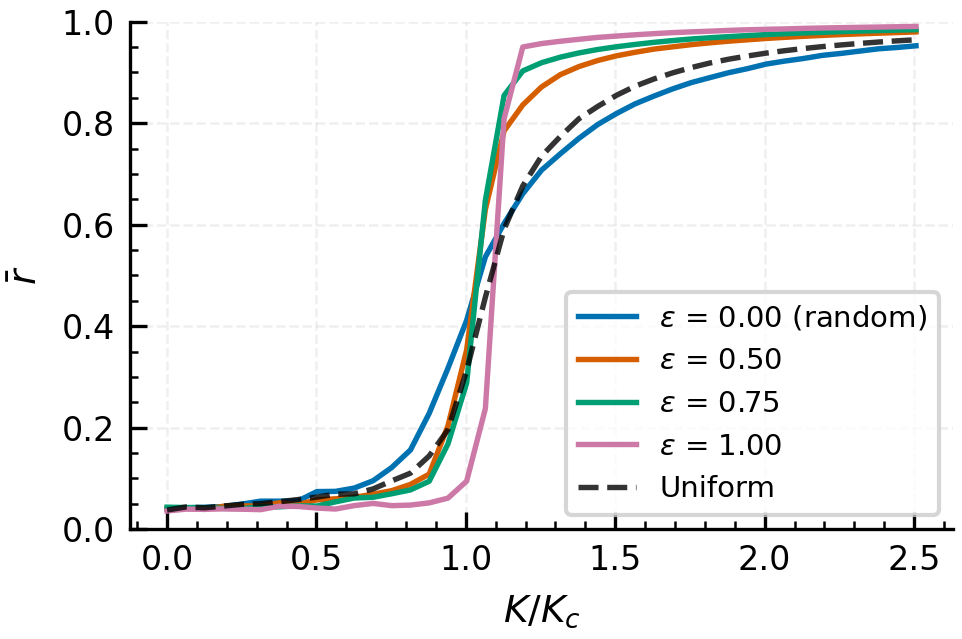
Figure 1: Synchronization order parameter rˉ versus normalized coupling strength K/Kc under various coupling schemes, depicting the sharp transition induced by proportional coupling.
The system further exhibits distinctive hysteresis in the order parameter under slow, adiabatic sweeping of K, a hallmark of metastable synchronized states and hybrid phase transitions not present in the uniform coupling scenario (Figure 2).
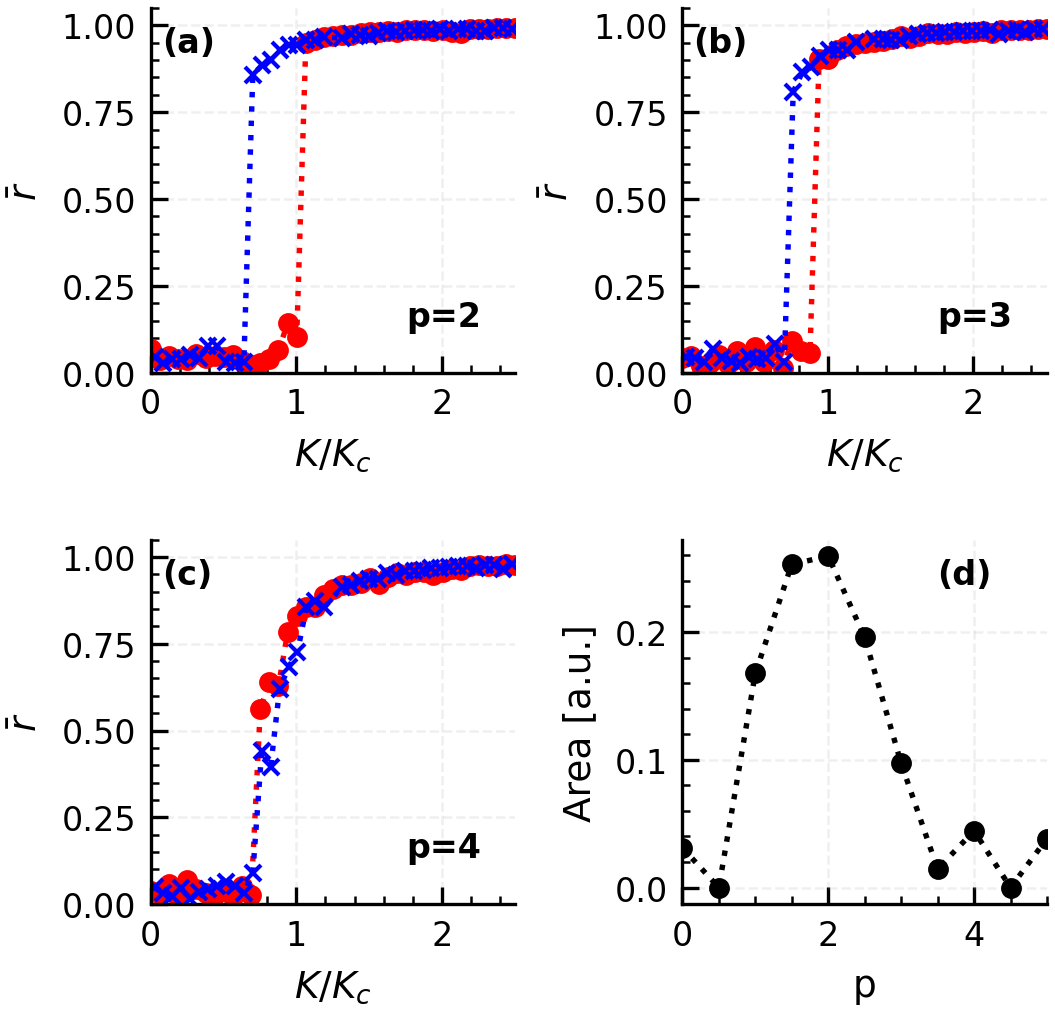
Figure 2: Hysteresis curves for generalized proportional coupling (p=2,3,4) showing forward (red) and backward (blue) sweeps, with maximal enclosed area near Kij=C({Ω})K∣Ωi−Ωj∣,0.
Critical Behavior and Transition Analysis
Extensive finite-size scaling calculations reveal that the order parameter transition sharpens with increasing network size. The transition point Kij=C({Ω})K∣Ωi−Ωj∣,1 scales sublinearly with Kij=C({Ω})K∣Ωi−Ωj∣,2, and the width of the transition region saturates, consistent with the first-order nature of the transition induced by proportional coupling.
The proportional scheme's bimodal distribution of Kij=C({Ω})K∣Ωi−Ωj∣,3 near the critical point signifies “all-or-nothing” synchronization (Figure 1 inset), strongly contrasting with the continuous, unimodal distribution characteristic of the canonical Kuramoto phase transition.
Generalized Proportional Coupling: Optimization via Power-Law Scaling
The study extends proportional coupling to a generalized power-law form: Kij=C({Ω})K∣Ωi−Ωj∣,4, with Kij=C({Ω})K∣Ωi−Ωj∣,5 a tunable exponent. Systematic parameter sweeps uncover that synchronization is maximized for Kij=C({Ω})K∣Ωi−Ωj∣,6, with Kij=C({Ω})K∣Ωi−Ωj∣,7 being optimal in the strong coupling regime for a range of realistic frequency distributions. For Kij=C({Ω})K∣Ωi−Ωj∣,8, the coupling budget is concentrated among highly detuned oscillators, hindering synchronization of the bulk population and leading back to a continuous (second-order-like) transition, reminiscent of a tricritical point in the (Kij=C({Ω})K∣Ωi−Ωj∣,9, C({Ω})0)-plane. The corresponding order parameter curves and critical behaviors are mapped in Figure 3.
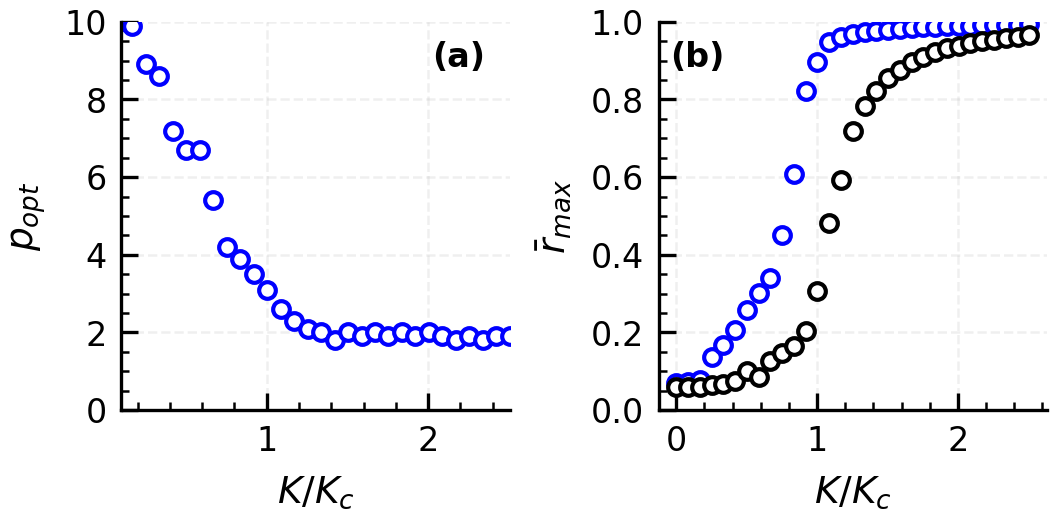
Figure 3: Heatmap showing the synchronization order parameter C({Ω})1 as a function of power-law exponent C({Ω})2 and normalized coupling C({Ω})3, with optimal sharpness near C({Ω})4.
Optimal values C({Ω})5 and corresponding maximal order parameter C({Ω})6 are quantified in Figure 2, confirming that generalized proportional coupling robustly outperforms uniform coupling for practical coupling strengths.
Figure 3: Panel (a) gives the optimal exponent C({Ω})7 for maximizing C({Ω})8 at each C({Ω})9; panel (b) shows the resulting N=5120 for each N=5121, systematically higher than uniform coupling across the coupling range.
Robustness and Practicality: Correlations, Disorder, and Sparsity
A core finding is that the proportional scheme's benefits persist even when only partial information about oscillator frequencies is available. As long as there is nonzero correlation (N=5122) between N=5123 and N=5124, synchronization is consistently improved over random or uniform coupling (Figure 1), demonstrating robustness to measurement error and system uncertainty.
Theoretically, it is shown that synchronization depends only on the sum of incoming coupling strengths per oscillator, rather than every individual edge. Numerical studies confirm that sparse implementation—retaining only the strongest 20% of coupling terms—suffices to induce global synchrony, with minimal performance degradation.
Theoretical Implications
Proportional coupling reshapes the Kuramoto network's critical properties:
- Phase transitions: The system can be tuned between second-order, first-order (explosive/hybrid), and tricritical-like transitions, providing a route to realize and control metastability in engineered oscillator arrays.
- Synchronization condition: Analytical results in the strong coupling regime reveal that N=5125 simultaneously regularizes effective detuning and optimally allocates budget, enabling all oscillators—including strongly or weakly detuned members—to participate in the synchronized state.
- Practical optimality: Explicit, local proportional heuristics achieve performance comparable to networks optimized via computationally intensive algorithms, even for large and heterogeneous topologies.
Practical Implications and Future Directions
The proportional and generalized coupling schemes are directly applicable to physical platforms—such as coupled laser arrays and Josephson junctions—where both the connectivity and per-link coupling strength are physically or technologically constrained. The finding that only partial frequency information suffices to realize substantial performance gains lowers the barrier for experimental application.
Future research may pursue:
- Application-specific cost functions, including more general forms of N=5126 and non-symmetric, directed, or time-varying coupling.
- Extension to oscillator systems with non-trivial network topologies, delay, or higher-order interactions.
- Integration with data-driven or reinforcement learning optimization for real-time adaptive control of synchronization in large complex networks.
Conclusion
Proportional coupling, both in its linear and generalized power-law form, provides a principled, robust, and highly effective strategy for enhancing synchronization in heterogeneous Kuramoto networks under tight coupling and connectivity budgets. The associated transition phenomena, critical properties, and energetic efficiencies offer new theoretical insights and practical tools for the design of engineered synchronization networks.

