- The paper introduces the SCORE framework, which statistically certifies ROA by estimating worst-case Lie derivative violations via Extreme Value Theory.
- It employs PSGLD sampling on constraint manifolds, block maxima extraction, and Weibull domain modeling to compute high-confidence bounds.
- The approach scales to high-dimensional systems, providing robust certification that depends on the expressivity of the chosen Lyapunov candidate.
Statistical Certification of Regions of Attraction via Extreme Value Theory
Introduction
Certifying the Region of Attraction (ROA) for nonlinear dynamical systems is a core objective in verifying stability for safety-critical control systems. The conventional paradigm relies on deterministic techniques such as Sum-of-Squares (SOS) programming and Satisfiability Modulo Theories (SMT), combined with polynomial or neural Lyapunov function synthesis. Despite their rigor, these methods do not scale to high-dimensional, dense, or non-sparse systems, constraining their applicability to moderate state dimensions (typically N≤20). The paper "SCORE: Statistical Certification of Regions of Attraction via Extreme Value Theory" (2603.29658) introduces SCORE, a statistical verification pipeline that pivots from pursing deterministic guarantees to quantifying worst-case violations with high statistical confidence, leveraging Extreme Value Theory (EVT).
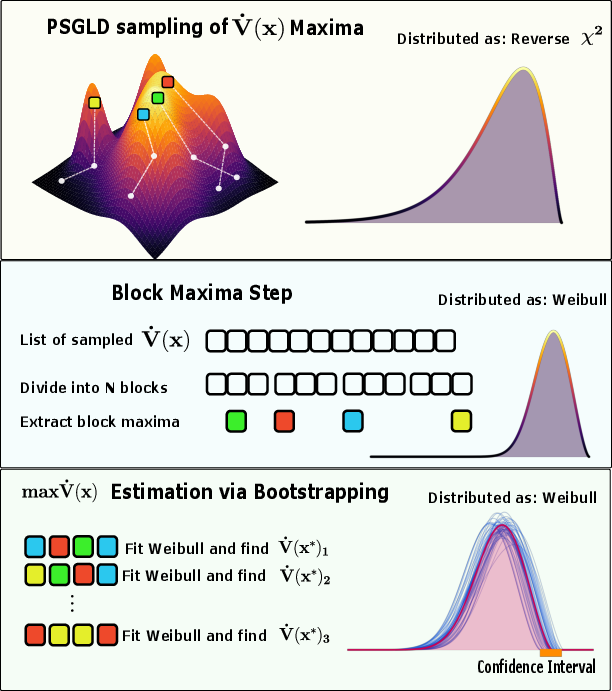
Figure 1: Graphical overview of the SCORE certification pipeline, illustrating PSGLD sampling of V˙(x) maxima, block maxima extraction, Weibull domain modeling, and statistical bounding for ROA certification.
Methodology
The crux of Lyapunov-based ROA certification lies in checking the strict negativity of the Lie derivative V˙(x) on the boundary of sublevel sets Ωρ—so, the main computational bottleneck is global maximization of V˙(x) under the manifold constraint V(x)=ρ. Exact maximization is intractable in high dimensions due to non-convexity and combinatorial complexity. SCORE reframes this as a constrained extreme-value estimation problem, targeting a statistical upper bound of the maximum Lie derivative.
Stochastic Sampling and EVT
To characterize the distribution of local maxima of V˙(x), SCORE employs Projected Stochastic Gradient Langevin Dynamics (PSGLD), performing diffusion-based exploration of the constrained manifold. This stochastic process is proved to place the sampled maxima in the Weibull maximum domain of attraction, given generic regularity (Morse-type) conditions on the landscape. The Weibull domain is crucial, as it corresponds to upper-bounded distributions of extreme values and permits constructive finite-sample upper confidence intervals.
The estimation pipeline comprises:
- Launching parallel PSGLD chains from uniform samples on the constraint manifold;
- Dividing trajectories into blocks and extracting block maxima;
- Fitting a Generalized Extreme Value (GEV) distribution to these maxima;
- Deriving a high-confidence upper bound for the global maximum Lie derivative, certifying the ROA if this bound is strictly negative and fitting passes statistical validation.
This process achieves robust worst-case guarantees with statistical rigor, while bypassing enumeration or hard constraint-solving.
Theoretical Foundation
Rigorous justification centers on the local quadratic approximation of V˙(x) near maximizers and ergodic sampling of the manifold. Under these conditions, the optimality gap between the true local maxima and samples is asymptotically χ2-distributed, and the sample maxima converge in law to a Weibull distribution. The finiteness of the right endpoint of the Weibull domain allows for certificate construction: for any fixed confidence level (1−α), one computes an upper bound for the worst-case violation.
The certification framework incorporates block bootstrapping to assess statistical uncertainty and applies rigorous goodness-of-fit checks (e.g., Kolmogorov-Smirnov) to avoid overconfident or miscalibrated certificates.
Numerical Experiments
Certification Tightness
To benchmark certification tightness, the method is evaluated on the 2D reversed Van der Pol oscillator—a standard setting where exact ROA is tractable via SOS. When SCORE is applied to the same Lyapunov candidate as the exact method (SOS-synthesized polynomial), the certified ROA closely matches (certifying 83% of the true ROA compared to the 95% of SOS). However, with a less expressive dictionary-based quadratic Lyapunov candidate, the certified ROA shrinks to 37%, indicating that while SCORE provides sharp statistical guarantees, ROA size is fundamentally constrained by Lyapunov function expressivity.
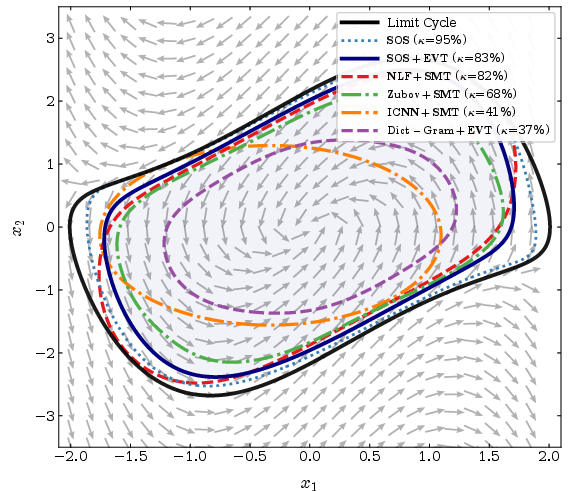
Figure 2: Certified Regions of Attraction for the 2D Van der Pol oscillator: conservative coverage using EVT + Dict-Gram (reflecting candidate limitations) versus tightness with EVT + SOS and exact SOS.
High-Dimensional Scalability
SCORE's principal advantage is scalability. In a dense V˙(x)0-dimensional linear dissipative system, SCORE scales seamlessly to V˙(x)1, far exceeding existing baselines (e.g., NLF/ICNN + SMT, PINN + SMT, classical SOS) that fail beyond V˙(x)2 due to combinatorial explosion and numerical ill-conditioning. This is enabled by stochastic, local-gradient-driven exploration that is computationally intensive but does not require explicit enumeration of all constraints.
Implications and Future Directions
The SCORE framework makes an explicit tradeoff: discarding absolute determinism for high-confidence statistical guarantees, but this is justified and quantified through EVT. The approach is especially pertinent for high-dimensional dense systems, including those parameterized by data-driven surrogates or complex physical kernels, where existing formal pipelines are inapplicable.
A fundamental limitation, rendered explicit in the 2D experiments, is that certification is only as expressive as the underlying Lyapunov candidate. Future directions include combining SCORE with more effective, scalable synthesis paradigms, such as sparse polynomial bases, structured system decomposition, or even architectures amenable to better theoretical understanding of their optimization landscape. Extension to infinite-dimensional ROA certification for PDEs or operator-learning frameworks is feasible but requires significant advances in numerical conditioning, mixing, and sampling algorithms, for which directions like Riemannian preconditioning and advanced MCMC are advocated.
Conclusion
SCORE presents a statistically-rigorous, EVT-based methodology for ROA certification that is unique in its scalability and formal quantification of uncertainty. It enables practical, high-confidence certificates for high-dimensional nonlinear systems, contingent on Lyapunov candidate quality, and sets a new standard for statistical formal verification in nonlinear stability analysis. Further advancements in Lyapunov function synthesis are likely to unlock the full potential of this verification paradigm.