- The paper demonstrates that the HZ metric reduces Einstein's equations to four effective equations, enabling propagation solely of the plus polarization mode.
- It employs weak wave turbulence theory and high-resolution DNS with a GPU-based TIGeR code to reveal dual cascade dynamics with Kolmogorov-Zakharov spectral scaling.
- The study highlights nearly Gaussian canonical statistics with intermittent deviations, underscoring the need for constraint-preserving numerical methods.
Gravitational Wave Turbulence in the Hadad-Zakharov Metric Framework
Theoretical Basis and Metric Analysis
This work systematically examines gravitational wave turbulence (GWT) within canonical general relativity, employing the Hadad-Zakharov (HZ) metric, a diagonal metric ansatz parameterized by four functions subject to seven coupled, nontrivial Einstein field equations. Consistency and compatibility of this system are rigorously assessed, both via the underlying Bianchi identities and expansion in the weakly nonlinear limit. The analysis demonstrates that, under suitable initial conditions and in the weakly nonlinear regime, the full system reduces to four effective equations that suffice to propagate the genuine degree of freedom, ensuring equivalence with GR at the order considered.
Notably, dimensional reduction arguments show HZ spacetime is equivalent to a 2+1D gravity theory minimally coupled to a scalar field, thus propagating a single dynamical degree of freedom. Linear perturbation about Minkowski spacetime, tracked using a scalar-vector-tensor (SVT) decomposition, reveals that this degree of freedom corresponds uniquely to the "plus" (+) polarization mode of gravitational waves, with the "cross" (×) polarization excluded by the reduced metric structure. The perturbation analysis further confirms that wave evolution is governed by a scalar field satisfying a 2D wave equation. This singular dynamical content is manifest at all orders accessible in the weakly nonlinear regime.
Wave Turbulence Closure and Statistical Theoretic Regime
Theoretical predictions for GWT in this setting are developed using the framework of weak wave turbulence, in which quartic interactions dominate and the amplitude equation for canonical variables yields a natural truncation and closure. The kinetic equation for the wave action spectrum nk exhibits two conserved quantities: energy and wave action (number), facilitating a dual cascade—a direct cascade of energy to small scales and an inverse cascade of wave action to large scales. Exact solutions of the kinetic equation yield Kolmogorov-Zakharov (KZ) power-law spectra: k0 for the direct cascade (energy) and k−2/3 for the inverse cascade (wave action), characterizing scale-local energy and wave action transfer consistent with quartic interaction processes.
Numerical Simulation Strategy
An efficient, high-resolution direct numerical simulation (DNS) is performed using the novel GPU-based TIGeR code, which solves the reduced Einstein system within the HZ ansatz using a pseudo-spectral method and second-order Adams-Bashforth time stepping. Initial conditions are prepared as narrow-band random-phase wave spectra, with dissipation imposed at high wavenumbers to suppress aliasing and ensure numerical stability. The simulation resolves dual cascade dynamics on a 10242 grid for >80,000tGW (where tGW is the linear wave timescale), enabling characterization of inertial ranges, spectral scaling, and higher-order statistical quantities.
Conservation Laws and Spectral Transfer
The temporal evolution of the normalized total energy and wave action demonstrates excellent conservation over the majority of the simulation, with relative errors remaining below 10−2 except near the cascade fronts.
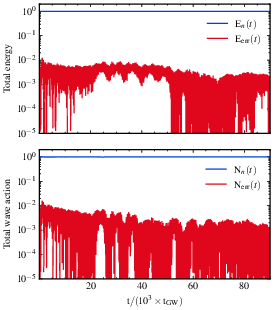
Figure 1: Temporal evolution of the conserved quantities E (top) and ×0 (bottom) evidences robust conservation, with only minor oscillations due to numerical dissipation.
2D and 1D spectral diagnostics confirm primary theoretical predictions. The dual cascade dynamically transport energy to high wavenumbers and wave action to low wavenumbers, as seen in the spectral propagation of both quantities.
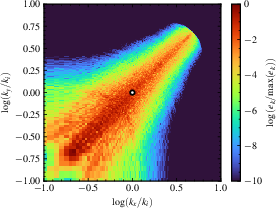
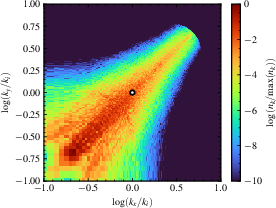
Figure 2: 2D snapshots of energy (left) and wave action (right) spectra display cascade broadening in Fourier space, peaked at low ×1 due to the inverse cascade.
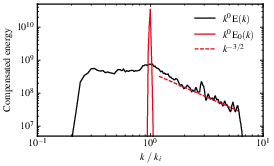
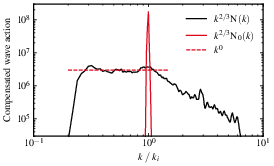
Figure 3: 1D spectra for energy (left) and wave action (right) at initial and late times, compensated to test for KZ scaling, showing good agreement (×2 for wave action), although a steeper than predicted ×3 is observed for the direct energy cascade.
Advancement of cascade fronts is quantified; the direct front terminates upon reaching the dissipative range, while the inverse front propagates more slowly, likely due to limited inertial range and finite-size/DNS restrictions.
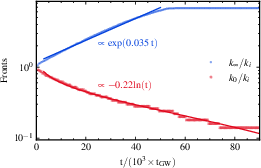
Figure 4: Front position evolution for both cascades reveals different propagation rates and corroborates dissipation onset in the direct cascade.
Curvature and Constraint Analysis
Curvature scalar analysis (Ricci and Kretschmann) provides diagnostic evidence that the time-evolving solutions correspond to physical degrees of freedom and not gauge artefacts.
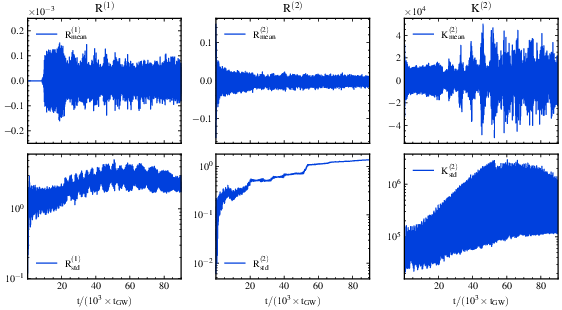
Figure 5: Time evolution of mean and standard deviation for Ricci and Kretschmann scalars; ×4 demonstrates robust propagation of genuine GWT degrees of freedom.
The observed inexact constraint satisfaction is attributed primarily to spectral method artefacts, in particular the exclusion of modes with ×5 or ×6, but deviations are quantitatively subdominant.
Statistical Properties of Canonical and Metric Fields
The PDFs of canonical variables (×7, ×8) and their increments evolve towards nearly Gaussian distributions for small to moderate amplitudes, with significant non-Gaussian (fat-tailed) corrections at large amplitudes, indicative of intermittency and coherent structure formation.
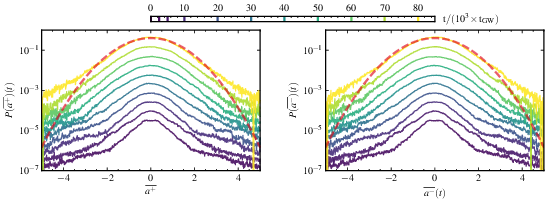
Figure 6: Normalized PDF of canonical variables approaches Gaussianity over time, with fat tails emerging due to coherent events.
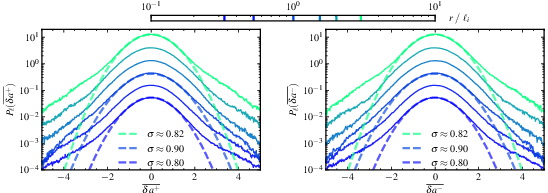
Figure 7: PDFs of increment statistics at multiple length scales exhibit non-Gaussian tails, especially at large scales, characteristic of intermittent turbulent fluctuations.
Structure function analysis yields scaling exponents that are approximately linear ("monofractal") for the gauge-invariant metric components, while canonical variables display weak multifractal signatures in the direct cascade.
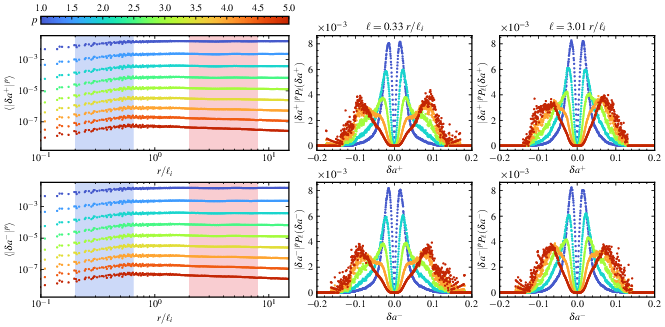
Figure 8: Structure functions for ×9, nk0 highlight scaling ranges used to extract exponents; integrand analysis demonstrates statistical convergence up to nk1.
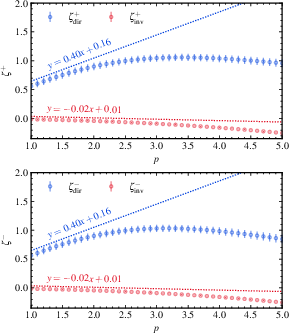
Figure 9: Scaling exponents for canonical variables in different inertial ranges indicate similar fractal properties for nk2 and nk3, more multifractal in the direct cascade.
Analysis of the gauge-invariant, physical metric variables in both real and Fourier space confirms that the structure functions are more purely monofractal.
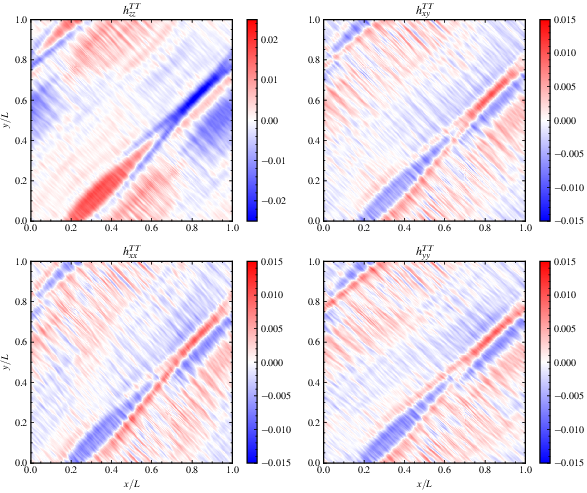
Figure 10: Spatial maps of gauge-invariant variables at simulation end illustrate differences in amplitude and spatial structure among nk4, nk5, nk6, nk7.
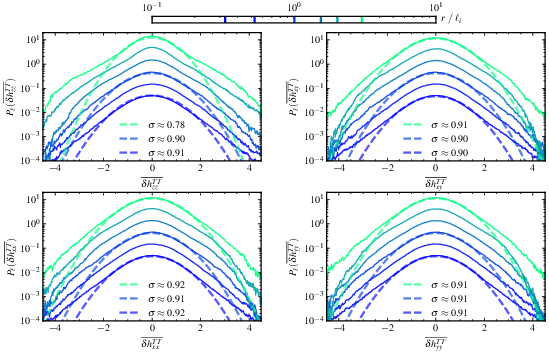
Figure 11: Increments' PDF for gauge-invariant variables, with nk8 showing visually stronger intermittency than other components.
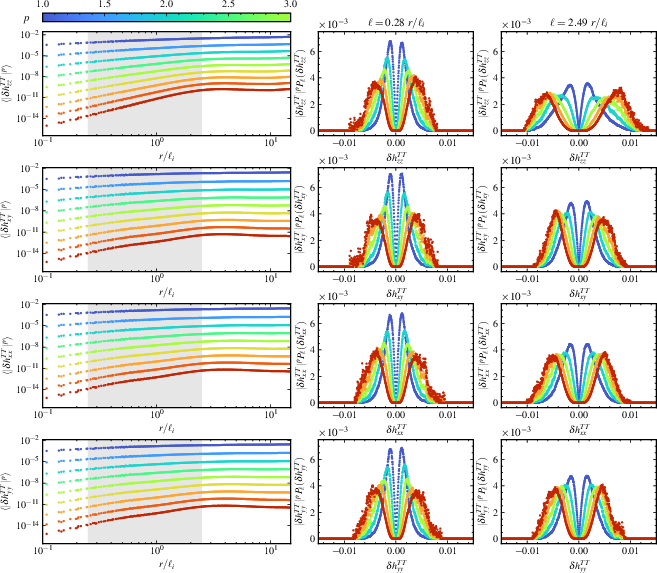
Figure 12: Structure functions for gauge-invariant metric components: monofractal scaling over a broad inertial range, with statistical convergence up to nk9.
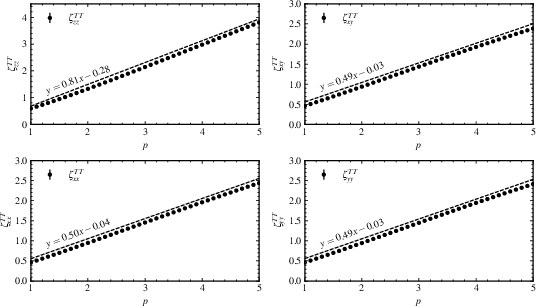
Figure 13: Scaling exponents for all gauge-invariant components show near-linearity versus moment k00; deviation at high k01 reflects limited DNS sample.
Implications and Future Prospects
This study provides the first DNS-based verification of the full dual cascade and associated KZ spectra in GWT derived from GR, within the constraints of the HZ reduction. The results robustly support the applicability of weak wave turbulence theory to gravitational contexts, at least when strong nonlinear couplings and inverse cascade condensation are not dominant. However, the observed violation of energy constraint preservation in pseudo-spectral DNS underscores the necessity for improved numerical schemes or constraint-enforcing formulations in future studies.
Major claims:
- The dual cascade is realized for the dynamical degree of freedom, with the wave action following the predicted k02 KZ scaling in the inertial range.
- Deviations from expected scaling (direct energy cascade steeper than k03) suggest that quartic non-local interactions or finite-size effects are non-negligible in DNS regimes.
- The canonical variables' statistics are nearly Gaussian, but with substantial intermittent events, while gauge-invariant metric fields display classic monofractal scaling.
Potential future directions include:
- Extending numerical techniques to larger Reynolds and scale-separation limits, possibly using constraint-preserving schemes or adaptive mesh approaches.
- Forcing the system to achieve fully stationary turbulence, allowing precise quantification of direct cascade locality and intermittency.
- Generalizing the framework to include "cross" polarization or more general spacetimes, thus opening the path to physically richer gravitational turbulence studies.
Conclusion
This work achieves a rigorous numerical and analytic synthesis, demonstrating gravitational wave turbulence within the HZ metric formulation in GR. The DNS results confirm the expected dual cascade and KZ spectral laws, quantify statistical intermittency, and supply first-principles evidence for the closure of the Einstein system in the weakly nonlinear regime. The established methodology provides a concrete basis for further investigation of GWT in both astrophysical and early-universe contexts, as well as methodological foundations for turbulence analysis in gravitational theories.
Reference: "Towards Gravitational Wave Turbulence within the Hadad-Zakharov metric" (2603.29699).

