- The paper introduces a recursive ML model (RHINO-MAG) using a parameter-efficient GRU architecture for accurate H-field inference under dynamic excitation.
- It integrates physical priors and a warmup regime within its feature engineering, achieving an average SRE of 8.02% and NERE of 1.07% on the MC2 benchmark.
- The study highlights the challenges of blending physics-based and data-driven models, suggesting future research into hybrid architectures and vector field GRUs.
Recursive H-Field Inference for Dynamic Magnetic Excitation: Analysis of RHINO-MAG
Problem Statement and Motivation
Modeling the transient, temperature-aware magnetic field intensity (H) response to complex excitation in ferrite materials is critical for optimal magnetic component design. Traditional phenomenological and physics-based models, such as Jiles-Atherton (JA) and Preisach, exhibit notable limitations when confronted with diverse, real-world operating conditions and the nonstationary nature of modern power electronics excitation. Furthermore, there remains a disconnect between microphysical equations (e.g., Landau-Lifshitz-Gilbert, LLG) and effective, scalable macroscopic predictive frameworks. This impedes simulation accuracy, core loss estimation, and ultimately, efficiency improvements in power electronics.
Modeling Framework and Methodological Choices
The paper introduces RHINO-MAG, a ML-centric approach targeting recursive time-series inference of H based on observed B (magnetic flux density) under dynamic excitation, aligning with the objectives of the MagNet Challenge 2025 (MC2).
A modular modeling pipeline is constructed:
- Input/Output Specification: The model receives observed {Bk}, initial {Hk} (for warmup), and core temperature ϑ. The goal is accurate out-of-sample H inference over a prediction horizon.
- Feature Engineering incorporates physical priors (raw, first and second finite differences of normalized B; temperature) without explicit frequency extraction, ensuring applicability for arbitrary, non-sinusoidal input signals.
- Training Objective: The loss combines weighted L2 tracking error and an energy-weighted term integrating aspects of SRE (sequence relative error) and NERE (normalized energy relative error), designed to maintain numerical stability and prioritize core loss-relevant deviations.
- Model Architecture Spectrum: An extensive comparative study is conducted with diverse architectures:
- Purely data-driven black-box RNNs (notably, GRU and LSTM variants).
- Hybrid models injecting physical structure, e.g., GRU output directly parameterizing JA components, or using JA as a regularization term (PINN-style) for RNNs.
- Fully physics-based ODE solvers (inverse JA, Preisach, micromagnetic LLG PDE).
- Parameter-Efficient GRU: A dedicated GRU with direct prediction structure (GRU-P) leverages a warmup regime where the observed H values initialize the hidden state, allowing separation of state initialization and recursive prediction (Figure 1 and Figure 2).
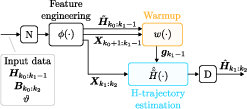
Figure 1: Schematic structure of the overall model pipeline, indicating normalization and splitting of sequences for warmup and prediction phases.
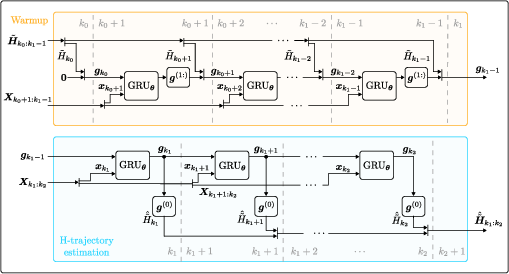
Figure 2: Detailed depiction of warmup and rollout for the GRU-P, highlighting the initialization procedure and recursive inference of H0.
The experimental validation centers on the MC2 benchmark dataset, representing a highly challenging setting with 15 ferrite materials subjected to quasi-arbitrary, temperature- and frequency-varying waveforms. Five blind test materials are analyzed for generalization, with strong attention to robustness and parameter economy.
Key findings:
- GRU-P Achieves Leading Efficiency: With only 325 parameters (≈3 kB), the GRU-P achieves an average SRE of H1 and NERE of H2, outperforming both physics-based and hybrid models of comparable size.
- Comparison to Hybrid and Physics-Inspired Models: Introduction of explicit JA structure (static or dynamically parameterized), Preisach models, or attempts to regularize the RNN with direct physics equations did not yield improved trade-offs. These alternatives often suffered from numerical instability, inferior fit, or lack of alignment between latent physical states and modelled trajectories.
- Pareto Trade-offs: Extensive Pareto analysis (Figure 3 and Figure 4) demonstrates the scalable accuracy-to-parameter trade-off of the GRU-P. Notably, it offers superior performance/size characteristics for low-to-moderate parameter counts, which is highly salient for eventual integration into FEM simulation pipelines.
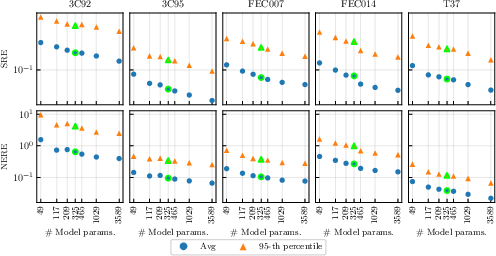
Figure 3: Pareto front for GRU-P models, indicating strong accuracy-to-size efficiency for MC2 submission candidates.
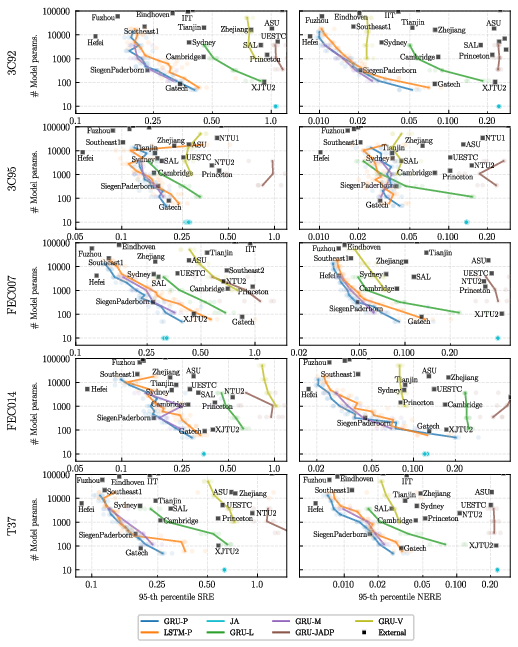
Figure 4: Extended Pareto trade-off visualization for all model families across final test materials, including ablations and external MC2 submissions.
- Qualitative Evaluation: GRU-P maintains robust prediction fidelity across disparate conditions, including major/minor loops and extreme cases (Figures 4, 7, 8). The warmup regime ensures errors are not accumulated recursively, preserving stability.
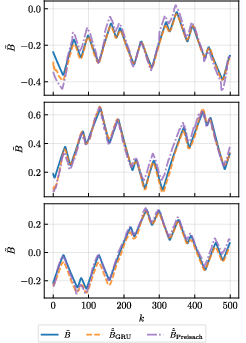
Figure 5: Representative H3 prediction time series and BH-loop closure for GRU-P, showing high tracking accuracy under nonstationary excitation.
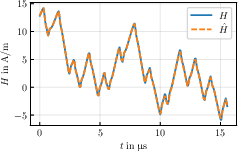
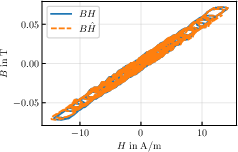
Figure 6: GRU-P performance on 3C95, H4, H5.
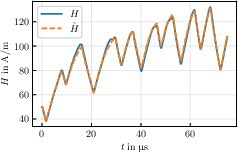
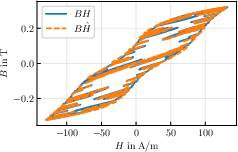
Figure 7: GRU-P performance on FEC014, H6, H7.
Theoretical Implications and Future Directions
The results underscore a central assertion: while phenomenological and physics-inspired models offer interpretability, their effective macroscopic accuracy remains bounded by unmodelled physics and parameter inflexibility in transient, high-dimensional settings. Small, purely black-box RNNs—given proper regularization, feature engineering, and warmup—outperform such structured models in this task.
However, the lack of gain from hybridization suggests an ongoing challenge in robustly integrating physical inductive biases without adversely constraining expressivity or amplifying numerical instability. The investigation into vector field GRUs or direct LLG regularization—alluded to be promising for physically interpretable latent states—remains an open avenue, hampered by computational tractability and insufficient alignment between microscopic dynamics and macroscopic requirements.
Ongoing research should focus on:
- Systematic hyperparameter optimization of the GRU-P and related architectures.
- Rigorous evaluation of hybridization strategies, potentially leveraging differentiable simulators or new forms of physical regularization.
- Transfer and meta-learning protocols—such as few-shot adaptation across materials—referencing [Li2023], which could further enhance practical utility in industrial workflows.
- Scalable deployment studies in the context of FEM simulation, where computational graphs must be evaluated millions of times, thus making parameter efficiency nonnegotiable.
Conclusion
RHINO-MAG formalizes and empirically validates a recursive, highly parameter-efficient GRU-based approach for time-resolved H-field inference under dynamic excitation, resolving a longstanding bottleneck in computational magnetic modeling. The methodology decisively outperforms physically motivated alternatives within the tested regime, as evidenced by MC2 benchmark performance.
The gap between physical interpretability and predictive superiority remains non-trivial. Effective physics-informed modeling of macroscopic dynamic magnetic phenomena continues to be an open question, pointing towards future work in model structure optimization, hybridization, and application-context transferability.
References
- "RHINO-MAG: Recursive H-Field Inference based on Observed Magnetic Flux under Dynamic Excitation" (2603.29745)