Beyond Expectation Values: Generalized Semiclassical Expansions for Matrix Elements of Gauge Coherent States
Published 31 Mar 2026 in gr-qc, hep-th, and math-ph | (2603.29826v1)
Abstract: We derive an asymptotic expansion for off-diagonal coherent-state matrix elements of non-polynomial operators in gauge theories admitting holomorphic coherent-state representations. The derivation combines stationary-phase analysis with an operator-level treatment of the Taylor remainder, and yields explicit semiclassical error control under stated assumptions. As a primary application, we formulate the expansion for volume and flux related operators in Loop Quantum Gravity and compare it with the standard diagonal expansion proposed in arXiv:gr-qc/0607101. By organizing the expansion around the genuine off-diagonal Berezin symbol rather than a diagonal expectation value, the resulting formula preserves the full holomorphic structure of the geometric phase and reproduces benchmark matrix elements accurately in the numerical regimes tested here, particularly when the coherent-state labels are well separated.
The paper introduces an explicit asymptotic expansion formula using off-diagonal Berezin symbols for non-polynomial operators in gauge theories.
It employs stationary-phase analysis and operator-level Taylor remainder evaluations to achieve controlled semiclassical error bounds for LQG matrix elements.
Numerical validations on volume and flux operators demonstrate that the new expansion method outperforms traditional expectation-value-based approaches.
Generalized Semiclassical Expansions for Gauge Coherent State Matrix Elements
Overview
The paper "Beyond Expectation Values: Generalized Semiclassical Expansions for Matrix Elements of Gauge Coherent States" (2603.29826) establishes an explicit asymptotic expansion formula for off-diagonal coherent-state matrix elements of non-polynomial operators in gauge theories, with direct application to non-perturbative sectors of Loop Quantum Gravity (LQG). The principal advancement lies in organizing the semiclassical expansion not around diagonal expectation values but around genuine off-diagonal Berezin symbols, thereby preserving holomorphic structure and full geometric phase information. The derivation employs stationary-phase analysis and operator-level Taylor remainder evaluation, resulting in controlled error bounds. Numerical validation is provided for the expansion applied to volume and flux operators in LQG, demonstrating improved accuracy over previous expectation-value-based approaches.
Formalism for Off-Diagonal Semiclassical Expansions
The coherent-state representation is leveraged to relate quantum and classical dynamics via phase-space labels, wherein the computation of off-diagonal matrix elements ⟨z∣f(A^)∣z′⟩ is vital for discrete-time path integrals and analytic continuation. Previous methods in LQG relied on expansions centered at diagonal expectation values, which are only reliable in the strict continuous-time limit with infinitesimally close states. The present work resolves this deficiency by centering the expansion at the off-diagonal Berezin symbol
C(z,z′)=⟨z∣z′⟩⟨z∣A∣z′⟩
and performing an explicit stationary-phase treatment.
A primary result is an asymptotic expansion for non-polynomial operator powers (notably (A2)q with q fractional):
under appropriate analyticity and non-degeneracy conditions for the coherent-state overlap.
A rigorous error estimate is provided via the operator-level evaluation of Taylor remainders and saddle-point cancellation, and this mechanism is shown to generalize to analytic functions f(A).
Applications in Loop Quantum Gravity
The expansion formula is applied to the sector of non-polynomial volume and flux operators in canonical LQG, where matrix elements between distinct Thiemann coherent states are necessary for path-integral construction in the reduced phase space quantization scheme. The technical challenge arises because the volume operator is non-polynomial in the holonomy-flux algebra, and exact matrix elements are not available.
Verification is provided that the assumptions underlying the expansion formula are satisfied for the multi-edge coherent states in LQG:
Semiclassical fluctuation suppression: Off-diagonal fluctuations of flux operators satisfy
⟨ψ∣Qv∣ψ′⟩2⟨ψ∣Qv2∣ψ′⟩=1+O(t)
for semiclassical parameter t→0, ensuring validity of the expansion.
Saddle-point structure and holomorphic overlap: The coherent-state overlaps admit a unique dominant saddle for sufficiently close phase-space configurations, providing non-degenerate critical points for the stationary-phase expansion.
The expansion for the quantum volume operator applied to coherent states, replacing the expectation-value-based formula with the off-diagonal Berezin symbol, yields more accurate results, particularly for well-separated labels.
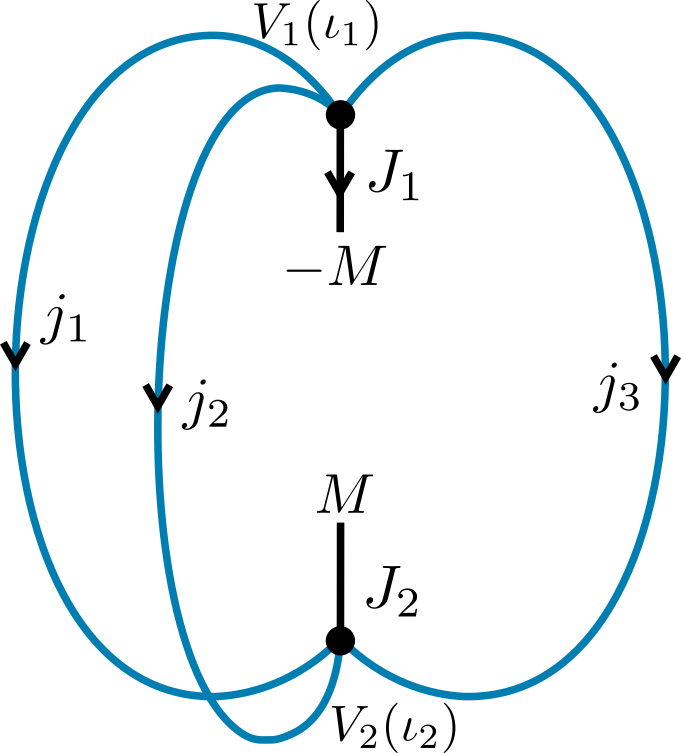
Figure 1: Spin-network structure of a gauge-variant 3-bridges graph used for numerical validation.
Numerical Validation and Comparison
Extensive numerical evaluations are performed for the matrix elements of volume operators in finite graph setups. The comparison focuses on a gauge-variant 3-bridges graph, wherein coherent states are specified with angular separation in the flux variables.
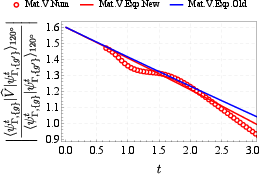
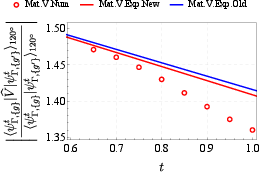
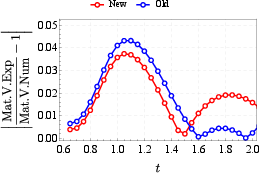
For several values of the relative angle θ, the new expansion and the old expectation-value-based expansion are evaluated up to O(t2), with strong numerical results highlighting that the new expansion:
Accurately reproduces numerical matrix elements even as the coherent-state labels become well separated (large C(z,z′)=⟨z∣z′⟩⟨z∣A∣z′⟩0).
Shows discrepancies with the old expansion at leading order for separated states, indicating structural inadequacy of pure expectation-value-centered formulas.
Figure 2: Matrix element comparison for the volume operator in coherent states as a function of semiclassical parameter.
Figure 3: Relative discrepancy between numerical data and old/new expansion formulas for C(z,z′)=⟨z∣z′⟩⟨z∣A∣z′⟩1.
Numerical convergence in the small-C(z,z′)=⟨z∣z′⟩⟨z∣A∣z′⟩2 regime validates the expansion's accuracy, with the new formula outperforming the old for finite-step path integral computations.
Implications and Theoretical Extensions
The formalism provides a robust semiclassical expansion framework applicable to analytic functions of gauge operators, offering a structurally consistent method for operator evaluation in discrete path integrals. The expansion is universal under general analyticity and saddle-point conditions, and directly transposable to complexified phase spaces, relevant for analytic continuation and instanton physics.
Beyond quantum gravity, the method aligns with deformation quantization approaches, as the Berezin symbol expansion mirrors non-commutative star-product structures. It is well positioned for future development in lattice gauge field theories, non-perturbative fixed points, and anomaly cancellations.
One open avenue remains the generalization to degenerate sectors where the off-diagonal Berezin symbol may vanish, necessitating regularized or alternative expansion schemes. Applications to interference phenomena and analytic continuation of physical parameters (time or gauge group) are prospective research directions.
Conclusion
The paper rigorously advances an asymptotic expansion for off-diagonal coherent-state matrix elements of non-polynomial gauge operators, centering on the Berezin symbol and providing controlled semiclassical error bounds. Application to the quantum volume sector of LQG demonstrates improved analytical and numerical accuracy over diagonal expectation-value expansions, especially for non-overlapping coherent-state configurations. The generality and consistency of the expansion carry substantial implications for operator evaluation in quantum field theory, and the framework is expected to catalyze further developments in gauge-theoretic path integrals, analytic continuation, and non-perturbative quantum dynamics.