- The paper introduces a hybrid numerical framework combining high-performance Julia and Python symbolic tools to evaluate the LQG volume operator.
- It accurately calibrates coherent state matrix elements against semiclassical expansions, validating numerical results with analytic benchmarks.
- The study reveals non-diagonal matrix elements and quantum volume inversion, deepening insights into the quantum-to-classical transition in gravity.
Bridging Quantum and Semiclassical Descriptions of Volume in Loop Quantum Gravity
Introduction and Motivation
The quantization of geometric operators, particularly the volume operator, is fundamental in the canonical approach to Loop Quantum Gravity (LQG). Semiclassical analysis is essential for connecting background-independent, discrete quantum geometric structures with classical geometry and gravitational dynamics. While analytic evaluation of the quantum volume operator is feasible only for highly symmetric configurations due to the algebraic complexity introduced by the square root of flux operators, a nonperturbative bridge to semiclassical physics demands efficient and accurate numerical approaches. The paper "Bridging Quantum and Semiclassical Volume: A Numerical Study of Coherent State Matrix Elements in Loop Quantum Gravity" (2603.29839) provides a comprehensive numerical framework for evaluating the volume operator on both gauge-variant and gauge-invariant spin-network states, calibrates the numerical results against semiclassical expansions, and explores the spectral and probabilistic structure of the quantum volume operator.
Volume Operator and Spin-Network Framework
The LQG volume operator is defined as a sum over vertices of the spin network graph, built from triple commutators of flux operators, and takes a concrete form through intricate recoupling theory involving $3nj$-symbols. The analytic challenge arises from the nontrivial square root structure, which impedes closed-form expressions for matrix elements on generic vertices, especially when the valence exceeds four.
Coherent states, constructed via the heat-kernel complexifier method, are utilized to probe the semiclassical regime. These states are labeled by SL(2,C) group elements encoding classical holonomies and fluxes. Both gauge-variant and gauge-invariant variants are considered. Gauge-invariant coherent states feature a group-averaging integral over SU(2) at each vertex. The matrix elements of the volume operator between such states can be expressed as sums over spin-network basis components, allowing for direct numerical evaluation once an efficient computational strategy for recoupling coefficients and the volume operator's action is provided.
Numerical and Semi-Analytic Algorithmic Advances
The computational core is a hybrid framework that leverages Julia for high-performance state-sum evaluation and Python's symbolic toolkits (SymPy/SymEngine) for analytic expansions of operator powers. The approach circumvents the analytic bottleneck of the volume operator's non-polynomiality by direct diagonalization in each fixed-spin subspace. Several algorithmic optimizations are implemented:
- Pre-caching of Recoupling Symbols: All relevant $3j$-symbols required for intertwiner construction are precomputed and stored as hash-maps, enabling O(1) access during contractions.
- Vectorized and Parallelized Tensor Contractions: Utilizing SIMD and multi-core architectures, the framework broadcasts contractions over all intertwiner index combinations, drastically reducing computational time.
- Efficient Handling of Matrix Roots and Truncation: For large spins, only a subset near the coherent state peak is considered, harnessing the peakedness property to ensure numerical convergence with a reasonable cutoff on maximal spin.
- Symbolic Expansion for Higher Operator Powers: Derivatives arising in the computation of powers of flux operators are algorithmically decoupled using chain-rule techniques and symbolic simplifications, supporting expansions to high operator powers (e.g., q=8), essential for precise semiclassical analysis.
The algorithm produces not just expectation values, but non-diagonal matrix elements as well, thus capturing the full structural content of the quantum operator between arbitrary coherent states.
Validation and Benchmarking: Gauge-Variant 3-Bridges
Numerical consistency is validated by cross-comparing the norm and expectation values of the coherent states and associated operators with exact analytical results obtained via Poisson-resummed series and closed-form expressions. As demonstrated in the analysis of gauge-variant 3-bridges,
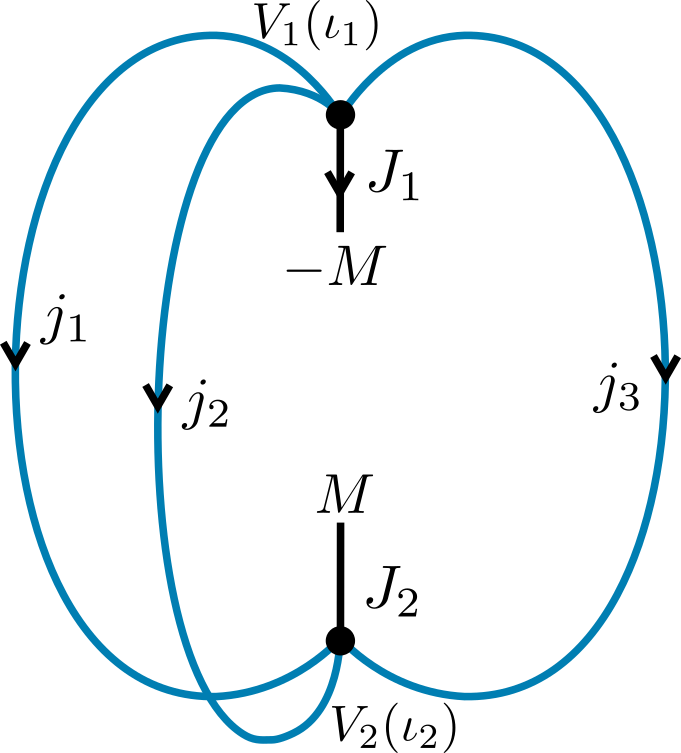
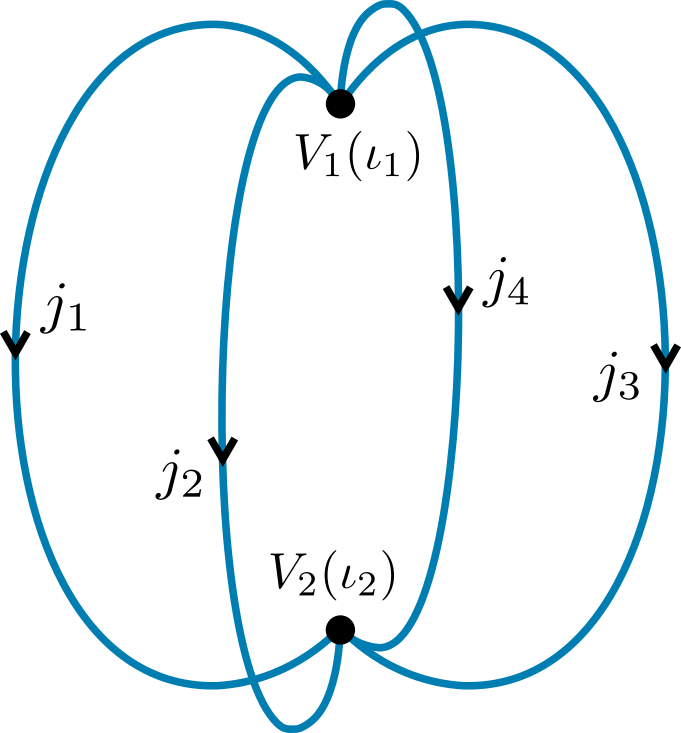
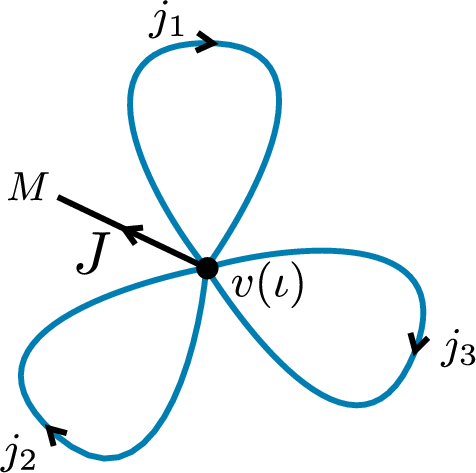
Figure 1: Schematic of a gauge-variant 3-bridge graph illustrating the vertex and edge structure for non-gauge-invariant states.
the numerical and analytic results agree within machine precision once the spin cutoff is chosen sufficiently large. The influence of the so-called n-winding corrections, inherent to the compactness of SU(2) and appearing in the Poisson resummation, is systematically investigated; for t≲1, the main (n=0) term is already sufficient, but deviations grow at larger SL(2,C)0.
Concerning higher-order operator moments, SL(2,C)1, numerical calculations match analytical expressions up to the explored range. The semi-classical expansions converge rapidly for expectation values and matrix elements in the semiclassical regime.
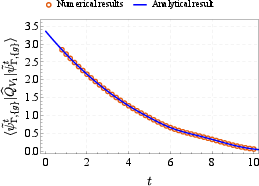
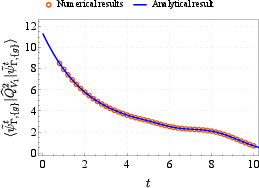
Figure 2: Expectation value of SL(2,C)2 as a function of the semiclassical parameter t, showing agreement between numerical results and semiclassical expansions.
This is further reinforced by polynomial fits to the volume operator's expectation value, which match analytic expansions in SL(2,C)3.
Matrix Elements and Non-Diagonal Structure
Non-diagonal matrix elements (i.e., off-diagonal in the basis of coherent labels) are accessible numerically for the first time, with high accuracy. These reveal the detailed behavior of quantum fluctuations and the breakdown of naive perturbative expansions when the coherent states are widely separated in phase space. The validity of the improved semiclassical expansion for matrix elements, as opposed to the traditional expansion optimized for expectation values, is established and shown to capture the relevant physics for a wide range of parameters.
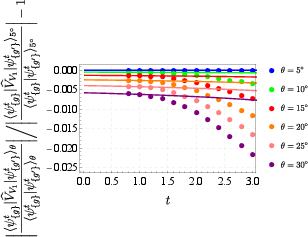
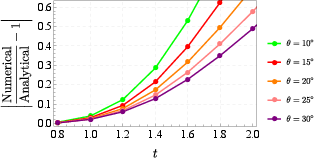
Figure 3: Difference between the matrix elements of SL(2,C)4 as a function of the separation angle (SL(2,C)5) between classical orientations, quantifying the breakdown of semiclassical expansions for large classical separation.
Gauge-Invariant 4-Bridges and Polyhedral Geometries
For gauge-invariant spin networks with 4-valent vertices corresponding to classical tetrahedra, both regular and deformed (irregular) geometries are explored. The algorithm recovers the correct classical volume (up to known normalization factors) in the semiclassical limit, both for regular and strongly deformed tetrahedra. The second-order semiclassical expansion remains accurate except for the most highly deformed cases, where higher-order corrections become non-negligible.
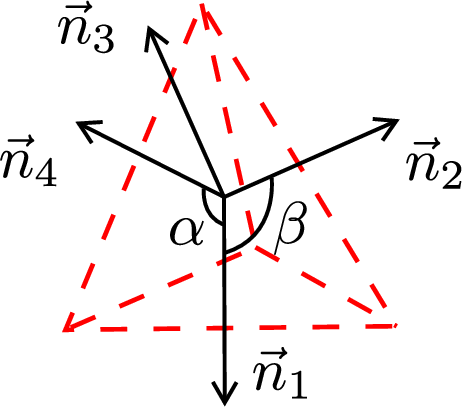
Figure 4: Illustration of a tetrahedron specified by its four face normals and characteristic angles SL(2,C)6 and SL(2,C)7, forming the parameter set for the 4-valent vertex geometry.
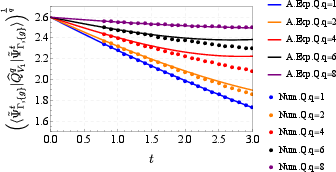
Figure 5: Analytical expansion and numerical results for SL(2,C)8 across regular and a range of irregular tetrahedra, as a function of SL(2,C)9; agreement is strong in the semiclassical regime.
A notable result is the observation that, in the deep quantum regime, the expected ordering of volumes by symmetry (regular > irregular) can be inverted—highly deformed tetrahedra can have larger quantum volumes than regular ones when SU(2)0 becomes large.
Asymptotics, Spectral Structure, and Classical Limit
The maximally excited eigenvalue of the volume operator is shown numerically to approach the classical polyhedral volume in the large-spin limit for both tetrahedral and cubical configurations. The approach follows a power-law scaling with spin, and systematic deviations in the quantum regime are characterized by universal exponents across geometric families.
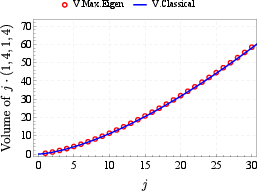
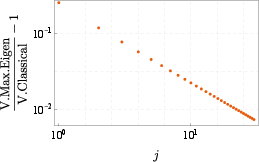
Figure 6: Comparison between the maximal eigenvalue ("V.Max.Eigen") and the classical polyhedral volume as a function of spin; the quantum to classical transition is manifest.
Furthermore, the quantum coherent state overwhelmingly projects onto the eigenstate of the maximal volume eigenvalue for highly symmetric graphs, confirming the semiclassical peakedness property and justifying truncations in future numerical simulations.
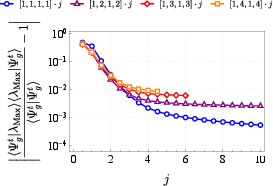
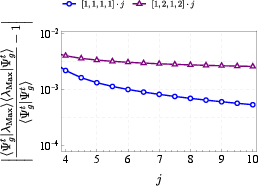
Figure 7: Relative difference between the coherent state overlap with the maximal volume eigenstate and the full state normalization, demonstrating localization in the semiclassical regime.
Practical and Theoretical Implications
The numerical and analytic framework enables, for the first time, the controlled study of quantum geometric operators across the full crossover from deep quantum to semiclassical physics, within full LQG and for physically relevant spin networks. This has direct consequences for:
- Evaluating matrix elements of the Hamiltonian constraint,
- Construction and testing of semiclassical states for black holes, cosmological bounces, and general polyhedral geometries,
- Benchmarking spectral properties central to coarse-graining and renormalization strategies,
- Development of efficient sampling and truncation methods for coherent state path integrals.
The observed inversion of volume hierarchy in the deep quantum regime underlines that quantum geometry in LQG does not simply amount to discrete quantization of classical quantities but features non-classical ordering and spectral flow, which must be understood in any effective/phenomenological application. The localization properties of coherent states on maximal eigenstates pave the way for more aggressive and physically justified approximation schemes.
Conclusion
This work establishes a numerically robust and semi-analytically validated mapping between quantum and semiclassical regimes in LQG for the volume operator, operative on a wide class of spin network states. All key claims and results are supported by quantitative agreement between numerics and semiclassical expansions in their shared regime of validity, and the numerical machinery enables extension to regions intractable analytically. The framework is extensible and can underpin studies of other geometric operators and dynamics in canonical and covariant LQG.
Future directions include the numerical exploration of the Lorentzian Hamiltonian operator, further study of the physical significance of quantum ordering inversions, and the extension of the approach to complex combinatorics of higher-valent graphs and dynamics—crucial for full quantum gravity phenomenology and comparison with results from spin foam models.