- The paper demonstrates that galactic constellations identified in DESI DR1 are confined to scales below ~400 h⁻¹Mpc, aligning with cosmic homogeneity predictions in ΛCDM.
- It employs human pattern recognition and a crowd-sourced interactive platform to detect and catalog familiar patterns in the distribution of galaxies.
- The methodology reveals challenges in automated pattern detection in noisy datasets, emphasizing the distinct advantage of human-in-the-loop analytics.
Galactic Constellations and Cosmological Homogeneity in DESI DR1
Introduction
The identification of "galactic constellations"—recognizable shapes formed by the spatial distribution of galaxies rather than stars—offers an unconventional but instructive approach to both public engagement and studies of large-scale structure (LSS). This work, "Galactic Constellations in DESI DR1 and the Scales of Cosmological Homogeneity" (2603.29912), operationalizes the concept by systematically searching the dense subset of the Dark Energy Spectroscopic Instrument (DESI) DR1 data for such patterns, quantifies their physical sizes, and contextualizes their existence with respect to the cosmological principle and the ΛCDM paradigm.
Data and Visualization Techniques
The DESI DR1 comprises the most detailed spectroscopic map (14 million extragalactic spectra over 14,000 deg2) currently available. The instrument's fiber positioners and spectrographs facilitate high-completeness redshift acquisition for diverse target classes, with the DR1 sample dominated in these analyses by the Bright Galaxy Survey (BGS) and Luminous Red Galaxy (LRG) targets at z<0.8.
A subset within right ascension 125<α<250 deg and declination −7<δ<7 deg, corresponding to a region of near-maximal completeness and galaxy density, forms the search space. Comoving positions are computed using Planck 2018 cosmology. To enable visual recognition of non-random features, the data are sliced in 2-degree declination bins and further processed—point transparency and color encode depth and density, respectively—thus aiding foreground/background discrimination and highlighting filamentary structure.
The methodology leverages human pattern-recognition, with initial discoveries made visually and then expanded via a public-facing web interface.
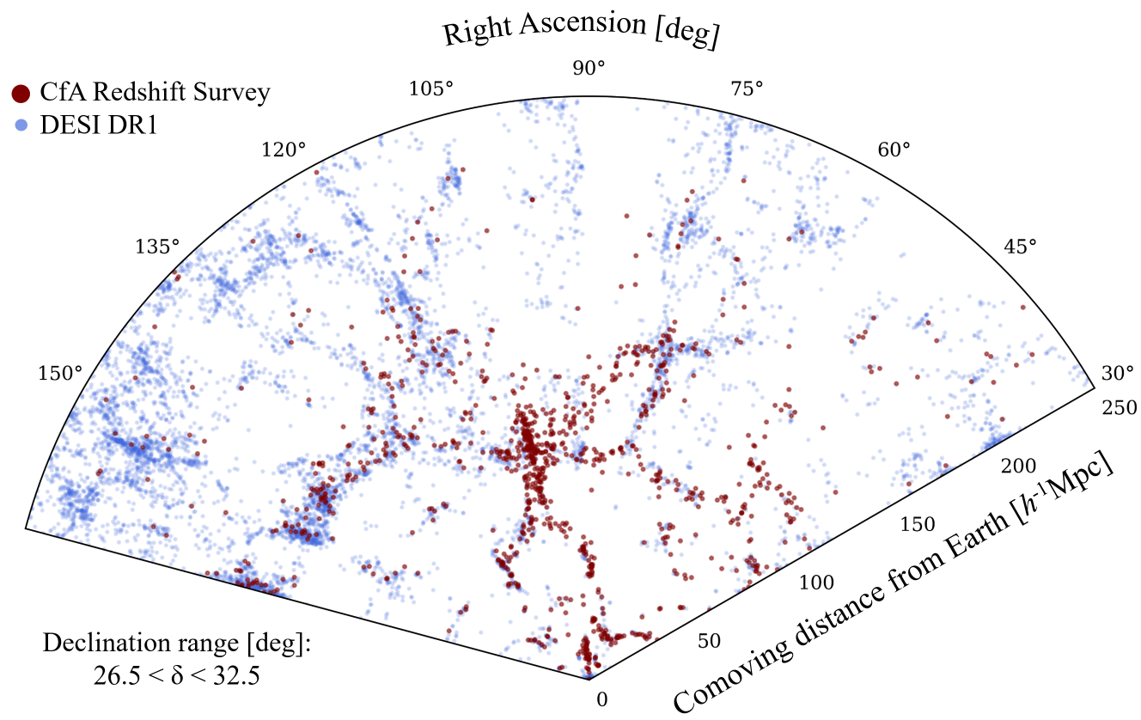
Figure 1: The CfA Stick Man, a historical archetype of galactic constellations, within the legacy CfA Redshift Survey and updated using modern DESI measurements.
Discovery of Galactic Constellations
Early visual scans and subsequent crowd-sourced exploration via the interactive website (https://cmlamman.github.io/galactic-constellations) yielded both previously known and novel "constellations" in the galaxy distribution. The most notable are:
- Pisces Grandis: a ∼270 h−1Mpc elongated overdensity, interpreted as the largest "fish"-like configuration, providing a visually compelling example of how LSS features can mimic memorably anthropomorphic forms.
- DESI Stick Woman: a figure analog to the iconic CfA Stick Man, detected within the DESI data, reinforcing the persistence of such accidental configurations.
- "W" Structure: resembling the Cassiopeia stellar constellation, highlighting the emergence of familiar asterisms from the cosmic web even at large scales.
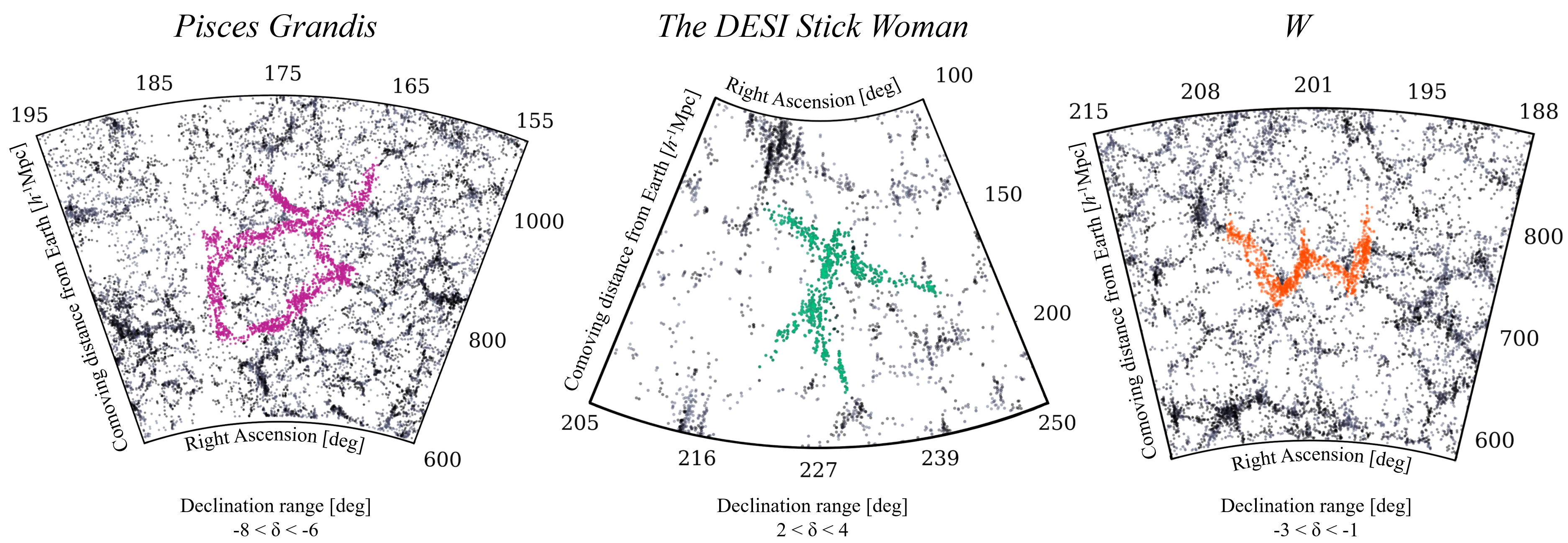
Figure 2: VISual representations of major galactic constellations in DESI: Pisces Grandis, Stick Woman, and "W", mapped within specific declination slices.
An interactive gallery allows users to annotate additional patterns, facilitating a community-driven cataloging process. Early usage produced 93 constellations, subsequently analyzed for their physical extent.
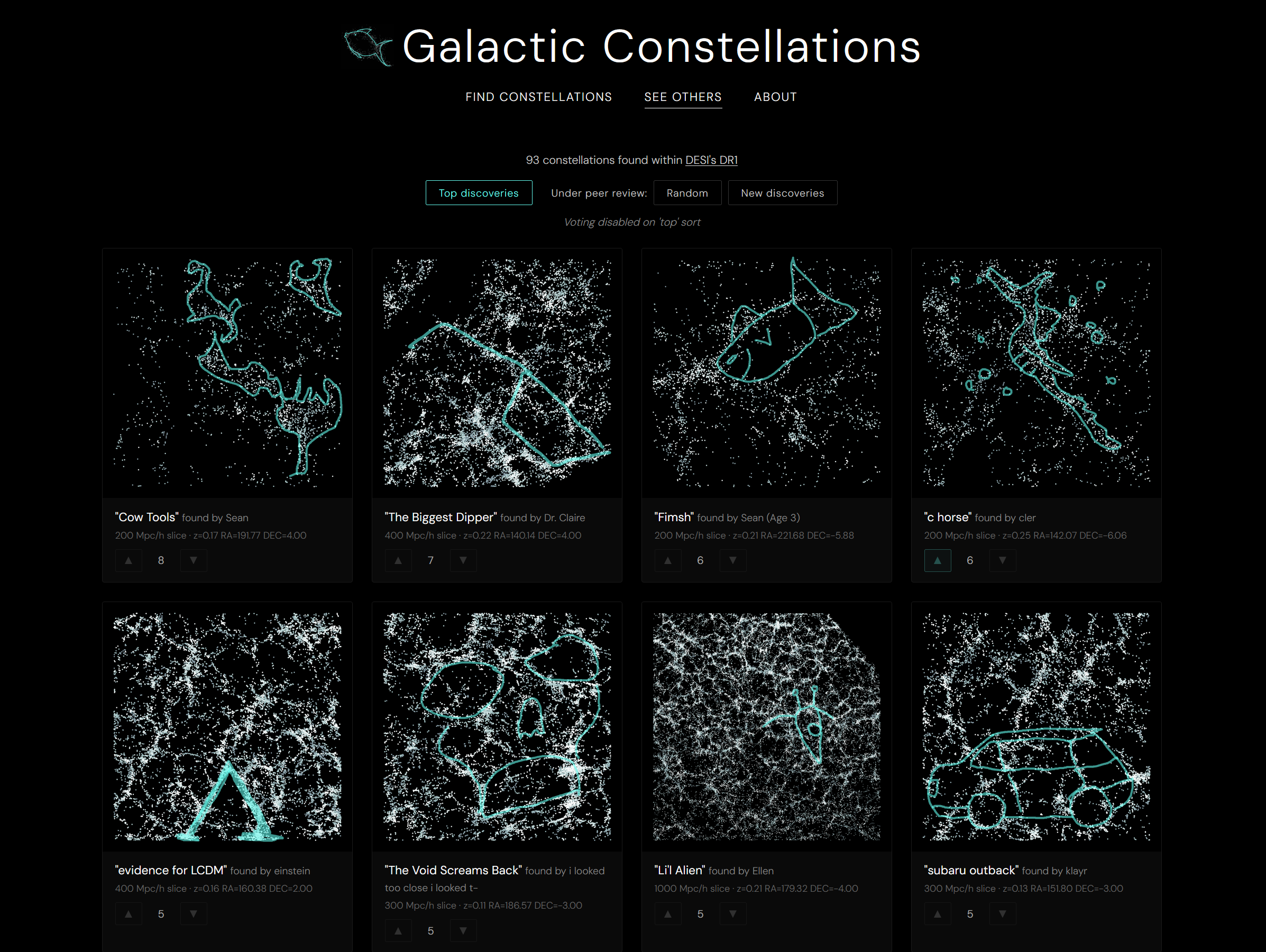
Figure 3: The public gallery interface for submitting and visualizing discovered galactic constellations—engaging both scientific and non-expert users.
Human vs. AI Pattern Detection
Attempts to automate constellation discovery with state-of-the-art LLMs (e.g., Claude Opus 4.6) failed to yield results comparable to human input, corroborating recent neuroscientific and vision science findings that humans retain distinct advantages in abstract, pose-invariant object recognition and creative extrapolation in complex, noisy domains [wichmannAreDeepNeural2023; holzingerHumanlevelConceptLearning2023; ollikkaComparisonHumansAI2024]. This underscores the value of human-in-the-loop analytics in exploratory contexts, especially when signal-to-noise is low and priors are weak.
Cosmological Implications: Scales of Homogeneity
A theoretical motivation for quantifying the sizes of constellations is their utility as a qualitative probe of the scales at which the universe transitions from inhomogeneous (structured) to homogeneous and isotropic, as required by the cosmological principle (CP) and as modeled in ΛCDM. Existing observational and theoretical estimates place this transition in the range 60–500 h−1Mpc [ntelisExploringCosmicHomogeneity2017; marinoniScaleCosmicIsotropy2012; avilaHomogeneityScaleGrowth2022].
By measuring the maximum extent of each submitted constellation and comparing this against the physical box size (set by the visualization slice), the paper finds that all cohesive patterns identified by users reside below the upper boundary (∼400 20Mpc), aligning with theoretical expectations for onset of cosmic homogeneity.
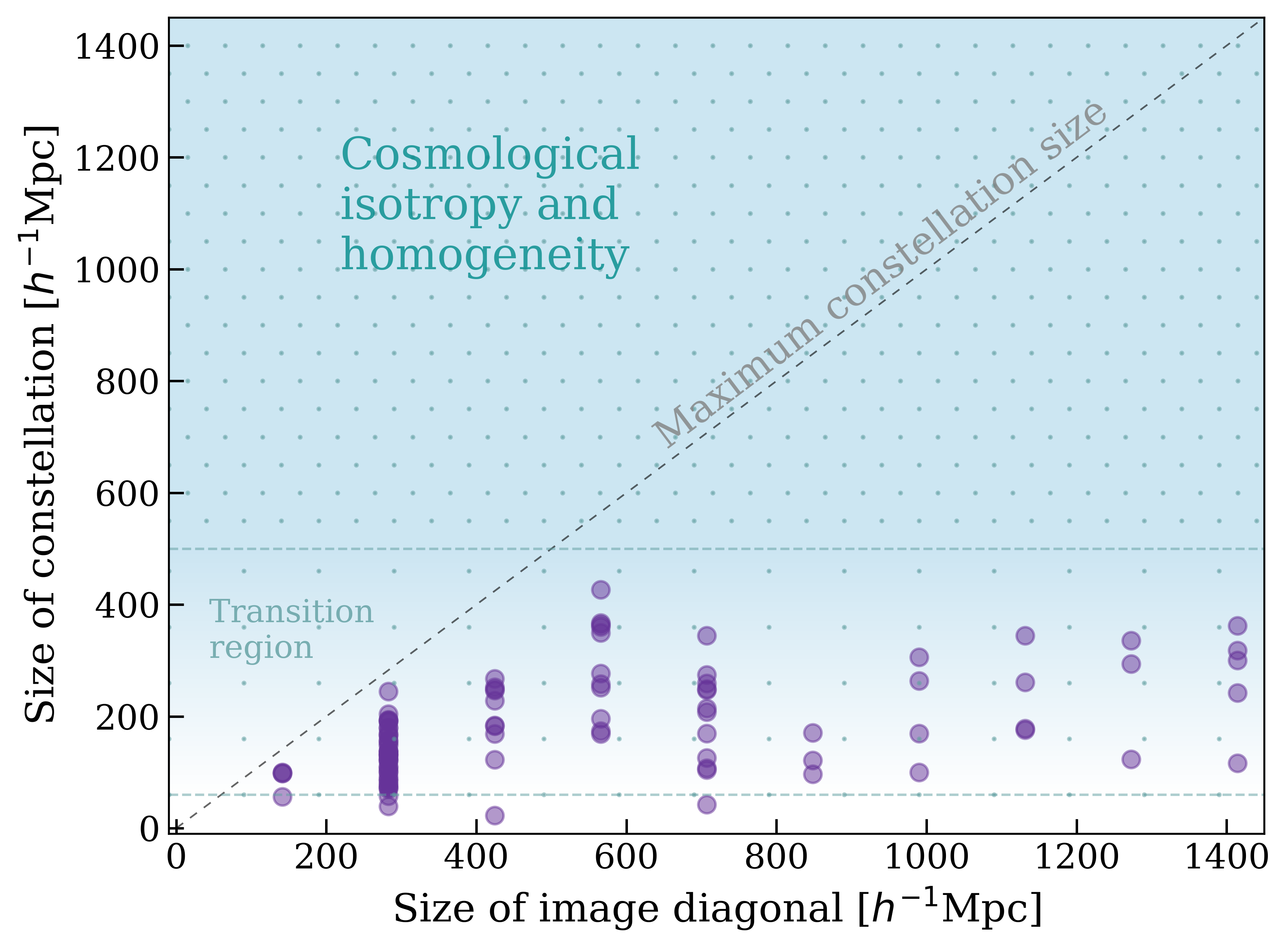
Figure 4: Largest physical extents of discovered galactic constellations vs. visualization box size; all cohesive patterns fall within predicted homogeneity scales, consistent with 21CDM.
In an inhomogeneous or anisotropic universe, one would expect recognizable large-scale shapes to emerge above these scales, but their absence in the data supports the statistical isotropy and homogeneity postulates.
The work further highlights the frequentist fallacy in assigning cosmological significance to the existence of individual unusual structures (e.g., Pisces Grandis): similar "tensions" are bound to occur by chance in any sufficiently rich dataset, given the combinatorial multiplicity of possible patterns.
Practical and Theoretical Consequences
Practically, this approach introduces a novel, accessible mode of public engagement with LSS surveys, translating the typically abstract subject of cosmic web structure into a format conducive to intuition-building and cultural participation.
Theoretically, the alignment between the size distribution of galactic constellations and predicted homogeneity scales in 22CDM offers a "citizen science" cross-check of the large-scale isotropy assumption using subjective, visual pattern matching. While not strictly quantitative, this approach could be made robust via controlled studies that mix real and mock data, potentially augmenting the statistical arsenal for testing the CP beyond standard moments and correlation functions.
The negative result on automating constellation identification with current AI also pinpoints an unsolved challenge—creative data synthesis and pattern prioritization in vast, noisy spatial data remains a uniquely human strength, at least in this regime and with general-purpose models.
Future Perspectives
Moving forward, multiple extensions are envisioned:
- Exploiting the greater data volume and sky coverage available in future DESI releases (and next-generation surveys), with more granular slicing and multi-dimensional projections (including 3D topology rather than 2D slices).
- Systematically comparing pattern frequency and extent in real vs. simulated data as a test of both cosmological theory and sub-grid physics in simulations.
- Developing semi-automated methods, possibly combining human-initiated pattern templates with algorithmic searches for similar forms in large datasets, bridging current ML limitations.
- Public engagement strategies that leverage such platforms to recruit a semi-expert user base for exploratory annotation projects.
Conclusion
This study operationalizes the concept of galactic constellations in the context of DESI DR1 and demonstrates that visually salient, physically contiguous patterns in galaxy distributions are confined to scales consistent with expectations from cosmic homogeneity under 23CDM. The community-driven approach opens a new avenue for intuitive exploration of LSS and public involvement, while also illuminating the current boundaries of automated pattern recognition in astronomical datasets. The absence of large-scale, super-homogeneity constellations provides an unconventional yet complementary validation of the cosmological principle.