- The paper introduces a competitive equilibrium framework that quantifies how spam MEV saturates blockspace and undermines user welfare.
- It employs detailed empirical analysis on Base and Arbitrum, revealing that blockspace expansion leads to disproportionate increases in spam gas usage.
- The study concludes that protocol tweaks, such as raising gas price floors and implementing priority fee ordering, can effectively mitigate spam MEV while enhancing system performance.
Spam MEV Dynamics in High-Throughput Blockspace
Introduction
"Blockspace Under Pressure: An Analysis of Spam MEV on High-Throughput Blockchains" (2604.00234) presents a comprehensive theoretical and empirical treatment of the spam MEV phenomenon observed on modern, high-throughput, low-fee blockchains. The work articulates a formal competitive equilibrium framework for spam MEV—distinguishable from targeted MEV both in mechanism and in macro-level impact. The analysis rigorously characterizes equilibrium spam volume in terms of blockspace design parameters, with significant implications for user welfare, validator revenue, and network externality. Empirical validation leverages recent data from major Ethereum rollups, especially Base and Arbitrum, demonstrating alignment of theoretical predictions with observed deployment dynamics.
Modeling Spam MEV and Blockspace Design
Spam MEV is characterized by speculative high-frequency probing transactions that only resolve profitably at execution time, contrasting with off-chain computed, targeted attacks that dominate on Ethereum L1. The low transaction fees and abundant throughput on rollups lower the cost-of-failure sufficiently for spammers to saturate blocks with futile probes, which can constitute the majority of gas usage in high-capacity regimes.
The paper's model centers blockspace constraints (max), minimum gas price (min), and the transaction fee mechanism (TFM). Spam bots are treated as profit-maximizing agents, entering the block up to the point where expected (execution-time) profit is dissipated by inclusion fees, yielding closed-form equilibrium conditions. User and system impact are tracked using three metrics: user welfare (aggregate user surplus), validator revenue (total fees), and network externality (system costs).
The framework distinguishes three block utilization regimes: (1) spam exclusion (no-profit region), (2) spam at gas price floor (user and spam coexist at low cost), and (3) spam-congested equilibrium (spam displaces users, raising gas prices and system costs).
Empirical Genesis and Growth of Spam MEV
Data from Base shows that following the Dencun upgrade and associated blockspace expansion, spam gas grew 122× while non-spam gas rose only 11.2× (Figure 1).
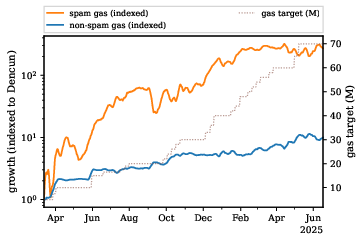
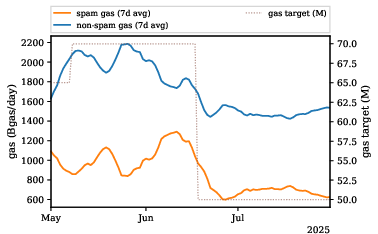
Figure 1: Spam and non-spam gas on Base indexed to Dencun; spam gas rose 122× as block capacity expanded, outpacing organic usage by an order of magnitude.
Empirical responses such as the reduction of gas targets and the introduction of higher minimum gas fees on Base demonstrably suppressed spam, with spam volumes dropping by 34\% after the capacity cut and by up to 55\% following gas price floor increases. A similar pattern is observed on Arbitrum, which, with a higher minimum fee, exhibited lower spam shares compared to Base.
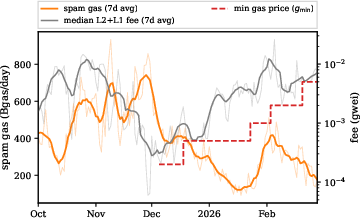
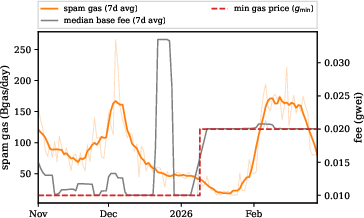
Figure 2: Spam gas on Base over time; average daily spam gas dropped by 33\% after minimum gas price enforcement.
The paper presents robust econometric evidence: spam on Base scales superlinearly with blockspace (>2× increase in spam for each 1× increase in gas target), while user throughput increases much less, highlighting the elastic, exploit-driven nature of spam MEV.
Equilibrium Analysis and Impact
Analytic solutions and numerical simulation show that spam volume and its proportional share of blockspace both increase with capacity and decrease with gas price floor. The critical threshold Bplat defines the blocksize at which user welfare plateaus—further capacity expansion increases spam and network costs, but not legitimate throughput.
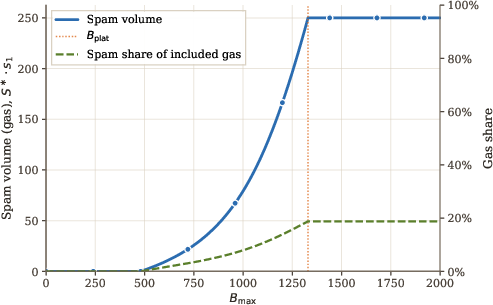
Figure 3: Equilibrium spam volume as a function of block size; spam rises rapidly as blocksize increases and plateaus as the gas price floor regime dominates.
The work presents a striking and contradictory insight: increasing blockspace does not proportionally benefit users once spam MEV equilibria dominate. Instead, it disproportionately rewards zero-sum spam at user and ecosystem cost. Figures 5 and 6 delineate that user welfare loss peaks exactly at the transition into the spam regime, at which point validator revenue and network cost (externality) peak due to spam fees.
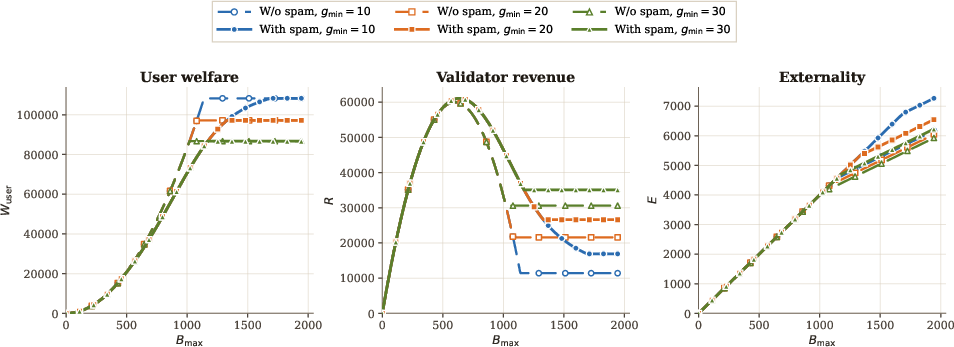
Figure 4: Levels of user welfare, validator revenue, and externality with and without spam, showcasing welfare transfer from users to validators and increased system cost in the spam world.
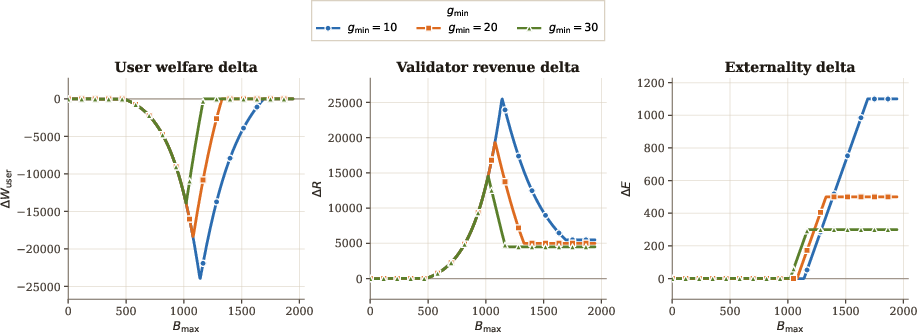
Figure 5: Marginal impact of spam; spam reduces user welfare and increases validator revenue and externality most sharply as blocksize approaches the spam equilibrium threshold.
The analysis formalizes blocksize selection rules—if optimizing for user welfare, block capacity should not exceed Bplat; marginal blockspace above this threshold is captured by spam.
Marginal Allocation and Priority Ordering Mechanisms
The paper further quantifies the allocation of marginal blockspace between legitimate users and spammers. With blocksize increase, an ever-smaller fraction of new capacity serves users (muser falls), so designers should cap size where non-user consumption dominates.
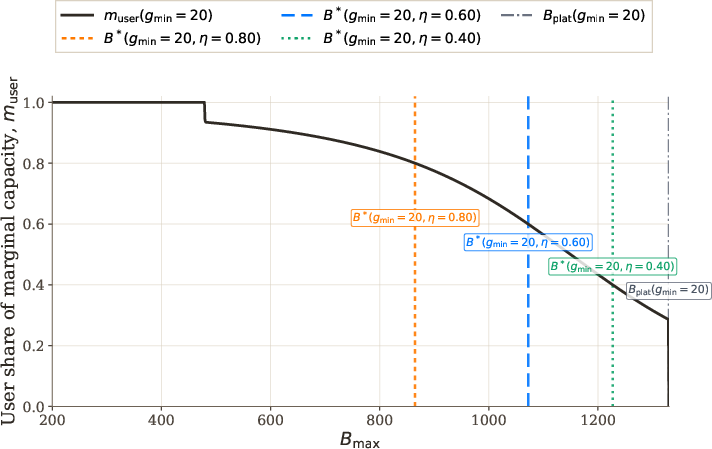
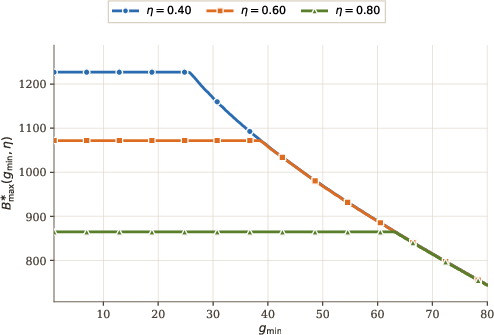
Figure 6: For fixed gas price floor, marginal user share of increased blockspace falls rapidly; spam absorbs the bulk of incremental capacity post-min0.
Introducing approximate priority fee ordering (PFO)—partitioning the block into priority-priced sub-blocks—alters spam incentives. When a substantial fraction of users bid for early placement in the block, spammers must pay higher fees for profitable positions, reducing spam volume and pushing it toward later, cheaper block positions.
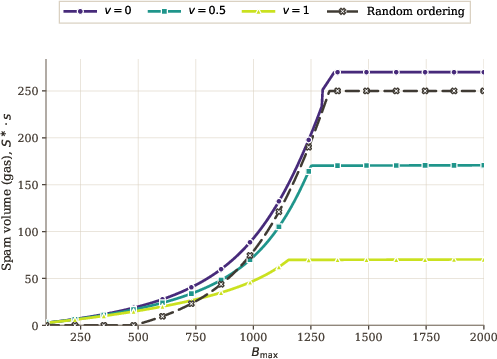
Figure 7: Equilibrium spam volume under PFO with varying user priority participation; as more users compete for early slots, spam volume decreases.
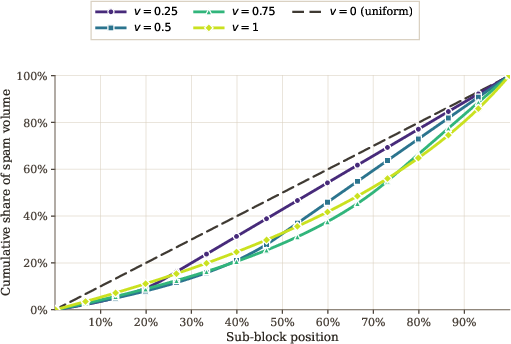
Figure 8: Spam location in block under PFO; higher user priority participation moves spam to later positions, decreasing its value density.
The model demonstrates that PFO's effectiveness is highly sensitive to the share of users competitively bidding for early block position—full user participation substantially suppresses spam.
Systemic Implications for Scaling and Mitigation
As user demand and blockspace both scale, spam's share of total gas plateaus at a nontrivial positive value—it does not vanish. Neither the "spam will eat the chain under scale" nor "scaling blockspace dilutes spam" narratives hold in isolation.
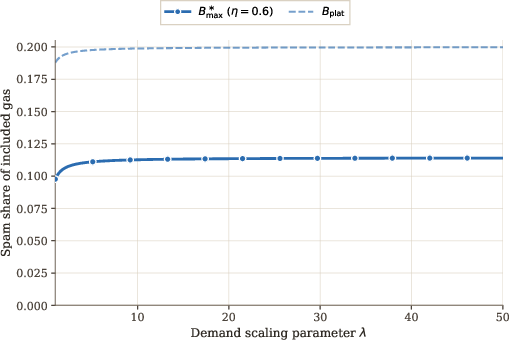
Figure 9: Spam share of included gas versus increasing demand scaling parameter; spam share stabilizes at a significant fraction, not vanishing with scale.
With PFO, the spam fraction can be reduced (especially with more intensive user competition for priority), but not eliminated.
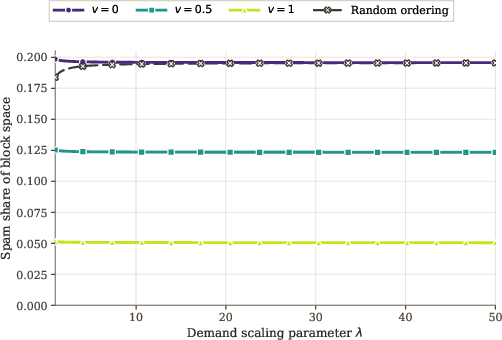
Figure 10: Spam share under demand scaling across PFO/user-priority parameters; higher user competition reduces, but does not eliminate, persistent spam share.
Empirical event analysis underscores these results: on Base, spam share tracked capacity expansion, peaking above 50\% and falling precipitously following protocol gas price floor introduction.
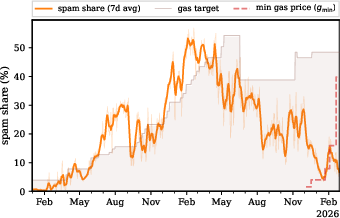
Figure 11: Spam's share of gas on Base; capacity expansions track spam spikes, gas price floor introduction sharply cuts spam share.
Similarly, spam on Arbitrum rebounded after an incremental gas price floor increase, illustrating that mitigation efficacy is highly sensitive to parameter choice and spammer adaptation.
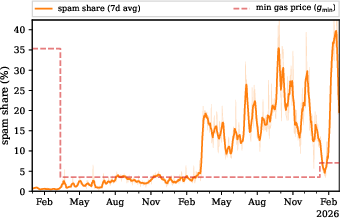
Figure 12: Spam share on Arbitrum; brief decline after fee increase, then rebound, demonstrating adaptive spam dynamics.
Practical Mitigations and Empirical Corroboration
The analytic framework supports two primary mitigation families:
- Incentive-based mechanisms: Raising min1 (gas price floor) and charging for reserved, not merely consumed, gas (disincentivizes partial/failing probes). Chains such as Monad and Sui have adopted these, while Base and Arbitrum increases in min2 resulted in proximately sharp spam reductions, with negligible effect on organic throughput.
- Cheap-path mechanisms: Selective execution/cancellation or block producer filtering to minimize resource costs of failed spam probes, subject to system tradeoffs around execution bottlenecks, auditability, and operational fairness.
Empirical regression confirms that spam gas elasticity with respect to blockspace on Base is 2.27 (min3), equating to superlinear responsiveness, and spam reduction via minimum gas price occurs without user throughput impairment unless the fee increase is marginal relative to spam profit.
User-focused metrics (welfare, inclusion) worsened at precisely the capacity settings that maximized validator revenue from spam, validating the adverse welfare-externality trade-off of unconstrained scaling.
Conclusion
This work provides a theoretically rigorous and empirically validated analysis of spam MEV's dependence on blockspace design and fee parameters. The principal findings are:
- Spam MEV absorbs marginal blockspace with increasing efficiency as capacity expands, at strong cost to user welfare and blockchain decentralization.
- Gas price floor increases are highly effective at capping spam, whereas blockspace expansion predominantly benefits spammers unless carefully capped at or below min4.
- Priority fee ordering achieves spam mitigation only when a substantial user fraction bids for priority; otherwise, spam is displaced rather than eliminated.
- As system demand and supply both scale, spam reaches an endemic, persistent fraction of blockspace, establishing a lower bound on non-productive execution cost.
These results have direct implications for blockchain protocol design, rollup gas policy, and MEV mitigation mechanisms. Future work in the area will need to address the interplay of incentive and cheap-path mitigations, effects under non-linear demand growth or multiple opportunity types, and formal auditability in selective execution.
Reference: "Blockspace Under Pressure: An Analysis of Spam MEV on High-Throughput Blockchains" (2604.00234).

