- The paper introduces a novel yotta-eV τ⁺τ⁻ collider concept aimed at probing s-channel Higgs production and new physics regimes.
- It demonstrates a design using asymmetric e⁺e⁻ collisions to achieve high Lorentz boosts, extending τ lifetimes for effective collisions.
- It highlights significant technical challenges including extreme magnetic field demands, radiation hazards, and material constraints.
Motivation and Design of a Yotta-eV τ+τ− Collider
Historical Context and Motivation
The impetus for exploring ultra-high energy lepton colliders is a direct response to the limitations and trajectories of current and near-future accelerator facilities. The LHC, and its upgrade to the HL-LHC, will maintain the energy frontier for the next decade, but there is no consensus on the optimal path for the subsequent generation. While much of the community’s current focus is on the development of a muon collider, the authors advocate for a decisive escalation in ambition, proposing a τ+τ− collider at yotta-electronvolt (YeV, 1024 eV) scales.
Historically, collider facilities have evolved in terms of both energy and technological complexity, as shown in the global distribution (Figure 1) and operational chronology (Figure 2) of past colliders.
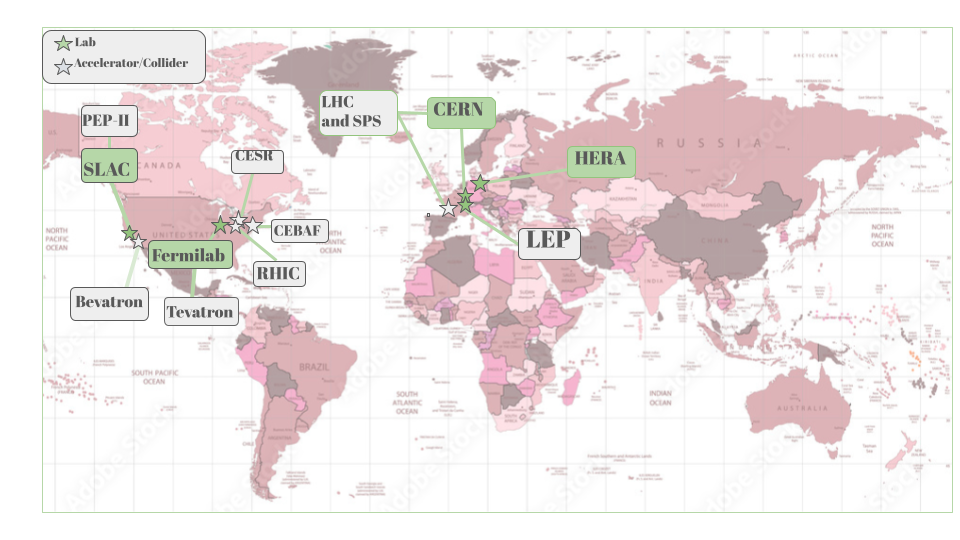
Figure 1: Map of locations of previous colliders.
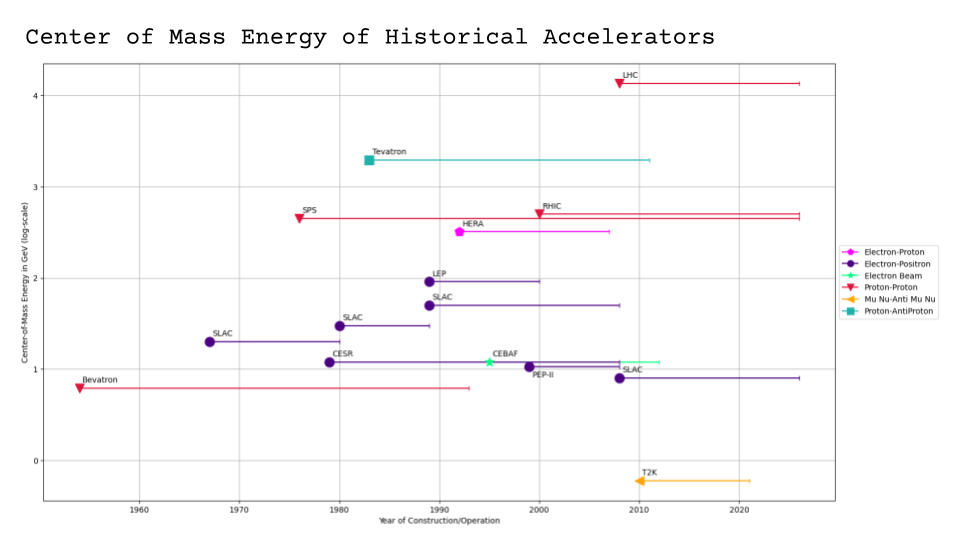
Figure 2: History of previous colliders showing years of operation and energies achieved.
The τ lepton, as a third-generation fundamental lepton, offers unique couplings by virtue of its large mass. Its use in a lepton collider scenario would enable direct s-channel Higgs production with enhanced rates, and, critically, access potential new physics sectors strongly coupled only to third-generation particles. This is theoretically motivated by numerous BSM scenarios, including variants of supersymmetry and compositeness, and further underscores the necessity of pushing beyond the established muon collider paradigm.
Standard Model, Higgs Hierarchy, and Beyond
The theoretical drivers for the study of ultra-high energy colliders are the open questions of the Standard Model: the unexplained origins of dark matter and dark energy, the fine-tuning and radiative stability of the Higgs mass, and the observed baryon asymmetry of the Universe. Radiative corrections to the Higgs mass induce quadratic divergence controlled by the cutoff Λ (Figure 3), which, absent a mechanism like SUSY (see Figure 4 and Figure 5), suggest that new physics thresholds must eventually manifest.
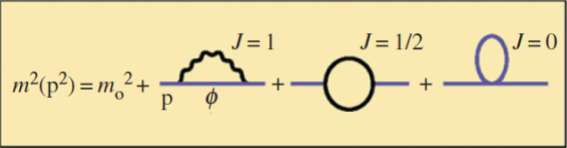
Figure 3: Radiative corrections to the mass of the Higgs boson from quantum loops containing fermions or bosons.

Figure 4: Supersymmetry effect on the mass of the Higgs boson.
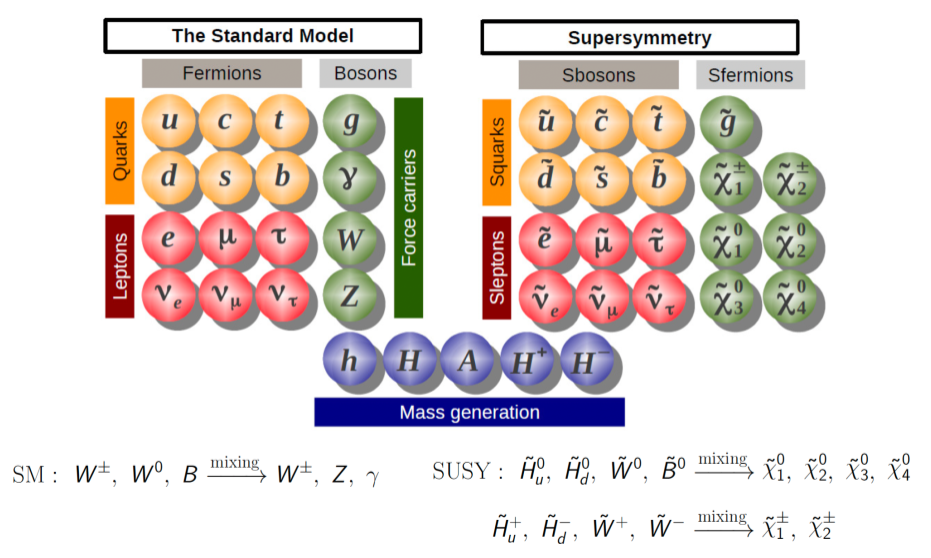
Figure 5: The Standard Model with Supersymmetric extension.
The heavy mass of the τ leads to substantial Yukawa coupling to the Higgs. Enhanced s-channel Higgs production, as well as rare exotic decays (e.g., to muons as reported by CMS, Figure 6), are promising targets for precision studies and indirect searches. Additionally, the unprecedented CM energy opens parameter space for direct discovery of states far beyond the reach of current facilities.
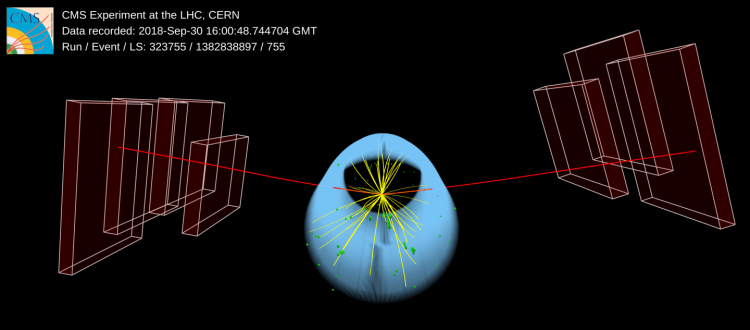
Figure 6: Higgs boson decaying to 2 muons (CMS event display).
Advantages and Technical Rationale for a τ Collider
Scientific Opportunity
The τ sits at the confluence of several advantages:
- Strong Higgs Coupling: As the heaviest lepton, it maximizes s-channel Higgs production cross-sections.
- Clean Leptonic Initial State: Unlike hadron accelerators, background processes are substantially suppressed, allowing for precision measurements.
- Potential for Enhanced BSM Sensitivity: Theories with preferential couplings to third-generation leptons predict enhanced signals in τ-pair channels.
Production Mode: Asymmetric e+e− Collisions and τ+τ−0-Pole Production
To overcome the extremely short τ+τ−1 lifetime (τ+τ−2 s), the paper proposes utilizing highly asymmetric τ+τ−3 collisions to produce Lorentz-boosted τ+τ−4 bosons, which subsequently decay to τ+τ−5 pairs at laboratory-frame τ+τ−6 values sufficient for useful collision rates. This concept is motivated by the success of asymmetric colliders like PEP-II for CP violation studies and allows for relativistic extension of the τ+τ−7 lifetime necessary for the target interactions.
Comparative Analysis: Muon vs. Tau Colliders
The muon collider, compared to electron-positron or proton machines, benefits from suppressed synchrotron losses (due to higher mass), direct CM energy usability, and compactness relative to equivalent hadron facilities. The τ+τ−8 offers the same theoretical advantages but with significant practical challenges due to its much shorter lifetime. Nevertheless, the τ+τ−9's unique couplings and SM/BSM sensitivity make it, in principle, a scientifically optimal beam particle for universal lepton-lepton colliders.
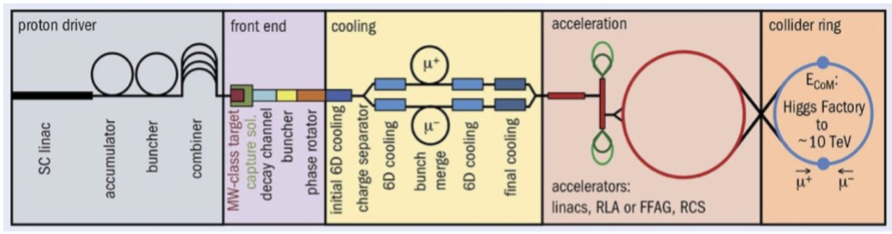
Figure 7: Muon collider conceptual design.
Lifetime, Relativistic Effects, and Required Energetics
A collider based on 10240 leptons is only viable if the particles can be accelerated and collided before they decay. Achieving meaningful boosts (10241 for lifetimes of 10242(ms)) requires individual 10243 energies on the order of exa- and zetta-electronvolts (10244–10245 eV). This is a full 8–10 orders of magnitude beyond current technology, as highlighted by lifetime/energy scaling tabulated in the paper.
The energy scaling of survivability motivates both linear (to avoid overwhelming synchrotron losses) and, for completeness, circular designs. The scaling of magnetic rigidity (Figure 8) and the dependence of achievable field strength versus ring geometry and energy (Figure 9, Figure 10) underscore the intrinsic engineering limits.
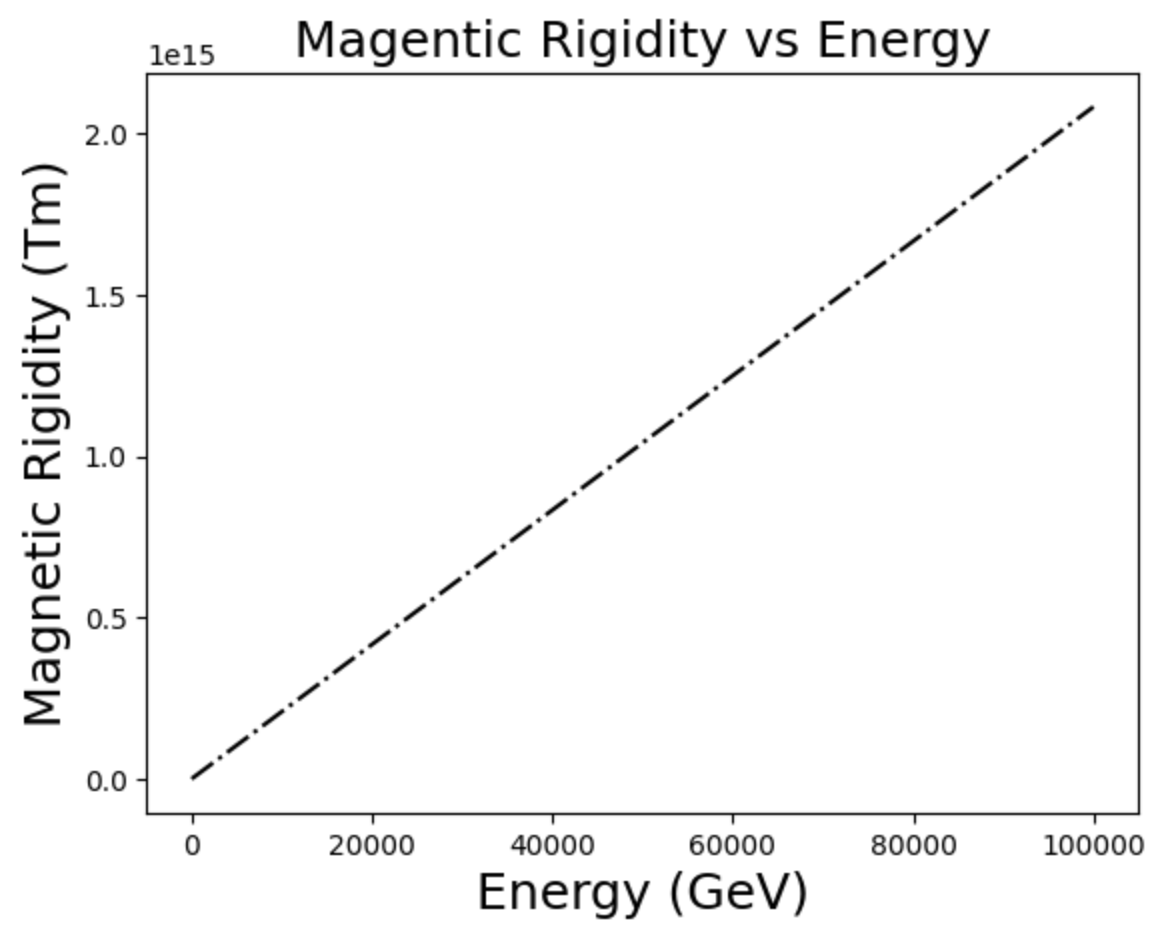
Figure 8: Linear relationship between magnetic rigidity and tau particle energy.
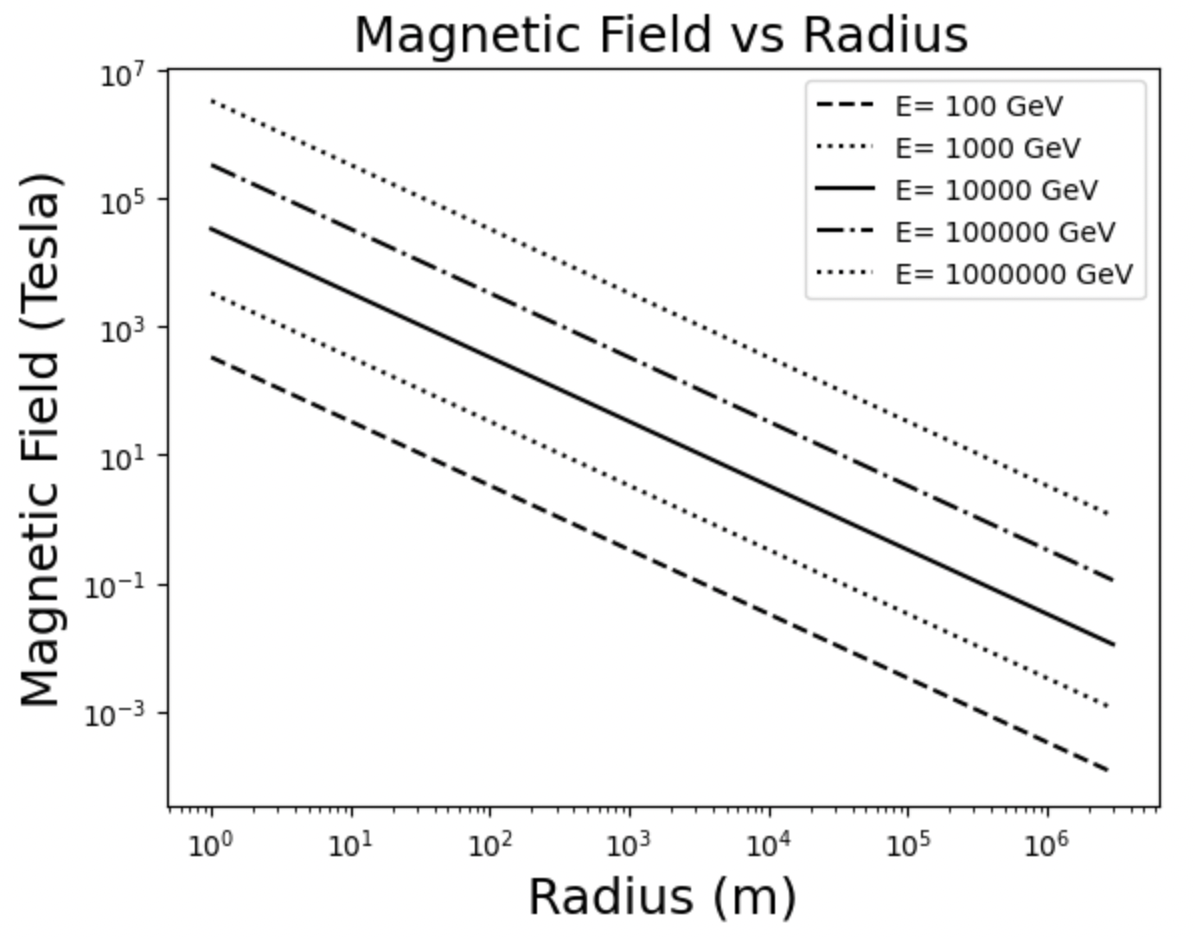
Figure 9: Dependency of required magnetic field strength on collider radius for various energies.
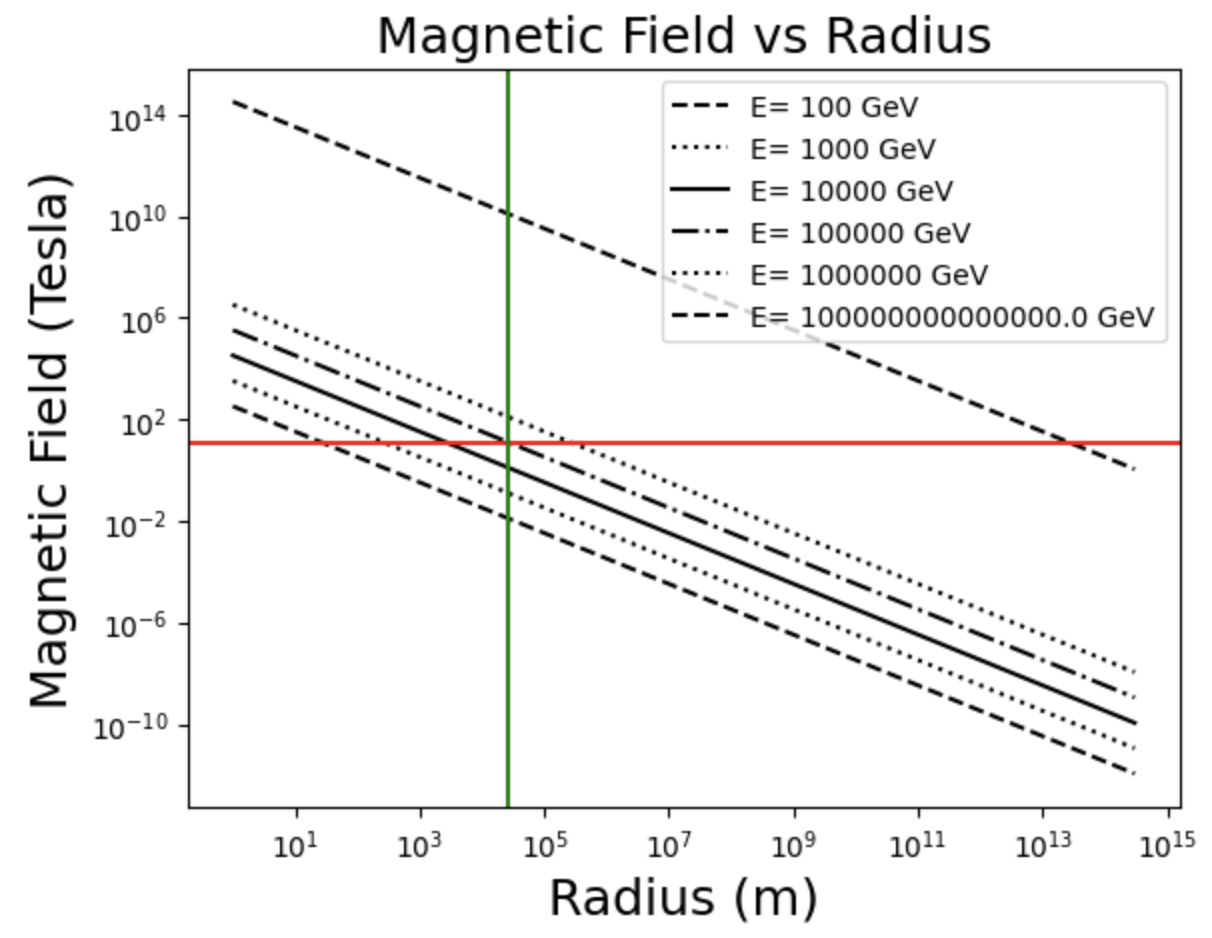
Figure 10: Field strength and achievable energy for a target ring radius, highlighting the infeasibility of Earth-bound radii with current materials.
In the hypothetical scenario of extremely strong fields, even terrestrial collider rings that could encircle Earth would require magnet strengths comparable only to astrophysical objects (e.g., magnetars, not accessible with known materials).
Major Engineering and Physical Challenges
Electric Fields and Acceleration
Current RF cavity technology (102462 MV/m) is incapable of providing the necessary field gradients over tractable distances. Advanced concepts such as plasma wakefield acceleration (1024710 GV/m, subject to beam stability limits) represent a possible future improvement, but even optimistic projections fall several orders of magnitude short of what is required to build a compact yotta-eV 10248 collider. Exotic fields at the Schwinger limit are only achievable in singular laboratory events.
Magnetic Fields
The required field strengths, to bend ultra-high-energy 10249 beams around even planetary-scale radii, exceed the limits of bulk matter and would necessitate not only superconductors beyond niobium-tin but engineering of astrophysical-scale magnetic systems, which is inconceivable with present or foreseen technology.
The “Ring of Death” Radiation Problem
At these energies and intensities, massive coherent neutrino production from τ0 decays creates extreme radiation concerns, the so-called “ring of death.” Calculations show that even at the PeV scale, the annual dose on the Earth’s surface would be far above lethal levels. Scaling to YeV would amplify this by many orders of magnitude, thus necessitating either space-based facilities or unprecedented shielding.
Beam Production and Handling
Production of τ1 leptons in sufficient quantities is a formidable challenge. Standard secondary production methods (neutrino beamlines, meson decay chains, Figure 11) have low efficiency due to the short lifetimes and high rest mass. Highly asymmetric τ2 collision designs with τ3-pole production offer the optimal route to produce sufficiently boosted τ4 beams, as depicted in the schematic collider design (Figure 12).
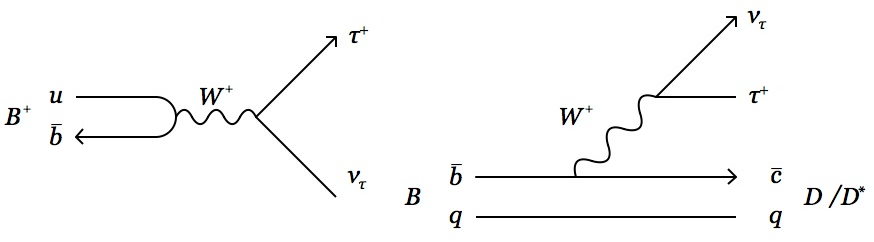
Figure 11: Feynman diagrams for B meson decays producing taus in the final state.
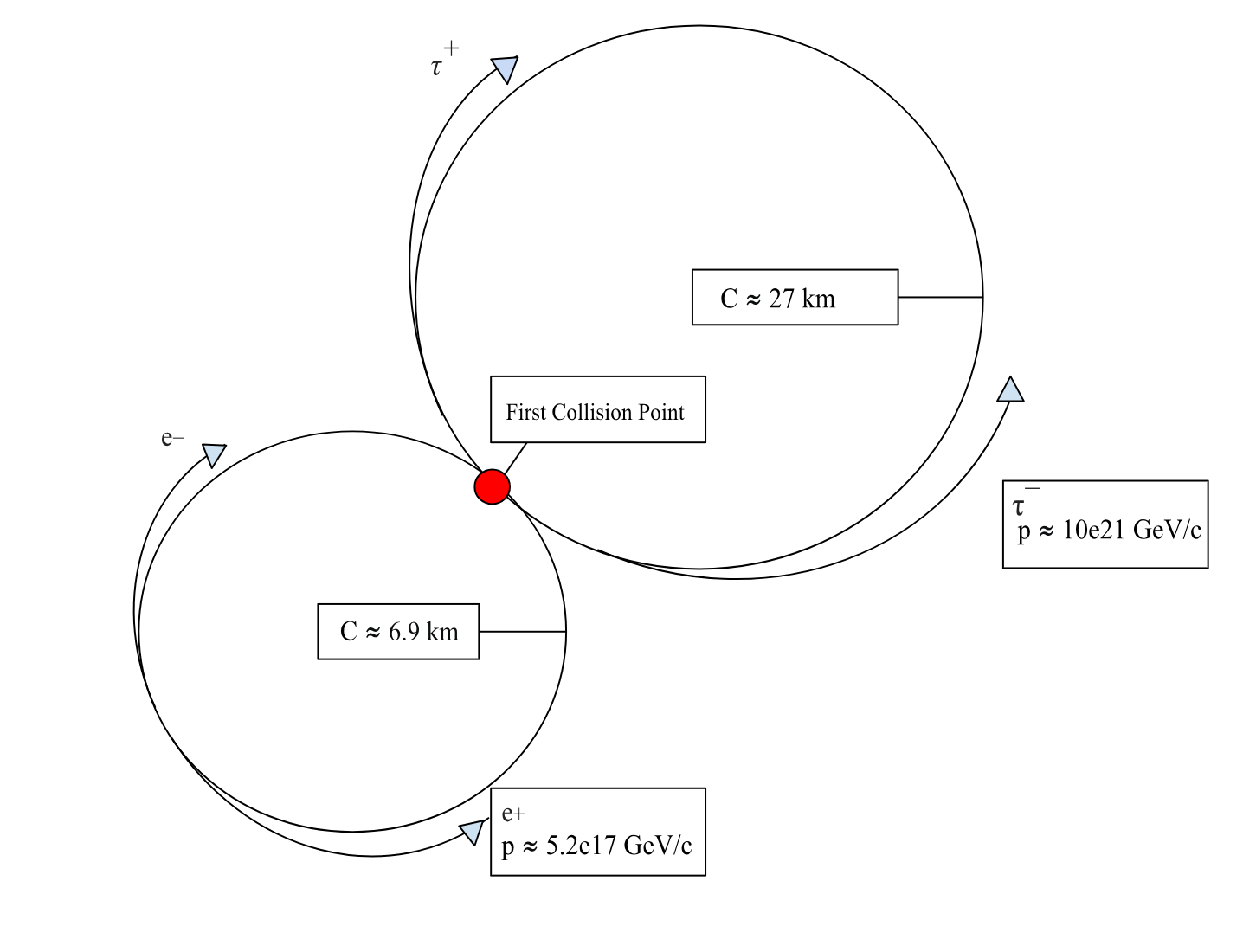
Figure 12: Conceptual design: Asymmetric collider to produce and accelerate taus for collision.
Implications and Future Outlook
The physical and engineering requirements for a yotta-eV τ5 collider far exceed the conceivable capabilities of a Type 0.7 (current Earth) or even fully Type I civilization on the Kardashev scale. Construction of a planetary-to-interstellar scale accelerator (potentially positioned in the Oort cloud) would require material, energetic, and organizational resources exceeding all present human activity.
Should such a facility ever be realized, however, it would constitute an unparalleled probe of the Higgs sector, direct searches for physics at mass scales in excess of any known cosmic process, and would become humanity’s ultimate tool for particle physics. Of note, the discovery of a fourth generation of fermions would immediately shift technological development toward a collider exploiting those heavier particles, given their higher direct cross sections for new physics.
Conclusion
The τ6 collider at yotta-electronvolt energies, as described in "Motivation and design of a yotta-eV τ7 collider" (2604.00440), systematically explores the theoretical, scientific, and engineering dimensions of the most ambitious lepton collider concept. While the overwhelming challenges render it infeasible with current technology, the discussion elucidates the ultimate trajectory for energy frontier collider physics. The study provides benchmark calculations for future civilization-scale projects, frames the coupling of fundamental and engineering constraints, and highlights the physics motivations that will persist for as long as particle physics seeks to probe the structure of the vacuum at the highest energies accessible to intelligent life.
References
- "Motivation and design of a yotta-eV τ8 collider" (2604.00440)

