- The paper establishes that resonance-saturated NLO counterterms are crucial for a unified description of s- and p-wave hyperon non-leptonic decays.
- It employs a relativistic EOMS ChPT framework that integrates ground-state, decuplet, and resonance octets to preserve power counting and accurately fit experimental data.
- The paper quantifies uncertainties from higher-order corrections and resonance coupling estimates, underscoring the need for refined baryonic weak decay models.
Hyperon Non-Leptonic Decays in Relativistic Chiral Perturbation Theory with Resonances
Introduction and Motivation
This work presents the first relativistic next-to-leading order (NLO) calculation of non-leptonic hyperon decays within the framework of Chiral Perturbation Theory (ChPT), incorporating both ground-state baryon octet and decuplet contributions as well as tree-level effects from 1/2− and (excited) 1/2+ resonance octets as proxies for NLO weak low-energy constants (LECs). The motivation stems from longstanding theoretical difficulties in achieving a simultaneous description of s- and p-wave amplitudes for hyperon non-leptonic decays and the insufficiency of the heavy-baryon framework at reproducing both partial waves at NLO. Recent improvements in experimental data, especially on polarization observables from BESIII, further motivate a theoretical update grounded in modern relativistic techniques.
The theoretical bottleneck at NLO arises from an excess of unknown weak LECs in the analytic O(MK2) corrections, which cannot be constrained unambiguously from available decay amplitudes. Previous works addressed this using non-relativistic calculations or only partial inclusion of counterterms. This study fills the gap by providing a relativistic, power-counting-conserving loop calculation in the Extended-On-Mass-Shell (EOMS) scheme and estimating the dominant NLO counterterms by integrating out low-lying baryon resonance octets.
Theoretical Framework
The effective Lagrangian comprises terms encoding strong and weak interactions among Goldstone bosons, ground-state baryon octet/decuplet, and the resonance octets. The power counting is preserved using the EOMS prescription to subtract power-counting-breaking pieces in baryon loops, ensuring a consistent chiral expansion even in the presence of explicit baryon masses.
The weak sector is formulated by octet-dominated four-quark effective operators governing s→d transitions, consistent with experimental dominance of ΔI=1/2 amplitudes and the suppression of $27$-plet (i.e., ΔI=3/2) transitions. The analysis accounts for isospin decomposition, employing updated phase-shift information for final-state interactions to extract the ΔI=1/2 parts of experimental amplitudes, maximally exploiting the precision of current data.
For the NLO LECs, the analysis leverages resonance saturation by integrating out 1/2+0 and 1/2+1 baryon octets. Their mass differences to ground-state baryons are small enough that their effect on 1/2+2- and 1/2+3-wave amplitudes is non-negligible and must be retained explicitly. The strong couplings of these resonances are updated using state-of-the-art partial decay widths. This approach allows estimation of the otherwise unconstrained LECs, crucial for deriving quantitative predictions.
Calculational Approach
Amplitudes for each decay are computed at the full 1/2+4 level, including tree-level terms, octet and decuplet loop contributions, and the tree-level resonance exchange that saturates the NLO LECs. The full set of relevant Feynman diagrams is considered. The impact of baryon mass splittings, wave function renormalization, and chiral loop corrections is consistently incorporated. Theoretical uncertainties, primarily arising from higher order truncation and resonance coupling uncertainties, are quantified and propagated into the final fits.
Data Analysis and Fit Strategy
A meticulous extraction of the experimental amplitudes is performed, utilizing not only branching ratios and decay parameters from BESIII and PDG, but also incorporating isospin relations and phase-shift data. This enables a robust mapping between theoretical amplitudes and experimental observables. The fit is executed in both the physical and isospin bases, but the main results primarily constrain the eight isospin amplitudes 1/2+5.
The analysis proceeds incrementally by first omitting resonance contributions. The fit quality is poor and the convergence of the chiral expansion is slow, confirming the necessity of including the resonance-dominated NLO counterterms. With resonance contributions enabled, the fit quality dramatically improves, allowing simultaneous consistency with both 1/2+6- and 1/2+7-wave data across all measured decay modes.
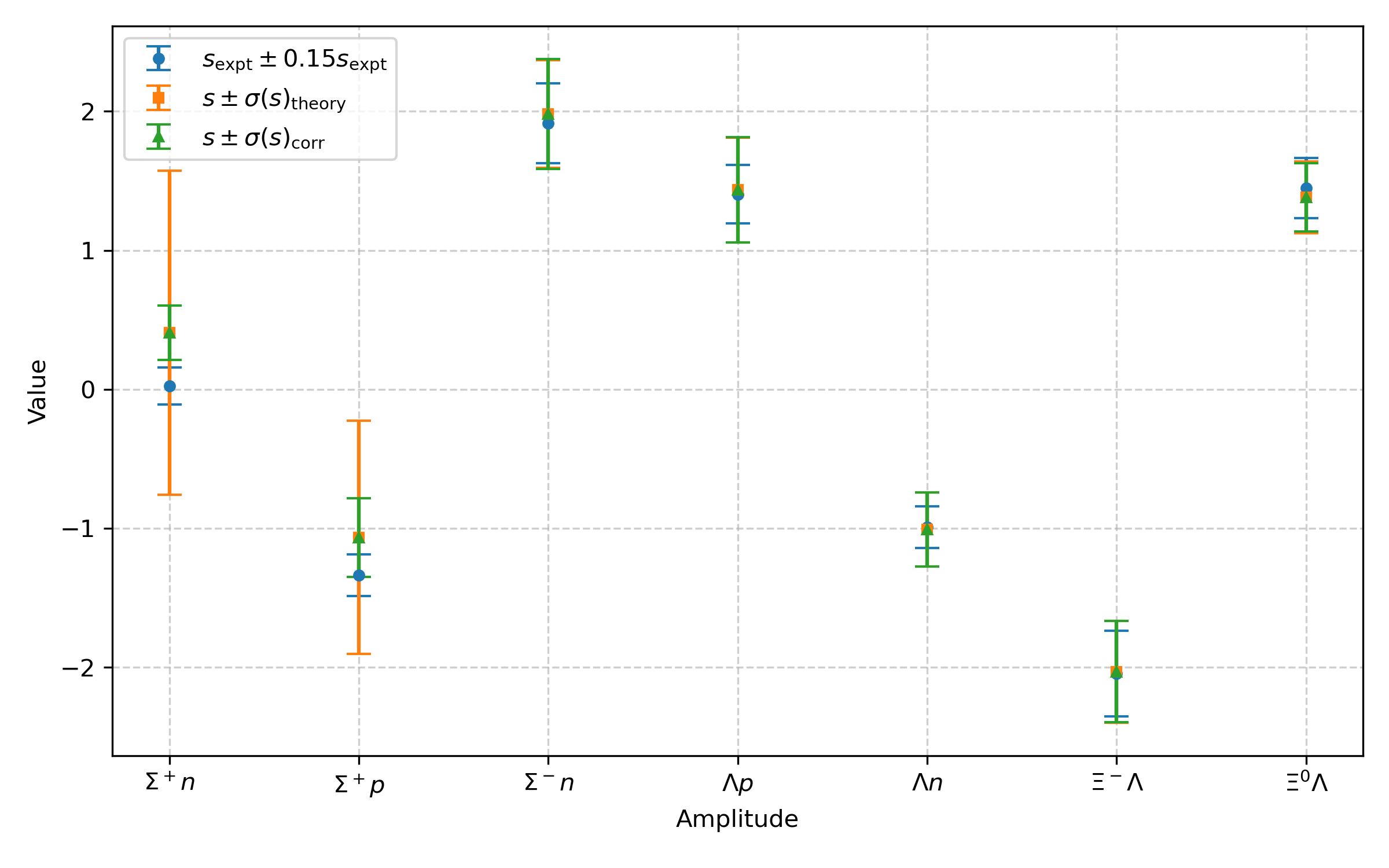
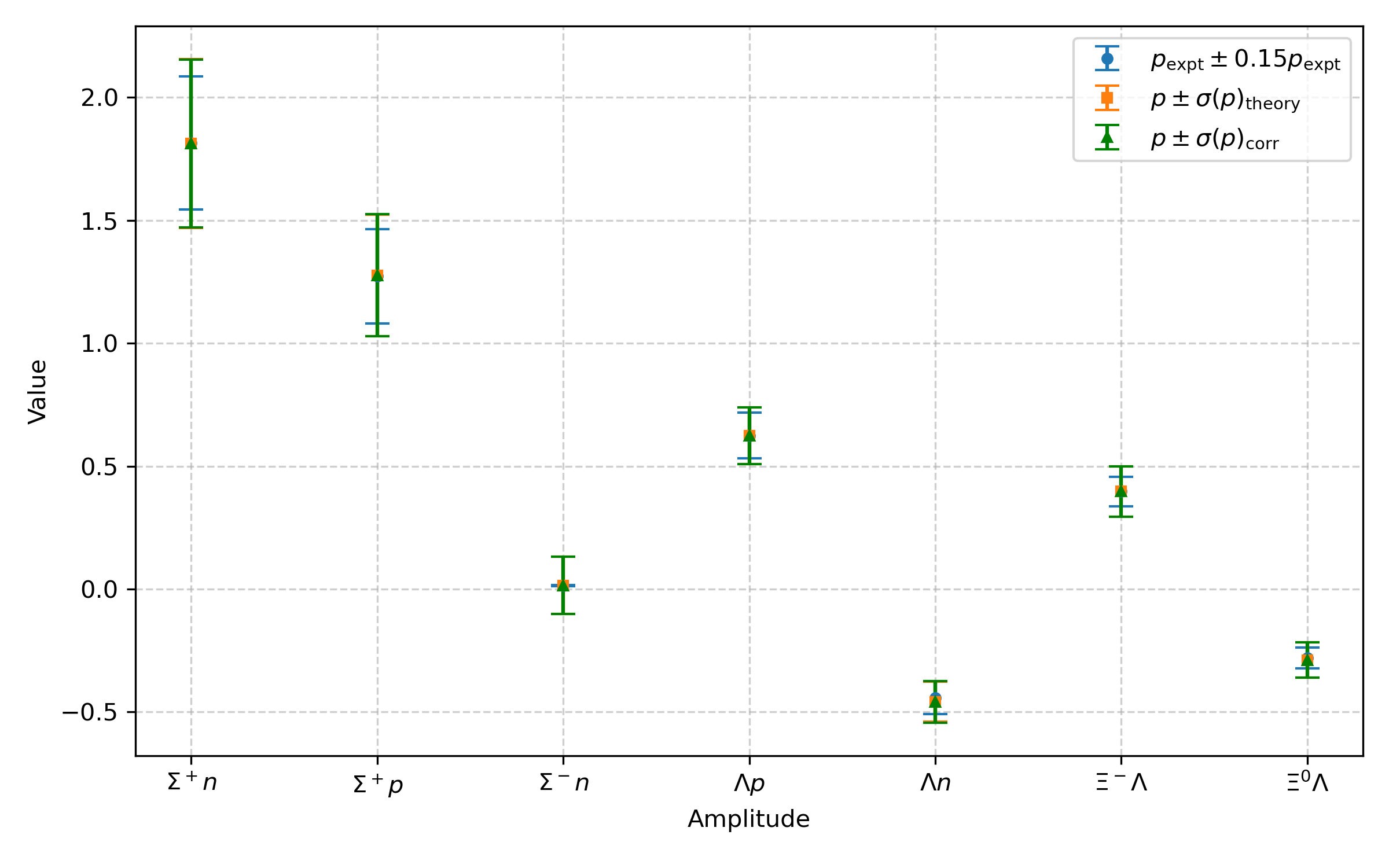
Figure 1: Results of the combined fit to the 1/2+8-wave amplitudes for the isospin-decomposed data, showcasing compatibility between the theoretical model (including resonance effects) and experimental extractions.
Numerical Results and Model Assessment
The best fit, utilizing relativistic EOMS ChPT with explicit resonance contributions, demonstrates the following features:
- The NLO resonance-saturated terms are numerically dominant, frequently exceeding the tree-level and loop components (as illustrated in Figure 2 and Figure 3).
- The theoretical description matches the experimental amplitudes for all measured decays within estimated uncertainties, with a reduced 1/2+9 close to unity.
- The inclusion of decuplet baryons as explicit degrees of freedom in loops is found subdominant compared to the resonance-exchange mechanisms.
- The fitted weak LECs show correlations and relatively large uncertainties, reflecting both the slow convergence of the underlying chiral expansion and the non-negligible theoretical error budget.
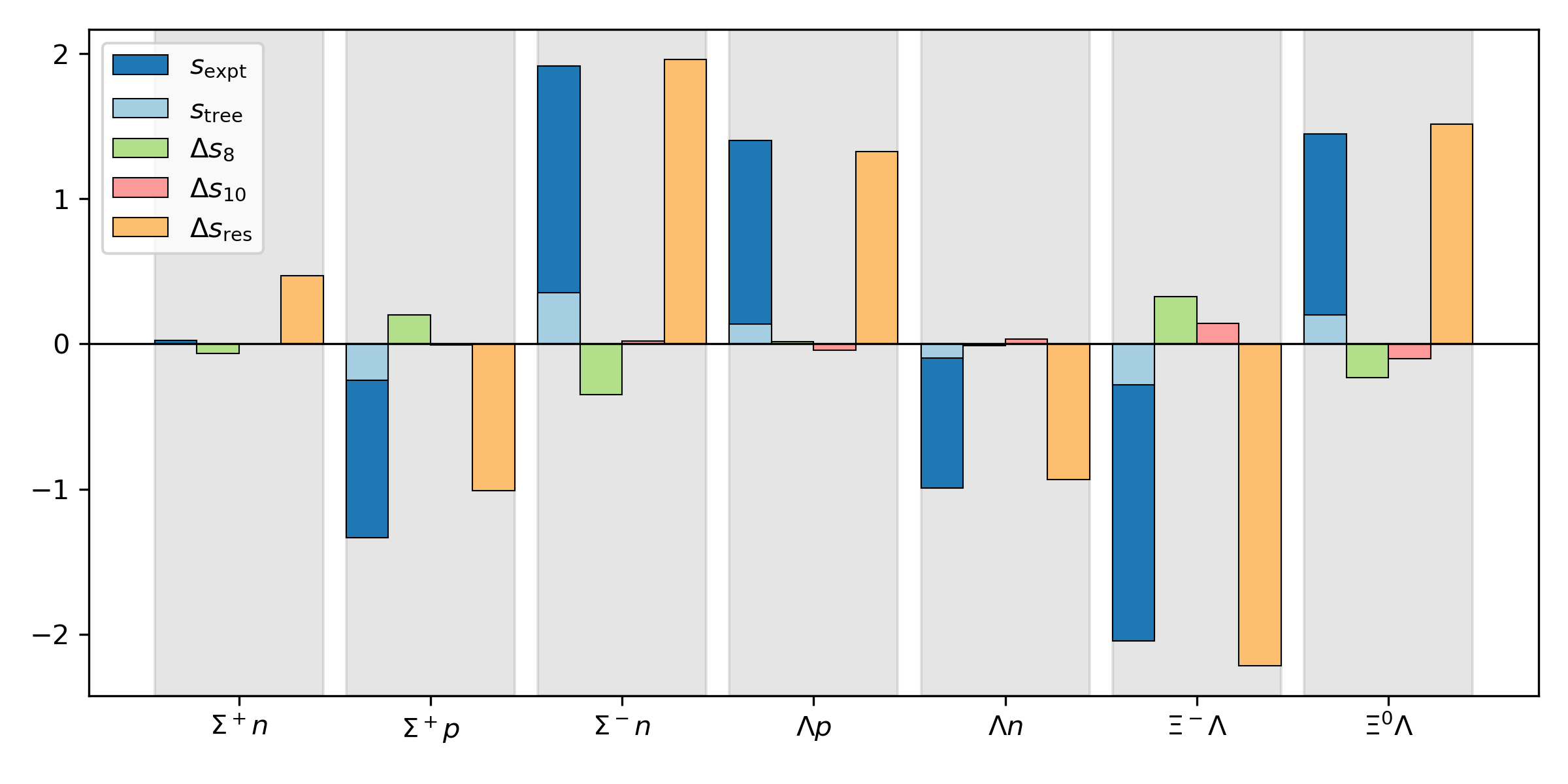
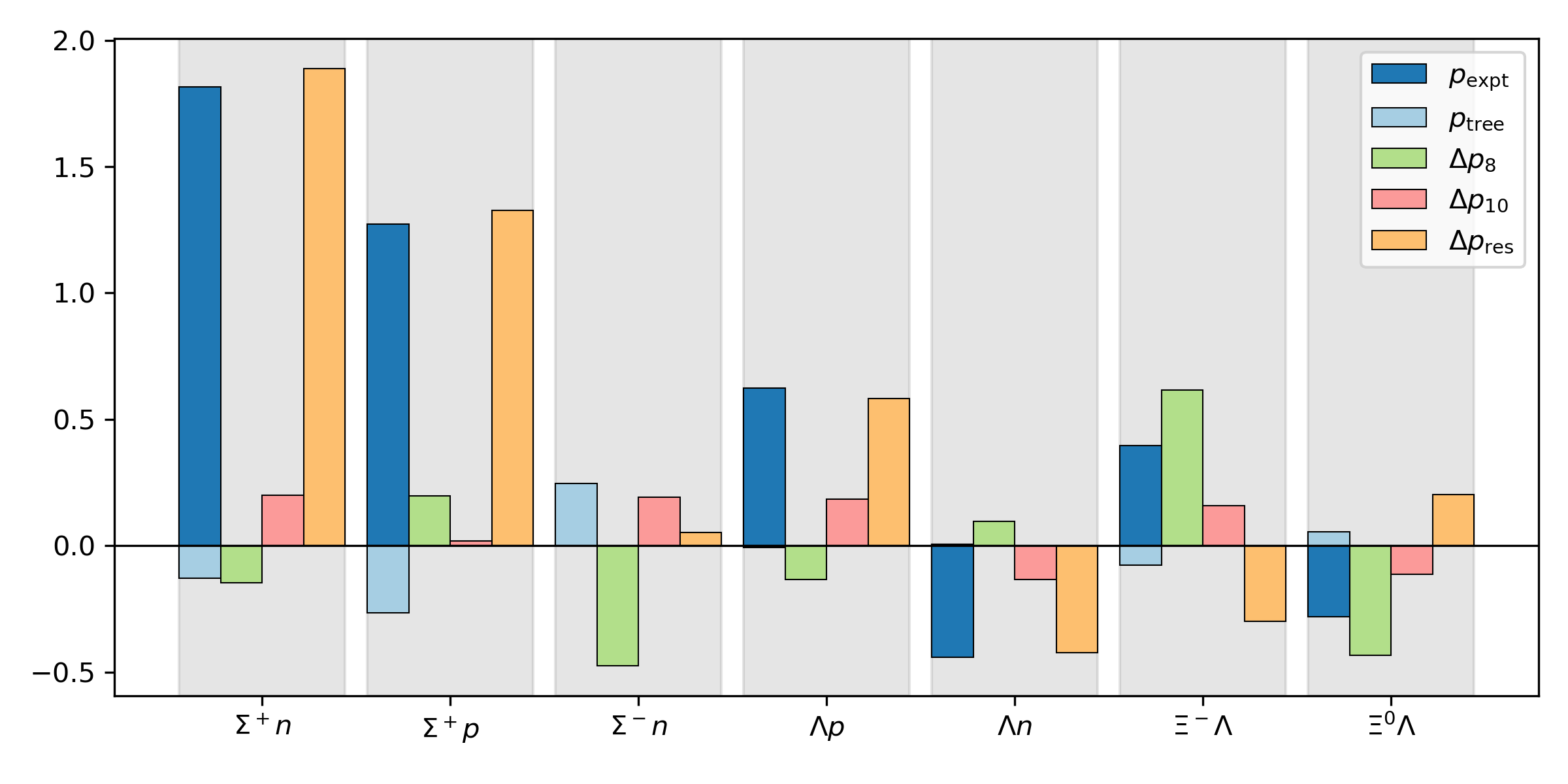
Figure 2: Size comparison of s0 to the various chiral and resonance contributions to the physical amplitudes, explicitly demonstrating the dominance of the resonance-exchange terms.
Theoretical and Practical Consequences
This study substantiates that resonance exchange saturates the weak NLO LECs governing hyperon non-leptonic decays. The slow convergence of the chiral expansion, as manifest in the large-size NLO effects, highlights the necessity of extending relativistic ChPT by either incorporating more resonance degrees of freedom dynamically or pushing the chiral expansion to higher orders.
The critical dependence on resonance saturation implies that approaches neglecting resonance physics, or those using only heavy-baryon approximations, systematically miss dominant contributions to both s1- and s2-wave amplitudes and cannot adequately account for modern experimental data.
The explicit separation of s3 and s4 amplitudes and their individual extraction from data enables targeted theoretical modeling. Embedding the resonance mechanism within a covariant, power-counting-consistent ChPT framework closes previous loopholes in the non-relativistic paradigm and provides a foundation for robust predictions in related baryonic weak processes.
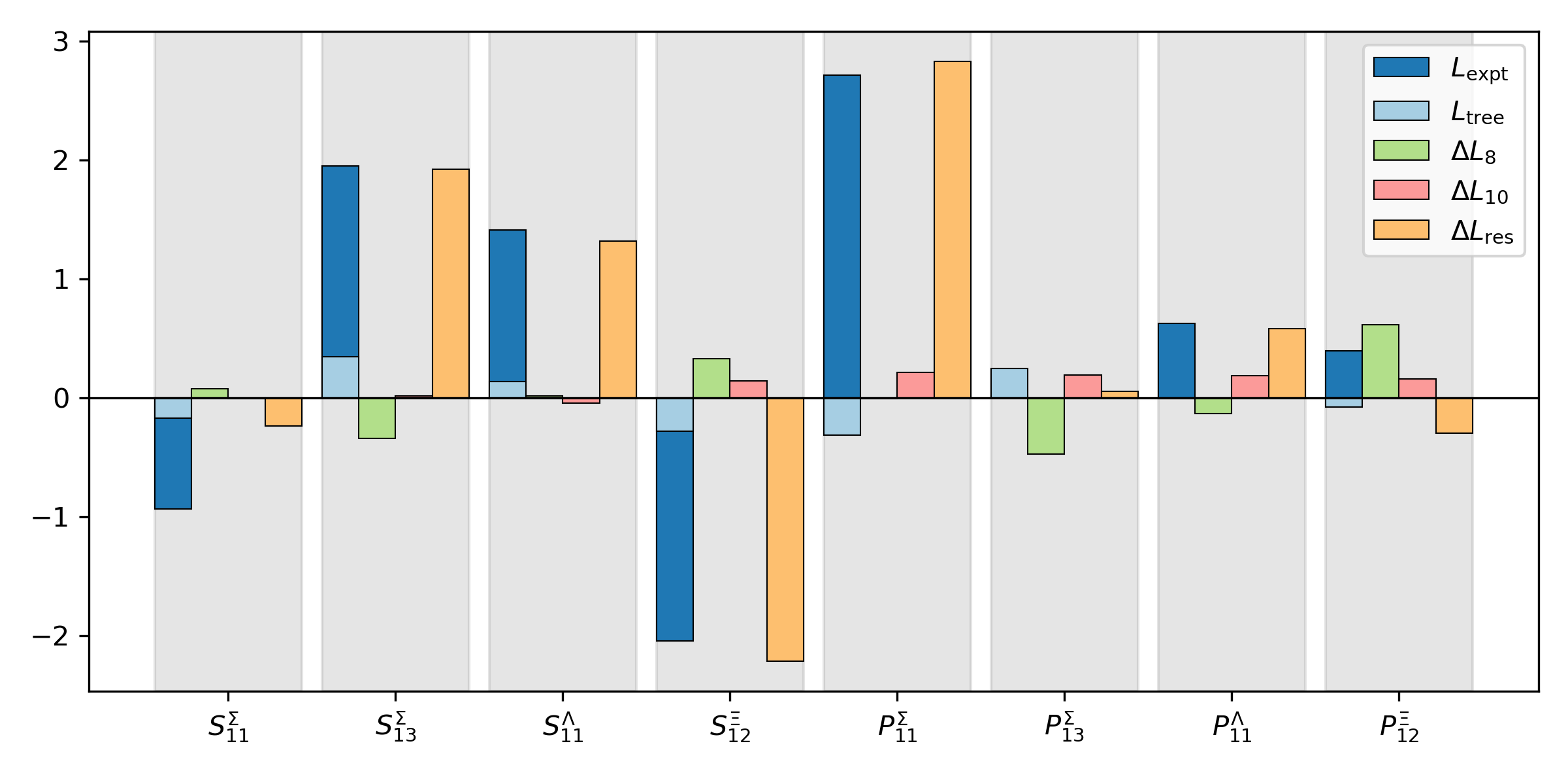
Figure 3: Size comparison of s5 to the various chiral and resonance contributions to the isospin amplitudes, further emphasizing the crucial role of resonance saturation at NLO.
Outlook and Future Directions
This formalism suggests that future work should address:
- Inclusion of higher mass resonance effects and possibly the explicit dynamical treatment of the low-lying s6 and s7 octets in loops to further enhance convergence.
- Systematic study of weak radiative and semileptonic hyperon decays with the same framework, as the dominance of resonance-saturated NLO LECs may extend to other weak hyperon processes.
- Exploration of the interplay between model-based resonance saturation and unitarized ChPT approaches, particularly in channels where resonances are dynamically generated.
The results have practical implications for the development of lattice QCD calculations which may, in the future, provide independent constraints on weak LECs and test the resonance saturation hypothesis.
Conclusion
This work establishes that the inclusion of resonance-saturated NLO counterterms within a relativistic, power-counting-robust ChPT framework is essential for a simultaneous and quantitatively accurate description of s8- and s9-wave hyperon non-leptonic decays. The results demonstrate the central numerical relevance of low-lying baryon resonances. The methodology and results set the standard for future effective field theory analyses of baryon non-leptonic processes and motivate further theoretical and experimental advances.