- The paper demonstrates that a fully off-shell UχEFT framework captures the two-pole nature of the Λ(1405) via a systematic global fit to K⁻p scattering data.
- It shows that discrepancies in K⁻p femtoscopic correlations arise mainly from effective range differences rather than distinctive off-shell dynamics.
- The study reinforces the coupled-channel, dynamical origin of the Λ(1405) and outlines implications for hypernuclear physics and nonperturbative QCD.
Off-shell Chiral Dynamics and the Structure of the Λ(1405): Implications from K−p Femtoscopy
Introduction: Nonperturbative QCD in the Strangeness Sector
The KˉN low-energy interaction, and specifically the nature of the Λ(1405) resonance, constitutes a central testbed for nonperturbative QCD in the hadron spectrum. The Λ(1405), which lies close to the KˉN threshold, is widely interpreted within chiral SU(3) dynamics as a superposition of two coupled-channel poles. Disentangling the chiral, coupled-channel, and off-shell effects on the spectral and correlational observables is essential for the quantitative understanding of the resonance substructure and its manifestation in both femtoscopy and few-body nuclear systems.
The paper presents the first systematic investigation of the S=−1 meson-baryon interaction using a fully off-shell, covariant, unitarized chiral effective field theory (UχEFT) framework up to NLO, both for direct scattering observables and for femtoscopic two-particle correlation functions. This essay outlines the technical approach, principal findings, and theoretical implications, focusing on the role of off-shell effects in precision hadron spectroscopy and femtoscopy.
Framework: Covariant Off-shell UχEFT with Unitarization
The theoretical approach combines a covariant chiral Lagrangian up to O(p2) with a fully off-shell, momentum-dependent Bethe-Salpeter equation. Both LO (Weinberg-Tomozawa, WT) and NLO chiral structures are included, with all off-shell dynamics regularized by finite-range form factors. The amplitudes are subject to a global fit including total cross sections for all open K−p0-induced channels, threshold branching ratios, and the K−p1 scattering length.
This off-shell approach is systematically contrasted with the conventional on-shell (factorized) approximation, which is common in previous literature but introduces unphysical left-hand analytic cuts, especially problematic for analyses near and below threshold.
The results of the parameter fit reveal a robust agreement with all salient K−p2 scattering and subthreshold amplitude data, with the off-shell framework eliminating all spurious left-hand analytic structure inherent to the on-shell reductions.
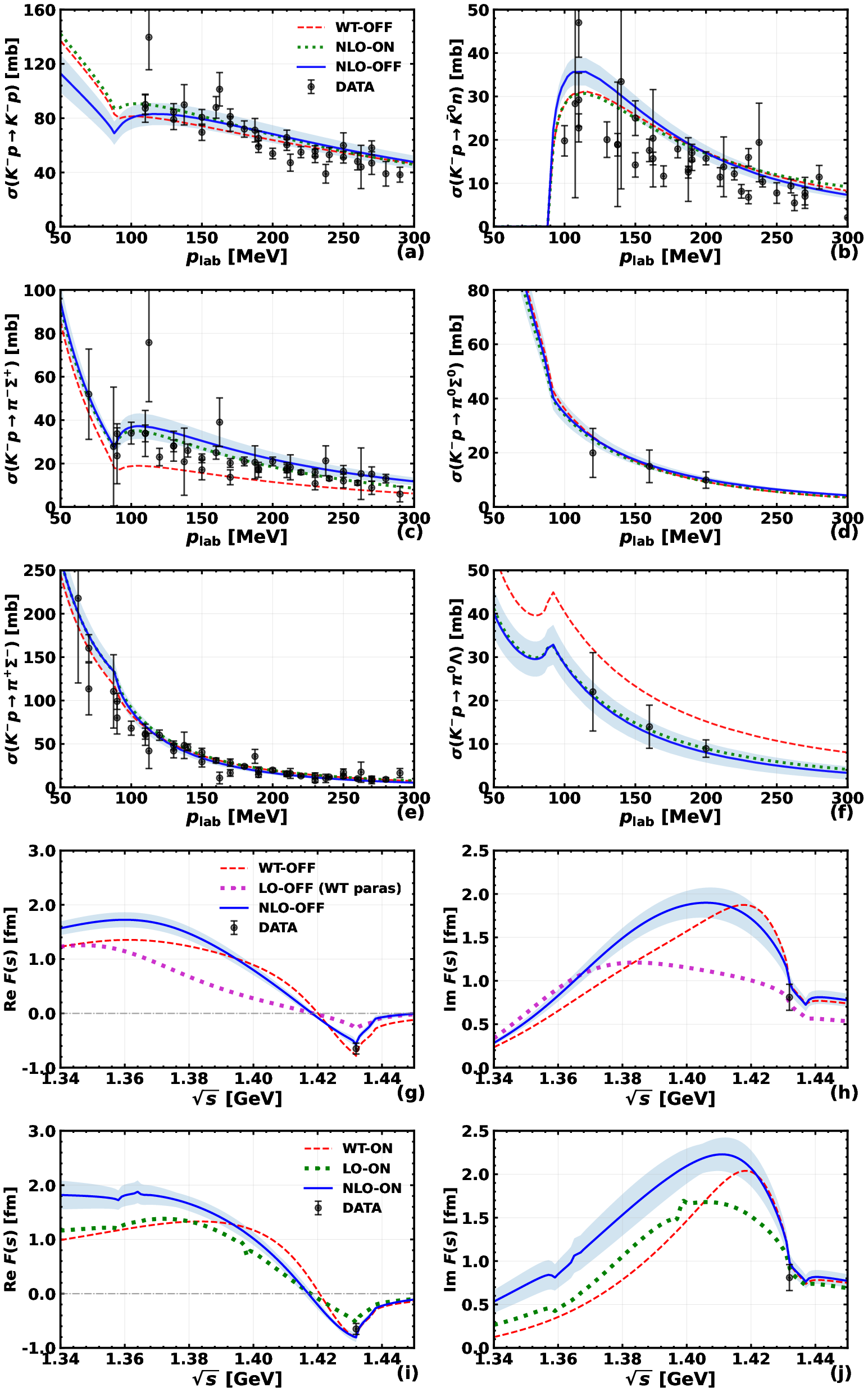
Figure 1: Global fit results for K−p3 scattering and subthreshold dynamics, comparing experimental data and UK−p4EFT predictions at WT and NLO, with the off-shell formulation yielding smooth subthreshold amplitudes.
Spectral Structure: Two-Pole Nature of the K−p5
The extracted complex-energy pole structure confirms the dynamical generation of two isospin-zero hyperon states: a lower pole, K−p6, predominantly coupled to K−p7, and a higher pole, K−p8, with substantial K−p9 content. The off-shell and on-shell schemes yield highly consistent results for the pole positions at NLO, while the off-shell treatment avoids spurious subthreshold discontinuities and ensures improved analytic control.
The pole positions and residues at NLO in the off-shell scheme are:
- KˉN0: KˉN1,
- KˉN2: KˉN3,
with strong coupling constants to KˉN4 and KˉN5 channels that confirm the coupled-channel dynamical origin of both poles.
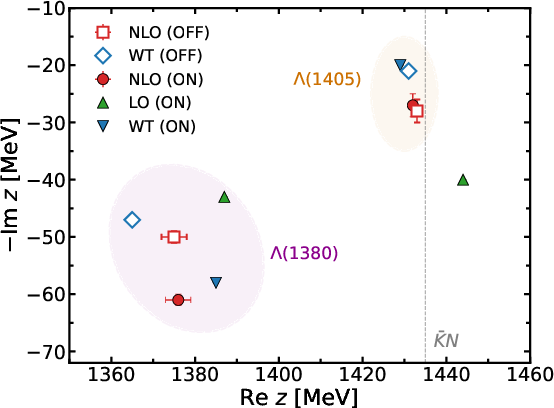
Figure 2: Pole positions of the KˉN6 and KˉN7 in the complex energy plane, indicating the stability and two-pole structure across different chiral orders and off/on-shell schemes.
Off-shell Effects in Femtoscopic Correlation Functions
The two-particle correlation function (CF) formalism connects the underlying KˉN8 interactions with short-range hadronic emission phenomena in KˉN9 collisions, notably measured by the ALICE collaboration. Here, the off-shell unitarized amplitudes are coupled to both Λ(1405)0 and Λ(1405)1 CFs calculated in the Koonin-Pratt formalism, incorporating source radius and channel mixing weights.
At the WT level, the off-shell and on-shell correlation functions are virtually indistinguishable, as the global parameter fit reabsorbs off-shell distinctions, yielding matching low-Λ(1405)2 behavior.
At NLO, noticeable deviations between off-shell and on-shell results emerge only for Λ(1405)3 CFs at low relative momentum (near threshold), attributable not to explicit off-shell dynamical features but to differing scattering lengths and fit parameters resulting from each regularization. This is substantiated by reconstructing the CFs via the on-shell Koonin-Pratt formula using the respective fitted scattering lengths.
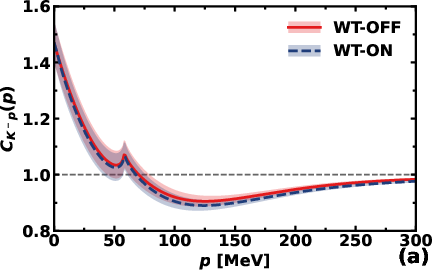
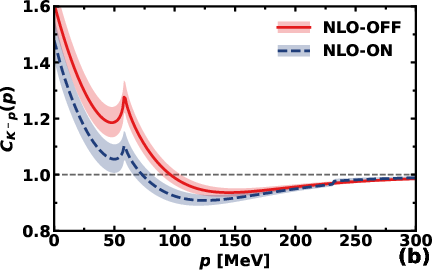
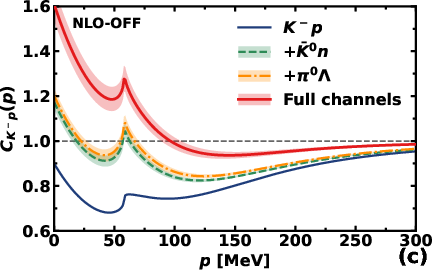
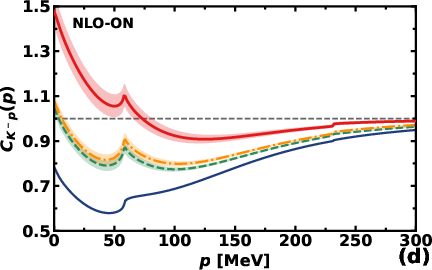
Figure 3: Λ(1405)4 CFs and the impact of off-shell dynamics for Λ(1405)5~fm, comparing off-shell and on-shell frameworks at both WT and NLO, with channel-by-channel decompositions.
Disaggregating the channel contributions demonstrates that the near-threshold discrepancy in CFs originates from the different Λ(1405)6 effective range parameters, not from any unique off-shell structure. The effect essentially vanishes for Λ(1405)7 CFs, confirming that off-shellness is not directly observable in the present two-body correlation observables with the fitted interaction.
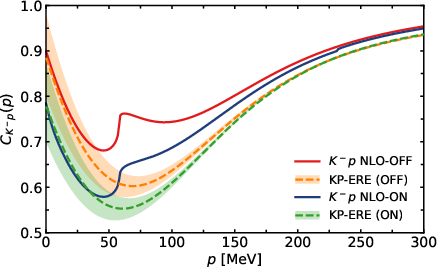
Figure 4: Comparison of the Λ(1405)8 single-channel CF between NLO off-shell/on-shell and the on-shell effective range parametrization, confirming discrepancies stem from different Λ(1405)9, not off-shell effects.
Comparison with Experimental Femtoscopy and Source Function Uncertainty
Fits to high-precision ALICE Λ(1405)0 CF measurements reveal that within current experimental uncertainties, both on-shell and off-shell schemes can accommodate the data equally well by adjusting the source radius Λ(1405)1 and channel weightings. The extracted Λ(1405)2 is sensitive to the assumed Λ(1405)3 weight, which is itself poorly constrained by current theory and data, leading to a degeneracy that masks possible genuine off-shell effects.
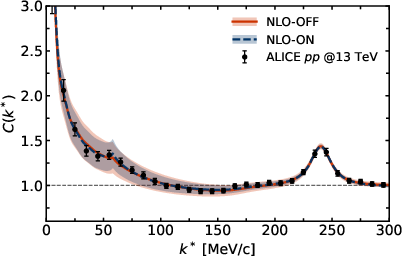
Figure 5: Comparison of the Λ(1405)4 correlation function Λ(1405)5 at NLO between the UΛ(1405)6EFT fit (off-shell and on-shell) and ALICE Λ(1405)7 collision data.
This strong interdependence between source parameters and the underlying off-shell interaction implies that, for the Λ(1405)8 system, off-shell ambiguities in the two-body Λ(1405)9-matrix are practically unresolvable from two-body femtoscopy alone. Instead, the CFs are predominantly sensitive to the fitted on-shell scattering parameters, and the profile of the source function remains entangled with the regularization prescription.
Broader Implications and Outlook
The manifest two-pole structure of the KˉN0, now shown to be insensitive to the off-shell or on-shell details of the unitarized chiral amplitude at NLO, reinforces its dynamical coupled-channel origin and indicates the robustness of chiral symmetry-breaking effects in baryon spectroscopy. The demonstrated absence of observable off-shell effects in two-body CFs highlights the limits of femtoscopic probes for model discrimination in the KˉN1 channel and suggests that three-body, nuclear-medium, or higher-order observables will be required to access genuinely off-shell dynamics.
From a theoretical perspective, the off-shell UKˉN2EFT formalism provides a fully analytic and systematic tool for future high-precision studies of strange nuclear systems, hypernuclei, and in-medium kaon condensation scenarios. Practically, further advances in the simultaneous extraction of source functions and scattering parameters—possibly utilizing joint theory-experiment machine learning frameworks—will be necessary for disentangling off-shell ambiguities from observable correlation data.
Conclusion
The study firmly establishes, within a fully off-shell and analytic chiral framework, that the qualitative features of the KˉN3 interaction and the coupled-channel structure of the KˉN4 are not affected by off-shell effects up to NLO, and that the primary observable consequences in femtoscopy arise from on-shell parameter adjustments dictated by global fits. Off-shell effects, though formally significant for analytic structure and higher-body applications, do not yield direct experimental signatures in current two-body femtoscopic observables. Future work will require more sophisticated experimental constraints and theoretical tools capable of simultaneously resolving the emission source profile and the short-range components of the hadronic interaction.
Reference: Off-shell Chiral Dynamics in the KˉN5 Resonance and KˉN6 Femtoscopic Correlations (2604.00791).