- The paper demonstrates that leading-order covariant ChEFT predicts Λ_c N correlation functions with distinct behaviors in singlet and triplet channels.
- The paper shows that S–D mixing critically drives a transition from weak attraction to repulsion in the triplet channel, aligning with lattice QCD phase shift data.
- The paper highlights that source-size dependence in femtoscopy can effectively discriminate short-range baryon interactions and reduce theoretical uncertainties.
Covariant Chiral Effective Field Theory Predictions for ΛcN Correlation Functions
Introduction
The theoretical study of the ΛcN interaction has become increasingly relevant due to the expected production of charmed hypernuclei at facilities such as FAIR and J-PARC. These systems are governed fundamentally by the ΛcN interaction, and detailed knowledge is required for the interpretation of anticipated femtoscopy experiments, which probe hadron-hadron correlations in high-energy collisions. Historically, phenomenological models and lattice QCD have offered contrasting predictions for the strength and nature of the ΛcN interaction. The recent application of covariant chiral effective field theory (ChEFT) allows systematic incorporation of relativistic corrections while maintaining chiral symmetry and provides a refined framework for theoretical predictions. This paper presents a comprehensive analysis of ΛcN correlation functions using leading-order covariant ChEFT, with particular emphasis on the sensitivity to coupled-channel effects and the distinction between singlet and triplet channels.
Theoretical Framework
The evaluation of two-hadron momentum correlation functions utilizes the Koonin–Pratt formalism, which integrates both the source geometry and final-state interactions:
C(p1,p2)∝∫drS12(r)∣Ψ(−)(r,k)∣2
The strong interaction components enter via the S-wave of the relative wave function, whose form is determined either through the solution of the Schrödinger equation or the Kadyshevsky equation for covariant ChEFT potentials. In practice, the interactions are derived from leading-order covariant ChEFT, combining four-baryon contact terms and one-meson exchange contributions. The fitting of the low-energy constants (LECs) is performed against HAL QCD lattice phase shift data at unphysical pion masses (mπ=410,570 MeV), then extrapolated to the physical pion mass. The inclusion of non-localities and S–D mixing inherent in the covariant approach yields pronounced sensitivity, especially in the triplet channel.
Fitting of ΛcN0 Interactions
The paper presents an updated fit of the covariant ChEFT LECs to HAL QCD lattice data. The fitting incorporates two strategies: one explicitly includes ΛcN1–ΛcN2 mixing (coupled channels), the other neglects these effects. The resulting ΛcN3-wave phase shifts for both singlet and triplet channels agree well with lattice simulations up to 30 MeV.
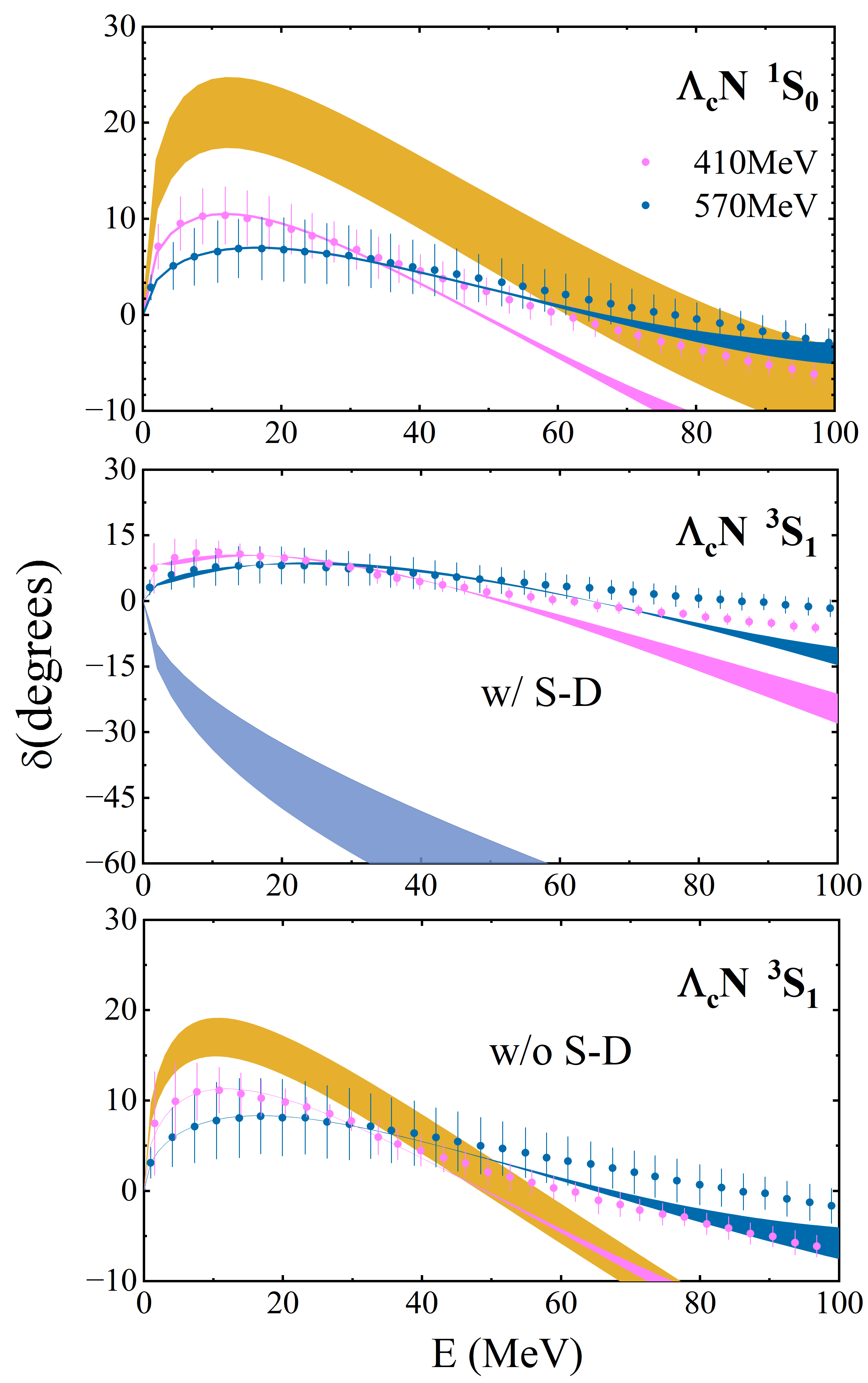
Figure 1: ΛcN4 ΛcN5-wave phase shifts from lattice QCD in comparison with ChEFT fits; extrapolation to the physical pion mass indicates moderate attraction in the singlet channel and strong sensitivity in the triplet channel to ΛcN6–ΛcN7 mixing.
Notably, the extrapolated ΛcN8 interaction remains moderately attractive at the physical pion mass, whereas the ΛcN9 channel exhibits a marked dependence on the coupled-channel treatment: explicit inclusion of ΛcN0–ΛcN1 mixing yields a repulsive phase shift, while omission leads to much weaker attraction. This dichotomy is a key result of the covariant formalism.
Correlation Function Predictions and Channel Sensitivity
Analysis of the ΛcN2 correlation functions reveals channel- and mixing-specific features:
- The ΛcN3 channel displays weak attraction in both strong-only and combined (strong+Coulomb) scenarios.
- The ΛcN4 channel is repulsive with ΛcN5–ΛcN6 mixing; without mixing, it is weakly attractive.
- The spin-averaged correlation function, dominated by the triplet weight, is repulsive when mixing is included; otherwise, it is weakly attractive.
The Coulomb repulsion is prominent in the ΛcN7 system and suppresses the correlation function at low relative momentum, with the strong interaction contribution significantly weaker than for ΛcN8, resulting in a shifted and diminished peak.
Source Size Dependence and Discriminating Power
The dependence of correlation functions on source radius (ΛcN9 fm) is systematically explored. As ΛcN0 increases, the strong interaction effects are diluted and the curves approach the pure Coulomb limit. Small-source femtoscopy retains sensitivity to the covariant ChEFT dynamics and cutoff dependence, offering an experimental handle to probe short-range physics. Large sources primarily test Coulomb effects and long-range behavior.
Comparative analysis with non-relativistic ChEFT and phenomenological models demonstrates marked discrepancies: the CTNN-d potential predicts strong attraction and low-momentum enhancement, whereas non-relativistic ChEFT produces a shallow attractive correlation. The covariant ChEFT, with ΛcN1–ΛcN2 mixing, favors a smooth repulsive signature, inconsistent with bound state models.
Experimental and Theoretical Implications
These results highlight femtoscopy’s potential to discriminate between theoretical models of the charmed baryon-nucleon force. The sensitivity of the triplet channel to relativistic and coupled-channel effects underscores the necessity of a covariant description in the interpretation of forthcoming ALICE and RHIC femtoscopic data. The spin-averaged correlation consistently offers a robust probe of the triplet component due to statistical weighting. The theoretical uncertainties associated with regulator dependence are explicitly quantified, demonstrating that precision measurements at small source radii can constrain short-range dynamics and the role of ΛcN3–ΛcN4 mixing.
Conclusion
The systematic investigation of ΛcN5 correlation functions using covariant ChEFT establishes that:
- The singlet channel (ΛcN6) is moderately attractive;
- The triplet channel (ΛcN7) is highly sensitive to coupled-channel physics, with ΛcN8–ΛcN9 mixing driving a transition from weak attraction to repulsion;
- Spin-averaged correlation functions are repulsive in the presence of mixing, a contradictory claim relative to many phenomenological models predicting attraction or bound states;
- Source-size dependence indicates that small-source femtoscopy remains a viable discriminator for short-range interactions and theoretical uncertainties.
These conclusions provide a critical reference for the interpretation of charm-sector femtoscopic measurements and deepen the theoretical understanding of charmed baryon-nucleon dynamics. Future developments may include extending covariant ChEFT to higher orders, integrating additional channels, and refining lattice-QCD-informed fits at the physical pion mass for enhanced predictive power.