- The paper introduces a coupled dynamical Boltzmann transport framework that integrates long-range electron-phonon and electron-electron interactions in 2D materials.
- It employs dynamical screening via the RPA and anharmonic phonon decay in an iterative solution to accurately model transport lifetimes and mobility trends.
- Key numerical results reveal a significant mobility reduction and non-monotonic carrier density dependence, highlighting the shortcomings of static screening approximations.
Coupled Dynamical Boltzmann Transport in 2D Materials: Interplay of Long-Range Electron-Phonon and Electron-Electron Interactions
Introduction and Motivation
The paper "Coupled dynamical Boltzmann transport equations with long-range electron-phonon and electron-electron interactions in 2D materials" (2604.01746) develops and applies a general theoretical and computational framework to treat electronic transport in 2D semiconductors and their van der Waals heterostructures, beyond simplified approximations. The central advance is a coupled set of dynamical Boltzmann transport equations (BTEs) that self-consistently couple the out-of-equilibrium distributions of electrons and polar phonons, incorporating fully dynamical long-range electron-phonon (e-ph) and electron-electron (e-e) interactions with proper treatment of dimensionality and screening. This approach is motivated by the need to capture the complex interplay of polar phonons, conduction electrons, and electron-hole pairs in experimentally relevant doped and encapsulated 2D materials, including the non-Lorentzian character of phonon modes due to strong electron-phonon hybridization and dynamical screening.
The authors derive two coupled BTEs: one for electrons and one for electrodynamically-active bosonic modes (phonons, plasmons, electron-hole pairs). The electron scattering rate is formulated from the retarded electronic self-energy using the RPA-screened Coulomb interaction, where the total inverse dielectric function −Imϵtot−1(q,ω) encodes all relevant collective and single-particle modes. The formalism treats both the parabolic (model system) and realistic (VED, van der Waals electrodynamics) cases, enabling both analytic insight and first-principles computations.
The key equation for the electronic lifetime is: τk−1,el=ℏNq2πq∑∫dωsign(ω)A(ω)Im[−ϵtot−1(q,ω)vq/π]δ(ω+εk+q−εk)
where A(ω) is a combination of Fermi and Bose distributions.
An essential conceptual step is the identification of the correct way to treat long-range polar phonons in the presence of electronic screening. The authors emphasize that in 2D, LO-TO splitting vanishes at q→0, but at finite q and finite carrier densities, the Fröhlich coupling is strongly renormalized by the continuum of electron-hole excitations. The non-Lorentzian phonon lineshape that emerges requires a novel definition of the frequency/momentum sectors where anharmonic phonon decay can dissipate momentum and yield finite resistivity.
Dynamical Response and Spectral Features
The paper deeply analyzes the collective excitation spectra of representative 2D materials, emphasizing the interplay between polar phonons, plasmons, and the electronic continuum. The imaginary part of the total inverse dielectric function, −Imϵtot−1(q,ω), displays rich features:
- In the absence of free carriers, the response is dominated by well-defined phonon modes.
- At finite doping, anti-crossing between plasmon and phonon modes is observed, and the longitudinal phonon mode acquires a non-Lorentzian shape as it enters the electronic continuum.
- The spectral weight of phonons and electrons is dynamically redistributed. The paper provides a quantitative spectral decomposition (see definition and plots of the "phonon content" F(q,ω)).
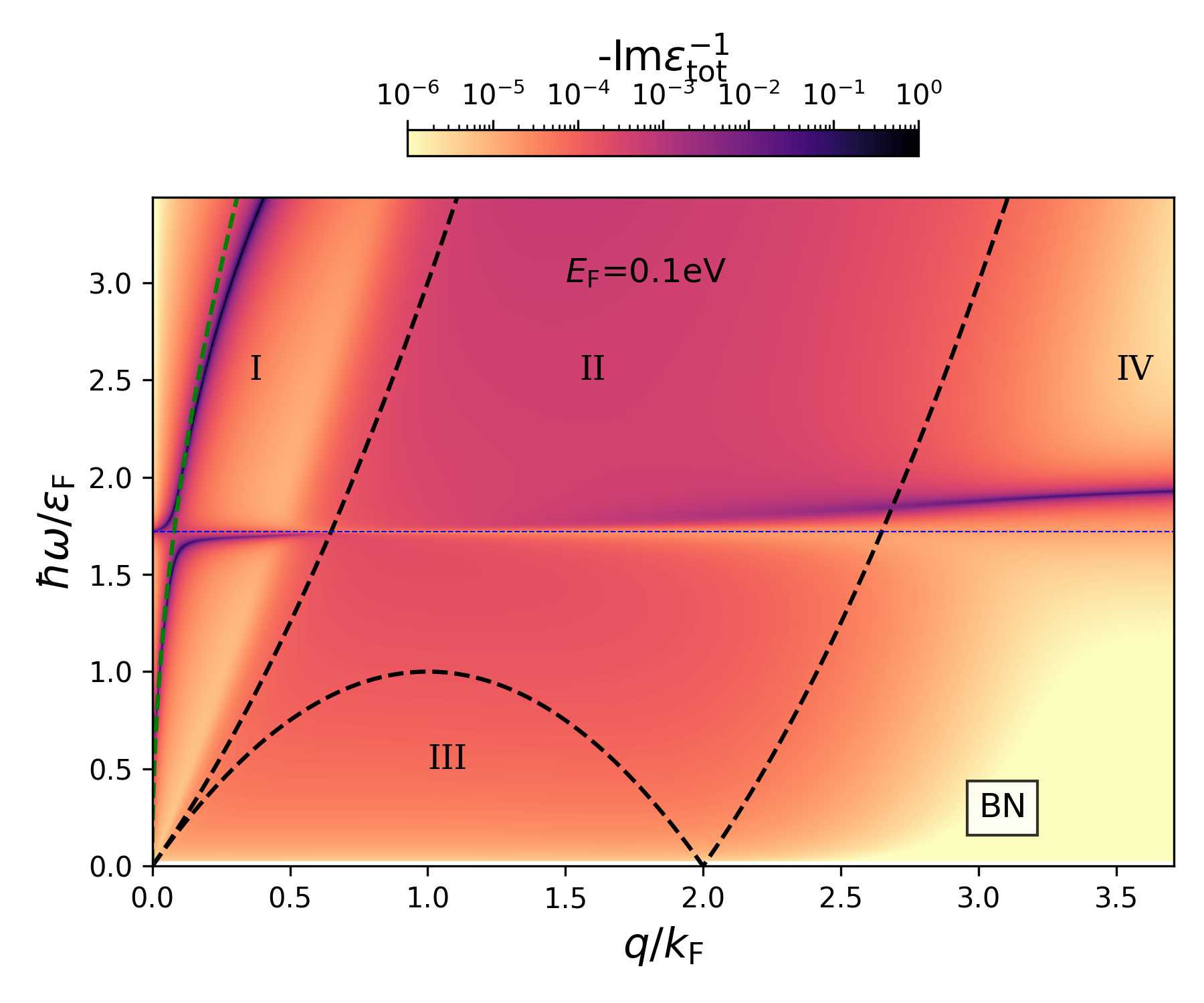
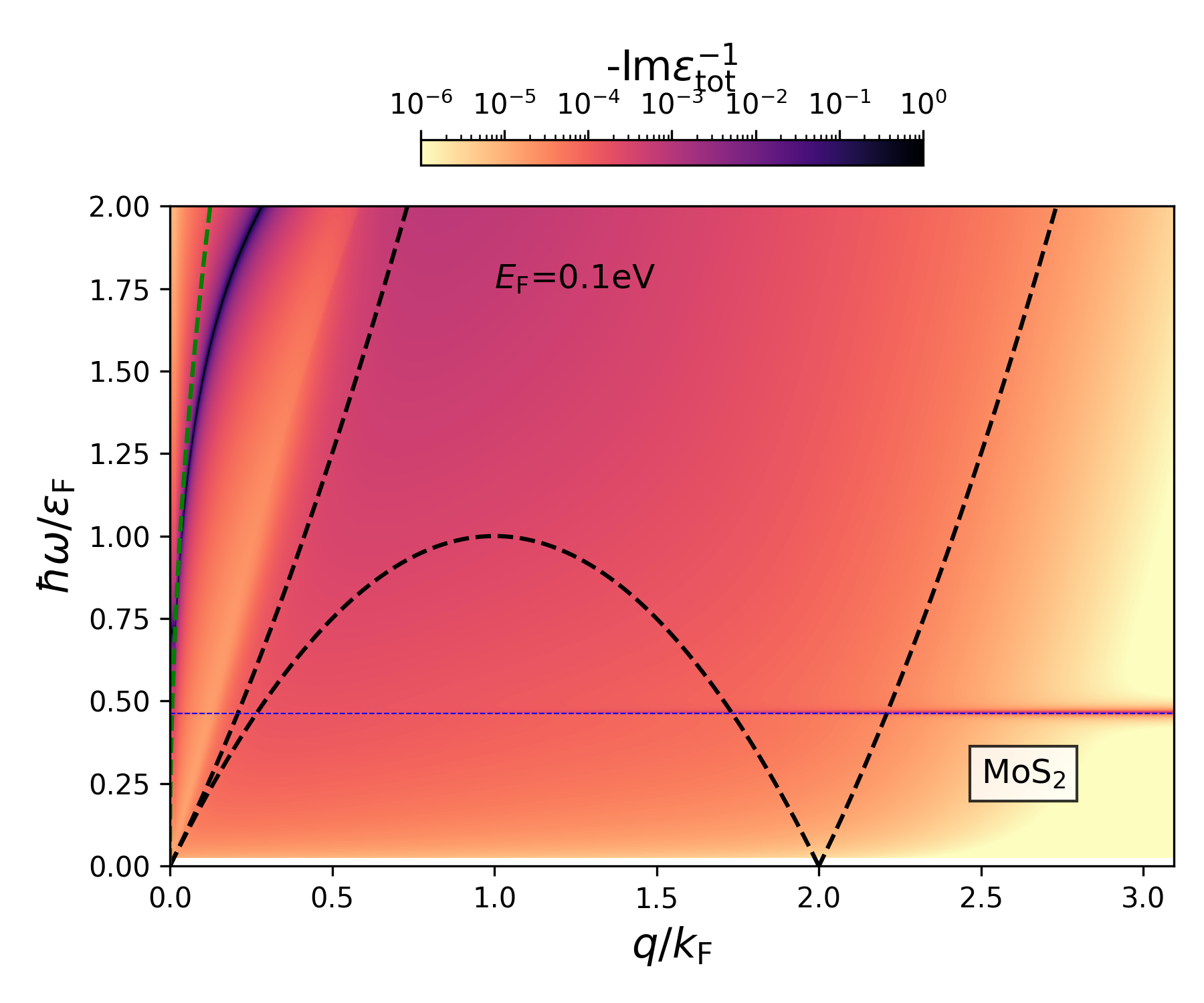
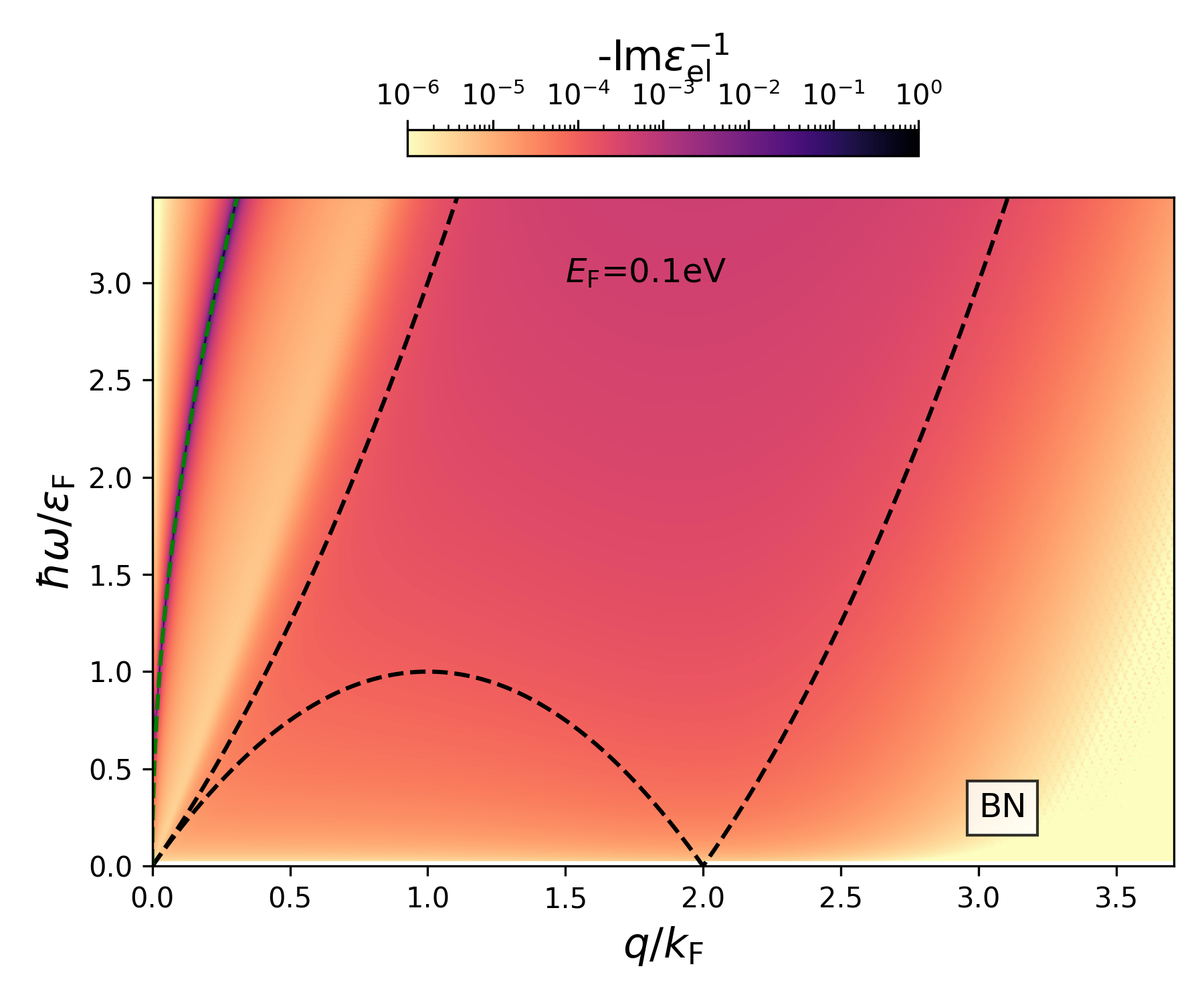
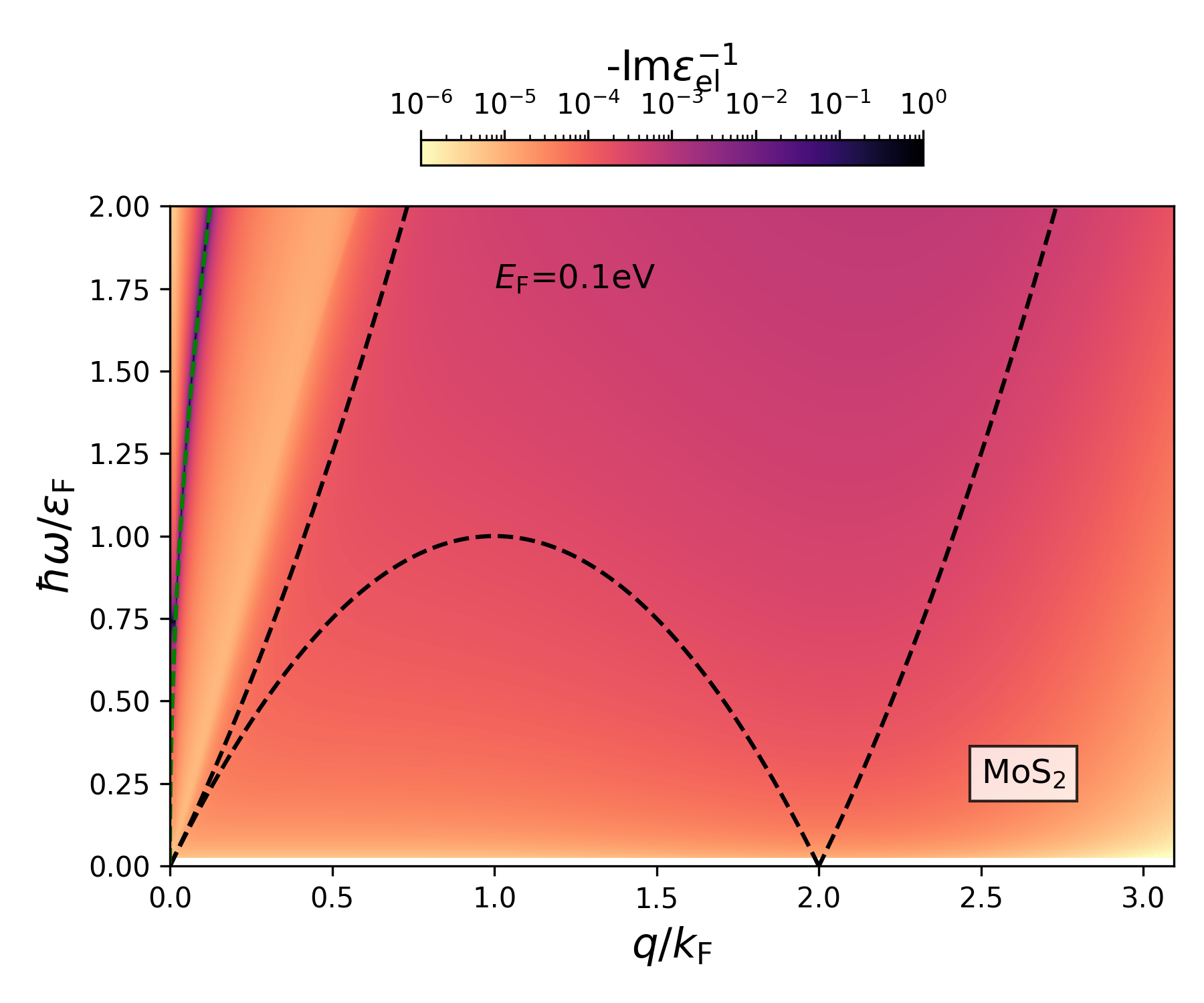
Figure 1: Map of −Imϵtot−1 as a function of frequency and momentum, illustrating the mode hybridization and electron-hole continuum boundaries in 2D h-BN and MoS2.
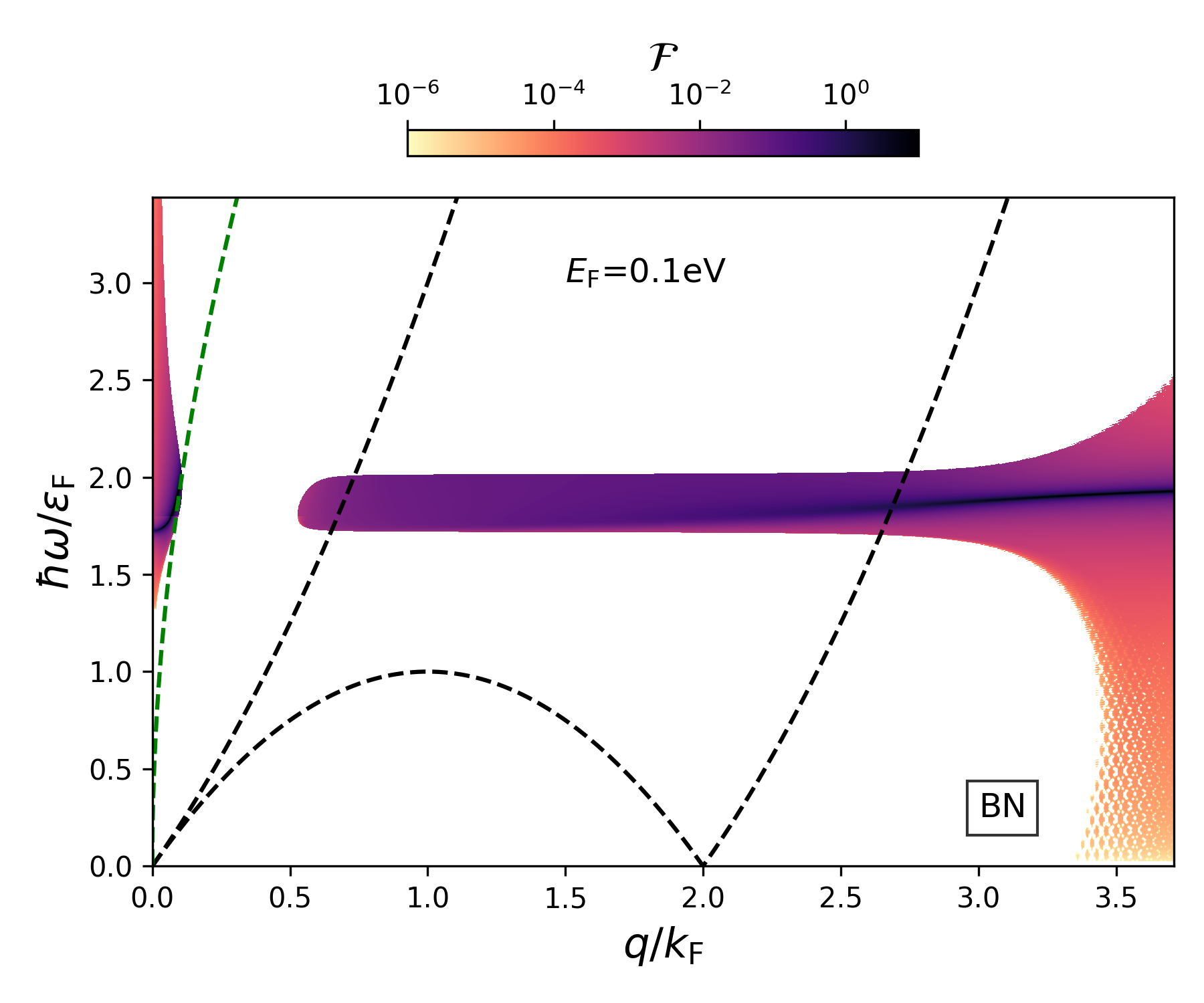
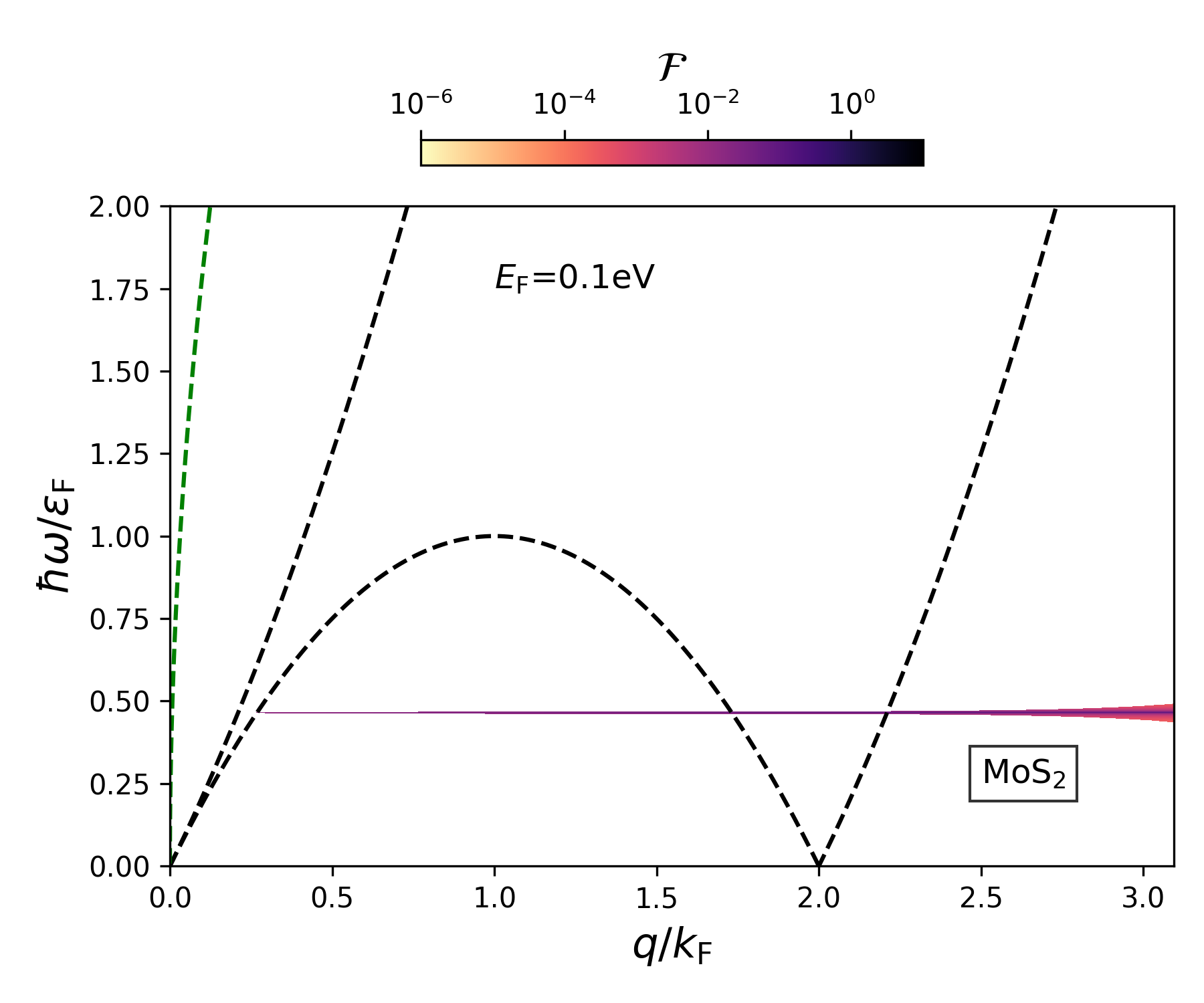
Figure 2: The phonon content F visualizes the localization of phononic character in the excitation spectrum, highlighting the non-Lorentzian and doping-dependent nature of phonon modes.
This decomposition is essential for correctly including anharmonicity and identifying the frequency-momentum regions where polar phonons actually contribute to momentum dissipation.
Iterative Solution of the Coupled BTEs
The computational procedure involves an iterative solution of the coupled electron and boson BTEs. Momentum dissipation is enabled via the introduction of an anharmonic phonon decay rate that operates only in regions of the spectrum with significant phonon content. Notably, in the absence of such scattering, the Peierls argument applies in the coupled BTE system: momentum cannot be dissipated by e-e or long-range e-ph scattering alone, reflecting the intrinsic conservation laws in a clean, defect-free crystal without Umklapp or anharmonicity.
The convergence properties of the iteration between electronic and phonon populations are systematically analyzed. Results demonstrate exponential convergence to the steady-state when momentum dissipation is present, and divergence in its absence, as required by theory.
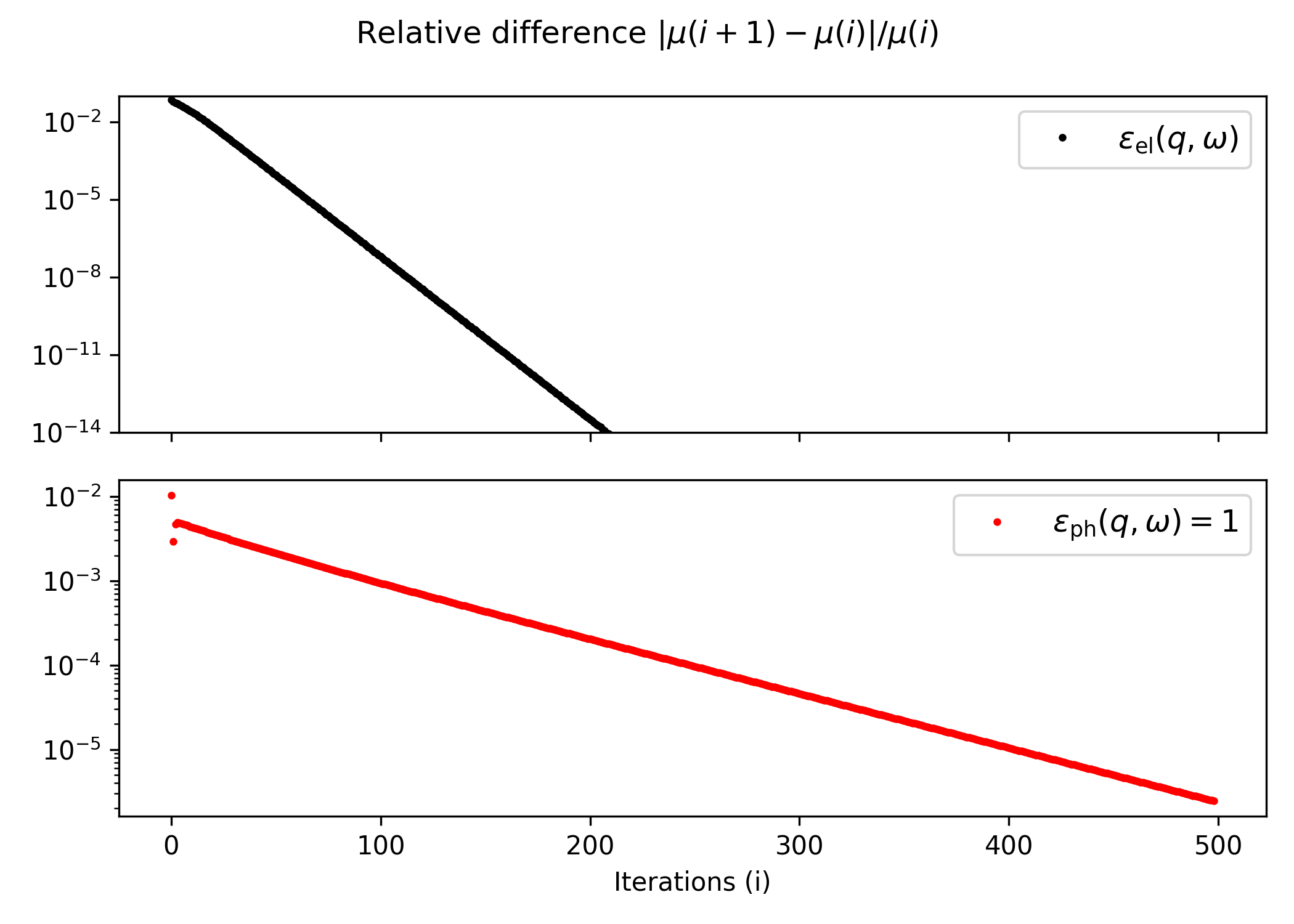
Figure 3: Convergence of the coupled BTE solution is achieved with both e-ph and e-e scattering present; without anharmonic dissipation, the system fails to reach a finite resistivity steady state.
Mobility Results: Impact of Dynamical Screening and e-e Interactions
The authors compute phonon-limited carrier mobilities in model 2D semiconductors (h-BN, MoSτk−1,el=ℏNq2πq∑∫dωsign(ω)A(ω)Im[−ϵtot−1(q,ω)vq/π]δ(ω+εk+q−εk)0) for several levels of dynamical sophistication in the screening and interaction treatment:
- "Unscreened coupling": static dielectric background only; no electronic screening of the e-ph vertex.
- "Statically screened coupling": e-ph interaction screened with the electronic response at τk−1,el=ℏNq2πq∑∫dωsign(ω)A(ω)Im[−ϵtot−1(q,ω)vq/π]δ(ω+εk+q−εk)1.
- "Dynamically screened coupling": full frequency-dependent electronic screening by itinerant carriers; coupled e-ph and e-e dynamics.
A central outcome is the quantitative demonstration that dynamical screening and e-e interactions introduce strong, non-monotonic, and material-dependent corrections to mobility compared to the common static or unscreened approximations. At relevant dopings, dynamic effects can enhance or reduce the computed mobility by factors much larger than previously considered. The "flattening" of the τk−1,el=ℏNq2πq∑∫dωsign(ω)A(ω)Im[−ϵtot−1(q,ω)vq/π]δ(ω+εk+q−εk)2 curves and the change in the location and character of minima (characteristic of polar phonon emission thresholds in Fröhlich systems) further illustrate the substantial change in the non-equilibrium carrier distribution resulting from the full dynamical theory.
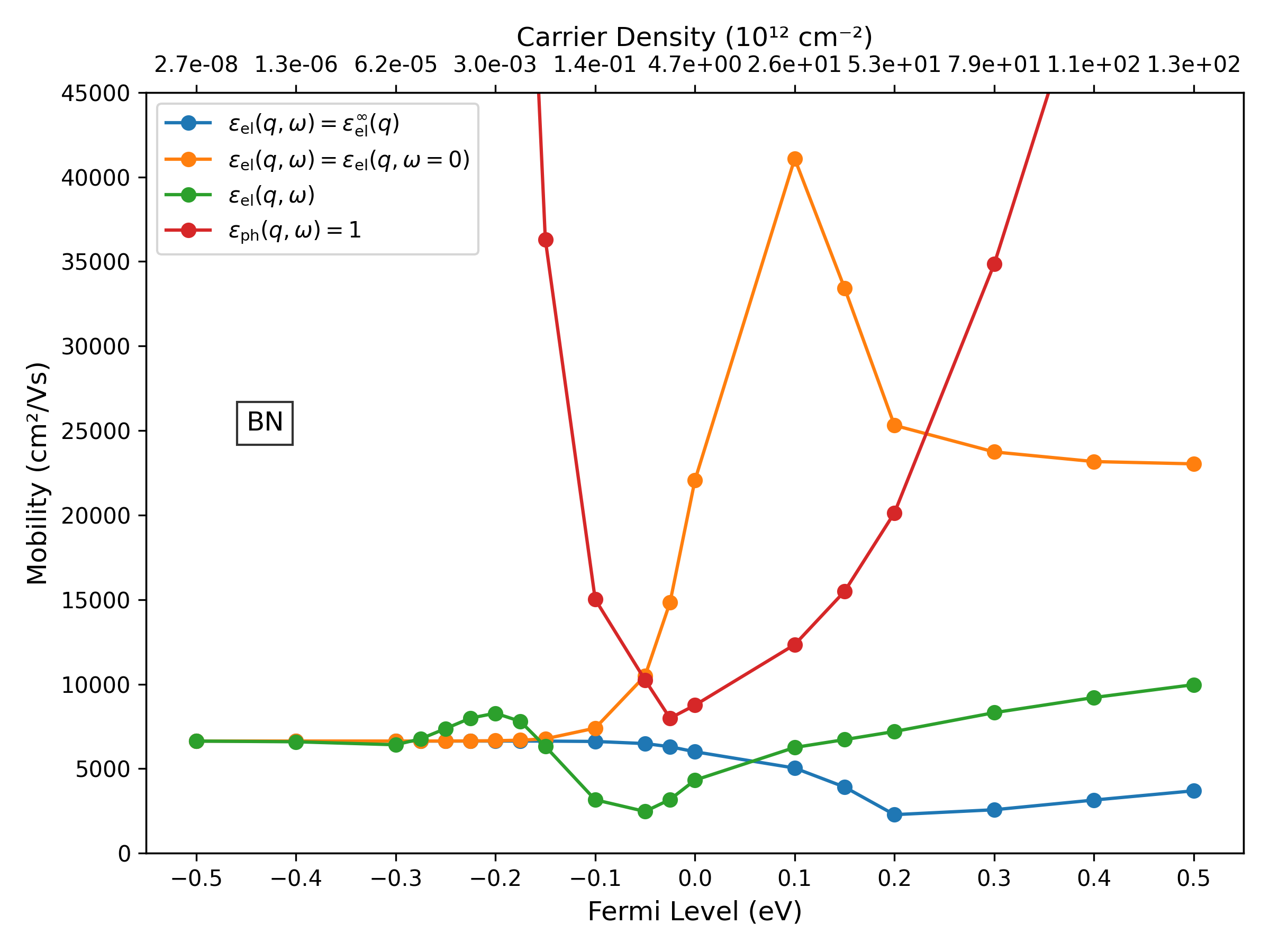
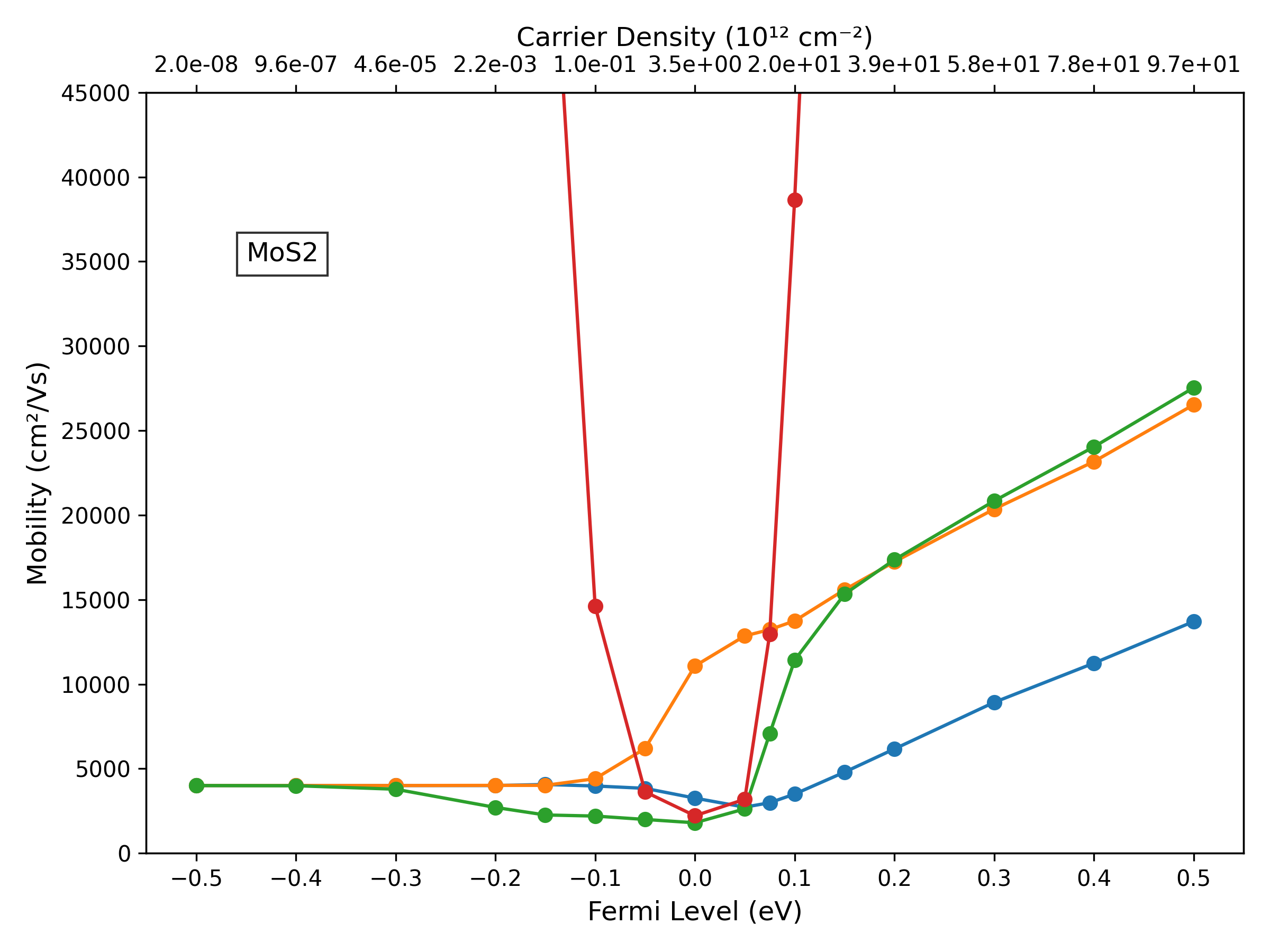
Figure 4: Phonon-limited mobility at room temperature for BN and MoSτk−1,el=ℏNq2πq∑∫dωsign(ω)A(ω)Im[−ϵtot−1(q,ω)vq/π]δ(ω+εk+q−εk)3, highlighting the suppression and reshaping of mobility as a function of doping when dynamical screening and e-e interactions are properly included.
The analysis isolates "direct" and "indirect" momentum relaxation effects—dynamical screening not only modifies the matrix elements but, via e-e and electron-hole pair excitations, facilitates indirect momentum re-shuffling that dampens non-equilibrium carrier population features and smooths the energy dependence of τk−1,el=ℏNq2πq∑∫dωsign(ω)A(ω)Im[−ϵtot−1(q,ω)vq/π]δ(ω+εk+q−εk)4.
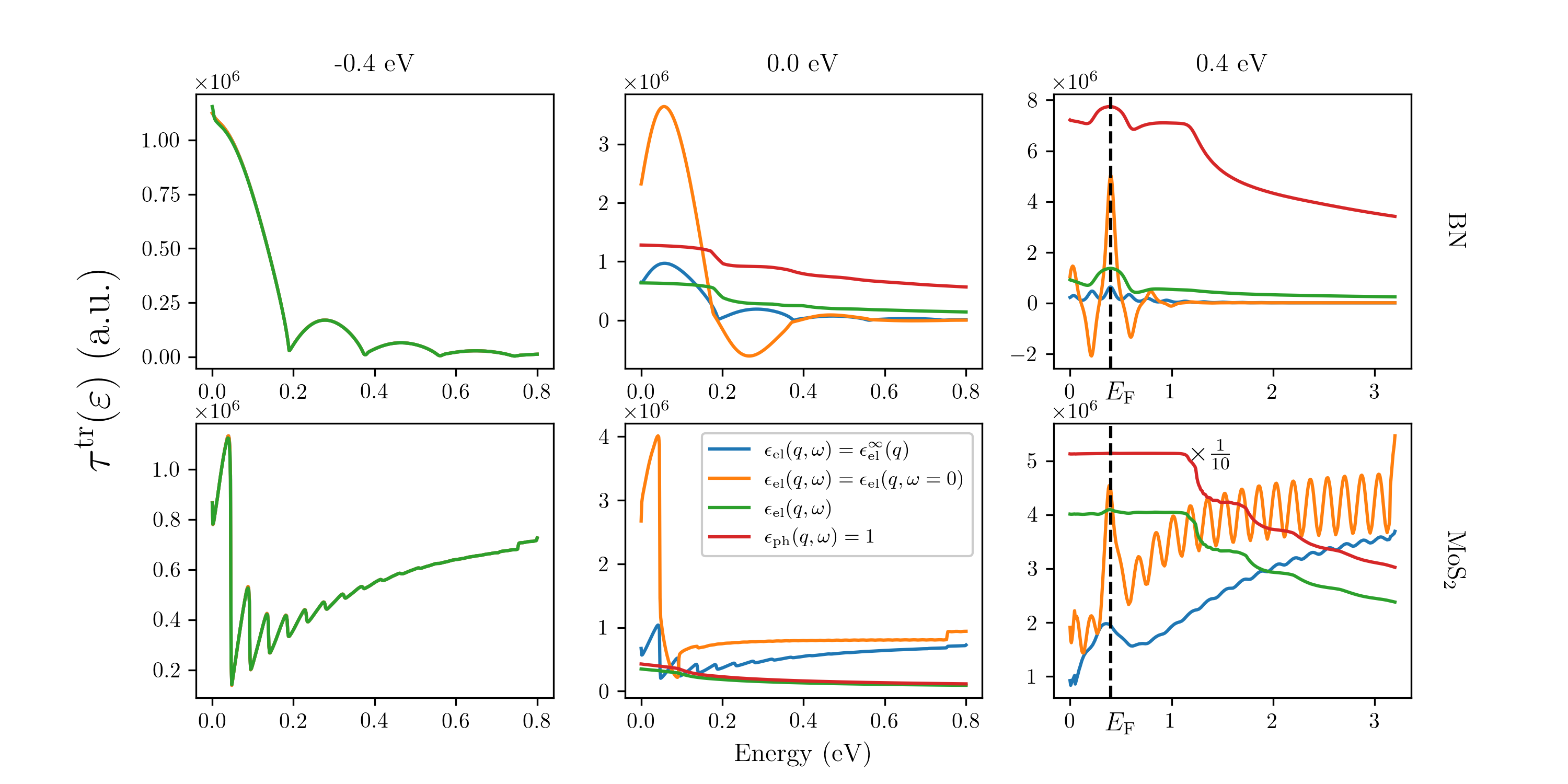
Figure 5: Energy dependence of the electronic transport lifetime under different screening and interaction scenarios, emphasizing the flattening and shifting of scattering features under dynamical coupling.
Realistic Heterostructures and Generalizations
The framework is systematically extended to van der Waals heterostructures through the VED approach. The case of BN-encapsulated graphene is explicitly discussed, with spectral and mode-resolved electron-phonon–plasmon couplings computed layer by layer, including both in-plane (LO) and out-of-plane (ZO) polar phonons.
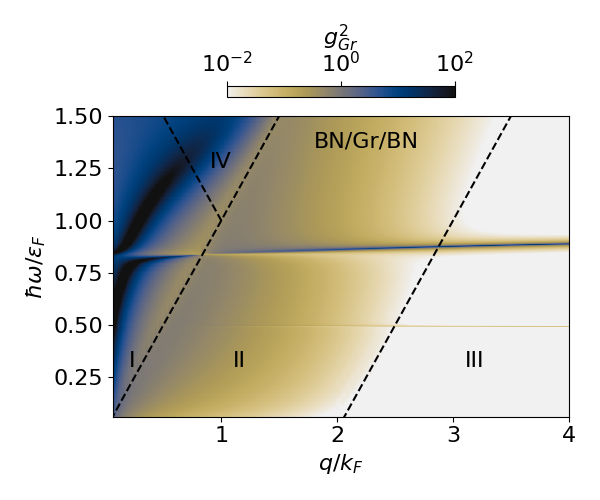
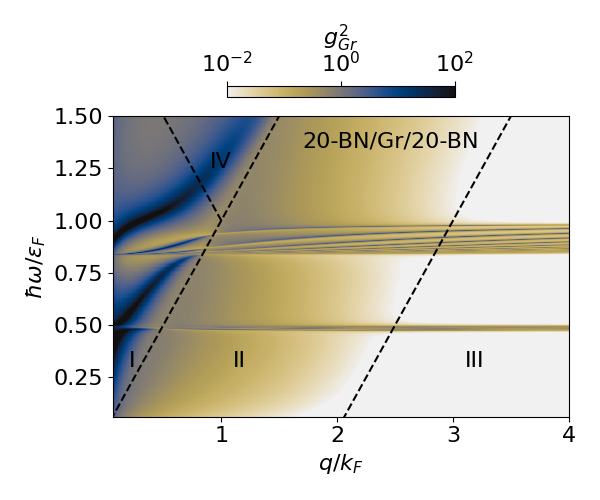
Figure 6: Layer- and mode-resolved electron-mode coupling in BN-encapsulated graphene, showing the multitude of interacting polar and electronic modes in a realistic heterostructure.
The formalism is general and equips the field with a path to ab initio, dynamical, and quantifiably accurate transport theory in complex, encapsulated, or doped 2D material platforms.
Theoretical and Practical Implications
This work rigorously proves that treatments neglecting dynamical screening and e-e interactions in polar 2D materials yield controlled but often large quantitative errors in mobility predictions. Particularly, the sensitivity of the full solution to carrier density—non-monotonic and material-dependent—is of immediate importance for both interpretation of experiments (where mobility benchmarks are used to claim "intrinsic" quality) and for predictive device design in high-performance 2D electron/hole gases, transistors, and optoelectronic platforms.
On the theoretical front, the necessity to abandon simple Lorentzian phonon lineshapes and Bloch's ansatz in transport regimes—notably at large τk−1,el=ℏNq2πq∑∫dωsign(ω)A(ω)Im[−ϵtot−1(q,ω)vq/π]δ(ω+εk+q−εk)5 and finite doping—clarifies a variety of previously ambiguous results regarding Fröhlich coupling, "remote" interface phonon scattering, and the ultimate limits of carrier mobility in 2D systems. Prospects for the inclusion of even more general band structures, vertex corrections, and further refinement of the treatment of anharmonicity and Umklapp processes are clearly delineated.
Conclusion
The rigorous coupled dynamical BTE framework introduced here, with its careful spectral resolution of both electron and polar phonon degrees of freedom—including all crucial dynamical screening and scattering channels—establishes a new reference standard for quantitative transport theory in 2D materials. The demonstrated failure of standard static and unscreened approximations at relevant doping levels mandates adoption of this or analogous methodologies for predictive computation of electron mobility, phonon drag, and related response functions in low-dimensional and heterostructured systems. The formal developments and computational tools are directly extensible to "real materials," with an immediate path to bench-marking against experiment and guiding next-generation device design.