- The paper reveals that the phonon thermal Hall effect in quartz is intrinsically linked to crystalline order and absent in amorphous silica.
- It employs high-precision thermal and magnetic field measurements to distinguish between phonon transport channels and validate Berry-phase coupling.
- Quantitative analysis shows a linear transverse response in quartz and a null result in silica, establishing benchmarks for thermal Hall studies in insulators.
Phonon Thermal Hall Effect in Quartz and Its Absence in Silica: An Expert Analysis
Introduction and Motivation
The investigation presented in "Phonon Thermal Hall Effect in quartz and its absence in silica" (2604.01908) addresses the origin and characteristics of the phonon thermal Hall effect (PTHE) in insulating solids, with a focus on comparative measurements in crystalline quartz and amorphous silica. Recognizing the ongoing debate and frequent attribution of PTHE to disorder or impurities, the authors aim to distinguish the effects of crystallinity and disorder on the emergence of thermal Hall transport by employing identically prepared samples and experimental apparatus, thereby eliminating significant confounding variables.
Experimental Strategy and Longitudinal Thermal Transport
The study juxtaposes two high-purity quartz crystals (distinguished by longitudinal thermal conductivity, i.e., degree of crystalline perfection) with a fused silica sample, all sharing the common SiO4 tetrahedral unit but differing fundamentally in long-range atomic arrangement. The comprehensive experimental configuration (one-heater, three-thermometer method) provides high-fidelity measurements of both longitudinal and transverse temperature gradients under applied magnetic fields.
The temperature dependence of the longitudinal thermal conductivity, κxx, displays canonical crystalline behavior in quartz, with a pronounced peak due to the suppression of Umklapp scattering as the temperature is reduced, followed by boundary-limited plateau at low-T. In contrast, silica exhibits a monotonic decrease in κxx with cooling, and distinctly lacks a phonon-Umklapp-dominated regime. The data in quartz agree quantitatively with prior benchmarks [Zeller & Pohl 1971], while the silica sample's conductivity strictly reflects glassy transport dominated by propagons, Rayleigh scattering, and diffusive modes.

Figure 1: Temperature dependence of longitudinal thermal conductivity in quartz and silica, with corresponding atomic structures illustrating periodicity versus disorder.
Transverse Thermal Transport: Evidence and Null Results
To probe the presence of PTHE, the study measures field-induced, odd (antisymmetric) components of the transverse temperature difference across the sample. For both quartz crystals, a finite, linear-in-field, antisymmetric transverse response is unambiguously detected, with amplitude correlated positively with crystalline quality. In silica, no measurable thermal Hall signal is discerned within the experimental noise floor, establishing a stringent upper bound and ruling out disorder-driven mechanisms for PTHE under these conditions.

Figure 2: Raw data for transverse temperature difference in two quartz crystals and one silica sample at T=15K, highlighting the antisymmetric component solely in quartz.

Figure 3: Temperature and field dependence of the transverse temperature gradient and the resulting thermal Hall conductivity.
The magnitude of the thermal Hall resistivity, W⊥/B≈10−6 m·K·W−1·T−1, is nearly identical for both quartz crystals, despite marked differences in longitudinal scattering rates. The thermal Hall angle, ∣κxy/κxx∣, peaks at a comparable temperature to the longitudinal conductivity, suggesting a universal relationship tied to normal (N) phonon-phonon collisions.

Figure 4: (a) Peak values of the thermal Hall angle and longitudinal conductivity; (b) Maximum normalized thermal Hall conductivity vs. longitudinal conductivity across insulators; (c) Thermal Hall resistivity as a function of T for quartz.
Disorder, Crystallinity, and Mechanistic Interpretation
The anti-correlation between disorder and PTHE amplitude supports the thesis that structural periodicity, rather than impurity-induced scattering, is essential for phonon Hall phenomena in insulators. This conclusion is reinforced by other material systems, such as SrTiOκxx0, Laκxx1CuOκxx2, and NiPSκxx3, where reduced crystalline quality corresponds to suppression or disappearance of PTHE. These results challenge models positing that impurity or charge defect scattering gives rise to PTHE, especially for non-magnetic, charge-neutral solids.
By comparing the experimental situation to the Senftleben-Beenakker (SB) effect in molecular gases, the paper highlights deep analogies: in both systems, heat transport occurs through channels that dissipate entropy differently and develop distinct couplings to the magnetic field. The SB effect, a well-characterized tensorial modification of thermal conductivity in polyatomic gases with field-induced precessional dynamics, is governed by the coupling of translational and rotational degrees of freedom to κxx4, and the emerging irreversibility hierarchy between channels.
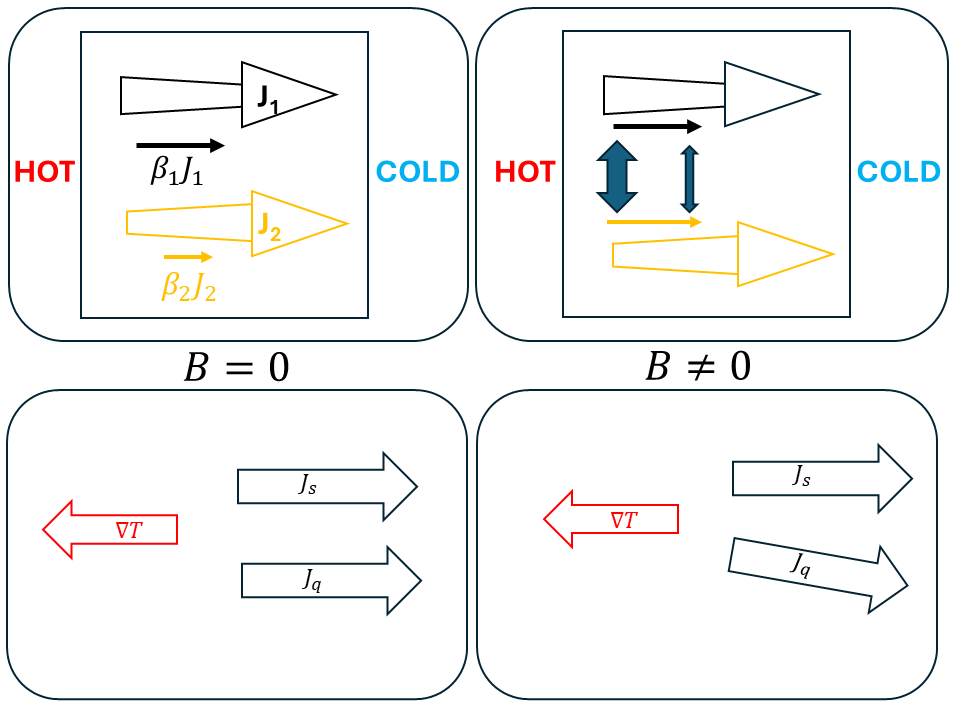
Figure 5: Schematic depiction of the misalignment between energy and entropy fluxes in the presence of a magnetic field for media with two heat transport channels.
Phonon Transport Theory: Two-Channel Paradigm
Taking the Callaway model as a theoretical starting point, the paper interprets phonon transport in terms of two populations: one dominated by normal (N) phonon-phonon scatterings, preserving crystal momentum, and one susceptible to Umklapp (U) processes, which generate entropy by violating momentum conservation. In this construction, energy flux arises from both populations, but entropy production is non-uniform, and crucially, the Berry-phase-like coupling to a magnetic field may differ by channel.
A sufficient, general set of conditions for observing PTHE thus emerges: (i) two non-equivalent energy/heat flow channels; (ii) disparate entropy production in each channel (i.e., irreversibility, as characterized by relaxation rates); and (iii) differential response to an external field. When these are met, energy and entropy currents are no longer collinear, resulting in a transverse thermal Hall effect even for neutral phonons.
Quantitative Model and Order-of-Magnitude Consistency
Pursuing a mechanistic estimate, the authors derive an expression for the transverse thermal resistivity, κxx5, based on the idea that the phonon heat flux induces a minute drift of lattice nuclei, which under an applied magnetic field, experiences a Berry force balanced by an entropic restorative force. The resulting formula,
κxx6
where κxx7 is the interatomic spacing and κxx8 is the sound velocity, yields values in excellent agreement with measurement for SiOκxx9 (quartz). This striking numerical correspondence underpins the claim that Berry-phase effects at the lattice scale, conditioned on crystalline symmetry and two-channel energy transport, are the dominant contributors to PTHE in non-magnetic insulators.
Experimental Techniques and Validation
The methodology features precise calibration and differential measurement techniques using Cernox thermometers, with careful minimization and characterization of spurious magnetoresistive and alignment-induced signals. The studied configuration and analysis pipeline, detailed in the appendix and enabled by high-resolution thermometer calibration (Figure 6), and robust antisymmetrization and error analysis (Figure 7), provide a high degree of confidence in the null result for silica and the field-linear, odd response signal in quartz.
Implications and Prospects
This work substantiates that PTHE in insulators is not a disorder-driven phenomenon but requires the existence of a periodic lattice enabling long-lived, symmetry-protected phonon modes. The explicit absence of any detectable transverse response in amorphous silica provides a stringent falsification of models based solely on impurity or charge inhomogeneity. The analogy to molecular gas transport highlights the broader thermodynamic and kinetic constraints underpinning Hall-like thermal transport in charge-neutral systems.
The findings suggest that Berry-phase physics, as generated by the interplay of lattice periodicity, normal and Umklapp dynamics, and the vector potential, should be central to future theoretical formulations of PTHE. Moreover, the derived empirical scaling law for T0 presents a predictive benchmark for PTHE amplitude across classes of insulators, including potential materials for thermal management applications.
Conclusion
The comparative analysis of crystalline quartz and amorphous silica demonstrates that the phonon thermal Hall effect is intrinsically linked to crystalline order, with no evidence for disorder-induced PTHE in highly amorphous systems. The results strongly argue that multi-channel phonon transport with asymmetric entropy production and Berry-phase coupling to magnetic fields is a necessary and sufficient condition for PTHE in non-magnetic insulators. These findings constrain viable microscopic models of PTHE, facilitate broad generalization to other crystalline material systems, and motivate further research into the role of geometric phases in collective excitations and thermal transport.