- The paper introduces a principled CCBQP framework that optimizes passage relevance and semantic diversity using an interpretable trade-off parameter.
- It leverages a tight non-convex relaxation and a specialized Frank–Wolfe algorithm to achieve scalable, efficient retrieval with exact convergence.
- Empirical evaluations show superior recall-diversity trade-offs and up to 22.9× speedups over traditional methods in large-scale retrieval scenarios.
Principled and Scalable Diversity-Aware Retrieval via CCBQP: An Expert Analysis
Motivation and Problem Statement
Retrieval-Augmented Generation (RAG) fundamentally relies on the quality of retrieved passages to ground LLMs in external knowledge, eliminating hallucinations and boosting factuality. However, standard top-k retrieval frequently results in redundant, semantically overlapping passages due to corpus-level duplications, constraining the effective utilization of LLM context and undermining coverage across multifaceted queries. Existing diversity-aware retrieval techniques, notably Maximal Marginal Relevance (MMR) and Determinantal Point Processes (DPP), struggle with theoretical guarantees and scalability: MMR lacks formal approximation guarantees for non-monotone objectives and scales linearly in k, while DPP suffers from both computational intractability (NP-hard MAP inference) and uninterpretability of the relevance-diversity trade-off parameter.
This paper introduces a rigorous formulation for diversity-aware retrieval as a cardinality-constrained binary quadratic programming (CCBQP), explicitly optimizing relevance and semantic diversity with an interpretable trade-off parameter, and overcomes both scalability and theoretical limitations through a tight non-convex relaxation solved efficiently via a specialized Frank--Wolfe algorithm.
The proposed formalization selects k passages maximizing a combined objective: passage relevance to the query and semantic diversity, where diversity is quantified by negative pairwise cosine similarity in embedding space. The crucial trade-off is controlled by parameter θ, with proper scaling for both terms, ensuring θ meaningfully interpolates between relevance and diversity across different k.
The authors leverage a non-convex continuous relaxation of the CCBQP, showing tightness of relaxation (integral solutions coincide with the binary optimum for λ≥2) under realistic embedding assumptions. Gradient-based optimization benefits from favorable landscape properties: all stationary points are either integral maximizers or strict saddles with positive curvature, enabling algorithms to escape suboptimal regions efficiently.
Moreover, as λ increases, the space of local maximizers monotonically expands, potentially introducing spurious optima but preserving original maximizers—thus, the authors adopt λ=2 as a balance.
Optimization Algorithmic Innovations
The tailored Frank--Wolfe algorithm incorporates several key enhancements:
- Exact Line Search: By leveraging the quadratic structure, the optimal step size for each iteration can be solved in closed form (γ maximizing a parabola), bypassing the convergence bottlenecks due to high Lipschitz constants caused by clustered embeddings.
- Sparse GEMV Acceleration: Computations involving matrix-vector products are reduced via sparsity exploitation, dropping complexity from k0 to k1. This is crucial for large candidate pools and enables sublinear scaling in k2.
- Local Exact Convergence: The algorithm rapidly converges to discrete maximizers without the need for rounding, a direct consequence of landscape guarantee.
- Complexity Analysis: Per-iteration complexity is k3 but exhibits practical sublinear scaling in k4, significantly outperforming extant greedy methods.
Empirical Evaluation: Retrieval and Generation
Retrieval Quality and Efficiency
Experiments on ASQA and QAMPARI with candidate pool sizes k5 million evaluate Recall@k6 and Intra-List Average Distance (ILAD) as metrics for relevance and diversity, respectively. The trade-off parameter k7 is systematically varied. The method consistently dominates baselines (MMR, DPP) on the relevance-diversity Pareto frontier, avoiding local sacrifices of recall typical in greedy methods and achieving significant speedups—up to k8 faster than MMR for large k9.
At moderate k0 (practically relevant for RAG), the proposed method achieves superior recall-diversity balance at reduced latency. For high k1, all methods revert to standard top-k2 retrieval, but the Frank--Wolfe algorithm remains much more efficient.
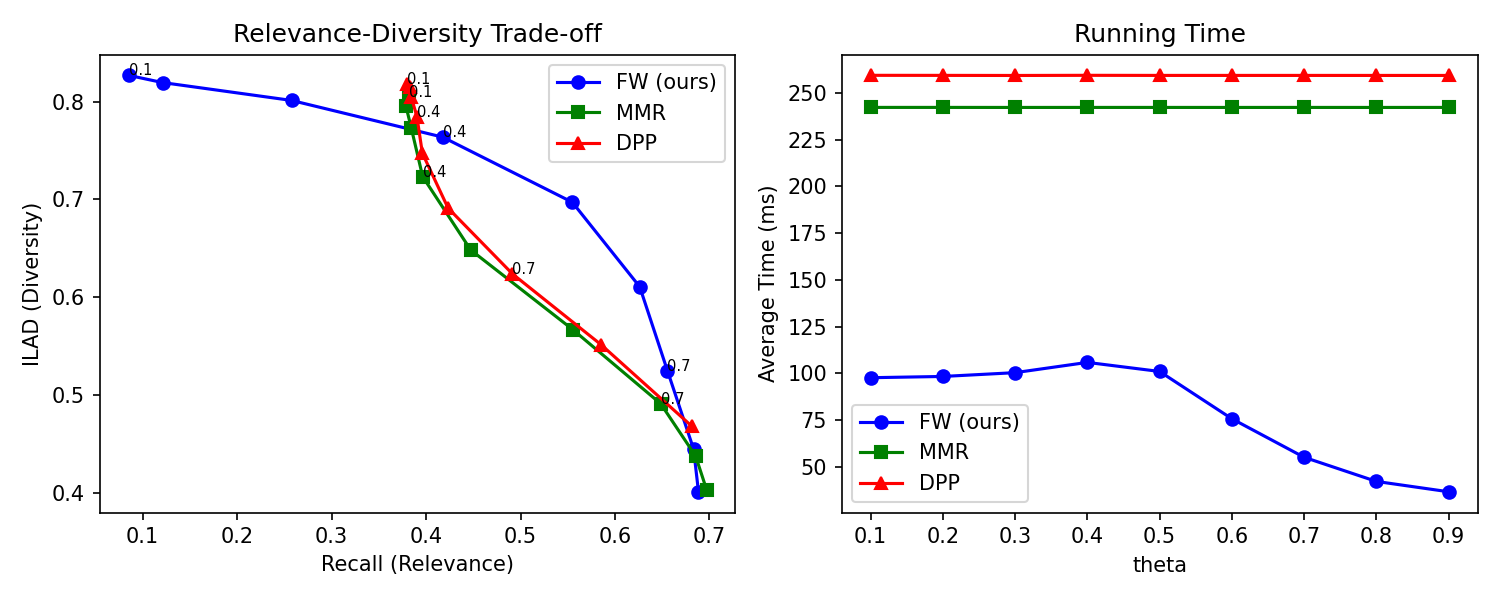
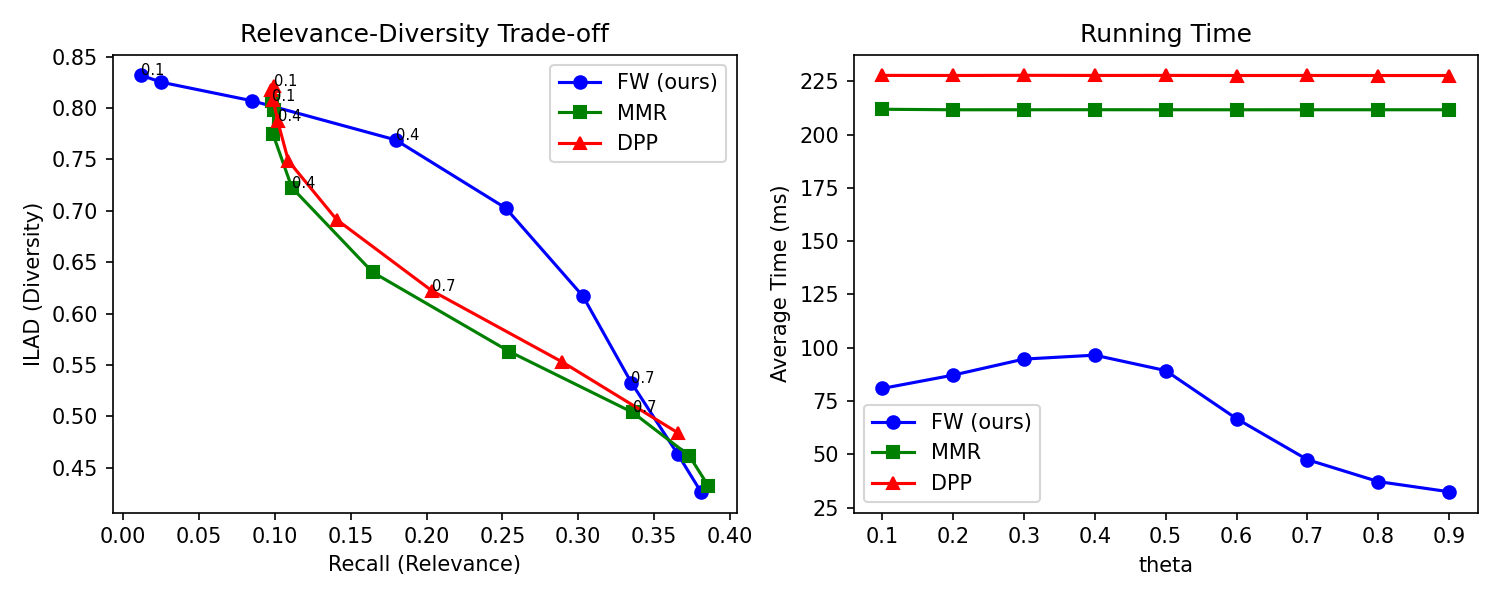
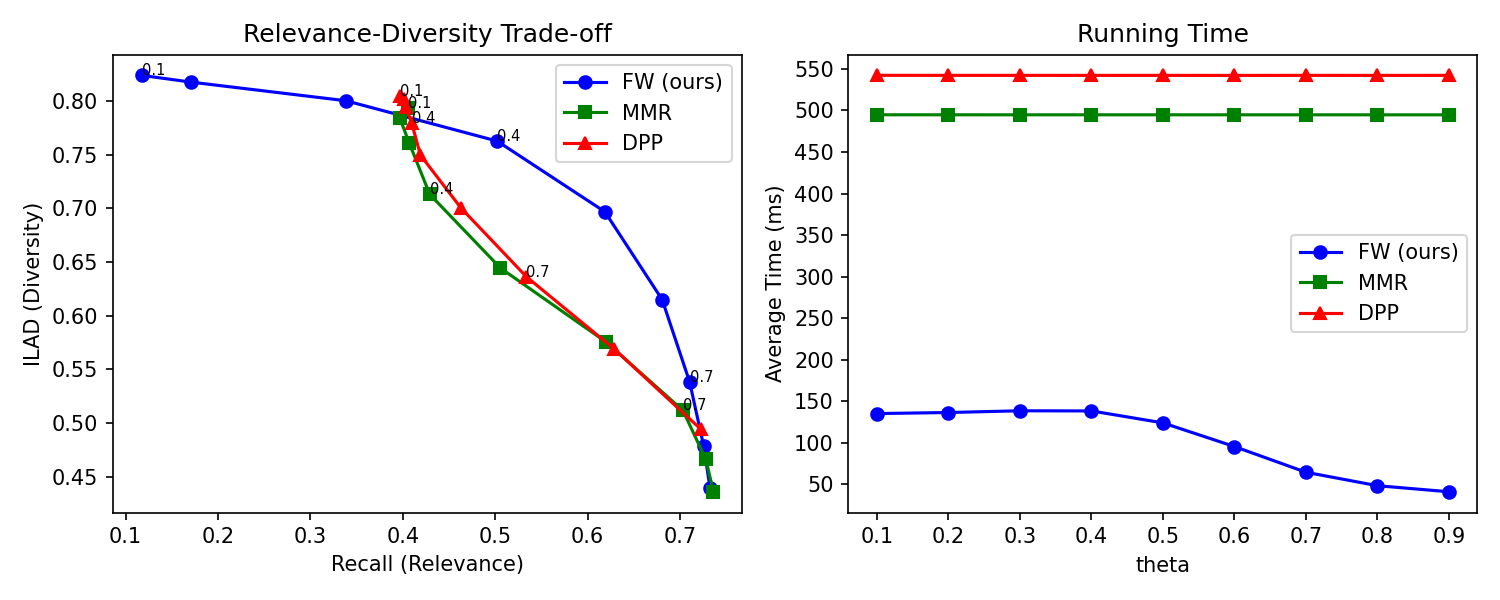
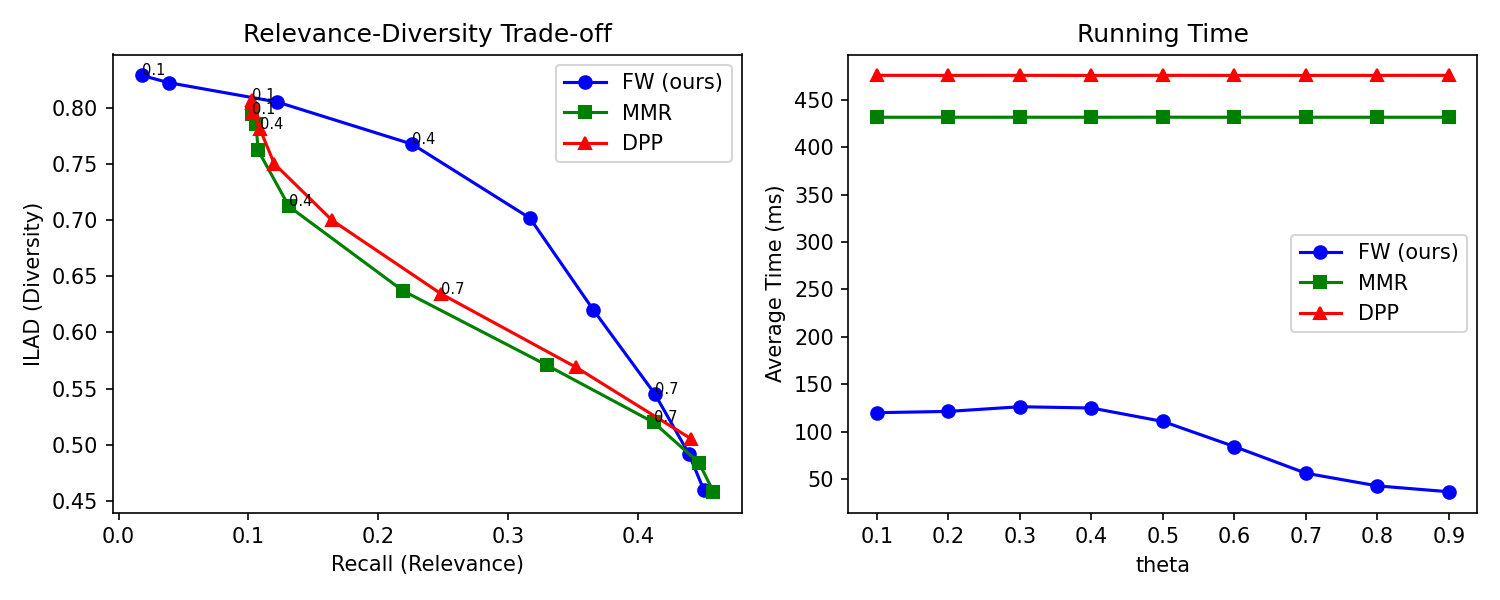
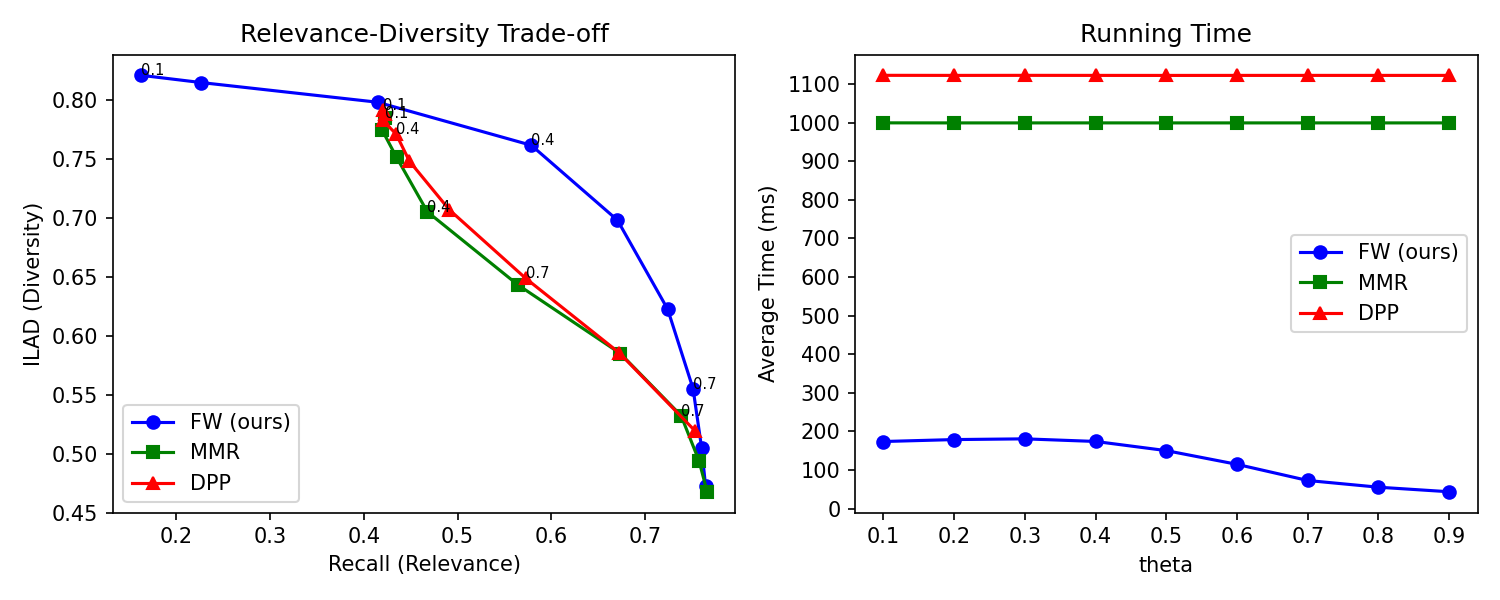
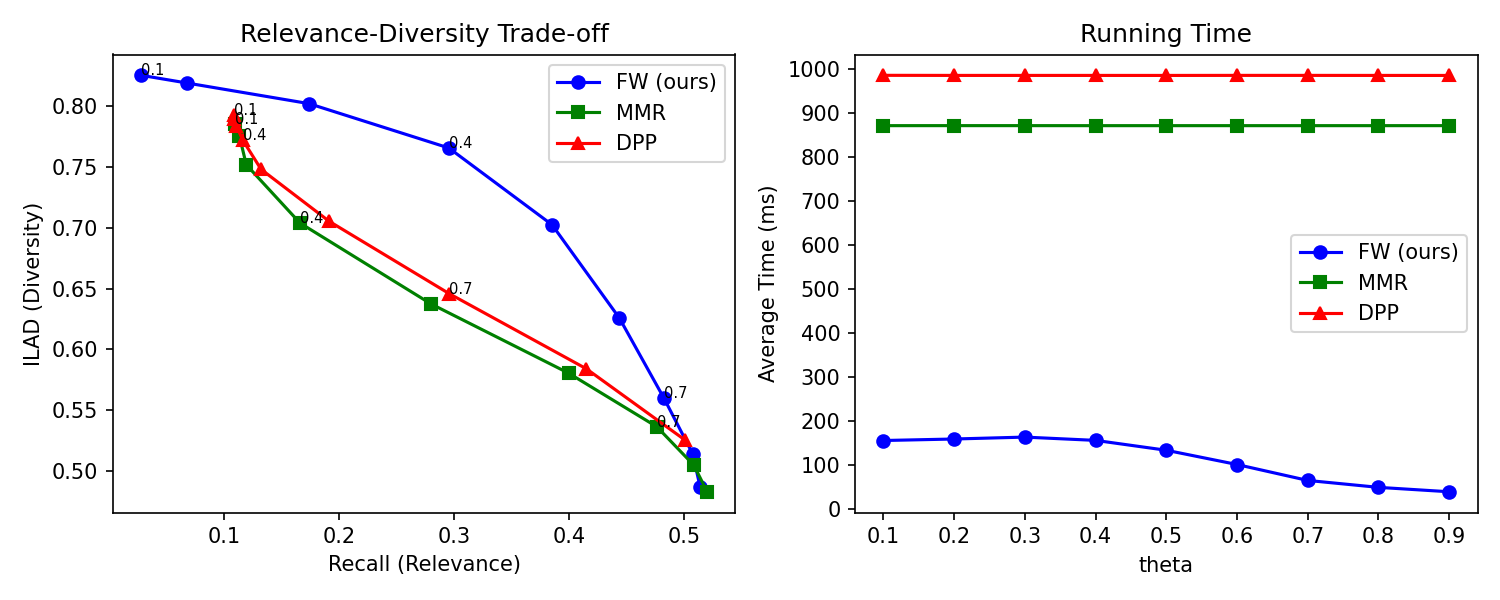
Figure 1: Pareto frontier and computational latency for ASQA (k3), highlighting the superior relevance-diversity trade-off and sublinear scaling in k4.
Generation Quality
End-to-end generation experiments emphasize the downstream performance on QAMPARI, using Llama-3.1-8B-Instruct as the reader LLM. Passage diversity, when promoted judiciously (k5–k6), yields modest but consistent improvements in F1 over standard top-k7 retrieval. Excessive diversity (k8) can degrade performance due to displacement of relevant evidence, especially in corpora with inherently low redundancy (e.g., Wikipedia).
Increasing retrieval size k9 increases recall but reduces precision, suggesting noise-induced information overload for the reader LLM. Generation results for ASQA show comparable trends: diversity-aware retrieval robustly improves recall at practical θ0, while retaining algorithmic scalability and hyperparameter robustness.
Practical and Theoretical Implications
The introduced CCBQP framework provides a principled foundation for diversity-aware retrieval, supporting interpretable and rigorous control of relevance-diversity balance, and establishing an efficient optimization regime in real-world RAG settings. The scalability makes it highly amenable to extended context windows in modern LLMs, enabling retrieval of large, diverse passage sets without inferential bottlenecks.
From a theoretical standpoint, the tight relaxation and benign optimization landscape advance the tractability for NP-hard subset selection problems involving relevance-diversity trade-offs, and demonstrate that non-convex methods can yield exact solutions with appropriately structured objectives.
Future research directions include:
- Evaluation on High-Redundancy Corpora: To fully exploit diversity-aware retrieval, more redundant datasets must be assessed.
- Larger Model Deployment: Extending experiments to larger LLMs may uncover novel behaviors and further validate scalability.
- Dynamic Trade-off Optimization: Joint optimization of θ1 in context-dependent settings, as supported by recent theoretical results.
- Integration with Advanced RAG Pipelines: Combining the framework with rerankers or hierarchical evidence selection modules.
Conclusion
This work establishes a rigorous, scalable, and interpretable framework for diversity-aware retrieval under the RAG paradigm, addressing key theoretical and computational deficiencies of prior methods. The tight continuous relaxation, specialized Frank--Wolfe algorithm, and extensive empirical validation demonstrate both robust Pareto frontier quality and exceptional efficiency. These results position CCBQP-based retrieval as a foundational tool for advanced knowledge-intensive NLP systems, facilitating context expansion and diversity-controlled generation in next-generation LLM architectures.