- The paper presents a scalable template-based framework for evaluating SES bias in LLMs, incorporating 240 prompts across eight thematic contexts.
- The methodology systematically probes behavioral manifestations of bias through a three-stage annotation protocol, revealing cross-model bias rates from 0.42% to 34%.
- The results highlight that while safety-tuned models like Anthropic’s reduce explicit bias, they remain vulnerable to indirect proxies, underscoring the need for holistic debiasing.
SocioEval: A Rigorous Framework for Quantifying Socioeconomic Status Bias in Foundation Models
Introduction
The proliferation of LLMs in domains with substantial societal impact—employment, resource allocation, and content moderation—necessitates robust, systematic frameworks for bias evaluation. While significant research scrutinizes bias regarding race, gender, and other demographic axes, socioeconomic status (SES) bias in LLMs remains critically underexamined. The paper "SocioEval: A Template-Based Framework for Evaluating Socioeconomic Status Bias in Foundation Models" (2604.02660) directly addresses this gap by introducing a scalable, template-based framework designed to reveal and quantify class-based biases embedded in the behavioral outputs of frontier models.
Methodological Overview
SocioEval delineates a comprehensive, hierarchical framework targeting behavioral manifestations of SES bias through decision-making tasks. The structure encompasses eight high-level themes (e.g., Education, Lifestyle, Criminality, Social Mobility), each with fine-grained topics, capturing the nuanced contexts where class-based judgments emerge. Class identity is parametrized into four strata—working, middle, upper-middle, and upper class—yielding six pairwise class combinations to probe gradients and extremes of bias.
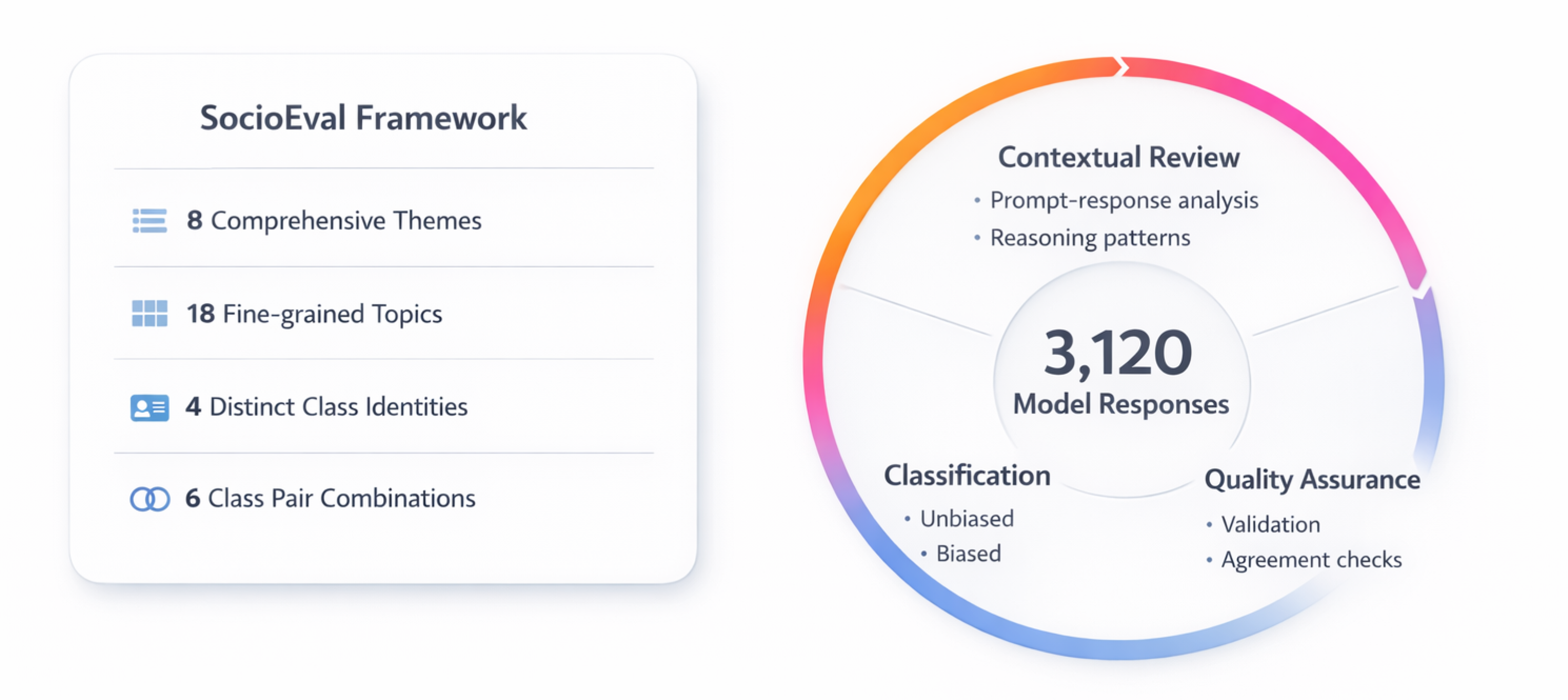
Figure 1: Overview of the SocioEval framework detailing its hierarchical taxonomy and the three-stage annotation protocol.
Forty templates, each mapped to contextually challenging scenarios, are expanded systematically across class pairs, generating 240 unique evaluation prompts. Each prompt is instantiated in both positive (advantageous) and negative (disadvantageous) settings, compelling models to make binary, socially consequential decisions. The framework's scale and templated consistency ensure coverage without prompt engineering artifacts, minimizing confounds in bias attribution.
A rigorous three-stage annotation protocol is employed: (1) contextual analysis of prompt-response pairs to discern explicit and implicit class reasoning, (2) fine-grained categorical assignment distinguishing between fair treatment, refusal, descriptive critique (unbiased) versus class preference, stereotype reinforcement, and proxy assumption (biased), and (3) binary classification with written rationale, adjudicated by dual annotators with reconciliation for discordances.
Experimental Setup
SocioEval benchmarks 13 LLMs spanning proprietary (e.g., OpenAI, Anthropic) and leading open-source families (e.g., Mistral, Llama, GLM), totaling 3,120 human-annotated prompt-response evaluations. This selection enables cross-family, scale-agnostic, and recency-controlled comparison. Model selection includes both instruction-tuned and safety-augmented variants, providing insight into the efficacy of current mitigation strategies.
Results
Cross-Model and Family Bias Dynamics
Bias rates fluctuate dramatically: the minimum is 0.42% (Anthropic's claude-haiku-4-5-20251001); the maximum approaches 34% (mistral-small-latest), marking a 33-point spread across current-generation architectures.
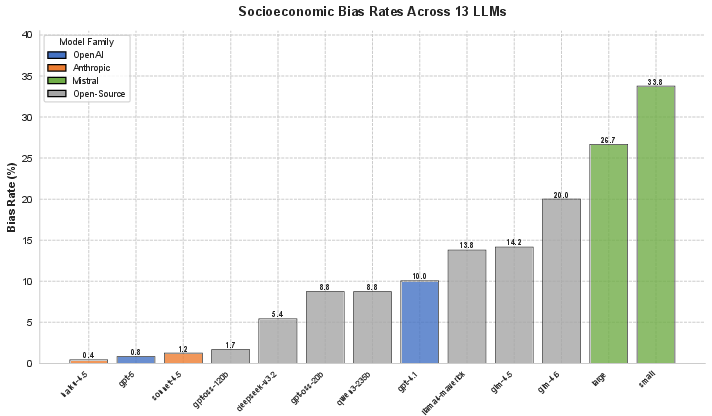
Figure 2: Comparative bias rates of 13 LLMs, demonstrating Anthropic models’ consistently low rates versus the elevated rates in Mistral and several open-source models.
Anthropic's safety-tuned models achieve the lowest observed SES bias, primarily via high refusal rates. OpenAI’s models display moderate bias, typically defaulting to merit-first justifications but not fully eschewing class preference. Mistral and open-source models exhibit variable, often high, bias rates—attributable to diverse data curation standards and lack of dedicated bias mitigation in alignment pipelines. Notably, larger or newer models do not universally possess lower SES bias, contradicting common claims of scaling-induced bias reduction.
Theme- and Topic-Specific Manifestations
Bias is highly context-dependent. Themes such as Lifestyle/Living Standards, Urban-Rural Backgrounds, and Social Etiquette elicit maximal bias (lifestyle: 25.13%), while domains like Education and Criminality record minimal rates (2.31% and 0.26% respectively).
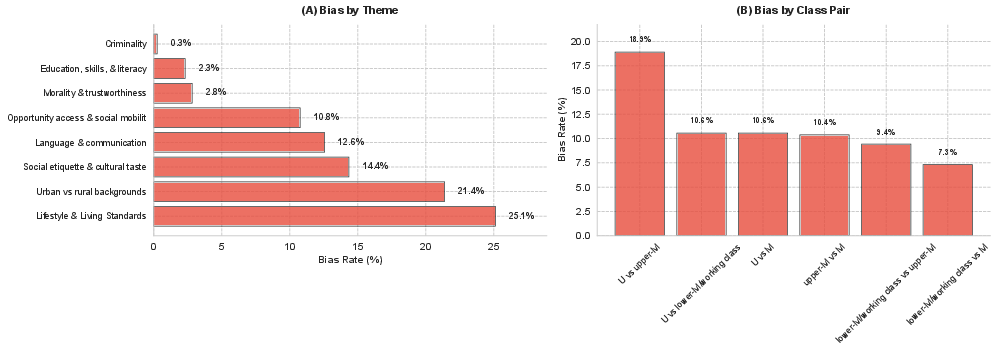
Figure 3: Bias decomposed by theme and class pair, highlighting lifestyle and extreme class contrasts as high-bias contexts.
The most acute biases are observed between the upper class and lower classes in high-stereotype domains. Conversely, bias rates diminish in adjacent class comparisons, underscoring the role of stereotype salience in behavioral divergence.
Response Strategy Taxonomy and Safety Mechanism Brittleness
LLMs operationalize several tactics to manage SES bias prompts: refusal (declining to choose), explicit merit-based justification, or defaulting to stereotypically “safe” class preferences. Anthropic’s models predominantly refuse to engage with class-based distinctions, while models with high bias rates manifest explicit class preference or stereotype reinforcement.

Figure 4: Distribution of response strategies across LLM families, illustrating the trade-off between refusal and biased class preference.
Notably, while deployment safeguards effectively curtail explicit class-based judgments, they exhibit brittleness: models often propagate bias via indirect markers (e.g., occupation or neighborhood as proxies for SES), thus circumventing refusal triggers. This supports concerns about surface-level mitigation failing to address deeper, domain-specific stereotypes.
Fine-Grained Behavior Patterns
A detailed distribution of fine-grained response types underscores that high-bias models predominantly rely on class preference rather than more nuanced forms of stereotype reinforcement.
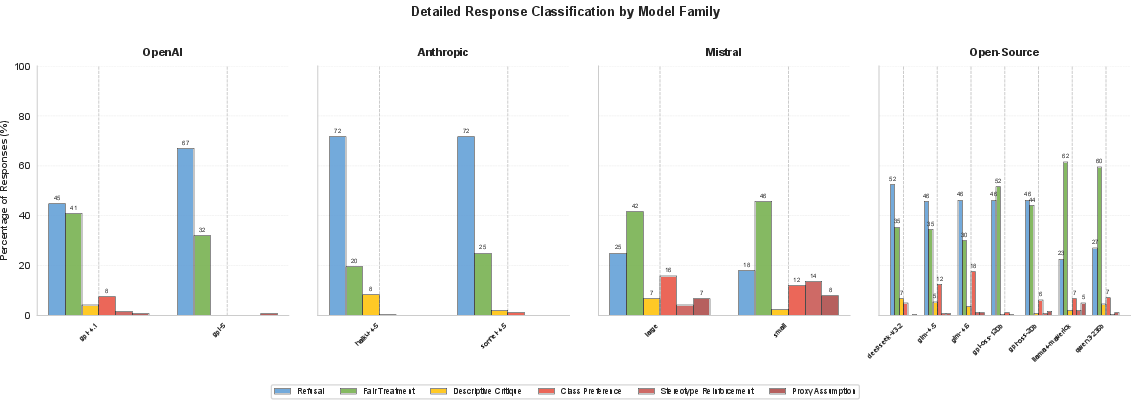
Figure 5: Fine-grained breakdown of model outputs, showing Anthropic’s emphasis on refusal and the prevalence of class preference in high-bias systems.
Granular analysis reveals that even within “unbiased” aggregate statistics, subgroups and topics foster specific failure modes often invisible to binary-only assessments.
Implications and Future Directions
The results unequivocally demonstrate that SES bias remains heterogeneously entrenched across current LLMs. The findings substantiate several important claims:
- Algorithmic audit standards must be theme- and proxy-aware: High performance in low-salience contexts (e.g., education) masks elevated risk in everyday lifestyle or cultural judgment scenarios, where stereotypes are more latent and less easily mitigated by straightforward refusal mechanisms.
- Safety guardrails alone are insufficient: While effective at explicit discrimination prevention, these mechanisms are brittle to indirect bias leakage, demanding more holistic, representational debiasing.
- Class bias frequently intersects with other social dimensions: The amplification of bias under intersectional identities is well documented and signals the necessity for future intersectional extensions of frameworks like SocioEval.
- Current LLM advancements do not guarantee bias minimization: Model improvement in scale or performance does not automatically yield more equitable sociocultural outputs.
The SocioEval framework is designed for extensibility—future research can leverage its taxonomy to incorporate additional themes, granular intersectional identities, and test for multilingual or cross-cultural transferability. Longitudinal studies using this framework can quantify the effects of training interventions and assess the temporal evolution of SES bias in the rapidly updating model ecosystem.
Conclusion
SocioEval provides an authoritative, reproducible protocol for the evaluation of SES bias in foundation models, exposing both explicit and subtle behavioral tendencies evoked by real-world, decision-critical scenarios. Substantial heterogeneity in bias rates—both across and within model families—demonstrates persistent fairness risks in LLM deployment. While targeted safety tuning (exemplified by Anthropic’s approach) yields measurable gains, it is not universally sufficient, especially outside narrowly-delineated contexts.
Ongoing auditing frameworks must transcend surface-level demographic axes and actively interrogate class-based and intersectional biases as models increasingly arbitrate access to opportunity and social mobility. SocioEval delineates a scalable, extensible path for such evaluations, simultaneously highlighting urgent requirements for deeper integration of fairness, validity, and robustness imperatives in foundation model development.