- The paper demonstrates that receiving an answer increases the helping hazard by 6% among newcomers using a robust staggered DiD survival analysis.
- It reveals an experience-dependent effect where the reciprocity influence fades to null as users gain tenure, confirming its role in contributor onboarding.
- The study identifies a 30–60 minute re-engagement window where optimal answer response times significantly convert newcomers into active helpers.
Generalized Reciprocity and Contributor Onboarding on Stack Overflow
Introduction
The phenomenon of generalized reciprocity, whereby individuals are more likely to help others after receiving help themselves, has been hypothesized to sustain cooperation in large-scale online communities. Despite extensive theorization, robust empirical support for generalized reciprocity in field settings, especially on open knowledge-sharing platforms, has been limited by significant methodological confounds. “Help Converts Newcomers, Not Veterans: Generalized Reciprocity and Platform Engagement on Stack Overflow” (2604.03209) develops a stratified, propensity-score-matched difference-in-differences survival analysis leveraging the fine-grained event dynamics of Stack Overflow to quantify the effect of receiving help (answers to one's question) on subsequent helping behavior. The analysis provides critical evidence on the incidence, experience stratification, and temporal moderating factors of generalized reciprocity at scale.
Methodology
The paper employs a matched difference-in-differences (DiD) staggered survival analysis on a longitudinal dataset comprising over 21 million Stack Overflow questions spanning 2008–2025. For each focal question posted by a user, a 4-day observation window is defined: two days preceding and two days following the question post. Treated instances (question received an answer) are propensity-score-matched to control instances (no answer received), using covariates capturing user tenure, baseline and recent activity, and question topical answer rate. The methodology leverages Cox proportional hazards models capable of incorporating time-varying covariates, allowing for precise estimation of changes in the hazard for helping (answering others' questions) as a function of treatment (answer receipt) and timing.
Covariate balance pre- and post-matching is assessed to ensure comparability (Figure 1, Figure 2), with post-matching standardized mean differences well below conventional thresholds. Analytical stratification by user tenure enables direct quantification of the experience-dependence of reciprocal helping effects.
Empirical Findings
Baseline Reciprocity Effect
Across the pooled sample, the analysis identifies a significant but modest generalized reciprocity effect: users who receive an answer exhibit a 6% higher hazard of helping others, compared to matched controls, controlling for general post-question engagement. This basic finding is evident in the aligned help-rate trajectories, which diverge between treated and control groups specifically after answer receipt (Figure 3).
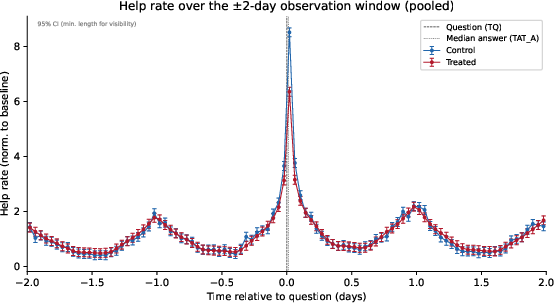
Figure 3: Normalized help rate in the ±4 day window, showing the effect of answer receipt on subsequent helping for treated versus matched control users.
Experience-Dependent Modulation
Critically, the effect of generalized reciprocity is highly experience-dependent, supporting the prediction that it is primarily an onboarding or conversion mechanism. Among users with less than one week of tenure, the hazard ratio for post-answer helping is 1.09 (95% CI: [1.08, 1.11]); the effect steadily declines with tenure, reaching null effect for users with more than six years of experience (hazard ratio ≈ 1.00; ns). This gradient is consistent across stratifications (Figure 4).
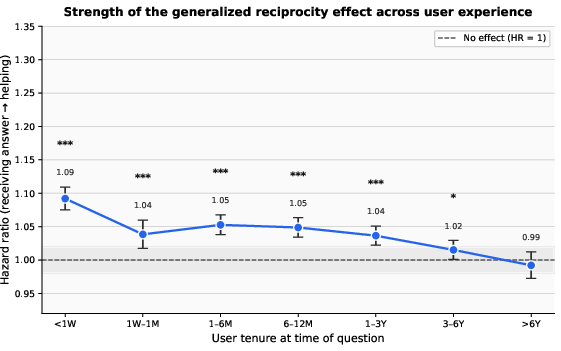
Figure 4: The strength of the generalized reciprocity effect (hazard ratio) by user tenure bucket, showing sharp attenuation with increasing experience.
Temporal Moderation: The Re-engagement Window
The effect of answer receipt is nonlinearly moderated by response time. While earlier theory predicts a monotonically decreasing effect with growing delay (emotional immediacy), the empirical results are more nuanced: the reciprocity effect is maximized for answers arriving between 30–60 minutes after the question. Answers arriving extremely quickly (<30 minutes) have little detectable effect, likely due to session closure dynamics (user leaves after answer). The effect attenuates for longer delays as the relevance or salience of the question fades (Figure 5). This inverted-U reflects a “re-engagement window” in which answer receipt is most likely to prompt users to return and subsequently engage in helping.
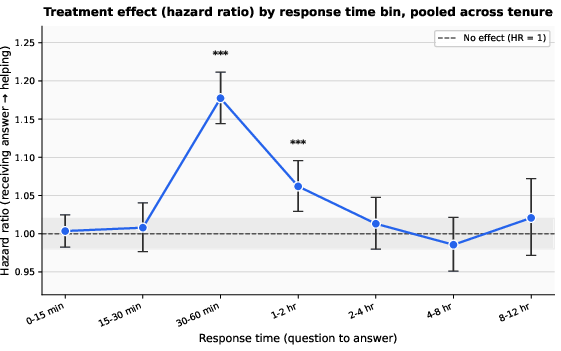
Figure 5: Hazard ratio for reciprocity by response time bin, peaking for 30–60 minute response times.
Help rates, parsed by whether users had received an answer or were still waiting, further reveal that a significant fraction of the effect operates through re-engagement: users are most likely to help after being drawn back to the platform by an answer notification, not while passively waiting (Figure 6).
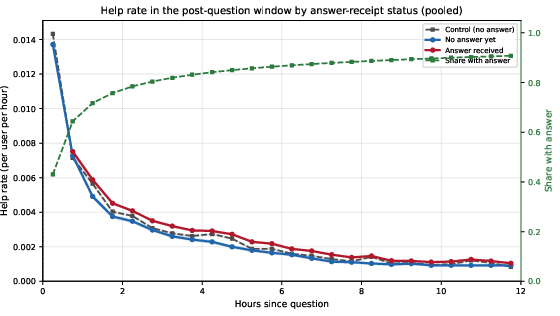
Figure 6: Help rates post-question, separated by answer receipt status—red: answer received, blue: not yet received; the cumulative answer receipt share indicates re-engagement dynamics.
Robustness and Balance Checks
Post-matching diagnostics confirm the success of propensity matching and common support (Figure 1, Figure 2), ensuring the robustness of the identification strategy.
Theoretical Implications
These findings demand a theoretical refinement of the role of generalized reciprocity in large-scale platforms. Rather than constituting a persistent driver of prosocial behavior among all users, generalized reciprocity is best conceptualized as a contributor-recruitment mechanism. It provides moral and emotional impetus for newcomers to transition into contributor roles before internalization of community-specific incentives (e.g., reputation) and socialization processes render generalized motives obsolete. This norm displacement dynamic reflects crowding out, in which extrinsic, community-specific incentives for helping (status, reputation) supplant generalized norms as users gain tenure.
The observed experience and temporal gradient provides a resolution to prior inconsistent literature findings, which often failed to account for heterogeneity across user experience or struggled with engagement confounds.
Given the concentration of the effect among newcomers and the time-dependence, platforms aiming to maximize contributor onboarding should prioritize fast, visible answering for new users. Algorithmic mechanisms to surface newcomer questions to experienced answerers, combined with prominent notification systems, are likely to yield greater conversion into active contributors. Importantly, features that extend active session duration may paradoxically attenuate re-engagement-driven reciprocity, while post-session notifications that prompt returns are more effective.
The implications for increasing prevalence of AI-generated answers are non-trivial. To the extent that newcomer engagement and conversion are mediated by gratitude or perception of human generosity, substituting automated assistance may erode the onboarding effect, impacting the supply of future contributors. The results suggest a need to explicitly model and perhaps counterbalance this risk in the design of AI-augmented knowledge-sharing systems.
Limitations and Future Work
While the analytical design robustly addresses user-type engagement confounds, residual unobserved time-varying user factors, and session-level states, may still influence estimated effects. Causal psychological mechanisms (gratitude, obligation, status motivation) are inferred indirectly; mixed-method approaches incorporating targeted experience sampling are warranted. Data on explicit session boundaries would allow direct validation of the re-engagement window.
Further, the generalizability to platforms with different norm regimes or smaller-scale, high-identity communities must be established. Long-term trajectories of reciprocity-activated contributors versus baseline users are of interest for understanding community health and retention.
Conclusion
Generalized reciprocity on Stack Overflow operates primarily as an onboarding mechanism, converting helped newcomers into helpers. Its effect fades with platform tenure as users internalize community-specific rewards. A temporal re-engagement window maximizes the effect for answers arriving within ~30–60 minutes post-question, revealing structurally unique session dynamics absent from laboratory studies. Platform interventions should thus be tailored to leverage these mechanisms in the design of notification, matching, and AI augmentation systems to optimize contributor recruitment and engagement.

