- The paper introduces a replacement theorem proving that group-averaged estimators consistently recover covariance eigendecomposition from a single observation under signal equivariance and noise ergodicity.
- It demonstrates that optimal group selection—especially using the symmetric group S_M—is crucial for maximizing subspace separation, variance concentration, and spectral performance in applications like massive MIMO and chirp detection.
- The study extends the framework to non-Abelian groups and transformer models, offering strategies that eliminate pilot overhead and enhance deep learning model adaptation without sacrificing estimation accuracy.
Algebraic Diversity: Group-Theoretic Spectral Estimation from Single Observations
Introduction and Theoretical Framework
"Algebraic Diversity: Group-Theoretic Spectral Estimation from Single Observations" (2604.03634) constructs a comprehensive mathematical framework showing that algebraic group action on a single observation can replace classical temporal averaging over multiple noisy samples for second-order structure extraction. This framework generalizes spectral estimation by formulating the group-averaged estimator FG as an average of the action of a finite group G on the observation vector, under two crucial hypotheses: signal equivariance and noise ergodicity with respect to G.
The paper proves the General Replacement Theorem, establishing that, under these conditions, FG is a consistent estimator of the population covariance eigendecomposition. It further proves that the symmetric group SM is universally optimal in delivering the Karhunen–Loève (KL) transform, i.e., no other group can exceed SM in subspace separation, variance concentration, or decorrelation. All classical spectral transforms (DFT, DCT, etc.) are recovered as group-averaged estimators with their natural groups and optimal signal classes.
Permutation-Averaged Spectral Estimation and Group Selection
A core technical result is the Permutation-Averaged Spectral Estimation (PASE) optimality theorem: for an observation of dimension M, the sharp optimal number of group elements is n=∣G∣=M, imposing a non-negotiable group order constraint. Fewer elements yield incomplete algebraic averaging; more (including permutations outside the matched group) degrade estimation quality—demonstrating that the group-selection problem is the sole nontrivial parameter governing estimation quality.
Figure 1 (referenced below) demonstrates, via Monte Carlo, that over-averaging (i.e., n>∣G∣) consistently degrades the eigenvalue SNR. Subsampling SM with any permutation ordering (random, SJT, Lehmer, or Heap) yields monotonic performance loss, thereby refuting the notion that defaulting to the universal group can circumvent group selection.
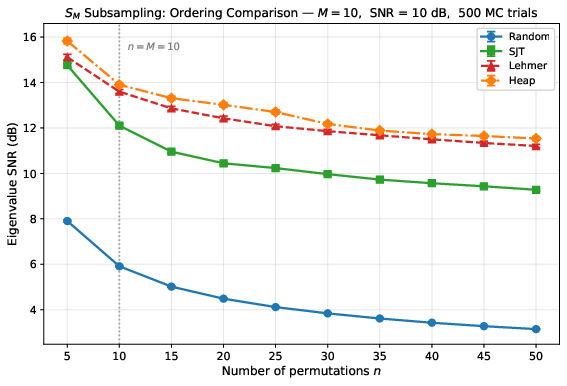
Figure 1: Eigenvalue SNR as a function of permutations G0 used from G1, under varying selection strategies. All methods degrade monotonically past the group order, highlighting the necessity of precise group selection.
Single-Snapshot Applications: Massive MIMO and Chirp Characterization
The framework is operationalized in canonical signal processing domains.
For massive MIMO, single-shot algebraic diversity (AD) estimation eliminates the pilot overhead bottleneck, enabling single-pilot estimation while delivering up to 64% higher effective throughput than MMSE approaches (Figure 2). The throughput advantage scales with antenna array size due to the decoupling of processing gain from pilot quantity—critically important at large G2.
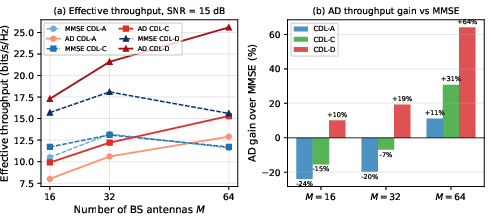
Figure 2: (a) Effective throughput versus array size G3 across CDL models; (b) Percentage gain of AD over MMSE. At G4, AD offers a +64% gain in CDL-D due to pilot overhead elimination.
For single-pulse waveform analysis, the framework reconstructs dechirp-then-DFT as conjugation of the cyclic group by the appropriate quadratic unitary. The chirp-adapted group achieves an 8.3G5 higher spectral concentration on LFM waveforms compared to the mismatched cyclic group, and outperforms standard FFT-based strategies by at least 8 dB in SNR threshold for reliable identification (Figures 3 and 7).
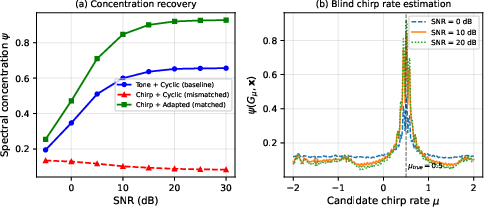
Figure 3: (a) The adapted-group concentration on chirps (green) is 8.3G6 that of cyclic (red). (b) Blind G7 sweep enables precise single-pulse chirp rate estimation.
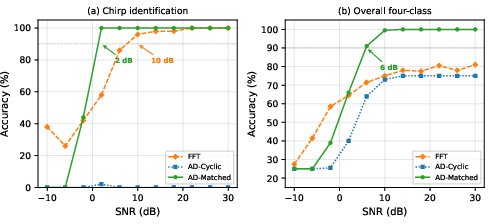
Figure 4: (a) Chirp identification SNR threshold: matched-group AD reaches 90% accuracy at 2dB, FFT only at 10dB. (b) Only matched-group AD achieves 90% overall four-class accuracy.
As shown in Figure 5, in nonstationary source scenarios with random waveform parameters per pulse, only matched-group AD maintains high classification accuracy (89%), whereas FFT-based methods plateau at 53%.
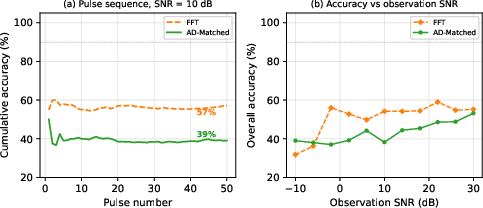
Figure 5: (a) Cumulative accuracy: AD-Matched sustains G889% accuracy in non-stationary conditions. (b) Matched-group AD achieves 90% at SNR = 14 dB, FFT never surpasses 90%.
Group Theory, Graph Signal Processing, and the Non-Abelian Question
The algebraic diversity mechanism is extended from abelian (e.g., cyclic, dihedral) to non-abelian groups. Through an exhaustive search and filtering pipeline over all six-vertex non-isomorphic graphs, the authors identify seven candidates whose automorphism groups are G9. Three display a strict spectral concentration advantage (up to 25.8%) over best possible conjugated cyclic groups, as evidenced in Figure 10. This is formalized as the Non-Abelian Dominance Hypothesis (NADH): genuine non-abelian symmetry can enable estimation advantages unattainable by any abelian group, contingent on multidimensional eigenspaces—connected to Schur's lemma and block-invariance in representation theory.
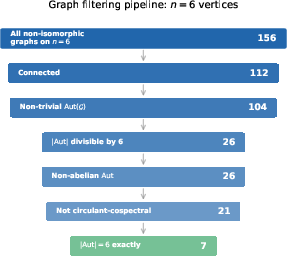
Figure 6: Structural filtering pipeline for order-6, non-abelian automorphism graphs, culminating in a set of seven group candidates with G0 structure.
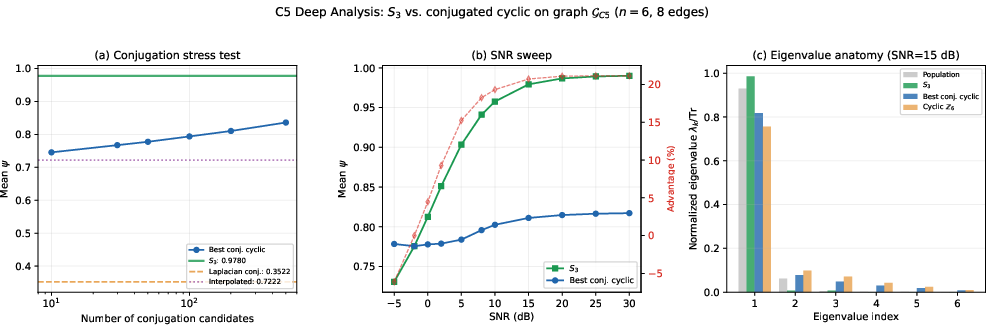
Figure 7: Analysis of candidate C5 (G1 plus pendant) confirms G2 advantage persists under increasing random conjugation, and that non-abelian block structure yields maximal eigenvalue ratio and spectral concentration.
The grouping framework is applied to Transformer LLMs, challenging the universal adoption of RoPE (rotary position embedding) as algebraically mismatched for the majority of attention heads (70-80%), based on commutativity residual G3 diagnostics.
Empirical analysis across five mainstream open-source models demonstrates that the optimal algebraic group is both architecture- and content-dependent, spectral concentration can be used to systematically prune low-utility attention heads (resulting in improved perplexity), and effective key subspace ranks are invariant with INT4 quantization. These group-theoretic observables enable zero-cost model adaptation and compression strategies.
Metrics for Group-Model Mismatch
Three core metrics are defined:
- Algebraic coloring index G4: Quantifies deviation from white noise (eigenvalue variance).
- Commutativity residual G5: Scale-invariant measure of structural misalignment between group action and covariance.
- Absolute mismatch G6: Energy-weighted analog of G7 capturing physical estimation loss.
Their complementary roles are illustrated in Figures 14-16. Whereas G8 captures available structure, G9 assesses structural alignment, and FG0 quantifies usable energy lost to mismatch.
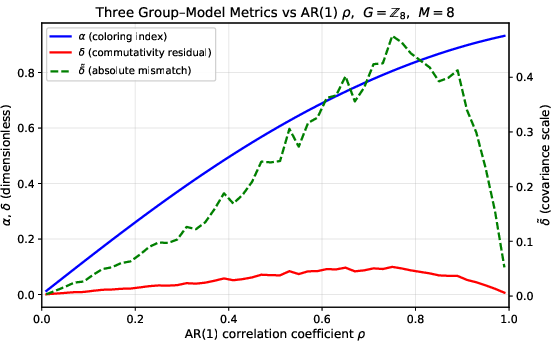
Figure 8: Three group-model metrics as a function of AR(1) correlation FG1 for FG2. FG3 monotonic, FG4 and FG5 feature maxima at distinct FG6.
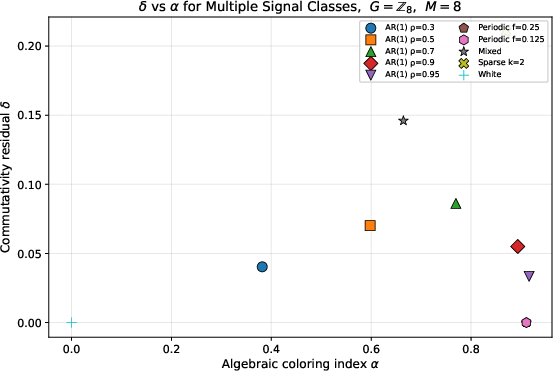
Figure 9: Nonredundancy of FG7 and FG8. Similar coloring indices can have markedly different commutativity residuals for distinct group alignment scenarios.
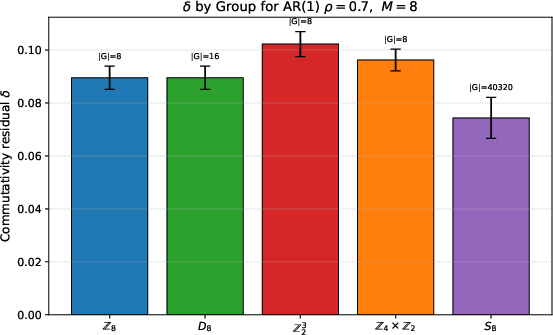
Figure 10: FG9 for various group structures/order shows inferior alignment for wrong-structure groups despite equal size, emphasizing necessity of algebraic structure matching.
Extension to Colored Noise and Computational Implications
The algebraic diversity framework is extended to colored noise. The noise covariance’s group structure is directly characterized, enabling fast structured whitening via the natural group transform rather than generic matrix inversion.
Analysis of sample complexity shows that group-constrained estimation achieves SM0-accuracy with SM1 elements, an SM2-fold improvement over unconstrained estimation, with concrete computational and latency benefits for massive MIMO (elimination of pilot overhead, full-rank estimation from a single snapshot).
Practical and Theoretical Implications
The duality principle between temporal averaging and group algebraic action reframes information extraction as projection onto invariant subspaces; every sensor observation is equated with an independent algebraic component. The group action uniquely separates these, with the KL transform obtained only for the optimal group. This has profound implications: for large-scale sensor systems, communications, radar/sonar, and even LLMs, single-observation algebraic diversity can eliminate the latency and sample inefficiency of multi-snapshot schemes without sacrificing statistical power.
In signal classes where covariance structure is not circulant or cannot be conjugated to circulant form, the algebraic diversity approach surpasses DFT/DCT-based methods (validated in hexagonal and graph-based settings).
Conclusion
This work formalizes an overview of group theory and statistical estimation, collapsing the degrees of freedom in spectral estimation to a single group-selection problem, resolved via commutativity residual or spectral concentration metrics. The approach is computationally tractable, fully general in its theoretical justification, and empirically validated across communications, radar, graph signal processing, and deep learning. The results have immediate practical significance for systems where sample efficiency, single-shot inference, or tight latency constraints are critical, and they point toward structural, group-theoretic approaches as the next frontier for robust, efficient information extraction in high-dimensional and non-stationary data regimes.
References: (2604.03634)

