- The paper presents a detailed taxonomy of 20 hardware-level governance mechanisms for AI compute, assessing their feasibility in adversarial settings.
- It categorizes methods into monitoring, verification, and enforcement, mapping each to domestic, bilateral, and multilateral regulatory scenarios.
- The findings reveal a critical readiness gap for treaty-grade oversight, underscoring the urgent need for R&D to develop deployable solutions.
Hardware-Level Governance of AI Compute: Feasibility Taxonomy and Implications
Introduction
The paper "Hardware-Level Governance of AI Compute: A Feasibility Taxonomy for Regulatory Compliance and Treaty Verification" (2604.04712) delivers a comprehensive technical taxonomy of hardware-level mechanisms intended to support AI governance, emphasizing monitoring, verification, and enforcement. It systematically assesses 20 mechanisms by function and technical feasibility, providing an in-depth adversarial analysis, mapping to regulatory scenarios, and highlighting the readiness gap between current capabilities and the requirements of robust multilateral treaty verification. The central argument is that while compute-based governance is increasingly favored in both national legislation and policy discourse, the actual technical realization of such mechanisms introduces significant temporal, adversarial, and feasibility constraints.
Rationale for Compute-Based Governance
Contemporary AI policy increasingly centers on compute as the regulatory lever of choice, motivated by three core properties: detectability, excludability, and quantifiability. These properties purportedly make compute a tractable focal point for interventions, unlike data, algorithms, or model weights, which resist effective technical oversight or control. Regulatory instruments such as the EU AI Act and U.S. Executive Orders operationalize compute thresholds, shifting obligations triggered by training runs over 1025 FLOPs, and analogous standards are featured in international proposals modeled on the IAEA and NPT.
However, the enforceability and robustness of these interventions hinge on hardware-level mechanisms capable of monitoring and attesting compute use in adversarial scenarios. The policy literature to date has largely operated at the level of conceptual desiderata, abstracting away from the underlying engineering challenges, which this paper addresses rigorously.
Taxonomy and Feasibility Assessment
The taxonomy partitions hardware-level mechanisms into three classes: monitoring, verification, and enforcement. These span from currently deployable methods (e.g., cloud provider logging, regulatory KYC, power metering) to speculative constructs such as multiparty cryptographic training initiation and fine-grained, tamper-evident hardware-enforced metering.
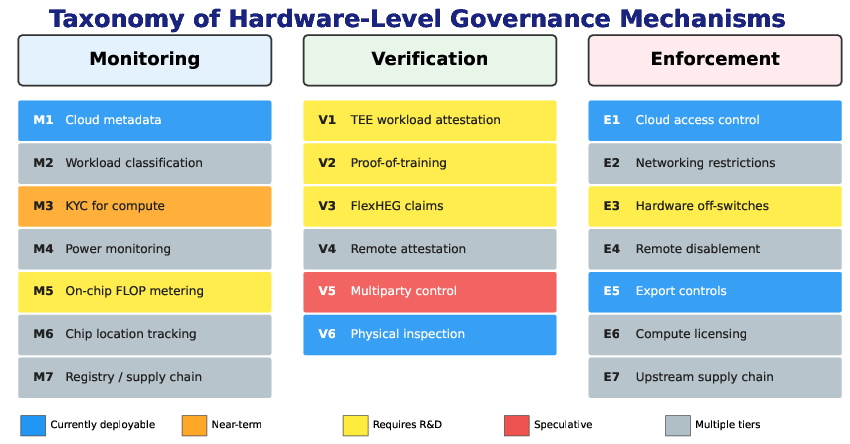
Figure 1: Overview of the 20 hardware-level governance mechanisms, partitioned by functionality and primary feasibility tier.
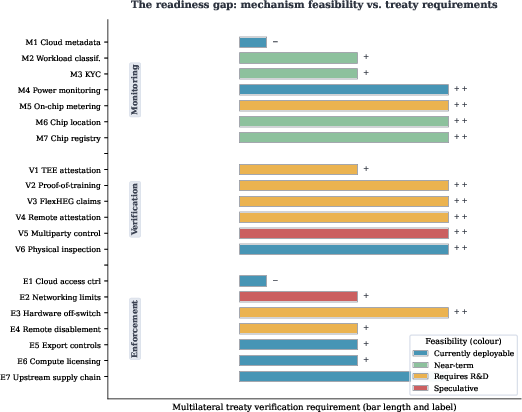
This structuring exposes a strong readiness gap: mechanisms essential for verifiable treaty enforcement (on-chip metering, proof-of-training, hardware enforcement) are not currently deployable, whereas available mechanisms offer, at best, baseline assurance suitable for domestic or cooperative regulatory environments.
Adversarial Analysis
The adversarial analysis is distinguished by its tiered model, aligning required security standards with attacker capability: commercial, non-state, and nation-state actors. For the lower tiers, practical physical security and signed firmware can offer deterrence and detection, while nation-state adversaries are likely to defeat most mechanisms that are not explicitly tamper-evident and subject to regular inspection.
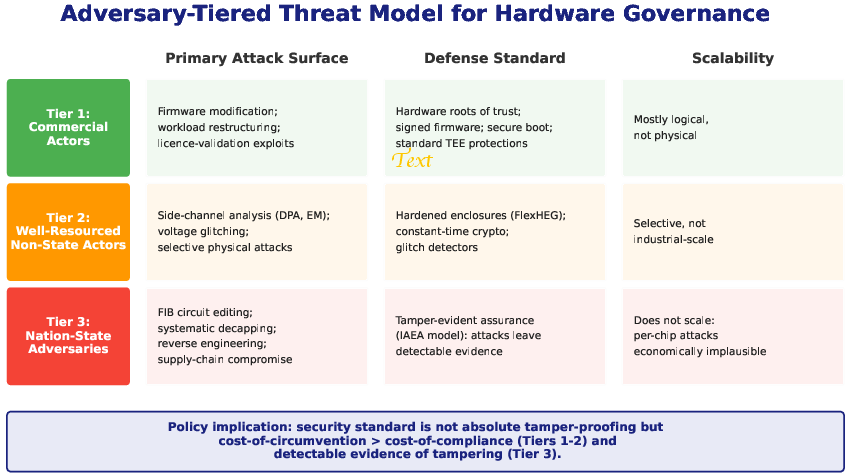
Figure 3: A threat model partitioning adversaries by attack surface, necessary defense standard, and attack scalability, underlining tamper-evident (not tamper-proof) assurance as the tractable goal.
A central policy implication is that tamper-evident, not tamper-proof, assurance is both a sufficient and realistic target for treaty-grade hardware governance, analogous to practices in nuclear verification regimes (IAEA). The paper identifies key adversarial tactics, including distributed training to evade thresholds, physical and side-channel attacks, workload laundering across providers, and algorithmic moves (e.g., distillation, fine-tuning, inference scaling) that render compute-based measures less meaningful over time.
Governance Scenarios and Mechanism Mapping
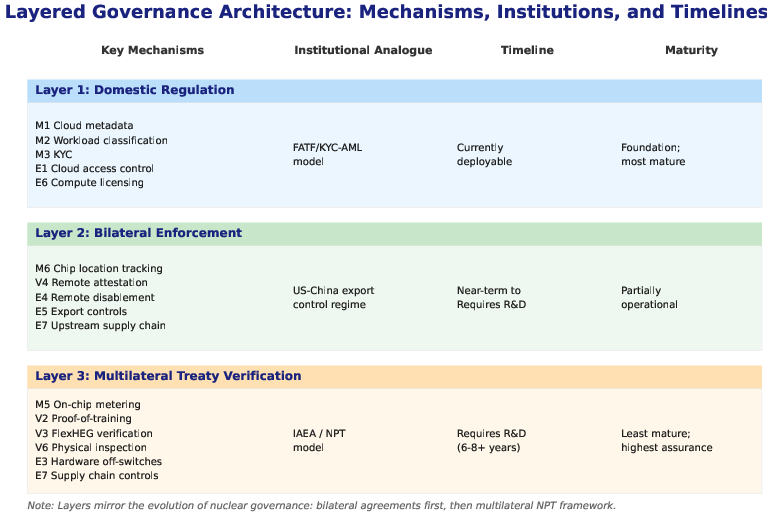
Four governance scenarios are mapped: domestic regulation, bilateral agreements, multilateral treaty verification, and industry self-regulation.
This stratification underlines the infeasibility of robust, multilaterally verifiable compute governance with only current or even near-term mechanisms.
Temporal Constraints and the Deployment Window
A critical contribution is explicit attention to the temporal window created by the present concentration of advanced chip manufacturing in a handful of democratic states. This concentration gives leverage to mandate technical governance features in new silicon, but the window is narrowing due to both distributed training advances and the geographic dissemination of fabrication capability. The paper estimates that key mechanism R&D (on-chip metering, proof-of-training, hardware-enforced licensing) would require 1.5–4 years of serious development and another ≈4 years for large-scale deployment.
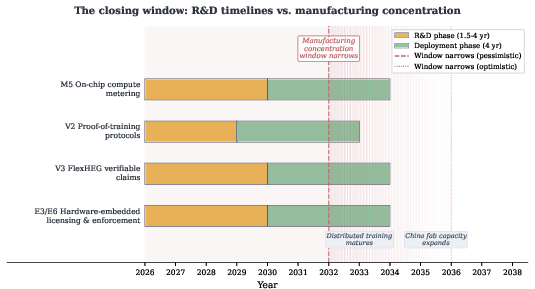
Figure 5: Timeline juxtaposing required R&D/deployment for the four highest-priority mechanisms against optimistic and pessimistic estimates for the persistence of semiconductor supply-chain concentration.
The implication is that if development is not immediately prioritized, the opportunity for globally enforceable hardware-level governance may be lost as adversaries or unregulated jurisdictions circumvent chokepoints, or as the context moves irreversibly toward distributed/low-bandwidth training.
Implications, Limitations, and Future Directions
Practical and Theoretical Implications
- The technical gap between policy aspiration and engineering reality is currently unbridgeable for treaty-grade governance.
- Only a layered governance approach is feasible, deploying what is currently operative at the domestic level and investing substantially in R&D for mechanisms that could underpin future bilateral or multilateral regimes.
- Proposals relying on yet-unbuilt mechanisms (hardware kill switches, robust proof-of-training, tamper-evident attestation) should not be legislated as immediately operational; regulatory credibility depends on aligning mandates with technical reality.
Research and Policy Recommendations
Immediate priorities are:
- Prototyping and benchmarking hardware metering mechanisms for robustness, die area overhead, and resistance to practical adversaries.
- Developing scalable, privacy-preserving proof-of-learning/proof-of-training protocols, balancing verification strength with commercial confidentiality.
- Extending governance architectures into inference and mixture-of-experts domains, as training-inference boundaries become increasingly porous.
- Designing cryptographically robust, politically legitimate multiparty enforcement structures, mitigating the risks of sovereignty infringement or centralization of disablement authority.
International institutional design should focus on harmonized chip registry standards, shared KYC protocols, and preparatory alignment on technical standards to ease future verification and enforcement integration.
Limitations
- Feasibility assessments are drawn from public literature and may not account for classified or proprietary advances.
- The taxonomy is focused on deep learning hardware; other modalities (e.g., neuromorphic, quantum, optical) are largely outside scope.
- Political economy and operational cost concerns (e.g., die area, energy, fabrication complexity) are not quantitatively modeled.
- The mapping for self-regulation is pessimistic, reflecting an acknowledged limitation in current voluntary adoption of hardware-based governance.
Conclusion
The paper delivers a landmark synthesis for researchers and policymakers, specifying the concrete engineering challenges and adversarial constraints facing hardware-level compute governance for AI. Bridging the readiness gap, particularly for treaty-verifiable mechanisms, is both an urgent and complex task, contingent on the timely alignment of technical R&D and global industrial policy. Without these investments, governance-by-compute will recede from an actionable policy lever to a theoretical construct, undermining the enforceability and legitimacy of future AI regulatory regimes.