- The paper demonstrates that quantum-inspired embeddings exhibit significant geometric limitations, evidenced by negative or near-zero correlations and collapsed discriminative power.
- It employs a comprehensive experimental framework combining window-based text segmentation, quantum-inspired transformations, and hybrid fusion with BM25 to assess performance across diverse domains.
- Results indicate that despite partial improvements from distillation and hybrid approaches, the embeddings consistently fail to maintain reliable ranking, especially in fine-grained retrieval tasks.
On the Representational Limits of Quantum-Inspired 1024-D Document Embeddings: Expert Analysis
Introduction
This work presents a systematic empirical study of quantum-inspired 1024-dimensional (1024-D) document embeddings (QEMB) within information retrieval (IR) and RAG systems, focusing on their representational capacity, limitations, and integration with strong lexical and dense retrieval baselines. The experimental framework combines window-based text segmentation, quantum-inspired transformations (e.g., angle and amplitude encoding, semantic projections such as EigAngle), multi-scale aggregation, and optional teacher–student distillation. The evaluation spans heterogeneous corpora in Italian and English, including technical, narrative, and legal domains, enabling controlled diagnosis of geometric and retrieval properties across semantic regimes.
Quantum-Inspired Embedding Paradigms and Empirical Framework
The study distinguishes three primary quantum-inspired integration modalities:
- Direct Quantum-Inspired Embeddings: Deterministic or circuit-based encodings map overlapping text windows to high-dimensional vectors, with the intention of leveraging properties of quantum Hilbert spaces for expressive distributions.
- Quantum Transformations over Classical Embeddings: Semantic-rich dense vectors (e.g., from multilanguage teacher models) undergo quantum-inspired mappings; however, non-linearities and numerical pathologies may erode underlying similarity geometry.
- Kernel-Based Quantum Similarity: Similarities are computed implicitly in high-dimensional quantum feature spaces, eschewing explicit embeddability and thus complicating indexability and large-scale retrieval.
For all embedding-based paradigms, the pipeline constructs fixed-size vectors (1024-D) through structured text segmentation, feature map aggregation, and L2 normalization. (Figure 1)
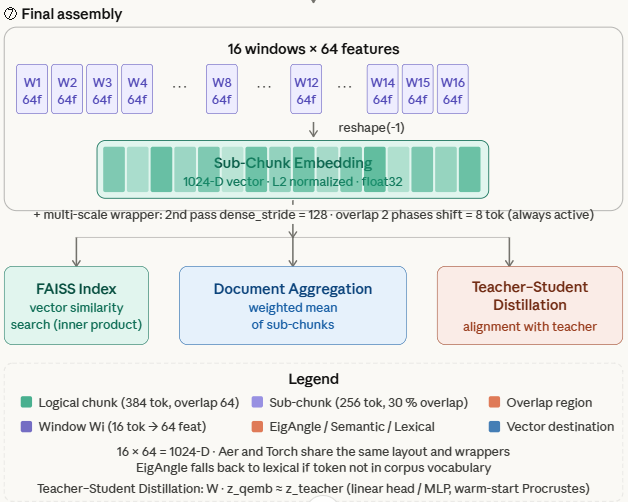
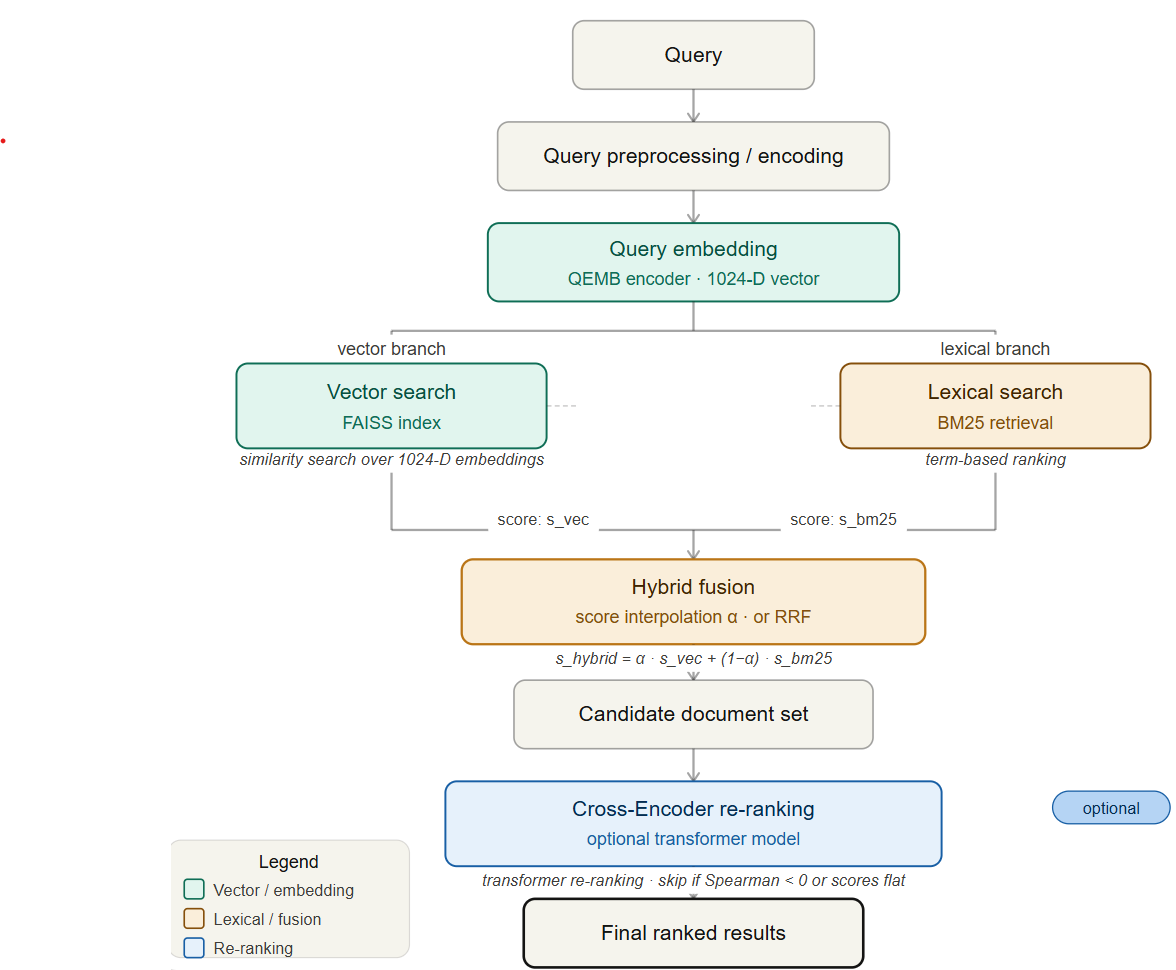
Figure 1: Embedding construction and hybrid retrieval pipeline; top shows assembly of the 1024-D embedding, bottom depicts the hybrid vector/BM25 retrieval and re-ranking process.
The research introduces a hybrid retrieval framework supporting static and dynamic score-level interpolation between BM25 and embedding similarity, candidate-union, rank fusion (RRF), and diagnostics such as an α-oracle, which serves as a conceptual upper bound for fusion effectiveness.
Geometric and Similarity Diagnostics
Pairwise similarity experiments on controlled English and Italian sentence pairs assess the alignment of QEMB, amplitude variants, and ZZ-based transformations with LLM proxies and teacher embeddings. Quantitative evaluation uses Pearson/Spearman correlation, mean absolute error (MAE), and distributional analysis.
The core findings are as follows:
- QEMB (baseline): Demonstrates negative or near-zero correlation with LLM-based reference similarity, severe distance compression, and a collapse of discriminative power (i.e., high similarity assigned to semantically unrelated pairs).
- QEMB (amplitude): Recovers moderate alignment (positive correlation), but remains substantially inferior to dense teacher baselines.
- ZZ-based/Quantum Kernel: Either compresses similarity values toward zero or clusters all pairs at high similarity, destroying inter-class separation.
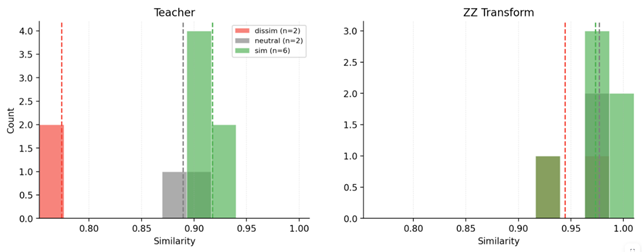
Figure 2: Distribution of similarity scores for ZZ-based transformations vs teacher embeddings; strong clustering at high similarity, diminishing semantic class separation.
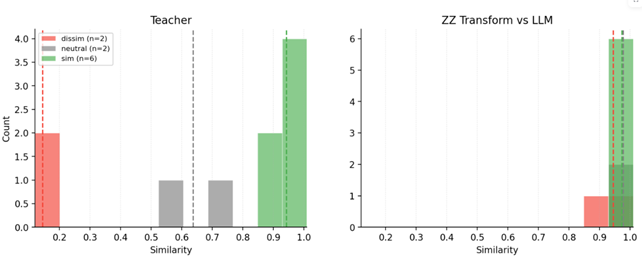
Figure 3: ZZ-based transformations compared to LLM-based similarity; compressed similarity values and attenuated class discriminability.
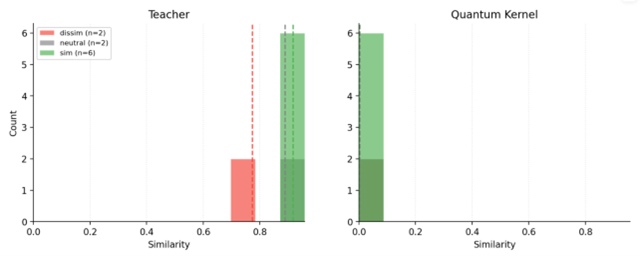
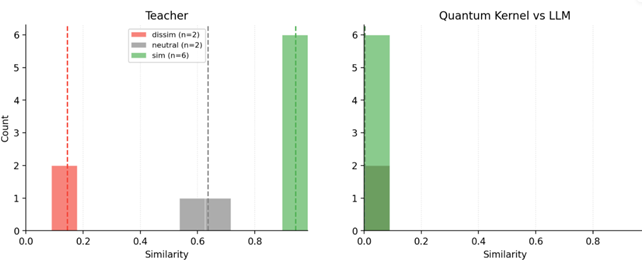
Figure 4: Quantum kernel similarities compared to teacher and LLM baselines; distributions collapse to near zero, eliminating discriminative power.
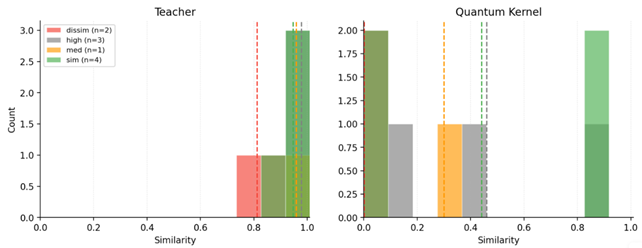
Figure 5: Quantum kernel similarities on legal-domain pairs; the kernel mapping collapses nearly all pairs to orthogonality, failing to preserve teacher-derived class structure.
Correlation coefficients and error metrics are summarized in the tables of the main text. Notably, quantum-inspired representations consistently fail to maintain the local or global neighborhood structure of semantic classes, and distillation only partially mitigates these defects without restoring reliable retrieval geometry.
Retrieval Effectiveness and Hybrid Architectures
Empirical evaluation on technical, narrative, and legal corpora elucidates the practical implications of the observed geometric pathologies:
- BM25 Baseline: In all corpora, especially technical and legal domains, BM25 offers robust recall and ranking, often outperforming both teacher and quantum-inspired embeddings.
- QEMB Standalone: Hit@1 and MRR drop substantially; relevant documents are rarely ranked at the top, even as recall at large cutoff (k=10) remains high due to lack of discrimination.
- Distilled QEMB: Improves global alignment with teachers but does not consistently enhance retrieval; in hybrid settings, distillation can degrade performance by removing residual, possibly orthogonal, signals.
- Hybrid Fusion: Combining QEMB with BM25 via score-level interpolation or candidate union can occasionally match or slightly improve over teacher/BM25 in certain domains; however, gains are data- and query-dependent, and not uniform.
Further, fine-grained (sub-chunk level) evaluation reveals near-complete collapse of QEMB ranking: zero relevant chunks in top-3 and negligible ranking correlation, highlighting amplification of representational defects at finer granularity.
Theoretical Analysis and Limitations
The central limitation is a geometric one: quantum-inspired feature maps applied to text yield compressed similarity spectra, high score saturation, and, in cases, inversion of semantic similarity order. These behaviors are robust to modifications in encoding (angle, amplitude, circuit depth) and distillation (linear/MLP projections). The resulting embedding spaces are unfit for direct use in ranking-oriented IR, lacking the necessary continuity and local structure required for effective ANN search and candidate prioritization.
Kernel-based approaches, while theoretically sound, are computationally impractical for low-latency IR and lack explicit, transferable representations.
The study discusses potential underlying factors, such as expressivity deficits akin to barren plateaus, and identifies a lack of robust, fine-grained semantic regularization as a central challenge.
Implications and Future Directions
The implications are both practical and theoretical:
- For Applied Retrieval: Quantum-inspired 1024-D embeddings, as constructed here, cannot supplant established lexical or neural dense approaches in practical RAG/IR pipelines. Their principal role, if any, is marginal—potentially as noisy, independent signals for hybrid fusion in select settings.
- For Theoretical Modeling: The mapping from high-dimensional geometry to retrieval-via-similarity is nontrivial for quantum-inspired constructions; ensuring monotonicity and local class preservation must be a design focus in any future architectures.
- For Methodological Research: Diagnostic tools for similarity geometry, distributional analysis, and failure case categorization are necessary preconditions for benchmarking quantum-themed models in NLP/IR (2604.09430).
Enhancements may involve adaptive or learned transformations (breaking from deterministic window-to-feature mapping), ranking-aware or contrastive objectives during representation learning, and structured interaction models for hybrid score fusion.
Finally, while quantum kernel and circuit-based approaches remain of theoretical interest, their lack of explicit, indexable, and transferable representations currently precludes adoption in operational retrieval architectures.
Conclusion
This work provides an authoritative diagnostic on the representational and operational boundaries of quantum-inspired 1024-D embeddings. It demonstrates that, despite their geometric formalism, these encodings do not yet match the local or global semantic structuring required for lexical/semantic IR. While they can, in some hybrid settings, act as auxiliary signals, their role remains secondary. Advancements in quantum-inspired representation for IR will require both architectural innovations preserving semantic locality and metric learning aligned with retrieval-sensitive objectives. The analysis and tools introduced herein set benchmarks for future research trajectories.

