- The paper introduces cognitive motifs as editable causal subgraphs to achieve bidirectional human–LLM alignment in planning tasks.
- It employs graph algorithms for concept extraction and dependency linking, significantly improving reasoning externalization and structured revisions.
- Empirical evaluations reveal enhanced trust, transparency, and targeted repair cycles, demonstrating practical benefits over traditional intent-based approaches.
CogInstrument: Cognitive Process Modeling for Bidirectional Human-LLM Alignment in Planning
Introduction and Theoretical Motivation
LLMs have achieved strong performance in planning and problem-solving contexts, but interaction paradigms are typically predicated on intent-centric human input, leading to persistent cognitive misalignment. Most contemporary interfaces capture “what” users want in a flat or weakly hierarchical manner but disregard the inherent causal dependencies, structural assumptions, and revisable rationales that underpin complex human reasoning. Such flattening occludes the dynamic formation and revision of beliefs, hindering both intent diagnosis and output traceability.
The paper “CogInstrument: Modeling Cognitive Processes for Bidirectional Human-LLM Alignment in Planning Tasks” (2604.10587) proposes an explicit cognition-centric approach to human–AI alignment. Distinct from prior intent-externalization and model-side reasoning visualization paradigms, CogInstrument introduces “cognitive motifs”—compositional and revisable causal subgraphs—as first-class units of interaction. By establishing cognitive motifs as editable visual artifacts, the system operationalizes human reasoning for bidirectional alignment, enabling iterative negotiation and synchronized plan formation.
CogInstrument applies a formal graph-based mechanism for reasoning capture:
- Concept Extraction: From user utterances, the system identifies typed cognitive concepts—beliefs, constraints, preferences, and factual assertions. These serve as atomic nodes in the cognitive graph.
- Causal Linking: Dependencies among concepts are instantiated as typed edges (enable, constrain, determine) following the semantics of Pearl’s causal framework. Linking leverages LLM-assisted candidate extraction with runtime evidence checks, incorporating confirmation, counterfactual, and mediation probes to clarify high-uncertainty substructures.
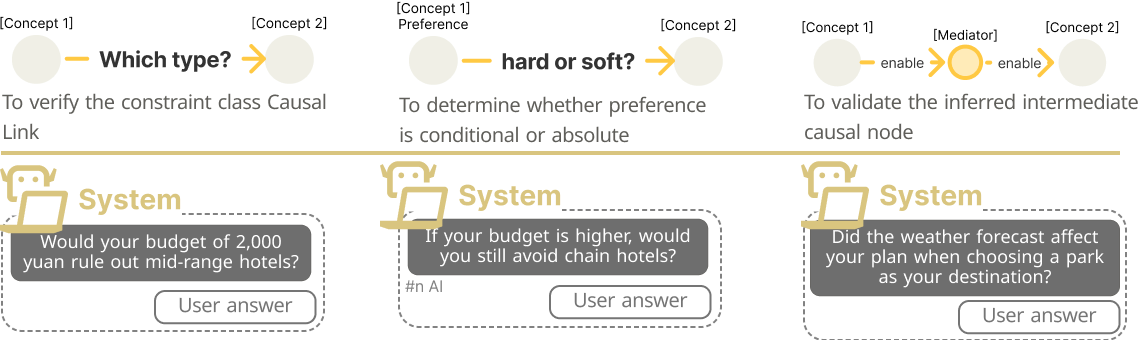
Figure 1: Representative clarification probes for different uncertainty patterns.
- Cognitive Motifs: A motif is operationalized as a reusable, minimal causal subgraph (Cμ,Eμ,ϕμ), with abstract reasoning functions (ϕμ) such as constraint propagation or trade-off resolution. Motif extraction proceeds from grounded dependencies, yielding a library of reusable schemas across operational contexts.
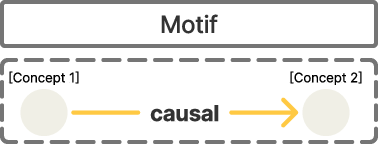
Figure 2: A motif is a reusable reasoning pattern with concepts and its dependency.
- Dependency Typing and Compilation: The system strictly enforces an acyclic backbone for dependency propagation, utilizing classic graph algorithms (A*, Tarjan’s algorithm) for structural repair and layout stability.


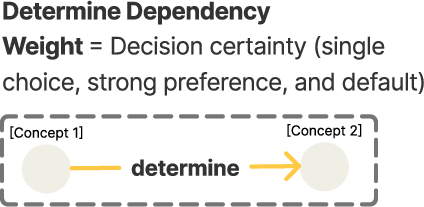
Figure 3: CogInstrument consists of three dependency types among concepts: enable, constraint, and determine. A motif is a reusable cognitive dependency pattern including at least two concepts.
- Interaction and Mixed-Initiative Update: CogInstrument decouples cognitive and task-plan states. User- or assistant-proposed changes undergo selective clarification and, when achieving threshold impact, are surfaced as explicit patches rather than opaque rewrites. Structural edits (concept/motif/edge-level) supplant traditional text-only correction for fine-grained, causal-propagation-aware revision.
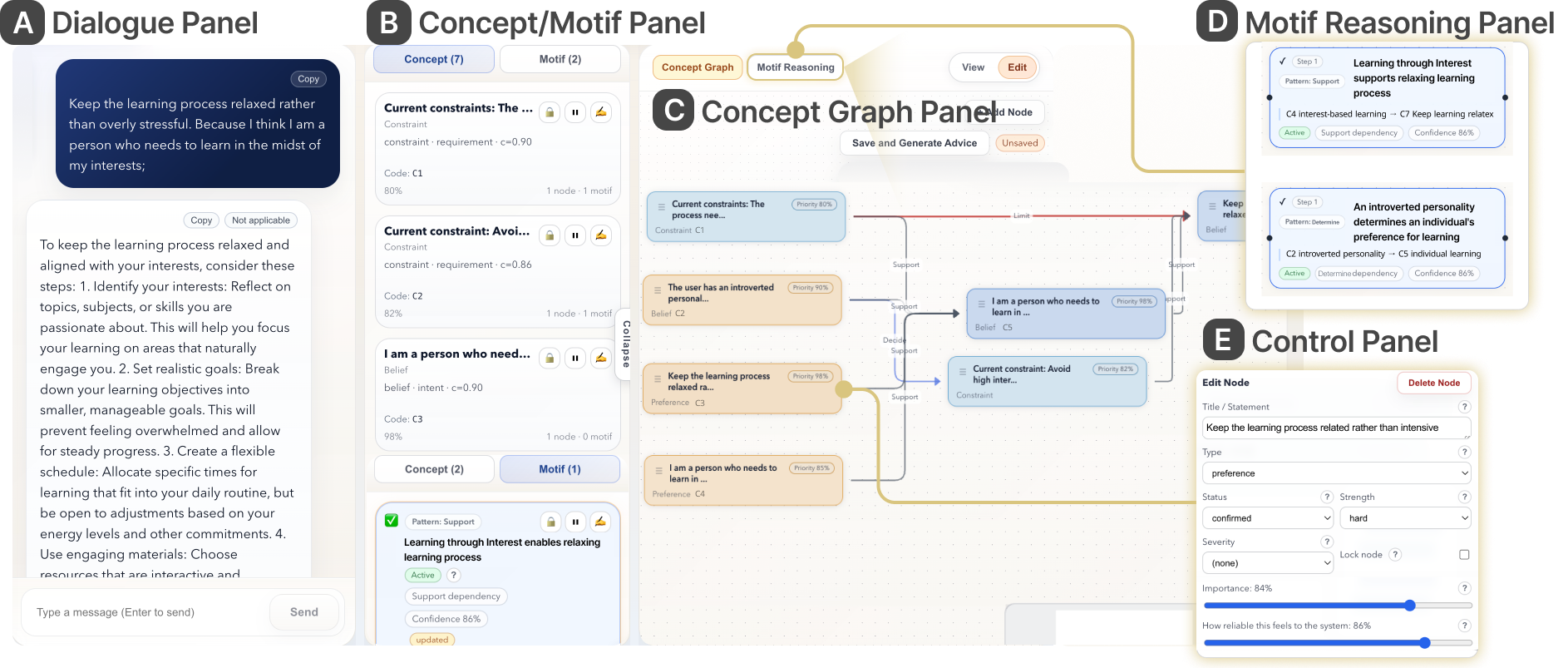
Figure 4: CogInstrument interface. Panels (A--E) provide synchronized views of the underlying reasoning state, ranging from high-level dialogue planning (A) and structural reasoning mapping (B--D) to direct intervention and patch management (E).
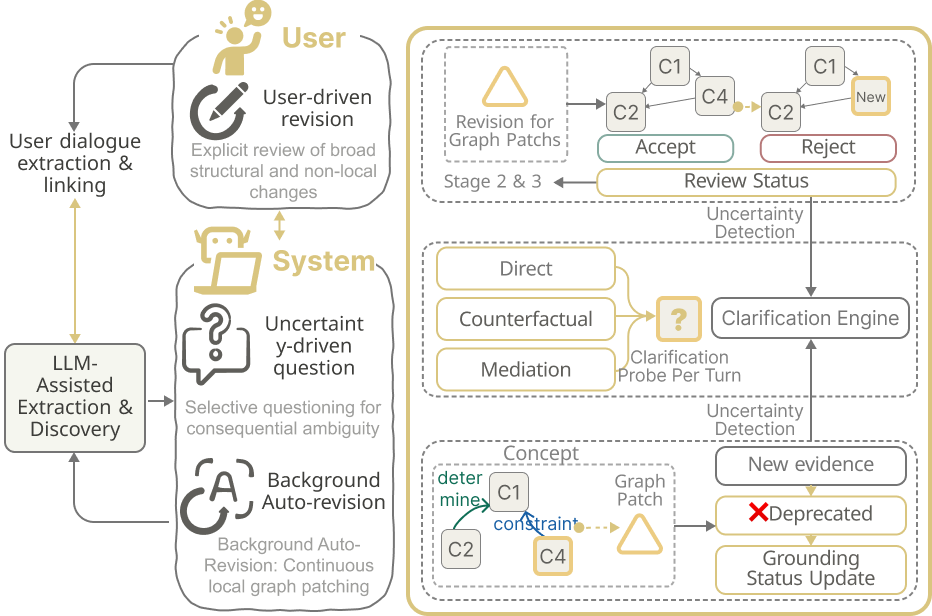
Figure 5: Three interaction modes: user-driven revision, uncertainty-driven question, and background auto-revision.
Empirical Validation and User Study Outcomes
The system was evaluated in a within-subjects study (N=12) with experienced LLM users, spanning travel and personal growth planning with domain–task pairs.
Main findings:
- Structured Externalization: CogInstrument improves participants’ ability to articulate, inspect, and revise implicit causal reasoning. All six Likert-scale constructs (diagnosis clarity, reasoning externalization, dependency grounding, revision coherence, cross-task transfer, trust/control) yielded statistically significant improvements (p<.014) over standard chat paradigms. Particularly, dependency grounding (2.89→5.97), reasoning externalization (3.10→6.00), and revision coherence (3.09→5.77) showed the largest effects.
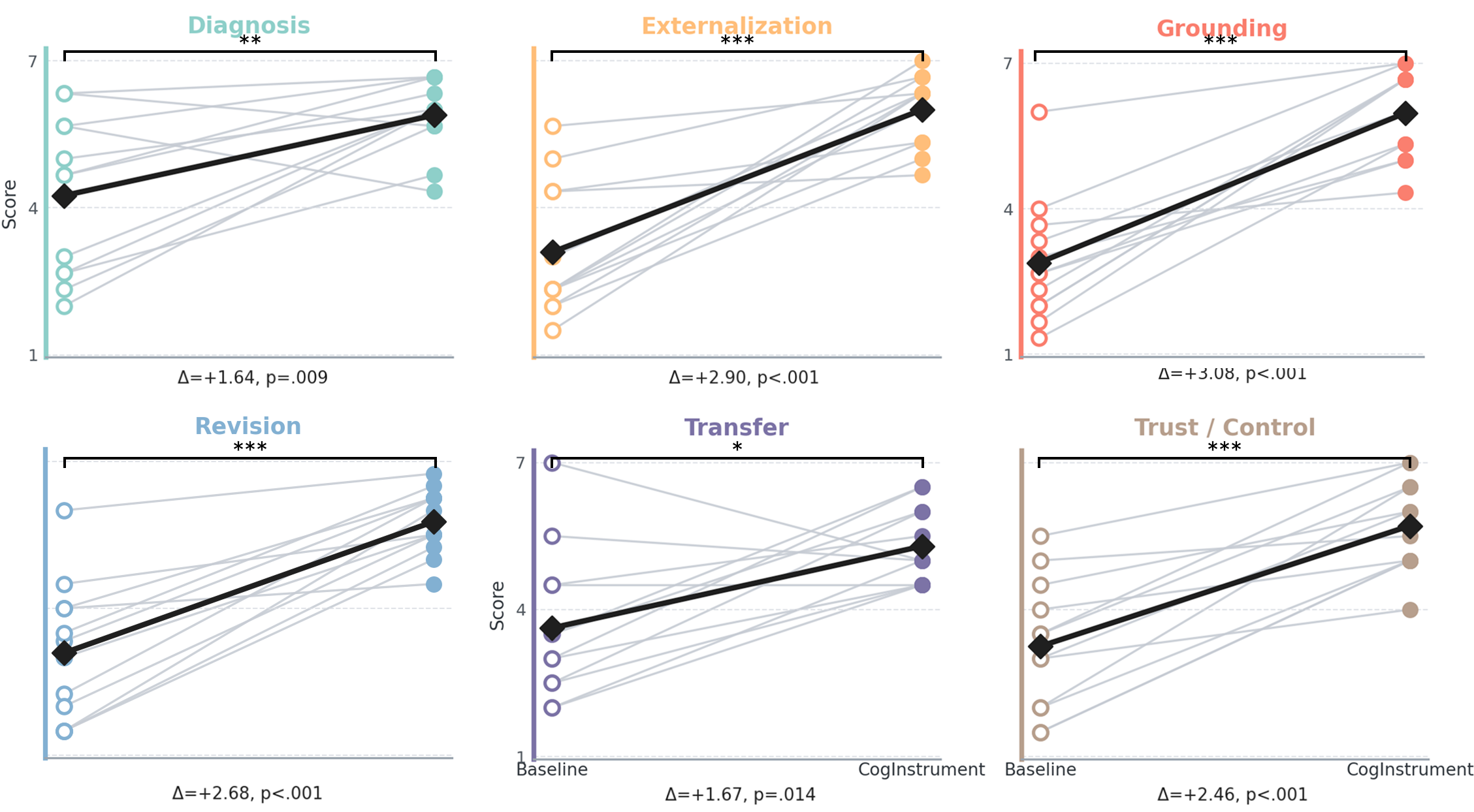
Figure 6: Paired participant trajectories and condition means for the six grouped Likert constructs. Across all six construct summaries, participants rated CogInstrument more favorably than Baseline.
- Revisability and Propagation: Participants preferred operating at the motif/edge level rather than restating, enabling targeted repair cycles (modifying specific causal links) and transparent versioning of revisions.
- Transfer and Reusability: Explicit motif libraries empower grounded cross-task transfer while retaining user control over generalization scope and evidence re-grounding. Though transfer effects were positive, high selectivity underscores the need for scope negotiation.
- Trust and Control: Participants reported increased trust due to structural legibility and stronger perceived control over system alignment—even when direct graph editing was infrequent.
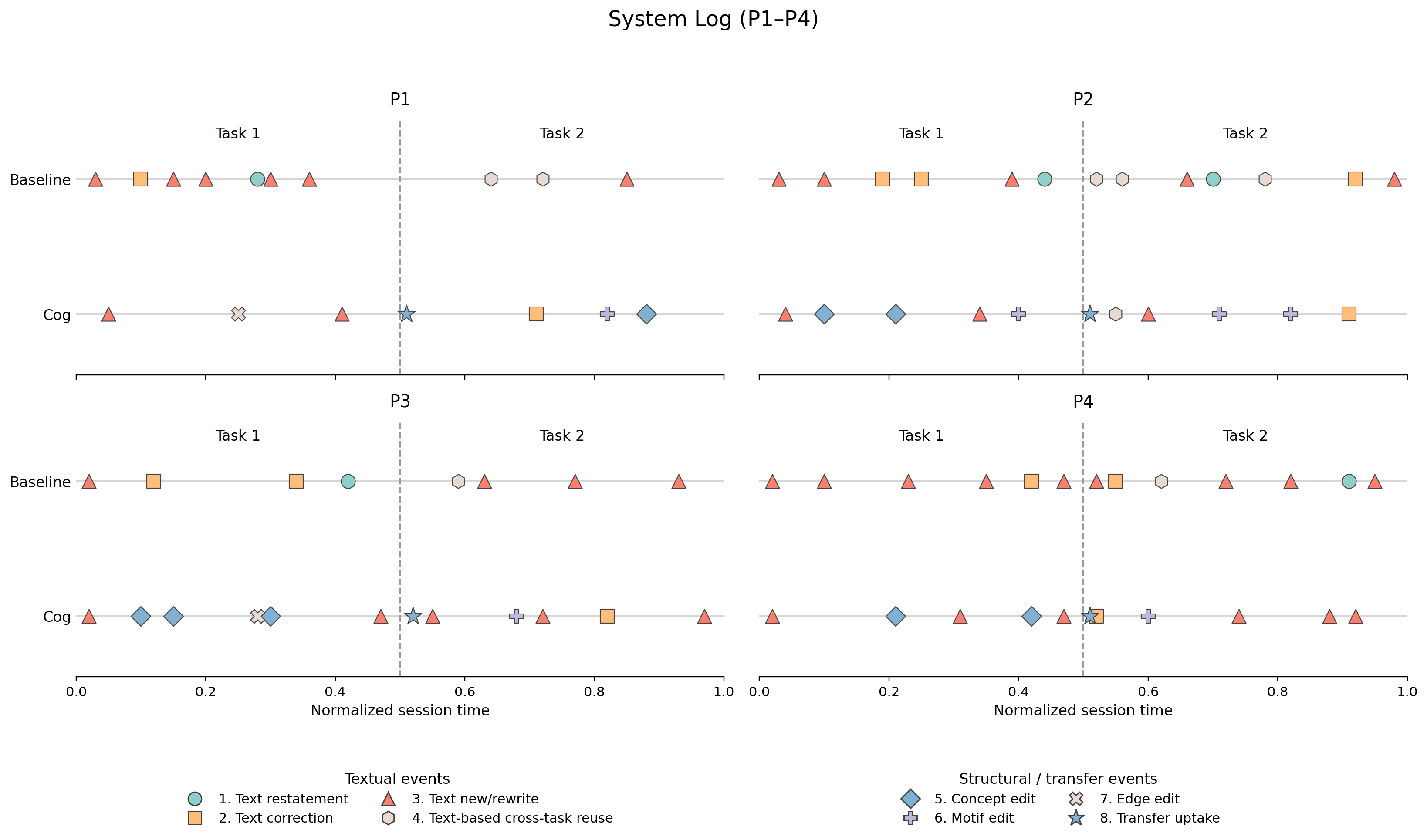
Figure 7: Full system-log timelines for Participants P1--P4, demonstrating a variety of revision strategies including text-dominant and structure-level interventions.
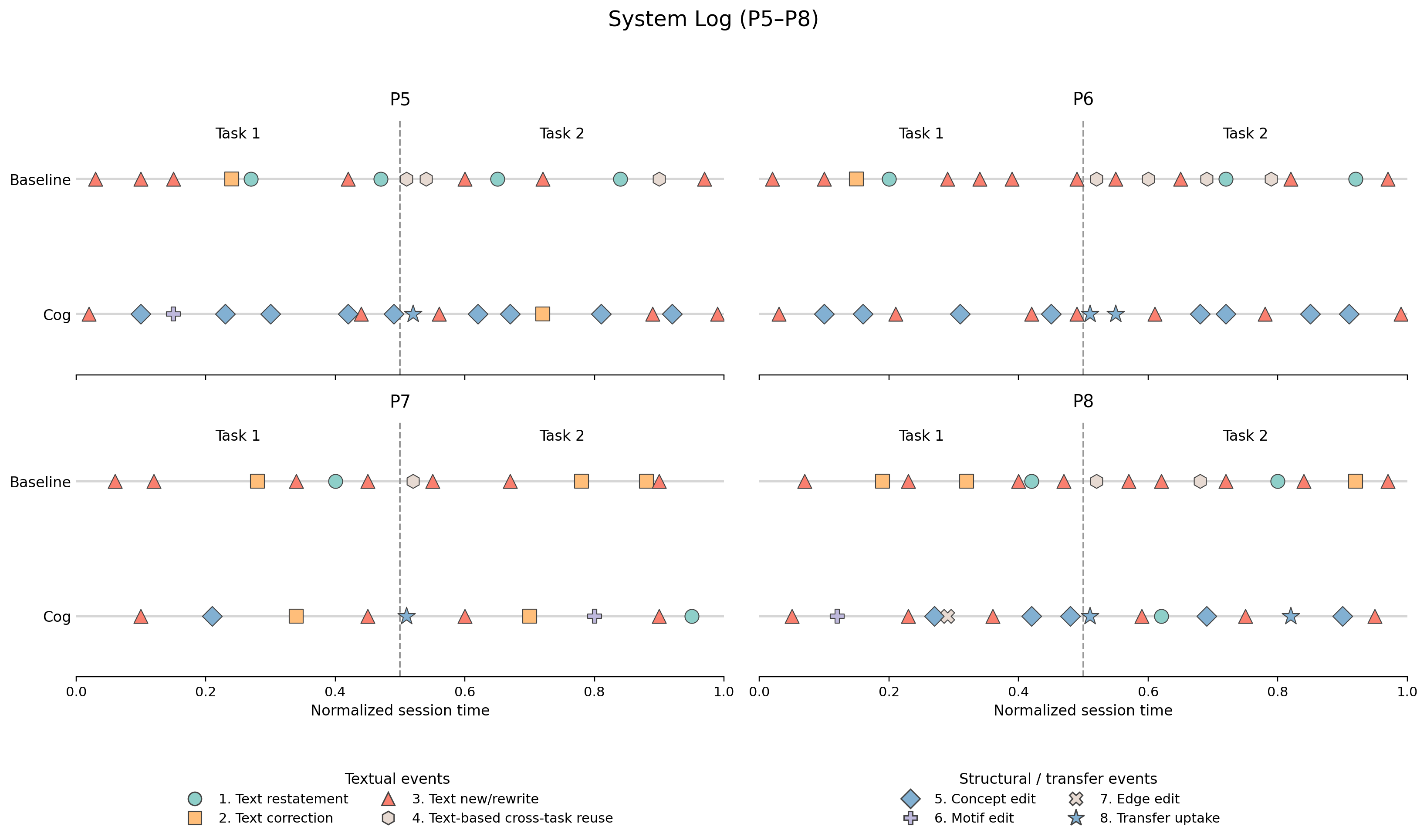
Figure 8: Full system-log timelines for Participants P5--P8, showing increased adoption of structure-level revisions and motif transfer in CogInstrument.
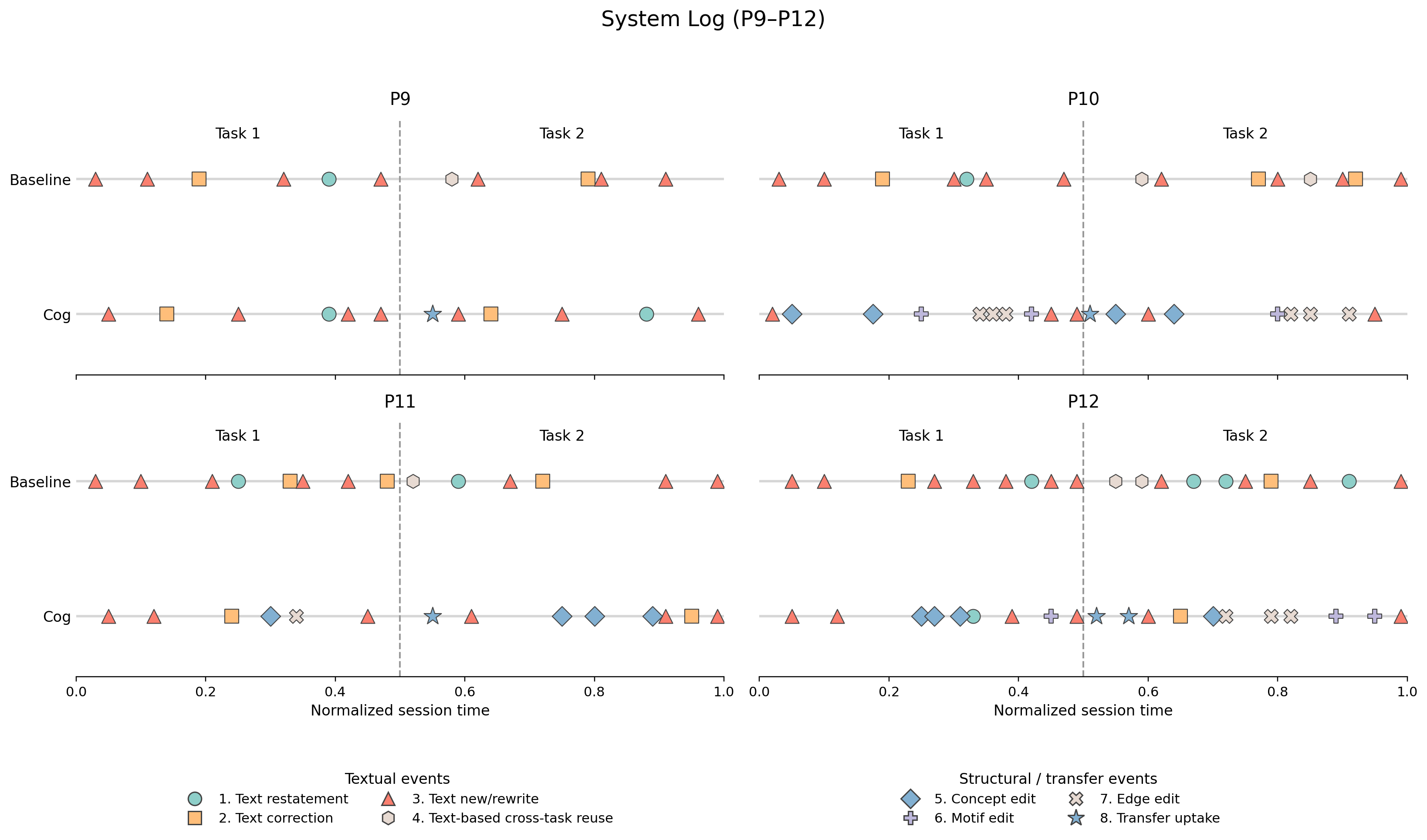
Figure 9: Full system-log timelines for Participants P9--P12, illustrating broad heterogeneity in revision and interaction mechanisms under the structural paradigm.
- Cognitive Cost: No overall usability loss or increased workload (SUS, NASA-TLX), although Mental Demand increased, consistent with a shift toward deliberate reasoning and structure-aware revision rather than routine prompt–response cycles.
Implications and Positioning
The cognitive motif model advances the human–AI alignment agenda by making reasoning itself—rather than surface intent—an explicit, manipulable substrate for collaboration. Unlike approaches such as OnGoal, Intent Tagging, or NeuroSync, which either flatten user goals or center model-internal task mappings, CogInstrument formalizes bidirectional, reviewable negotiation over the “why” and “how” of planning.
Pragmatically, the system’s reliance on deterministic graph compilation, classic patch management, and dependency-aware transfer ensures robustness and inspectability absent in “opaque” prompt-based approaches. This architecture enables compositional reuse and accommodates heterogeneous user appropriation without enforcing heavy structural overhead.
Theoretically, the work aligns with research trajectories in distributed cognition [Hutchins, 1995], instrumental interaction [Beaudouin-Lafon, 2000], and concept map-based learning [Novak & Musonda, 1991], but distinctly fuses these with contemporary LLM-powered mixed-initiative HCI.
Limitations and Future Work
The initial evaluation is bounded in scope (small-N, expert users, planning domain only), with subjective but not directly objective plan quality or extraction fidelity metrics. Support for hierarchical reasoning, generalization to non-planning domains (decision-making under time pressure, brainstorming), and adaptation for LLMs of divergent causal reasoning capabilities remain open.
Potential directions include:
- Multi-level motif hierarchies for strategic–tactical reasoning integration
- Expansion to rapid, less-structured collaborative ideation settings
- Longitudinal acquisition of co-evolving user–LLM reasoning artifacts, supporting genuine co-reasoning and “alignment drift” tracking
Conclusion
CogInstrument establishes cognitive motif-based externalization as a robust mechanism for achieving human–LLM alignment, supplanting intent-centric paradigms with structured, reviewable, and reusable reasoning artifacts. By treating causal dependencies as interaction primitives, the system demonstrates scalable gains in transparency, trust, controllability, and analytic value. The framework provides a foundational blueprint for future research into structured human–AI collaboration and opens pathways toward increasingly transparent, traceable, and adaptive cognitive interaction models.
References
- "CogInstrument: Modeling Cognitive Processes for Bidirectional Human-LLM Alignment in Planning Tasks" (2604.10587).