Published 14 Apr 2026 in quant-ph and physics.optics | (2604.12395v1)
Abstract: Linear optical spectra of molecular aggregates are often approximated by classical optics methods such as the discrete-dipole approximation (DDA), coherent exciton scattering (CES), and coherent potential approximation (CPA), where the only quantum-mechanical input to the calculation is the linear susceptibility of the monomers. However, the limits of validity of these classical optics methods remain opaque. Here, starting from a quantum mechanical Hamiltonian for the aggregate, we identify a limit where DDA/CPA/CES is exact: all-to-all coupled permutationally symmetric aggregates of $N \to \infty$ monomers. The permutational symmetry of this molecular version of the Lipkin-Meshkov-Glick model, which is closely related to that of the molecular polariton problem of many identical molecules coupled to a single-cavity mode, allows us to borrow recent techniques developed for the latter. In particular, we identify a $1/N$ expansion that corrects the classical optics limit with finite $N$ corrections to the linear response of the aggregate. These corrections feature as Raman-like transitions of a single monomer. We illustrate these findings with calculations on the very physically-relevant setup of a homodimer. Our findings clarify how quantum optical features that go beyond classical optics can already be present in simple arrays of quantum emitters such as molecular aggregates.
The paper establishes that for fully symmetric aggregates, classical-optics methods (DDA/CPA/CES) become exact in the thermodynamic limit.
It employs a Schwinger boson reformulation and a continued-fraction linear response to derive systematic 1/N quantum corrections.
The work highlights Raman-type spectral features in finite aggregates, bridging microscopic quantum effects with observable spectral behavior.
Permutationally Symmetric Molecular Aggregates: From Mean-Field Spectroscopy to Microscopic Quantum Corrections
Introduction
Molecular aggregates exhibit complex photophysics regulated by the interplay between electronic and vibronic couplings, collective symmetry, and aggregate geometry. Standard methods for computing linear optical spectra in such systems—including the discrete-dipole approximation (DDA), coherent exciton scattering (CES), and coherent potential approximation (CPA)—employ only the monomer linear response as quantum input, treating intermolecular coupling at a mean-field or classical level. However, the precise microscopic conditions under which these approaches become exact and the physical nature of their leading corrections have remained ambiguous. This paper presents a comprehensive analysis of molecular aggregates with full permutational symmetry, focusing on the all-to-all coupled case, and demonstrates that these systems furnish a controlled quantum limit in which DDA/CPA/CES-type spectra emerge rigorously.
The authors establish an explicit connection between collective molecular models (generalizing the Lipkin-Meshkov-Glick Hamiltonian for coupled monomers) and classical-optics spectral predictions, providing a unified framework for the structure-spectrum relationship. They further analyze systematic corrections to mean-field treatments by developing a $1/N$ expansion, allowing the isolation of inherently quantum, non-classical phenomena—most notably Raman-type spectral features—which survive in experimentally relevant finite aggregates such as dimers.
All-to-All Coupled Aggregate Model and Bosonic Reformulation
The study considers a symmetric ensemble of N+1 identical molecular monomers with uniform (all-to-all) electronic coupling, described by a generalized Lipkin-Meshkov-Glick Hamiltonian incorporating multimode vibronic structure. The full Hamiltonian includes each monomer's electronic and vibrational degrees of freedom, combined with a permutation-symmetric term for inter-monomer electronic coupling:
Figure 1: Schematic of an all-to-all coupled molecular aggregate highlighting full permutational symmetry of the couplings.
The symmetry constraints of the Hamiltonian restrict the system's evolution to the fully symmetric sector of Hilbert space. This enables an efficient mapping to a Schwinger boson formalism. Here, the occupation of vibronic states by indistinguishable molecules is tracked using bosonic operators, which dramatically facilitates exact and approximate analysis. The collective excitation manifold is organized by the number of electronic and vibrational excitations, resulting in a hierarchy of timescales and a natural basis for perturbative (i.e., $1/N$) expansions.
Dynamical Hierarchy and Continued-Fraction Linear Response
Time evolution in the aggregate is governed by a separation of scales imposed by permutation symmetry. Electronic excitation transfer that leaves the number of ground-vibrationally excited molecules unchanged occurs at a collective rate scaling with JN. Processes inducing vibrational excitations in the electronic ground state are suppressed, scaling as JN or weaker, motivating a block-structured analysis:
Figure 2: Hierarchy of dynamical timescales in an all-to-all coupled molecular aggregate supporting a controlled expansion in the number of ground-state vibrational excitations.
The authors derive an exact, continued-fraction expression for the linear optical response by exploiting the block-tridiagonal structure of the single-excitation Hamiltonian in the occupation-number basis. The calculation, based on sequential application of the Schur complement, allows for efficient numerics and analytic approximations, including a systematic $1/N$ expansion. The leading order (zeroth order) retains only collective Rayleigh-like electronic transitions, while higher-order terms account for quantum vibrational (i.e., Raman) sidebands.
Emergence of DDA/CPA/CES in the Thermodynamic Limit
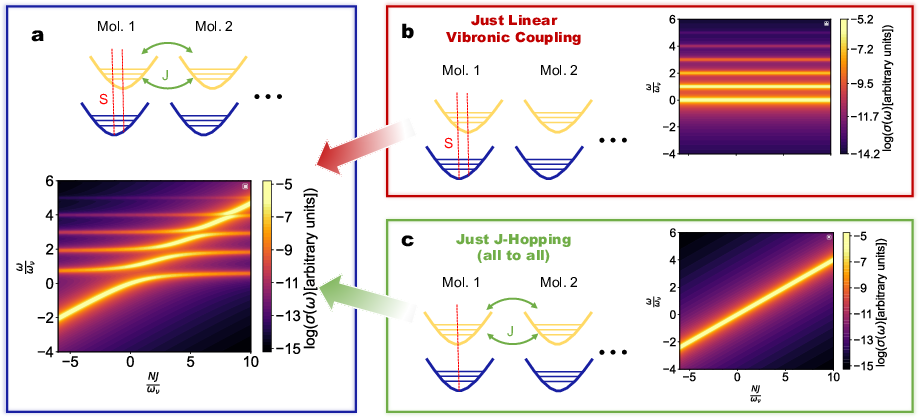
In the thermodynamic limit (large N at fixed JN), the ratio of intra-manifold to inter-manifold coupling diverges. The exact continued-fraction response collapses to zeroth order: only elastic Rayleigh-type processes within the fully symmetric manifold survive. In this limit, the spectrum is a simple functional of the monomer linear susceptibility and the collective coupling parameter, and the DDA/CPA/CES expressions become exact for the all-to-all coupled model:
Figure 3: Linear absorption spectra for all-to-all coupled aggregates across different coupling regimes; the universal features at large N are fully captured by DDA/CPA/CES.
Mathematically, the aggregate's absorption is
σ(ω)∝−ℑ[1−NJ⟨μg(ω)μ⟩⟨μg(ω)μ⟩]
where N+10 is the Green's function for a single monomer. This provides a unified perspective: the classical-optics methods are justified as exact mean-field theories for fully symmetric (infinite, all-to-all coupled) aggregates, clarifying both their computational success and physical limits.
Finite-Size Corrections: Raman-Type Quantum Features
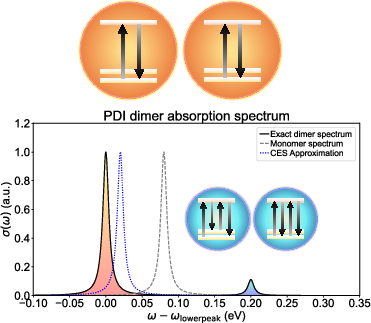
Finite aggregates, including dimers, display corrections to mean-field spectra not captured by classical-optics theory. The leading quantum corrections are identified as resonant Raman-like transitions: pathways in which absorption and subsequent emission involve vibrational sidebands in the ground electronic manifold. These corrections are systematically described by the N+11 hierarchy; in a dimer, the effect is analytically and numerically explicit:
Figure 4: Absorption spectrum of a model PDI dimer, emphasizing the origin of quantum Raman sidebands that are absent in the classical-optics prediction.
The dominant CPA-like (Rayleigh) feature is accompanied by secondary peaks—Raman sidebands—whose energy splitting matches ground-state vibrational frequencies. These features are not only spectroscopically resolvable but can cause small shifts of the principal absorption resonance, emphasizing that even the simplest aggregates require quantum treatments to capture all photophysical effects.
Implications and Prospects
This framework defines a precise boundary for the applicability of mean-field classical-optics approaches to the spectroscopy of molecular aggregates. For large, fully symmetric systems, DDA/CPA/CES are justified without approximation. For physically realistic aggregates—especially small, defective, or disordered clusters—Raman-type quantum corrections must be systematically included to accurately capture spectral features and encode vibrational structure.
Importantly, this approach provides a concrete connection to other collective light-matter systems, including molecular polaritons in cavities (where similar large-N+12 expansions and Schwinger boson mappings are used), and it can inform design strategies for organic optoelectronic materials via predictive structure-spectrum relationships. Quantum corrections derived here may be essential for subwavelength sensing, nonlinear spectroscopy, or coherent-control protocols where vibronic features play a central role.
Conclusion
Permutationally symmetric all-to-all coupled aggregates offer a rare instance in molecular spectroscopy where a mean-field, analytically tractable model fully captures the linear optical response—including the classical-optics limit. The exact mapping to DDA/CPA/CES approaches provides both computational efficiency and conceptual clarity regarding the nature of spectral renormalization by aggregate interactions. Quantum corrections, manifesting as Raman-type processes, are explicitly characterized, revealing their role in both shifting principal resonances and generating additional sidebands. This unified treatment rigorously defines when classical optics suffices and establishes a path for systematically incorporating quantum effects in the analysis and engineering of molecular aggregates and their photonic interfaces (2604.12395).