- The paper introduces Δ-SWIGs that extend traditional SWIGs, providing a graphical calculus to justify conditional parallel trends in DiD settings.
- The methodology systematically derives minimal conditioning sets to block backdoor paths, addressing nuances with time-varying and post-treatment covariates.
- Simulations reveal that relying solely on pre-trend tests can mislead causal inference, especially when treatment-covariate feedback is present.
Causal Graphs for Conditional Parallel Trends: A Technical Summary
Introduction and Motivation
The utility of Difference-in-Differences (DiD) estimators in empirical research is underpinned by parallel trends assumptions, often extended to conditional forms (CPT) when observable covariates are present. Despite their prevalence, formal methodologies to select and justify conditioning sets for CPT are notably absent—particularly when covariates are time-varying or may themselves be affected by treatment. Existing graphical frameworks such as DAGs and SWIGs are standard for unconfoundedness but have not been extended to the structural properties essential for CPT in DiD. The paper "Causal Graphs for Conditional Parallel Trends" (2604.12818) addresses this deficiency by introducing transformed Single World Intervention Graphs, termed Δ-SWIGs, to provide a d-separation-based, graphical calculus for CPT in DiD.
Graphical Framework: Δ-SWIGs
The paper operationalizes its graphical methodology by adapting and transforming SWIGs, which map potential outcomes for interventions. In traditional SWIGs, one can read off conditional independencies linked to unconfoundedness; however, standard DiD identification typically invokes parallelism of outcome differences across time, rather than levels. The novel graphical construct is the Δ-SWIG: instead of representing only counterfactual potential outcomes, nodes are added for first or higher-order differences between potential outcomes, e.g., ΔYt(0)=Yt(0)−Yt−1(0).
A central theoretical result establishes that d-separation in Δ-SWIGs implies conditional independencies for these differences, thereby providing a sufficient graphical condition for CPT. Conditioning sets can thus be mechanically derived from the structure by identifying variable sets that block all backdoor paths between treatment assignment and outcome differences.
Application to Canonical and Complex Settings
2×2 Design with Time-Invariant and Time-Varying Covariates
The classic two-period, two-group DiD setup is used to demonstrate the foundational mechanics of Δ-SWIGs. Under the standard single world additive separability (SWAS) assumption—requiring time-invariant unobserved confounding to be additively separable in untreated outcome equations—the diagrams reveal that CPT is justified graphically if one conditions on time-invariant covariates X. When time-varying covariates (X0,X1) enter the data-generating process, the minimal conditioning set expands correspondingly, and post-treatment variables may need to be controlled if there are direct effects of covariates on outcomes.
In the presence of covariate dynamics and potential feedback (i.e., when covariates are affected by previous treatment status), pre-treatment covariate adjustment may not suffice. The Δ-SWIGs make explicit when conditioning on post-treatment covariates is necessary and when it introduces new biases (e.g., "wrong world control bias" analogous to bad control or M-bias in DAG theory).
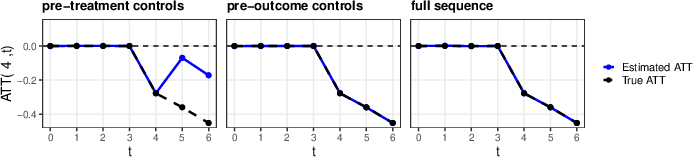
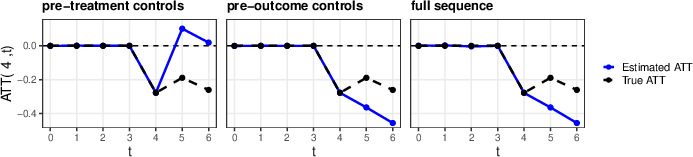
Figure 1: Simulation results displaying CPT estimator performance under different conditioning strategies and covariate-treatment feedback regimes.
Outcome Dynamics and Identification Failures
The graphical formalism clearly maps violations of CPT to specific features: outcome state dependence, outcome-treatment feedback, and outcome-covariate feedback. In these settings, "dilemma nodes" (colliders or variables influenced by both treatment and unobserved confounders) preclude separation of treatment from outcome differences regardless of the conditioning strategy. In particular, conditioning on bad controls (descendants of colliders) leads to the activation of previously blocked paths and thus confounding.
Post-treatment Covariates and Non-identifiability
When covariates after treatment are affected by treatment assignment, the requisite CPT involves counterfactual Δ0, which is not observed for the treated. Δ1-SWIGs make explicit that identification is only available under additional covariate exogeneity restrictions—a result consistent with and extending earlier work such as Caetano (2024).
Multi-period Designs and Staggered Adoption
The approach generalizes naturally to multi-period DiD designs with staggered treatment timing, such as in Callaway and Sant’Anna (2021). The minimal sufficient adjustment set for CPT, Δ2, is derived via parents of the relevant potential outcomes in the SWIG. The methodology is robust to various types of time-varying confounders and can accommodate both never-treated and not-yet-treated control groups.
Significantly, the work demonstrates that while parallel pre-trends (with appropriate conditioning) can be assured under weaker restrictions, identifying unbiased post-treatment effects generally demands stronger assumptions—typically, the absence of treatment-covariate feedback or of certain covariate-outcome dynamics. This distinction is routinely ignored in empirical practice, where pre-treatment tests are used as a blanket justification for post-treatment effects.
Numerical Illustrations
Simulations (see figure below) are conducted to clarify the practical consequences of the different conditioning strategies. Findings include:
- Pre-treatment covariate adjustment yields unbiased short-term effects and apparently parallel pre-trends, but can severely bias dynamic post-treatment effects.
- When no treatment-covariate feedback exists, using post-treatment or pre-outcome controls recovers unbiased estimates.
- If covariates are endogenous, all dynamic effect estimates are biased, an effect not diagnosed by pre-trend tests.
Figure 1: Simulation with various strategies: (a) no covariate feedback, (b) covariate endogeneity; parallel pre-trends do not guarantee unbiased post-treatment effects in (b).
Implications and Recommendations
Theoretical and Empirical Practice
- The identification of DiD under CPT is best viewed as a consequence of explicit causal and functional form assumptions, not as a primitive assumption justified by statistical diagnostics alone.
- Pre-trend analysis is shown to be insufficient for diagnosing violations that invalidate post-treatment effect identification, particularly when time-varying covariates are involved.
- The Δ3-SWIG graphical calculus enables systematic derivation of valid minimal and maximal adjustment sets, thus clarifying the identification versus estimation dimension in applied research.
Recommendations for Researchers
- Explicitly specify and test the structural and functional form restrictions underpinning CPT, rather than relying solely on empirical parallelism in pre-trends.
- Use Δ4-SWIGs to transparently derive and justify conditioning sets appropriate to the data-generating process and estimator.
- In multi-period and complex designs, adjust interpreting pre-trend test outcomes recognizing their limited informativeness for post-treatment effects under general conditions.
Directions for Future Research
The Δ5-SWIG methodology invites several extensions. Applications could include non-additive (or non-linear) separability structures, multi-valued treatments, and non-binary adoption regimes. Further, optimal selection of adjustment sets balancing identification power and estimation efficiency remains an open area, particularly in high-dimensional settings.
Conclusion
This work formalizes and generalizes the graphical approach to CPT justification in DiD designs. The Δ6-SWIG construction, along with the derived separation results, provides a powerful tool for transparent identification analysis. The framework has substantial practical implications: it delineates the limits of pre-trends as diagnostic tools, systemsatizes adjustment set selection, and clarifies the essential structural conditions required for robust causal inference with DiD under complex covariate dynamics and treatment timing (2604.12818).