- The paper conclusively differentiates R3m and Pca21 phases in epitaxial hafnia by leveraging high-resolution 3D reciprocal space mapping.
- It demonstrates distinct phase stability where R-phase remains invariant up to 800°C while OIII-phase undergoes a thermally reversible martensitic transformation.
- Electrical measurements reveal that R-phase exhibits robust as-grown polarization with high coercivity, whereas OIII-phase shows a pronounced wake-up effect and sharper switching.
Disentangling the Ferroelectric Phases of Epitaxial Hafnia
Introduction
The unambiguous identification of structural phases in hafnia-based ferroelectrics is of paramount importance for exploiting their functional properties in ultra-scaled non-volatile memory and logic devices. This work provides a conclusive resolution to the controversy surrounding the phase nature—rhombohedral (R3m) versus polar orthorhombic (Pca21, OIII)—in epitaxially stabilized hafnia films. Leveraging comprehensive 3D reciprocal space mapping via synchrotron-based grazing incidence diffraction, combined with advanced electrical and thermal studies, the authors quantitatively dissect the key distinctions between R- and OIII-phase stabilization, formation, and functional performance.
Phase Identification and Discrimination
A central claim substantiated in this work is the definitive structural fingerprinting of the polar R-phase and OIII-phase in epitaxial hafnia-based thin films. Films were synthesized via pulsed laser deposition on archetypal oxide substrates—SrTiO3 (with a La1−xSrxMnO3 buffer for R-phase stabilization) and Y0.095Zr0.905O2 (YSZ) for OIII-phase stabilization.
Reciprocal space reconstructions, assembled with high resolution and large coverage by detector-mediated grazing incidence X-ray diffraction, revealed the following:
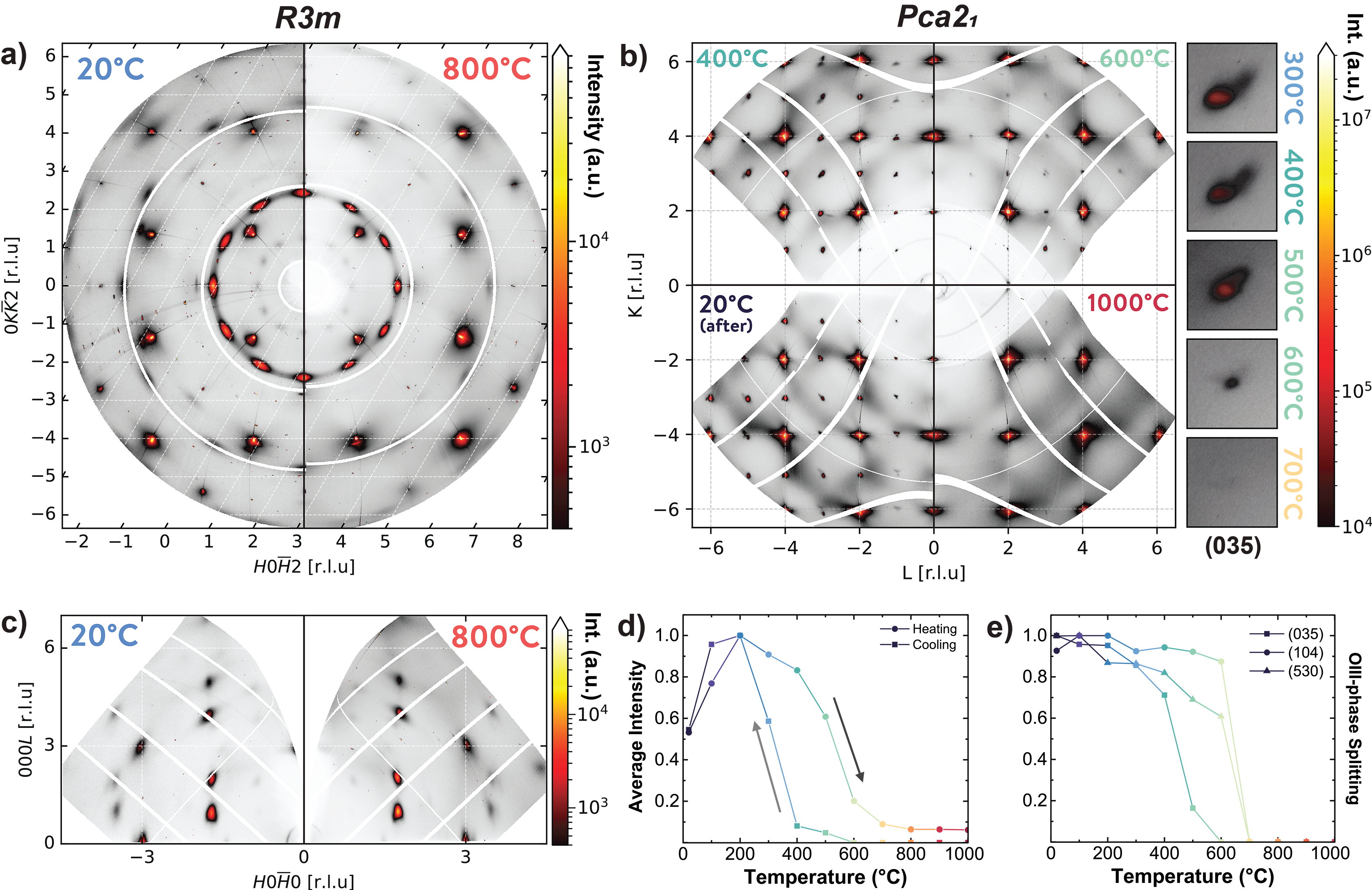
- R-phase films grown on STO/LSMO: All observed diffraction features, including domain multiplicity, peak splittings, and relative intensities, matched simulations for four-variant R3m rhombohedral symmetry, with a robust deviation of the rhombohedral angle (82.9–84.0°) from ideality. Simulated patterns for Pca210 (OIII) systematically failed to reproduce experimentally observed patterns for these films.
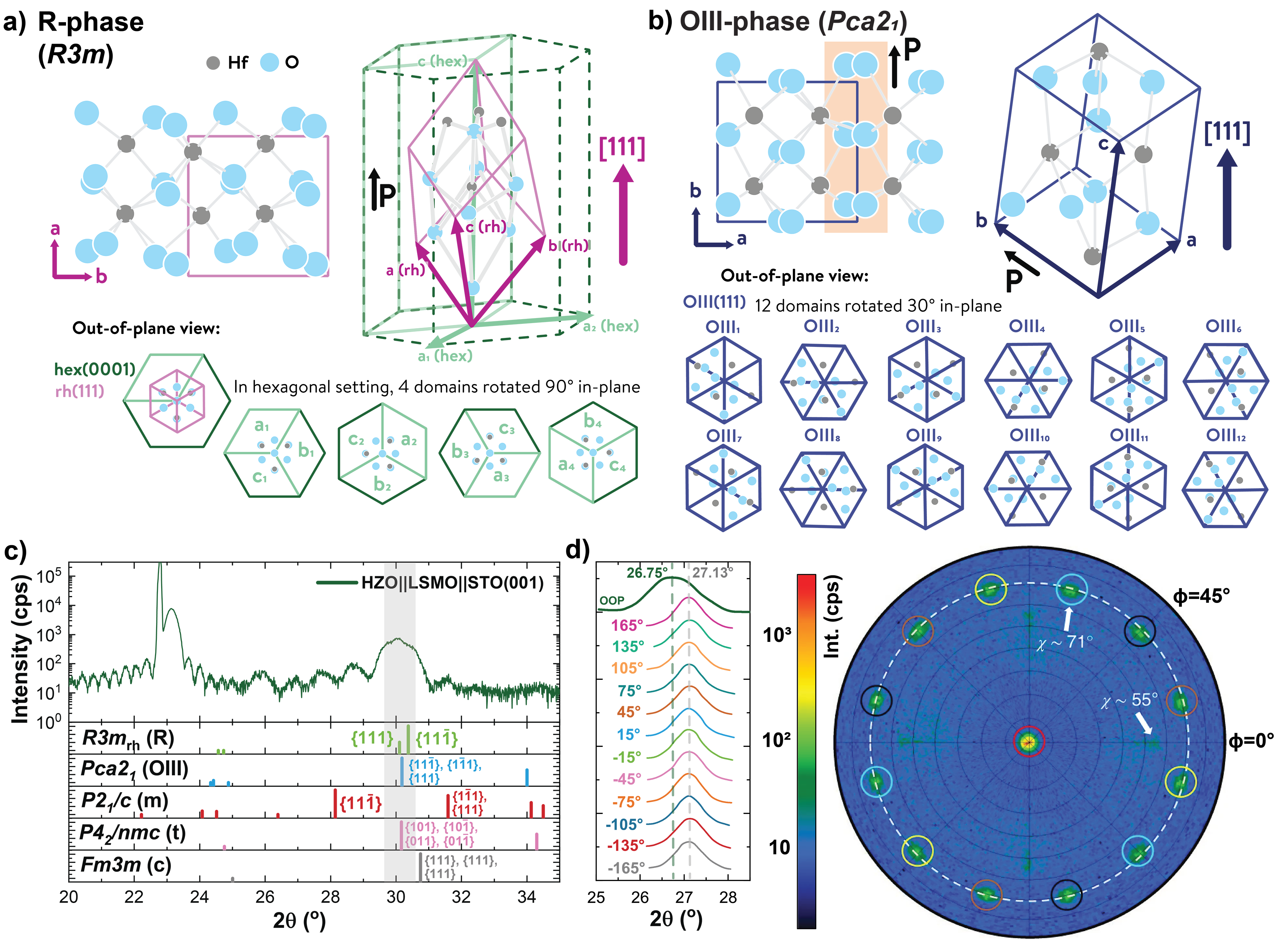
Figure 1: Schematic comparison of the Pca211 and OIII (Pca212) structures, as well as representative diffraction data and phase-specific theoretical predictions.
- OIII-phase films on YSZ(110): Measured 3D datasets displayed the expected three-domain orthorhombic splitting and angular arrangements, with close agreement to calculated patterns based on Pca213; there was no evidence of rhombohedral signatures.
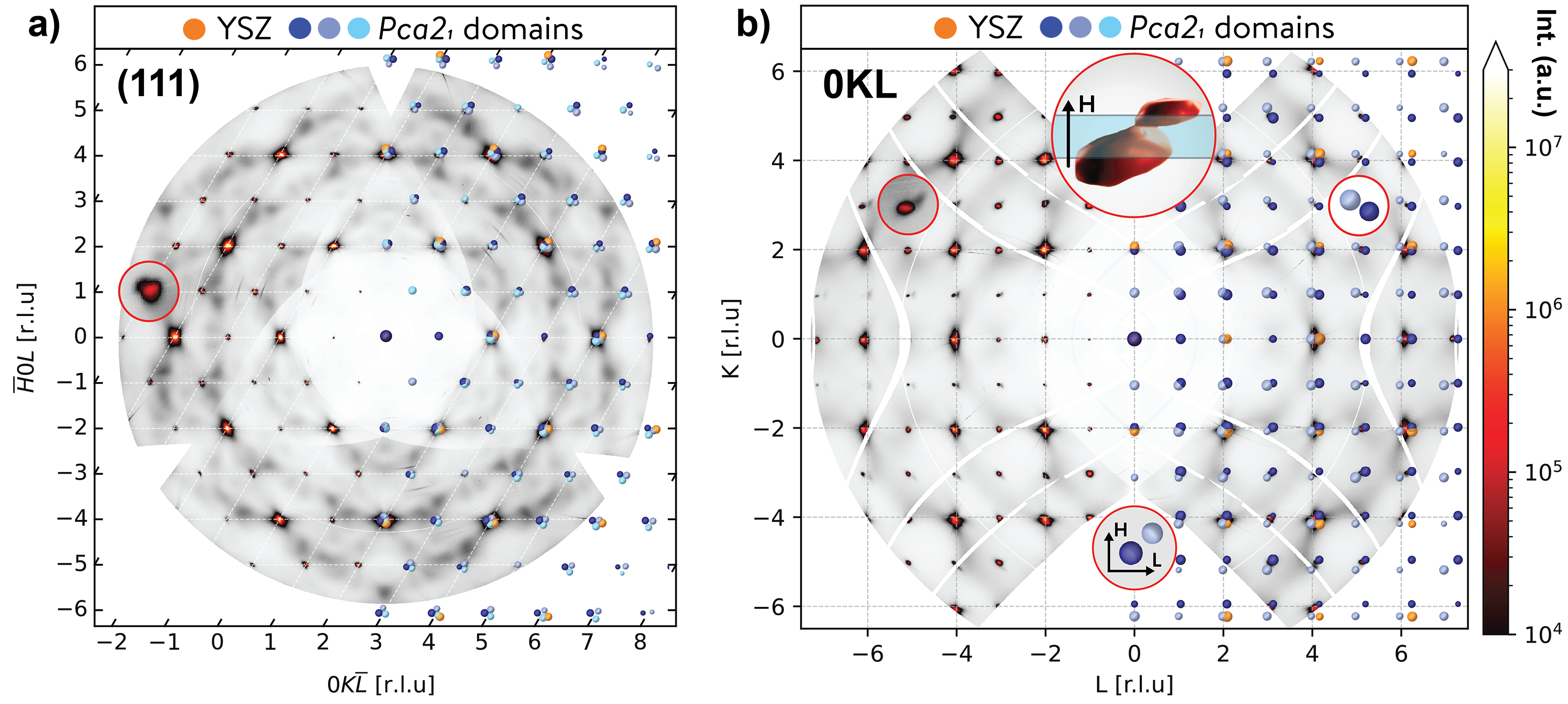
Figure 2: Reciprocal space reconstructions emphasizing the distinguishing peak splitting and reflection multiplicity for OIII-phase films.
The methodological advance here is the use of arbitrarily oriented reciprocal space cuts, revealing peak multiplicities and relative intensities inaccessible to standard 2D RSMs or θ–2θ scans, thereby eliminating the ambiguities that have plagued prior structural assignments.
Temperature-dependent measurements in a custom-designed, shadowless grazing incidence furnace permitted mapping of phase stability regimes and transformation kinetics:
These findings establish that the substrate (and associated strain state) dictates both the phase at growth and its thermal resilience, with the R-phase stabilized by large compressive strain on STO/LSMO.
Structure-Property Relationships in Ferroelectric Response
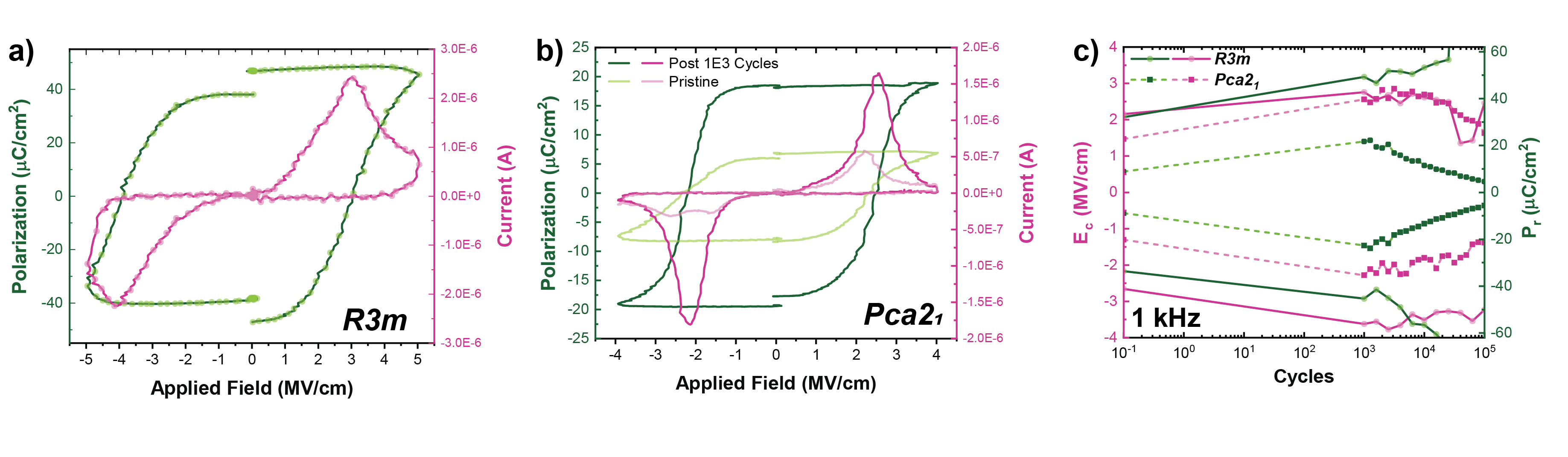
Electrical characterization revealed major distinctions between the R- and OIII-derived devices:
These contrasting behaviors are ascribed to fundamental differences in polarization orientation (purely out-of-plane for [111] R-phase, oblique in OIII(111)), defect chemistry (oxygen stoichiometry), and strain accommodation. The absence of a wake-up effect in R-phase films, even in pristine state, points to less domain wall pinning and superior initial performance, whereas OIII-phase films require cycling-induced domain reconfiguration.
Implications and Future Perspectives
The demonstrated capability to selectively stabilize either R- or OIII-phase via substrate engineering opens the route to deterministic ferroelectric device design in ultrathin hafnia. Substrate-induced large compressive strain can override bulk formation energy differences to stabilize high-energy rhombohedral variants. The findings advocate for expanded reciprocal space characterization, as 3D diffraction mapping was shown to be decisive for unequivocal phase discrimination and understanding domain structures.
Theoretically, this study clarifies the transformation sequence for each phase, including parent phase nucleation and martensitic transition pathways. Practically, it establishes the R-phase as a robust candidate for applications requiring out-of-plane polarization and superior as-grown performance, while emphasizing that tailored OIII-phase films (specifically, (010)-oriented to align the polar axis out-of-plane) could potentially outperform R-phase when engineered with suitable orientation and electrode configuration.
This underscores the need for future research in:
- Strain and orientation engineering to achieve pure, out-of-plane OIII-phase films.
- Fine-tuning oxygen stoichiometry to optimize both switching kinetics and endurance.
- Extending 3D reciprocal space mapping to related ferroelectric systems and phase boundaries.
Conclusion
This work conclusively distinguishes the epitaxial R- and OIII-phases in hafnia, eliminating ambiguities that constraints of lower-dimensional diffraction studies left unresolved. By correlating full 3D reciprocal space spectra, thermal stability, and functional (electrical) data, the distinctiveness of the R3m and Pca234 structural manifolds is established. The systematic use of large-volume reciprocal space mapping emerges as essential for next-generation phase engineering in ferroelectric and correlated oxide thin films.