- The paper introduces a novel benchmark and evaluation framework that integrates real mobile constraints with perceptual image super-resolution.
- The method employs one-step diffusion, LoRA adaptation, and knowledge distillation to achieve high perceptual fidelity and fast mobile performance.
- The results underscore the trade-off between perceptual quality and computational efficiency for practical deployment on mobile hardware.
The First Challenge on Mobile Real-World Image Super-Resolution at NTIRE 2026: Methods and Benchmark Analysis
Introduction
The NTIRE 2026 Mobile Real-World Image Super-Resolution Challenge (2604.17306) establishes a new testbed for algorithmic advances in perceptual image super-resolution (SR) applicable to real-world mobile hardware. The competition targets the ×4 SR setting under unknown, complex degradations. Solutions are required to be simultaneously competitive in perceptual fidelity and efficient for real-time deployment on MediaTek Dimensity platforms, enforcing strict architectural and operator constraints.
Spatial degradation in real-world capture—sensor noise, compression, non-ideal optics—presents a severe obstacle for practical SR systems, which in the literature often make unrealistic bicubic degradation assumptions. While GAN- and diffusion-based paradigms have improved texture and perceptual realism, their computational burden usually makes them infeasible for edge/mobile environments. This challenge formalizes a rigorous benchmark aligned with on-device requirements, balancing quantitative and qualitative image quality metrics and measured device-level inference latency.
Dataset and Evaluation Protocol
Two primary datasets were provided: DIV2K (1,000 2K-resolution images, with 800/100/100 training/validation/testing) and LSDIR (86,991 Flickr images). HR-LR pairs are created by non-bicubic, complex degradation with a 4× downsampling factor to simulate realistic mobile conditions. Challenge participants could also incorporate auxiliary datasets such as Flickr2K.
The final evaluation used a weighted fusion of six perceptual and IQA metrics—LPIPS, DISTS, MUSIQ, NIQE, MANIQA, CLIP-IQA—computed on the Y channel. The overall challenge score is a monotonic function of the product of perceptual score and speedup ratio (relative to OSEDiff [wu2024osediff]), enforcing a practical trade-off. Submissions were tested on 128×128 → 512×512 LR→HR patches on the target hardware, reporting full reproducibility with code and models.
Methodological Trends and Team Strategies
Significant convergence appeared in the use of generative priors (particularly from one-step diffusion) with heavy emphasis on network compression, perceptual-metric-oriented objectives, and staged curriculum fine-tuning. Team-wise, the dominant directions are as follows:
- One-step diffusion and LoRA adaptation defined the state-of-the-art, e.g., OSEDiff, PiSA-SR, FaithDiff, with team extensions focusing on latent-timestep alignment and multi-stage LoRA.
- Knowledge distillation and architectural pruning are universally used to fit strong generative priors into lightweight mobile-compatible backbones, often combining student UNets with tiny autoencoder decoders (e.g., TAESD, SamsungAICamera).
- Hybrid architectures and explicit detail refinement modules address the perception-distortion dilemma, with ensemble or residual structures fusing GAN and diffusion strengths (e.g., YuFans’ DiffBIR-RealESRGAN blend).
- Perceptual-metric-guided optimization supersedes pixel loss; all competitive teams incorporate direct supervision from challenge metrics (LPIPS, DISTS, NR-IQA) into the loss.
Notably, nearly all high-performing entries deployed either explicit IQA loss terms or IQA-weighted model selection, aligning optimization with the actual benchmark instead of classical PSNR/SSIM.
Top Methods
Team Antman
Team Antman employed an ESRGAN-derived RRDBNet backbone, fully convolutional, initialized from Real-ESRGAN x4plus, as shown below.

Figure 1: Antman's RRDBNet-based pipeline integrates explicit perceptual metric guidance in the loss, improving realism while preserving RRDB stability.
By including direct loss terms for MANIQA, MUSIQ, CLIP-IQA, LPIPS, and DISTS, the team pivoted the optimization toward the exact evaluation suite. No structural GAN or diffusion modifications were introduced. Compact fine-tuning on DIV2K unknown-degradation with heavy perceptual re-weighting yielded a strong perceptual score ($4.1659$) and a speedup of 21.79× relative to OSEDiff, resulting in a challenge total score of $33.24$.
Team SamsungAICamera
SamsungAICamera leveraged a distillation pipeline with a pruned one-step diffusion UNet student, TAESD-style decoder, and an interposed shallow detail enhancement module (DEM), preserving rich generative detail with minimal added overhead.
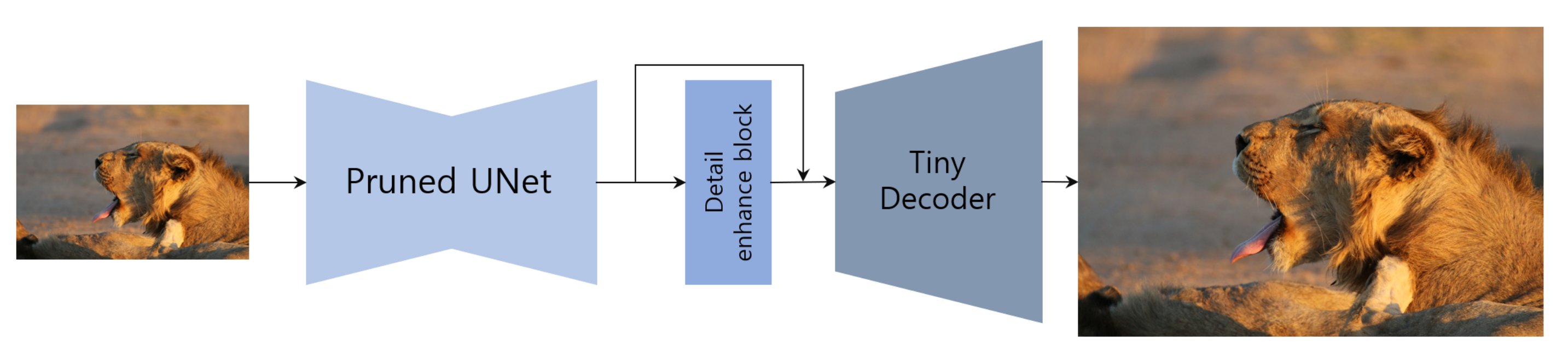
Figure 2: SamsungAICamera's efficient framework distills OSEDiff priors into a pruned UNet and TAESD decoder, with a shallow DEM for perceptual refinement.
Training was divided into three: a primary teacher-student distillation with L1/adversarial losses, a perceptual fine-tuning stage (LPIPS, DISTS, CLIP-IQA, MUSIQ, MANIQA), and targeted DEM optimization. Final inference involved tiled processing and reported an inference decomposition of $720$ ms (U-Net) / $30$ ms (decoder) / $8$ ms (DEM) on target hardware. Empirically, SamsungAICamera balanced perceptual score ($4.2392$) with 11.67× speedup (score 4×0).
Team TODSR
TODSR innovated with a latent-timestep alignment (LSA) and asynchronous conditional score distillation, improving conditional guidance and latent matching in one-step diffusion. Dual-LoRA structure allowed staged coarse/fine adaptation, trained end-to-end with pixel and DISTS losses.
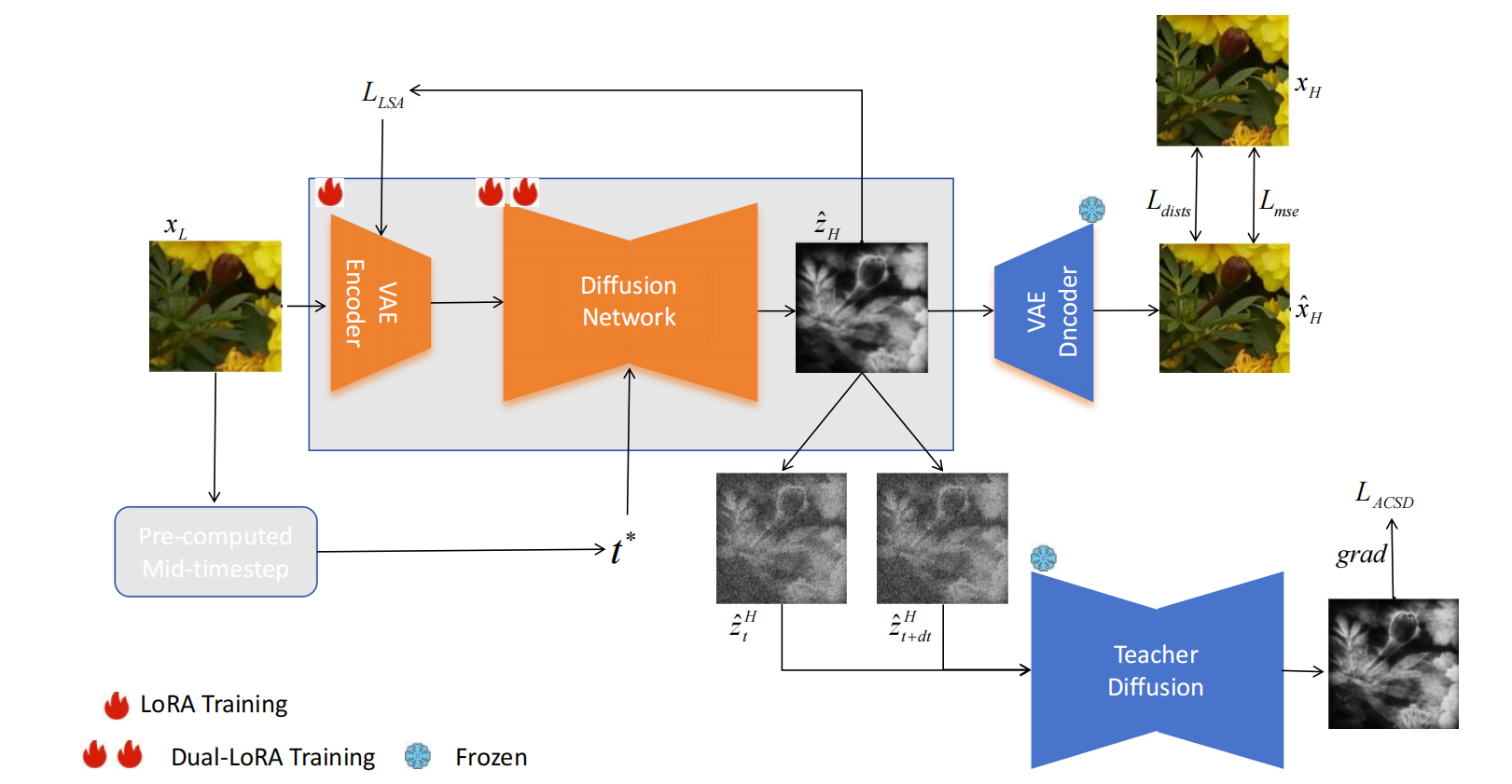
Figure 3: TODSR's architecture introduces explicit latent-timestep alignment and dual LoRA branches for progressive diffusion SR refinement.
Their approach, based on SD2.1 priors and PASD synthetic degradation, yielded a best score of 4×1 and a measured speedup of 4×2. The method excels in perceptual fidelity within moderate resource budgets.
Team YuFans
In contrast to the above, YuFans presented an inference-only blend of pretrained DiffBIR (diffusion) and Real-ESRGAN (GAN), with a post-processing cascade (unsharp mask, CLAHE, saturation). This late fusion allows leveraging both texture and structure with pre-existing weights, tuned by validation IQA metrics.
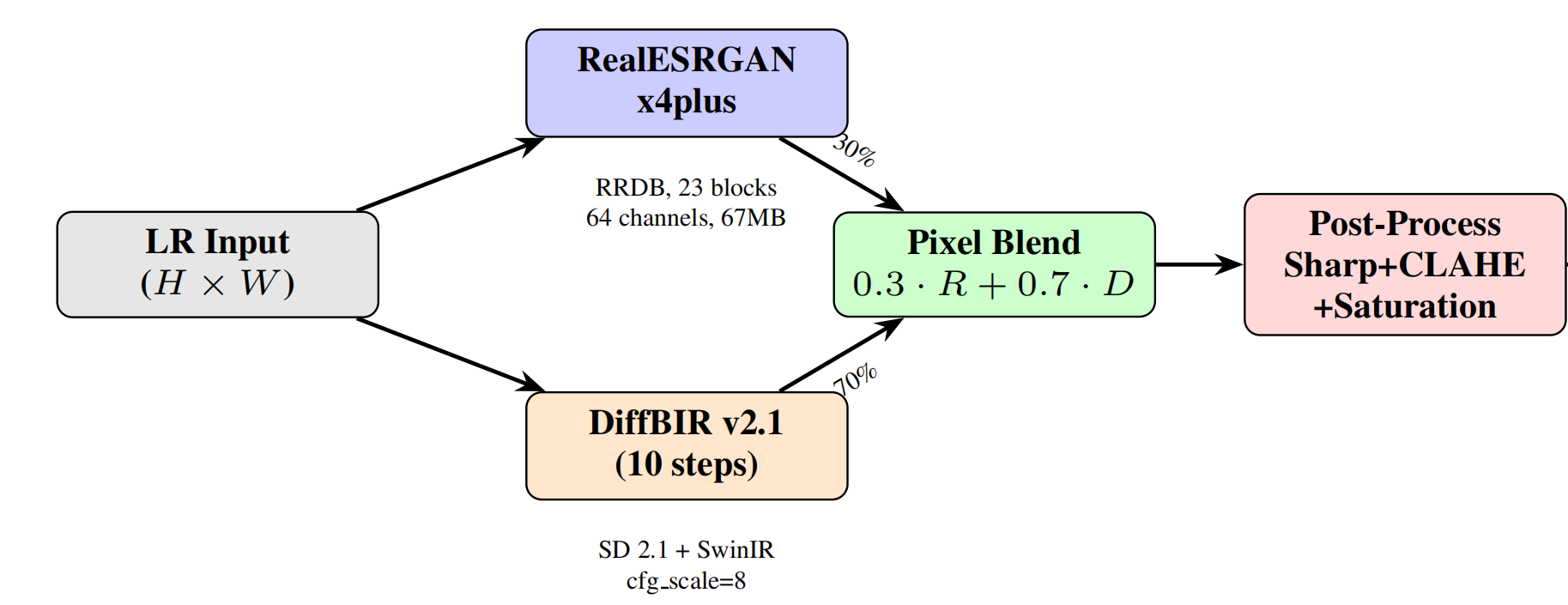
Figure 4: YuFans' ensemble fuses diffusion detail with GAN structure and employs patch-level post-processing to maximize IQA scores.
A fixed blend (4×3) maximized perceptual gains while managing mobile latency. No retraining or fine-tuning of backbones was performed.
Team IMAG2006
IMAG2006 adapted the OMGSR one-step diffusion framework [wu2025omgsr], with key replacement of DINOv3-based DISTS with LPIPS and DISTS in the objective and explicit no-reference IQA perceptual supervision (MUSIQ, CLIP-IQA, MANIQA). Loss normalization and balancing were performed to align with IQA maximization. The model was trained with AdamW and a multi-term loss to optimize for both structure and perceptual metrics.
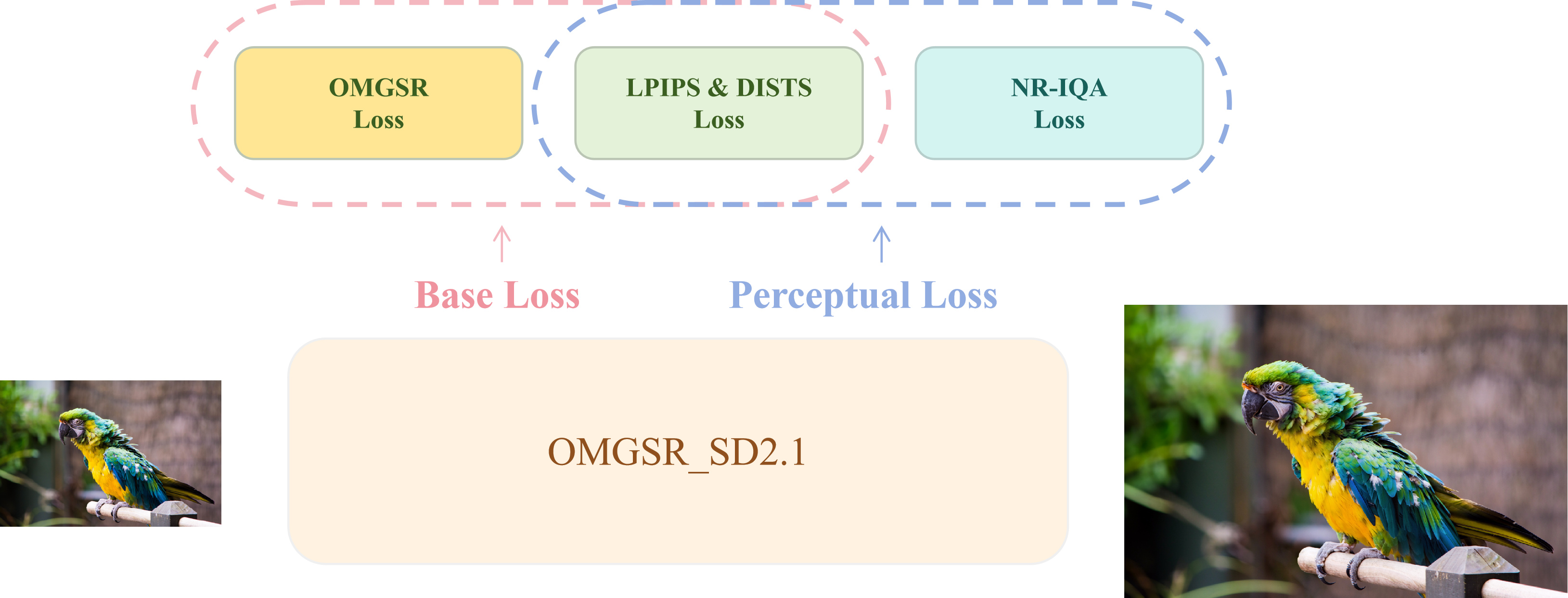
Figure 5: IMAG2006's approach modifies OMGSR by multi-metric perceptual supervision and loss normalization on one-step diffusion.
Benchmark Results and Analysis
The highest challenge scores were achieved by approaches directly optimizing for the challenge metric, often at the expense of classical pixel fidelity. The following summarized benchmark results:
| Team |
Perceptual Score |
Speedup |
Total Score |
| VIPSL |
4.03 |
113.85 |
42.21 |
| Antman |
4.17 |
21.79 |
33.24 |
| SamsungAICamera |
4.24 |
11.67 |
30.87 |
| TODSR |
4.35 |
1.00 |
20.42 |
| YuFans |
3.46 |
21.79 |
20.38 |
VIPSL captured the top rank by balancing a moderately high perceptual score with unmatched acceleration via an efficient PLKSR-Rep backbone and IQA-centric multi-stage fine-tuning. Antman secured efficient classical restoration with perceptual loss engineering. SamsungAICamera and TODSR further underscored the advantage of distilled, one-step diffusion models with architectural innovations to optimize the perception-runtime trade-off.
Implications and Future Directions
This challenge concretely demonstrates the field’s shift away from monolithic GAN/diffusion architectures toward more mobile-friendly, modular pipelines. Robustness to unknown degradations, IQA/perceptually-targeted training, and explicit hardware-aware design are now prerequisites for mobile deployment.
Architectural distillation, LoRA adaptation, and hybrid pipeline assembly are maturing as dominant strategies for propagating generative performance into resource-limited settings. Future systems will likely extend one-step diffusion with learned adaptive fusion, joint non-blind/semantic restoration, and more nuanced, hardware-aware curriculum search (potentially automated via NAS).
From an application perspective, these results accelerate the roll-out of mobile-embedded ultra-resolution pipelines for real-world photographic enhancement, telemedicine, and surveillance tasks, especially as edge AI deployment becomes ubiquitous.
Conclusion
The NTIRE 2026 Mobile Real-World Image Super-Resolution Challenge (2604.17306) has established a new, rigorous community standard for evaluating perceptual SR under real constraints. The strong numerical results achieved—particularly the high total scores with order-of-magnitude device speedups—were only possible via careful metric-oriented optimization, generative prior distillation, and deployment-aware engineering. The rapid progress reflected in this benchmark signals the practical viability of advanced SR on next-generation mobile platforms and motivates follow-up challenges on real-time augmentation and multimodal enhancement under strict deployment budgets.