- The paper demonstrates that decentralized gradient descent with heterogeneous local step sizes can achieve faster convergence than centralized algorithms.
- It employs a Performance Estimation Problem (PEP) framework to precisely quantify worst-case errors across various benchmarks including logistic regression, CNNs, and BERT fine-tuning.
- The findings imply that leveraging local data geometry and strategic resource allocation can enhance algorithm design in high-heterogeneity machine learning environments.
Decentralization as an Accelerator for Optimization and Machine Learning
Motivation and Context
Traditionally, decentralized optimization has been perceived as a trade-off necessitated by practical constraints in data privacy, communication, and device heterogeneity. The prevailing assumption is that centralized algorithms, operating on aggregated data, have superior convergence rates and performance. "Accelerating Optimization and Machine Learning through Decentralization" (2604.19518) systematically challenges this paradigm through rigorous theoretical analysis and empirical validation. The paper demonstrates that decentralization, when properly designed to leverage local geometry and heterogeneity, not only matches but can surpass centralized approaches in convergence speed for optimization and learning tasks.
Decentralized Gradient Methods and Heterogeneous Step Sizes
The study centers around server-assisted decentralized gradient descent algorithms, where each device adapts its step size according to its local smoothness constant. The algorithm initiates with heterogeneous local step sizes, allowing each agent to exploit the geometric properties of its dataset, and switches to a uniform global step size once convergence plateaus. Theoretically, this leverages local curvature disparities in non-i.i.d data, a factor overlooked by homogeneous centralized schemes. Importantly, this approach strictly assumes per-iteration computational parity between the centralized and decentralized protocols, enabling a fair comparison of convergence rates.
To quantify algorithm performance, the paper employs the Performance Estimation Problem (PEP) framework, which formulates the exact worst-case optimization error as a semidefinite program over prescribed function classes (convex, smooth, strongly convex). Unlike conventional analyses relying on upper bounds or empirical simulation, the PEP provides mathematically tight performance characterizations. The theoretical results establish that decentralization with adaptation of local step sizes achieves strictly faster convergence than centralized gradient descent when data heterogeneity is substantial.
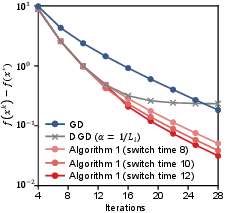
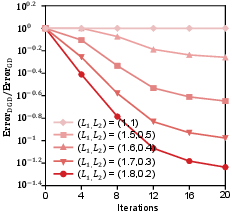
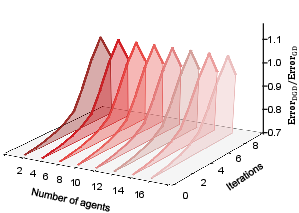
Figure 1: Performance comparison of Algorithm~\ref{algorithm} using PEP analysis, revealing that decentralization with heterogeneous step sizes (red curves) accelerates convergence relative to centralized gradient descent (blue curve), especially as data heterogeneity increases.
The acceleration is robust across various function classes, as confirmed by numerical solutions to the PEP and by Theorem 1, which gives an explicit ratio of optimization errors that is strictly less than one (Algorithm 1 vs. centralized GD) in all tested heterogeneous settings.
Empirical Evaluation: Logistic Regression, Neural Networks, and NLP
The theoretical findings are strongly corroborated by comprehensive experiments across classical and modern benchmarks:
- Logistic Regression on W8A: Data partitioned by labels, feature norms, and eigenvalues to induce heterogeneity. Decentralized learning substantially reduces the number of iterations to target accuracy compared to centralized GD.
- Deep Learning on CIFAR-10 and MNIST: Decentralized CNN training with label-based data partitioning. Both full-batch and mini-batch protocols show that decentralized approaches achieve superior convergence in loss and accuracy under pronounced data heterogeneity.
- BERT Fine-tuning for Sentiment Analysis (SST-2): Decentralized setting via Dirichlet-based label partitioning. The decentralized algorithm converges more rapidly in training and validation metrics than the full-batch centralized baseline.

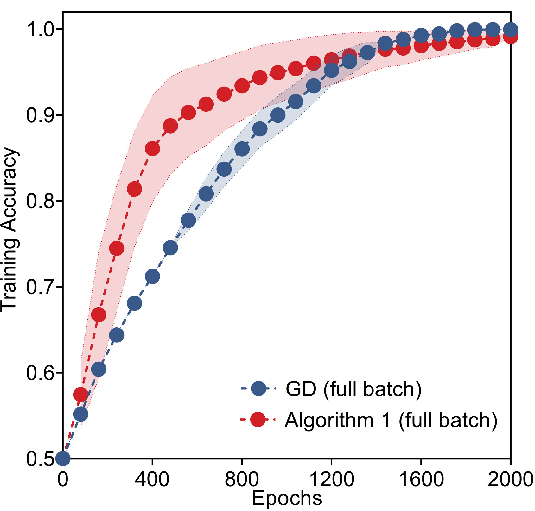
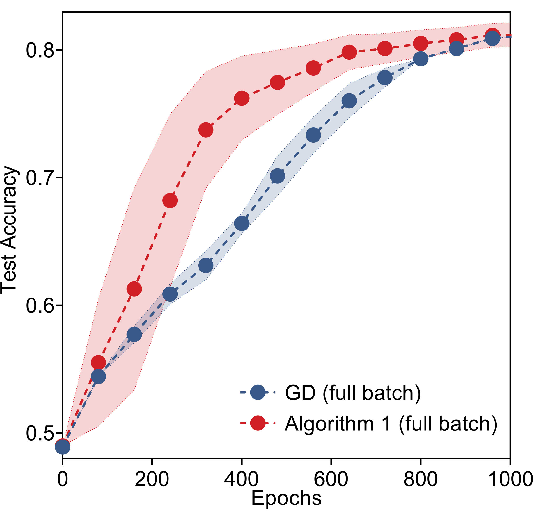
Figure 2: Comparison of decentralized Algorithm 1 and centralized GD on SST-2; decentralized protocol converges faster in training loss, training accuracy, and test accuracy, despite equal per-iteration compute cost.
Empirical results further demonstrate the scaling robustness of the proposed method: increasing the number of devices, elevating heterogeneity, and employing partial participation do not degrade, but rather enhance, the acceleration effect.
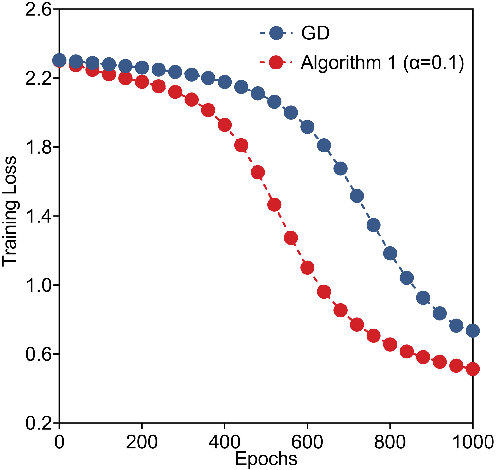
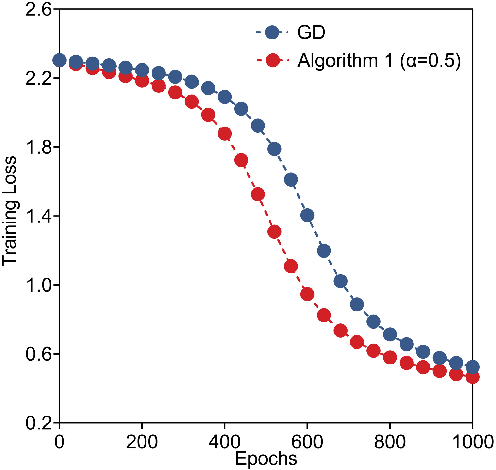
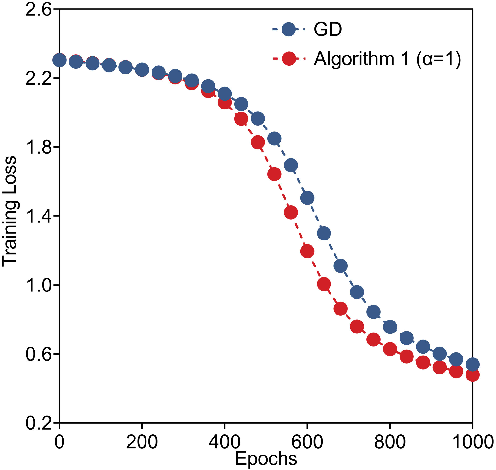
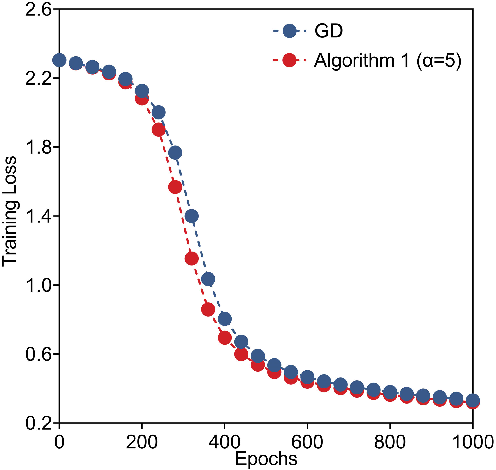
Figure 3: Training losses for various numbers of devices, showing that decentralization's performance advantage strengthens as the network size increases.
Contradictory Claims and Strong Numerical Results
The paper makes the bold claim—contradicting years of conventional wisdom—that decentralization is not a mere compromise but can be strategically exploited for acceleration even when centralized computation is feasible. This is not restricted to theoretical construction or pathological data splitting: empirical results across multiple datasets, models, and heterogeneity levels confirm this phenomenon. Algorithm 1 consistently achieves lower worst-case optimization error and requires fewer iterations for convergence, even with equal aggregate compute resources per iteration.
Practical and Theoretical Implications
The implications are multifaceted:
- Algorithm Design: Decentralized learning should be considered in scenarios prioritizing convergence speed, not only in privacy-constrained or communication-limited contexts.
- Resource Allocation: Aggregate computational capacity can be exploited more efficiently across decentralized systems, potentially overcoming single-server bottlenecks.
- Data Partitioning: Strategic (non-uniform) data splitting, even in centralized environments, can yield acceleration effects when local geometry is utilized.
- Theoretical Analysis: PEP and related frameworks enable precise performance benchmarking and inform the design of new distributed algorithms beyond the traditional bounds.
Communication overhead and stochasticity (mini-batch training) are noted as areas for future investigation, but the foundational acceleration effect is robust to these considerations.


Figure 4: Training losses of Algorithm~\ref{algorithm}, decentralized GD, and gradient tracking, illustrating convergence superiority of the proposed decentralized method.
Conclusion
This work establishes that decentralization, when properly exploiting local geometry and heterogeneity, can accelerate convergence in optimization and machine learning tasks beyond what is achievable by centralized approaches for a variety of practical and theoretical problem classes. The findings urge reconsideration of decentralized learning as a primary strategy for optimization, especially in high-heterogeneity domains, as well as inspire further theoretical and algorithmic exploration using exact performance estimation frameworks.

