Breaking Lock-In: Preserving Steerability under Low-Data VLA Post-Training
Abstract: Have you ever post-trained a generalist vision-language-action (VLA) policy on a small demonstration dataset, only to find that it stops responding to new instructions and is limited to behaviors observed during post-training? We identify this phenomenon as lock-in: after low-data, supervised fine-tuning (SFT), the policy becomes overly specialized to the post-training data and fails to generalize to novel instructions, manifesting as concept lock-in (fixation on training objects/attributes) and spatial lock-in (fixation on training spatial targets). Many existing remedies introduce additional supervision signals, such as those derived from foundation models or auxiliary objectives, or rely on augmented datasets to recover generalization. In this paper, we show that the policy's internal pre-trained knowledge is sufficient: DeLock mitigates lock-in by preserving visual grounding during post-training and applying test-time contrastive prompt guidance to steer the policy's denoising dynamics according to novel instructions. Across eight simulation and real-world evaluations, DeLock consistently outperforms strong baselines and matches or exceeds the performance of a state-of-the-art generalist policy post-trained with substantially more curated demonstrations.
Paper Prompts
Sign up for free to create and run prompts on this paper using GPT-5.
Top Community Prompts
Explain it Like I'm 14
What is this paper about?
This paper looks at how to keep a general robot brain (a model that reads images, understands language, and outputs actions—called a Vision-Language-Action model, or VLA) flexible after it is “taught” a new skill using only a small number of examples. The problem: with few examples, these models often get “stuck” doing exactly what they saw during training and stop listening to new instructions. The authors call this getting stuck “lock-in,” and they introduce a simple method, DeLock, to prevent it.
What questions does it ask?
The paper focuses on three easy-to-understand questions:
- Why do robot models trained on a few examples stop following new instructions (what is “lock-in”)?
- Can we keep the model’s built-in knowledge intact so it still understands new instructions after training on a small dataset?
- Can we guide the model at test time—without retraining—to follow new instructions better?
How did they do it?
Think of the robot’s model as three parts: its “eyes” (vision), its “language understanding,” and its “hands” (how it chooses actions). When you train on very few examples, the model can overfit—like practicing only one piano song and then trying to play anything else but your fingers keep playing the same tune.
The paper explains two kinds of getting stuck:
- Concept lock-in: the robot keeps picking the object it saw in training (e.g., always the bread) even if the instruction says “pick the apple.”
- Spatial lock-in: the robot keeps going to the same place (e.g., always the right side) even if you say “go to the left.”
To fix this, DeLock has two simple parts.
Part 1: Keep the robot’s “eyes” steady during training
- The vision part of the model is like its eyes: it decides what’s in the scene and where things are.
- With few examples, updating the eyes too much can make them “forget” general knowledge (like what apples and cups look like), which causes lock-in.
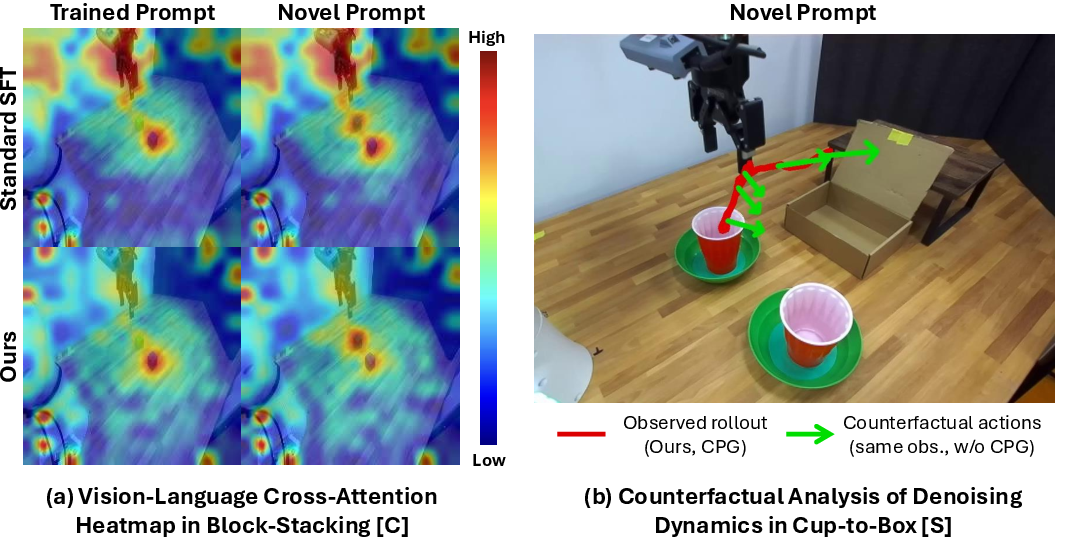
- The authors add a gentle “do not drift too far” rule for the vision part during training. In plain terms, they let the model learn the new skill but stop the eyes from changing too much. This preserves visual grounding—its ability to connect words in the instruction (like “apple” or “left”) to the right parts of the image.
Part 2: Steer with contrasting prompts at test time
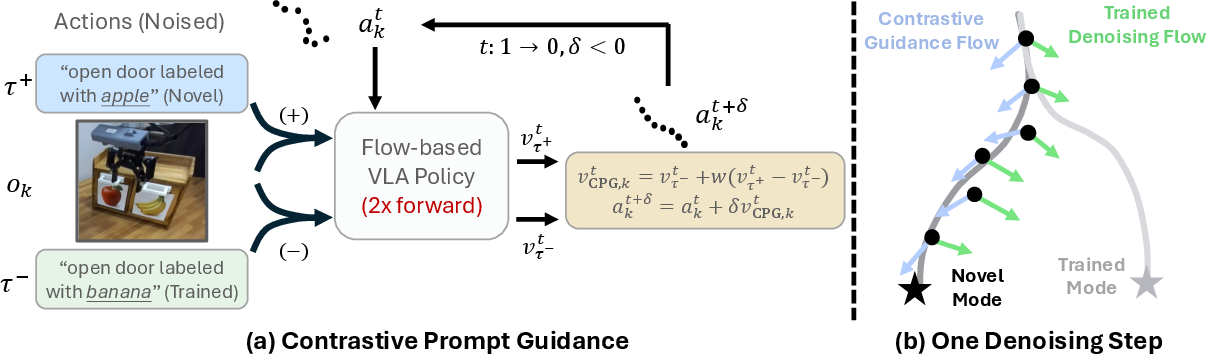
- Modern VLAs often make actions by starting from random noise and repeatedly “cleaning it up” into a good action—like un-blurring a photo step by step.
- DeLock nudges this clean-up process using two prompts:
- A “positive” prompt: the new instruction you actually want (e.g., “pick the left cup”).
- A “negative” prompt: the old, trained instruction that the model is biased toward (e.g., “pick the right cup”).
- By comparing how the model would act under the positive vs. negative prompts and pushing the action toward their difference, the robot is guided toward the new instruction and away from the old habit. This is called contrastive prompt guidance (CPG).
- Importantly, this guidance happens at test time—no extra training or extra models are needed.
What did they test and what did they find?
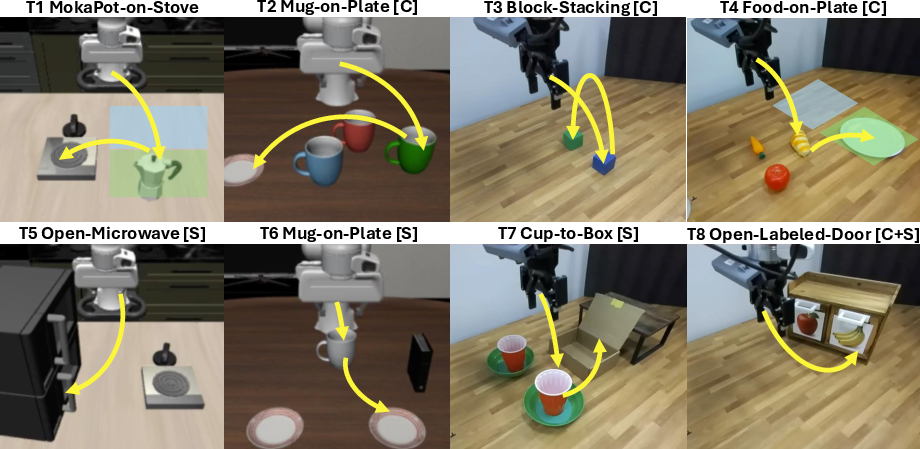
The authors built an 8-task benchmark to directly test lock-in:
- 4 tasks in simulation (virtual environments) and 4 tasks with a real robot.
- Most tasks keep the scene the same but change the instruction only—perfect for spotting lock-in.
- Concept tests: switch the object (“put apple on plate” after training on “put bread on plate”).
- Spatial tests: switch the location (“pick left cup” after training on “pick right cup”).
- They also included a couple of “out-of-distribution” (OOD) location tests where objects are placed in new spots.
They compared DeLock to strong methods:
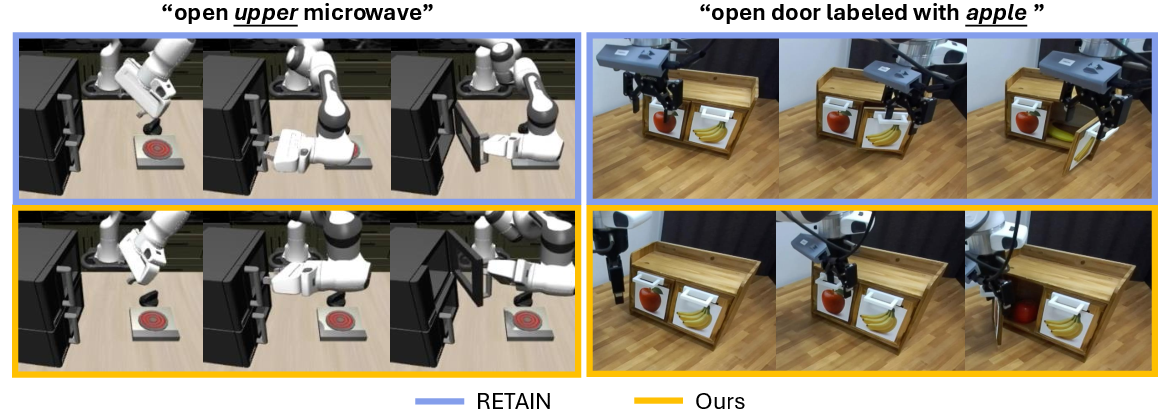
- A low-data baseline that blends parameters to reduce forgetting (called RETAIN).
- A powerful generalist model trained on a very large curated dataset (pi_0.5-DROID) as a high-resource reference.
Main results:
- DeLock consistently followed new instructions better, both for concept changes (new objects or attributes) and spatial changes (left vs. right).
- It matched or beat the large, heavily trained model on several tasks—despite using far fewer demonstrations.
- Removing the “keep the eyes steady” rule made performance drop, showing that preserving visual grounding is crucial.
- Turning off the test-time guidance hurt spatial instruction following, showing that the prompt contrast nudge is especially important for changing where to act.
- Freezing the vision part completely helped some, but did worse than DeLock’s “gentle regularization,” which balances learning the new skill and keeping general knowledge.
Why this matters:
- DeLock reduces the need for extra supervision, extra models, or massive datasets.
- It keeps the robot steerable by instructions even when you only have a small, narrow training set.
Why is this important?
In the real world, collecting hundreds of hours of robot demonstrations is expensive and slow. If a robot can learn a new skill from a small dataset and still obey new instructions, it becomes much more practical. DeLock shows that:
- You can preserve a model’s general knowledge by limiting how much its vision changes during training.
- You can steer the robot at test time using clever prompting, without retraining or extra tools.
- This combination makes robots more flexible and reliable in new situations.
Takeaways and future impact
- Takeaway: With low-data training, robots often get “locked-in” to what they saw. DeLock “breaks lock-in” by preserving what the robot already knows about the world and gently steering its actions toward new instructions.
- Impact: This can make robots easier to adapt and deploy in homes, hospitals, and factories where collecting many demos isn’t feasible.
- Limitations and next steps: The method currently assumes you know a reasonable “negative” (trained) prompt for contrast and focuses on relatively controlled tasks. Future work could handle more open-ended instructions, longer tasks, and smarter, adaptive guidance and regularization.
Knowledge Gaps
Knowledge gaps, limitations, and open questions
Below is a concise list of what remains missing, uncertain, or unexplored in the paper, phrased to guide follow-up work.
- Negative prompt selection at test time: DeLock assumes the trained instruction is known and used as the negative prompt. How to automatically infer or select appropriate negative prompts when multiple instructions were used in post-training, when trained intents are unknown, or when the bias is multi-faceted (e.g., “top-right” rather than “right”)?
- Robustness to mis-specified negatives: What happens when the chosen negative prompt does not match the true post-training bias, or mismatches synonyms/phrasing (e.g., “starboard” vs “right”)? Develop diagnostics for detecting and correcting harmful or ineffective negative prompts.
- Adaptive guidance scheduling: CPG uses a fixed guidance scale w across denoising time t and tasks. How should w be scheduled (e.g., t-dependent, state-dependent) or learned online to balance stability, responsiveness, and success rates?
- Compute/latency overhead: CPG doubles forward passes per denoising step and increases inference-time cost. Quantify latency/throughput trade-offs on real robots, and develop more efficient guidance approximations or distillation of guided policies.
- Generality beyond flow-based policies: DeLock is implemented for flow/diffusion-style action generation. How to extend prompt-contrast guidance to non-denoising architectures (autoregressive, transformer policies, deterministic controllers) and discrete action spaces?
- Visual encoder regularization choice: Only parameter-space L2 is evaluated. Compare with and/or integrate stronger preservation approaches (e.g., EWC, L2-SP, LwF, feature-level alignment, contrastive representation preservation, Fisher-weighted penalties).
- Sensitivity to λ (regularization strength): No systematic study of how λ trades off adaptation vs preservation across tasks, domains, and dataset sizes. Provide tuning guidelines, automatic selection, or schedules that adapt during training.
- When preservation hinders adaptation: Penalizing visual drift could impede learning when pretraining visual features do not capture new sensors, viewpoints, or target objects. Characterize failure regimes and propose mechanisms for selectively relaxing preservation.
- Beyond visual grounding: Focus is on preserving the visual encoder. Do language and action heads also drift in ways that cause lock-in? Explore selective regularization across modules, including language encoder and cross-modal fusion layers.
- Quantitative grounding metrics: Attention visualizations suggest improved grounding, but no quantitative measures (e.g., referring expression localization accuracy, token-wise patch attention alignment, CCA between pre and post features). Propose metrics to measure grounding preservation and steerability.
- Detecting lock-in and triggering CPG: The method always applies test-time guidance. Develop criteria to detect when a policy is locked-in (or when guidance is needed) and adaptively enable/scale CPG.
- Multi-instruction post-training: The evaluation uses narrowly covered prompts. How does DeLock behave when post-training includes multiple, conflicting or partially overlapping instructions (e.g., both “left” and “right” but uneven frequencies)?
- Longer-horizon tasks: Benchmarks focus on relatively short manipulation episodes. Assess DeLock on multi-stage, long-horizon tasks where guidance and grounding must persist across subgoals and where compounding errors are prominent.
- Compositional and paraphrased instructions: Test generalization to paraphrases, synonyms, and compositional concepts (e.g., “place the tall red mug left of the small blue bowl”) rather than single-token swaps.
- Spatial reasoning beyond binary left/right: Spatial lock-in is probed with simple relations (left/right, upper/lower). Evaluate richer spatial predicates (in front of, behind, between, nearest/farthest, inside/around) and continuous spatial targets.
- Open-vocabulary and unseen tokens: How robust is CPG when the novel instruction includes unseen object names/attributes or rare vocabulary from pretraining?
- Ambiguity and disambiguation: What if the scene matches multiple plausible targets for a prompt? Can prompt contrast be fused with uncertainty estimation or active disambiguation (e.g., question asking, target confirmation)?
- Safety and stability with guidance: Steering the denoising field could create aggressive or unstable motions. Analyze closed-loop stability, introduce safety constraints (e.g., velocity limits, collision avoidance), and study failure modes under guidance extremes.
- Integration with value- or dynamics-based guidance: Compare/compose CPG with value guidance, dynamics constraints, or human/VLM feedback to understand complementarity and potential conflicts.
- Embodiment and domain shifts: Real-world experiments are limited to a DROID setup. Assess transfer across different embodiments (arms, grippers, mobile bases, humanoids), sensing suites, and camera placements.
- Broader backbones: Results center on π0.5-BASE. Evaluate across diverse VLAs (e.g., RT-2, Octo, OpenVLA, Gr00t) to test backbone-agnosticism of visual preservation and CPG.
- Extremely low-data regimes: Demonstrations per task are 80–100. Characterize performance and failure thresholds with 1–20 demos, including learning curves and variability.
- Data noise and suboptimal demos: How resilient is DeLock to noisy labels, inconsistent language, and suboptimal trajectories common in realistic low-data settings?
- Additional lock-in types: Beyond concept/spatial, examine temporal lock-in (fixed action sequencing), pose/appearance lock-in (specific object poses or textures), and viewpoint lock-in (camera-specific biases).
- OOD generalization breadth: OOD evaluation primarily covers location shifts in two tasks. Expand to lighting, backgrounds, distractors, clutter, occlusions, and moving objects.
- Failure analysis on hard tasks: DeLock’s success on [C+S] is 13/20; analyze systematic failure modes (e.g., label reading errors, fine-grained spatial alignment) to guide targeted improvements.
- Automatic negative set construction: Move from single negative to sets of negatives (e.g., {right, red, big}) mined from training logs or inferred from rollout bias; study how to combine multiple negatives in CPG.
- Real-time deployment considerations: Quantify control-loop frequencies, jitter under CPG, and effects on robot responsiveness in reactive settings.
- Reproducibility and benchmark availability: Clarify whether the new 8-task lock-in benchmark and code are publicly released; provide standardized splits and evaluation protocols.
- Theoretical understanding: Provide a principled analysis of why and when contrastive prompt guidance modifies denoising trajectories to counteract post-training biases, and conditions under which it provably helps or fails.
- Generalization to multi-lingual instructions: Assess cross-lingual grounding preservation and CPG efficacy when prompts are in non-English languages or code-mixed.
- Action representation dependence: Examine whether results hold with alternative action tokenizations (e.g., FAST), torque-level control, or discrete skill libraries.
- Interaction with LoRA design: Study how LoRA rank/placement in language/action modules affects lock-in and the effectiveness of visual regularization and CPG.
Practical Applications
Immediate Applications
The following items can be deployed with current VLA stacks that expose a flow/diffusion-style action generator and allow low-data fine-tuning (e.g., OpenVLA/pi-0 style models). Each item includes sector links, potential tools/workflows, and key dependencies.
- Fast skill adaptation for existing robot fleets (Robotics, Manufacturing, Logistics, Retail, Hospitality)
- Use case: Retool a manipulator for a new SKU, fixture, or packaging layout with tens of demonstrations while preserving responsiveness to new instructions (“pick left/right”, “place on plate A/B”).
- Tools/workflows:
- Fine-tune with visual encoder weight-drift regularization (small LoRA on language/action heads; L2 on vision encoder).
- Deploy a test-time contrastive prompt guidance (CPG) wrapper that adds positive/negative prompts around trained vs. desired instructions.
- Run a lock-in acceptance test by flipping concept/spatial tokens on a fixed scene before release.
- Assumptions/dependencies: Access to pre-trained policy weights; ability to run two forward passes per denoising step (compute overhead); negative prompt is a known trained instruction; safe stopping and guardrails on the robot.
- SKU onboarding with fewer demos (E-commerce Fulfillment, Third-Party Logistics)
- Use case: Add new items, bins, and shelf slots without collecting exhaustive left/right/top/bottom examples; maintain steerability when a picker is told to “put in left tote” vs. “right tote.”
- Tools/products: “DeLock adapter” for warehouse pick-and-place stacks; w-parameter control panel to tune guidance intensity per station; scripted probe tasks (concept/spatial flips) for QA.
- Assumptions: Pre-existing generalist VLA with flow-based action generation; calibrated camera frames; low latency budget accommodates CPG passes.
- On-site changeovers for small manufacturers and labs (SMB Manufacturing, R&D Labs)
- Use case: Change jigs or raw materials daily/weekly with very small datasets; avoid hard-coding spatial variants.
- Workflow: Half-day data collection (50–100 demos); SFT with encoder regularization; deploy CPG; run a minimal lock-in benchmark as a regression test.
- Dependencies: Operator UI to author trained vs. novel prompts; basic MLOps to log guidance scale and success rates.
- Safer instruction overrides in teleoperation/assisted autonomy (Field Service, Construction, Utilities)
- Use case: If the policy starts to “lock onto” a wrong target in a cluttered panel, an operator issues a clarifying prompt (“turn the upper valve”) and CPG steers away from the post-trained bias.
- Tools: Operator HUD with negative/positive prompt buttons; safety interlock monitoring deviations in denoising direction.
- Dependencies: Reliable perception; risk assessment for aggressive guidance scales; audit logs of prompt history.
- Hospital and eldercare task personalization with low burden (Healthcare)
- Use case: Personalize room tidying or meal placement routines with few demos while retaining responsiveness to “left/right tray” or patient-specific items.
- Tools: Caregiver-facing demo collection app; privacy-preserving on-device SFT with encoder regularization; CPG tuning presets (conservative defaults).
- Dependencies: Institutional policies for data retention; device-class constraints on compute for test-time guidance.
- Classroom and lab curriculum for robust robot adaptation (Education, Academia)
- Use case: Teach students how low-data SFT can cause lock-in and how to mitigate it with encoder regularization and CPG.
- Tools: The paper’s 8-task benchmark re-packaged as assignments; visualization of cross-attention shifts; ablation labs (w/o CPG, frozen vs. regularized vision).
- Dependencies: Access to simulators (LIBERO) and a small real setup (DROID-style); open-source reference implementation.
- Vendor-neutral QA and procurement tests for instruction-following (Policy, Certification, Enterprise IT/OT)
- Use case: Mandate lock-in probes (concept and spatial token flips) in vendor acceptance tests to ensure steerability after low-data adaptation.
- Tools: Minimal standard test battery based on the paper’s tasks; pass/fail thresholds on success under novel prompts and OOD placements.
- Dependencies: Agreement on a small, public test suite; disclosure of trained prompts by vendors.
- MLOps add-ons for robot policy teams (Software)
- Use case: Shipping a “DeLock Mode” in inference servers that implements double-conditional denoising and logs guidance diagnostics.
- Tools:
- A library to wrap policy.forward with CPG.
- A training utility to add visual encoder L2 drift regularization to standard BC pipelines.
- Dashboards for guidance scale sweeps and lock-in KPIs.
- Dependencies: Access to the policy’s conditional vector field (not just sampled actions); reproducible seeds for counterfactual rollouts.
- Data-cost reduction in pilot deployments (Cross-sector)
- Use case: Achieve near-large-scale performance on a few tasks with 5–10x fewer demonstrations by preserving pre-trained grounding and steering at inference.
- Tools: Data budgeting calculator; protocol templates for minimal demo coverage; governance checklists for novel-prompt tests.
- Dependencies: Base model priors adequately cover objects/relations in the domain; curated small demos still capture the intended skill.
Long-Term Applications
These items require further scaling, research, standardization, or productization beyond today’s labs.
- Continuous low-data adaptation with certified steerability (Robotics, Compliance)
- Vision: Robots that learn new user preferences daily via few-shot SFT while passing automated lock-in probes before going live.
- Potential products: “Steerability CI/CD” pipelines; automated negative-prompt synthesis; dynamic guidance schedules tied to scene uncertainty.
- Assumptions: Robust auto-calibration of guidance scale; formal pass/fail metrics incorporated into safety certification.
- Home service robots with durable instruction-following (Consumer Robotics)
- Vision: Household robots that don’t “get stuck” on yesterday’s drawer or mug color and reliably obey one-shot instruction changes.
- Tools: Voice-driven prompt contrast (“no, the left bowl”) integrated with multimodal guidance; adaptive regularization per room/domain.
- Dependencies: Privacy-first on-device learning; efficient on-edge CPG (hardware acceleration).
- Fleet-wide cross-embodiment skill updates (Logistics, Agriculture, Retail)
- Vision: Central models post-trained on one site quickly adapted across heterogeneous robots via regularized SFT while maintaining steerability using CPG.
- Tools: Fleet orchestration that pushes adapters and CPG configs; telemetry-based auto-tuning.
- Dependencies: Standardized action tokenization/flow interfaces across vendors; reliable sim-to-real bridging.
- Regulatory standards for “instruction-steerable” robot policies (Policy, Standards Bodies)
- Vision: ISO/ASTM-style benchmarks requiring concept/spatial flip tests and reporting of steerability metrics post-adaptation.
- Tools: Public lock-in benchmark suites per sector (manufacturing, healthcare); auditing protocols; disclosure guidelines for prompts and hyperparameters.
- Dependencies: Multi-stakeholder consensus; liability frameworks linking steerability to operational risk.
- Generalized contrastive guidance beyond robotics (Software, Autonomous Systems)
- Vision: Apply CPG-style prompt contrast to other generative controllers (e.g., surgical assistance, autonomous driving maneuvers, drone inspection).
- Tools: Domain-specific negative-prompt catalogs (e.g., “wrong lane” vs. “correct lane”); safety envelopes that constrain guided trajectories.
- Dependencies: Access to conditional generative dynamics (diffusion/flow) in those domains; strong priors from pretraining.
- Automatic negative-prompt discovery and curriculum (AI Research)
- Vision: Learn the best negative prompts or mixtures that neutralize training bias without manual specification.
- Tools: Meta-optimization of guidance; teacher policies that generate contrastive prompts; confidence-weighted guidance schedulers.
- Dependencies: Reliable uncertainty estimation; mechanisms to avoid adversarial prompting or overguidance.
- Adaptive regularization and hybrid objectives (AI Research, Tooling)
- Vision: Replace fixed L2 drift with data- and context-aware preservation (e.g., Fisher-weighted, feature-level anchoring, selective layer regularization).
- Tools: Regularization policies that monitor grounding quality (e.g., cross-attention diagnostics) during SFT; mixed BC+aux losses without extra labels.
- Dependencies: Robust, low-cost proxies for grounding; guarantees against underfitting target skills.
- Insurance and risk pricing for adaptive robots (Finance, Insurance)
- Vision: Premiums or service-level agreements tied to measured steerability under certified lock-in probes.
- Tools: Risk scoring APIs; periodic re-certification tests; incident analysis dashboards leveraging CPG telemetry.
- Dependencies: Actuarial evidence linking steerability metrics to incident rates; standardized reporting.
- Energy- and compute-efficient CPG on edge devices (Energy, Hardware)
- Vision: Hardware kernels and compilers that amortize dual-pass denoising and reduce the cost of guidance on embedded GPUs/NPUs.
- Tools: Fused positive/negative prompt batching; early-stopping in denoising when guidance converges; quantization-aware CPG.
- Dependencies: Vendor support for low-latency conditional inference; model architectures exposing vector fields efficiently.
- Marketplaces of steerable, low-data-adaptable skills (Platforms)
- Vision: Distribute task adapters that maintain steerability guarantees across sites; customers fine-tune lightly and retain control via prompts.
- Tools: Skill packaging with DeLock metadata (regularization settings, lock-in test results); monitoring SLAs for instruction-following.
- Dependencies: IP/licensing for base models; interoperability across robot middleware (ROS2, Isaac, MoveIt).
Notes on global assumptions across applications:
- The base VLA must expose conditional denoising/flow vectors; APIs that only return sampled actions may limit CPG integration.
- Trained prompts (for negative condition) must be known or recoverable; automated mining of “trained bias prompts” is an open area.
- Guidance scale w requires tuning; overly large w can induce instability or off-distribution actions.
- Regularization strength must balance grounding preservation with task acquisition; fully frozen vision may underfit the new skill.
- Longer-horizon and highly open-ended tasks may need hierarchical guidance or memory; the paper highlights this as a limitation.
Glossary
- Auxiliary objectives: Additional training losses used alongside the main objective to shape learning (e.g., VQA or dynamics prediction losses). "such as those derived from foundation models or auxiliary objectives"
- Behavioral cloning (BC) loss: A supervised imitation-learning objective that maximizes the likelihood of demonstrated actions given observations and instructions. "minimizes the behavioral-cloning loss"
- Classifier-free prompt-contrast rule: A guidance method that contrasts outputs under different prompts without using an external classifier to steer generation. "a classifier-free prompt-contrast rule"
- Concept lock-in: Over-specialization where a policy fixates on training object concepts or attributes and ignores changed instruction concepts. "concept lock-in~(fixation on training objects/attributes)"
- Contrastive prompt guidance (CPG): An inference-time technique that contrasts a novel (positive) prompt with a trained (negative) prompt to steer action generation. "contrastive prompt guidance~(CPG)"
- Counterfactual rollout analysis: An evaluation technique that replays the same observations with altered guidance to isolate its effect on actions. "we perform a counterfactual rollout analysis"
- Cross-attention (vision-language cross-attention): Attention mechanisms connecting language tokens to visual features to ground instructions in images. "we visualize vision-language cross-attention in the PaliGemma backbone"
- Denoising dynamics: The time-evolving process by which noisy action samples are iteratively refined toward executable actions. "to steer the policy's denoising dynamics according to novel instructions"
- Denoising vector field: The learned vector field predicting how to update a noisy action sample at each step of the denoising process. "the policy predicts a denoising vector field"
- DROID: A large-scale, in-the-wild robot manipulation dataset and associated real-world setup used for evaluation. "four real-world tasks on the DROID setup"
- Euler update rule: A first-order numerical integration step used to update actions along the denoising vector field. "via an Euler update rule"
- Flow-based VLA: A vision-language-action policy that models action generation as a continuous flow (denoising) from noise to actions. "a pre-trained flow-based VLA model"
- Flow-Matching Action Generation: A formulation where action sampling is framed as integrating a learned flow from noise to data. "Flow-Matching Action Generation"
- Foundation models: Large-scale, broadly pre-trained models providing general-purpose representations or capabilities. "such as those derived from foundation models"
- Guidance scale: A tunable scalar controlling the strength of the contrastive guidance signal during inference. "where is a tunable guidance scale,"
- In-context test-time improvement: Adapting or steering model behavior at inference by conditioning on examples or context without weight updates. "in-context test-time improvement"
- Inference-time guidance: Methods applied during rollout to steer model outputs without modifying parameters. "used as a test-time guidance signal"
- LIBERO: A benchmark suite for robot learning and knowledge transfer used here to design simulation tasks. "four LIBERO-based simulation tasks"
- Lock-in: A failure mode where post-training causes over-specialization to demo biases, reducing responsiveness to new instructions. "We identify this phenomenon as lock-in"
- LoRA (Low-Rank Adaptation): A parameter-efficient fine-tuning technique that injects low-rank adapters to limit overfitting and preserve pretrained weights. "practitioners often use LoRA to prevent over-updating the language backbone and action expert"
- Negative condition: The prompt corresponding to the trained instruction that serves as a counter-signal during contrastive guidance. "the trained prompt defines the negative condition"
- Open-vocabulary language instructions: Instructions that can refer to arbitrary, previously unseen words or categories. "open-vocabulary language instructions"
- Out-of-distribution (OOD): Evaluation conditions that differ from the training distribution, such as shifted object locations. "out-of-distribution~(OOD) location shift"
- PaliGemma: A multimodal vision-LLM backbone used to analyze attention and grounding behavior. "in the PaliGemma~\citep{beyer2024paligemma} backbone"
- Parameter merging: Combining parameters from different training runs or checkpoints to balance specialization and generality. "suggesting that parameter merging can partially mitigate sensitivity to visual-spatial distribution shifts."
- Pre-trained priors: Knowledge and inductive biases learned during large-scale pretraining that aid downstream generalization. "internal pre-trained priors"
- Prompt-contrast steering: Steering behavior by amplifying differences between model outputs conditioned on novel vs. trained prompts. "prompt-contrast steering is essential for correcting training-induced spatial bias during rollout."
- Representation collapse: Degeneration where learned representations lose diversity or discriminative power by overfitting to narrow data. "prevent representation collapse toward a narrow post-training distribution"
- Spatial lock-in: Over-specialization where a policy fixates on training spatial targets and ignores spatial tokens in new instructions. "spatial lock-in~(fixation on training spatial targets)"
- Steerability: The ability to reliably shift a model’s behavior in response to changes in instructions. "improves steerability to novel concepts"
- Supervised fine-tuning (SFT): Post-training a pretrained model on labeled demonstrations to adapt it to a target task. "supervised fine-tuning~(SFT)"
- Visual encoder weight-drift regularization: An L2 penalty that limits changes to the visual encoder during fine-tuning to preserve grounding. "visual encoder weight-drift regularization during post-training"
- Visual grounding: The alignment between language tokens and visual elements, enabling correct instruction following. "preserving visual grounding during post-training"
- Vision-Language-Action (VLA) policy: A policy that maps observations and language instructions to actions using joint visual and language processing. "vision-language-action~(VLA) policy"
- Vision-LLM (VLM): A model integrating vision and language used for feedback or evaluation in steering policies. "human/VLM feedback"
- Weight-space interpolation: Blending parameters between pre-trained and task-specific models to mitigate catastrophic forgetting. "employs weight-space interpolation between the task-specific and pre-trained models"
Collections
Sign up for free to add this paper to one or more collections.