- The paper introduces a layer separation strategy that decouples deep network training, alleviating inter-layer coupling and nonconvexity in the cross-entropy loss.
- It leverages auxiliary variables and adaptive weighting to enable closed-form and gradient-based updates, ensuring monotonic descent in the surrogate loss.
- Extensive experiments on FNNs and CNNs demonstrate faster convergence, enhanced stability, and higher accuracy in deep architectures.
A Layer Separation Optimization Framework for Cross-Entropy Training in Deep Learning
The paper "A Layer Separation Optimization Framework for Cross-Entropy Training in Deep Learning" (2604.23225) addresses the high nonconvexity and inter-layer coupling endemic to deep neural network (DNN) optimization under the standard cross-entropy loss. As network depth increases, the deeply nested architecture leads to intractable optimization landscapes—posing practical challenges, including slow convergence, instability, and increased sensitivity to initialization and hyperparameters. While global convergence has been established theoretically for gradient-based methods under strong over-parameterization, these results are not practicable due to the size of networks required. This work proposes a theoretically justified layer separation strategy to address these issues, applicable to both fully connected neural networks (FNNs) and convolutional neural networks (CNNs).
Theoretical Framework and Model Construction
The central theoretical insight of the paper is to introduce auxiliary variables corresponding to hidden layer outputs and penalize their inconsistency in the network through weighted quadratic terms. This decouples the deep optimization problem into a series of more manageable subproblems with weaker inter-layer coupling. For both FNNs and CNNs, the proposed layer separation surrogate loss is adaptively weighted based on model parameters, establishing a provable upper bound on the original cross-entropy loss. Specifically, for any choice of trainable parameters and auxiliary variables, the original cross-entropy loss remains strictly below the surrogate loss scaled by a constant, thereby guaranteeing correct optimization incentives throughout training.
For FNNs, auxiliary variables cl are introduced for each hidden layer and coupled via quadratic penalties. Adaptive weights ωl are chosen as products of subsequent layer weight matrix norms, central to maintaining consistency between the surrogate and original losses. An analogous construction is made for CNNs, incorporating both convolution and pooling layers and auxiliary variables for the fully connected blocks.
Alternating Minimization Algorithms and Optimization Properties
The authors devise a suite of alternating minimization algorithms for both FNN and CNN layer separation models. Most updates are closed-form (least-squares), while updates for variables interacting with nonlinear activations are performed via gradient descent with monotone backtracking line search. The training algorithms are rigorously analyzed, establishing monotonicity in the surrogate loss under appropriate learning rates. The loss function is shown to decrease at each step, and the gradients used are proven to be Lipschitz continuous under mild boundedness assumptions on network parameters and activations. This ensures stable and predictable optimization trajectories, notably circumventing optimization stagnation and instability reported in deep cross-entropy models.
Empirical Results and Comparative Evaluation
Extensive numerical experimentation demonstrates pronounced empirical advantages of layer separation models over standard cross-entropy forms, particularly as network depth increases. Three classification tasks are studied, including synthetic geometry-based binary classification, PDE interface tracking, and multiclass digit classification (MNIST). Across all scenarios, the layer separation models (LySep-FNN and LySep-CNN) not only converge faster but achieve lower final cross-entropy losses and higher training accuracies, often dramatically so in deeper architectures. Strong numerical evidence is shown in the following figures:
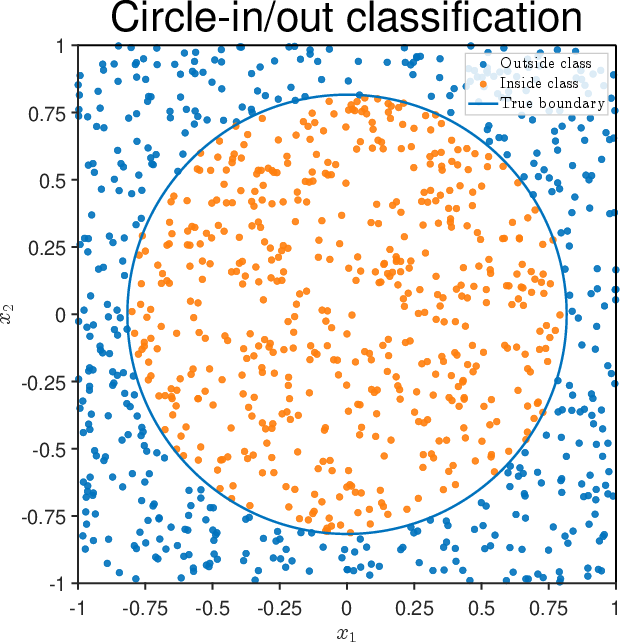
Figure 1: Test set label distribution for the circle-in/out classification task highlighting the ground truth boundary.
The optimization dynamics for LySep-FNN exhibit faster loss decrease and accuracy rise, with markedly lower variance across random initializations:


Figure 2: Mean training cross-entropy loss and training accuracy versus iterations for shallow and deep FNNs on the circle-in/out task. Shaded bands show stability across seeds.
For deep networks—where conventional cross-entropy optimization stagnates (training accuracy dropping to near random levels, loss not decreasing)—the layer separation model retains high accuracy and low loss:


Figure 3: Classification results on the test set for shallow and deep FNNs; LySep-FNN matches the true boundary closely, while CE-FNN misclassifies extensively in deep regimes.
For interface tracking in PDEs, LySep-FNN reconstructs the interface with far fewer misclassifications, even as depth increases (shown in both quantitative tables and the following qualitative plots):
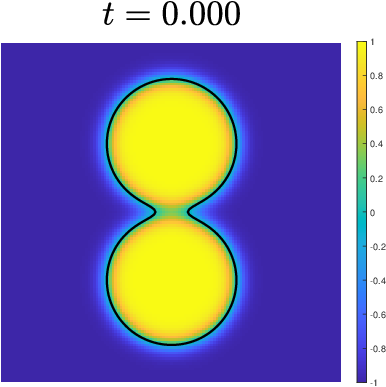
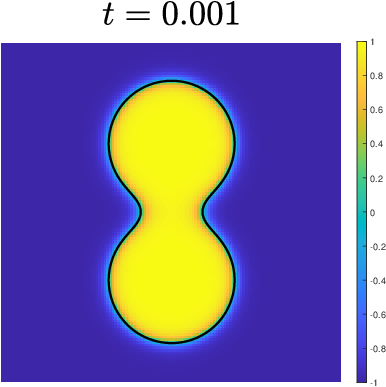
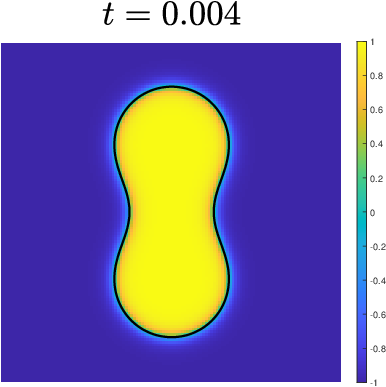
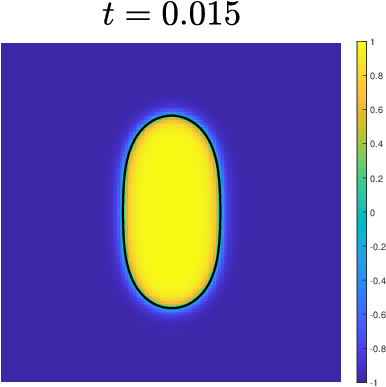

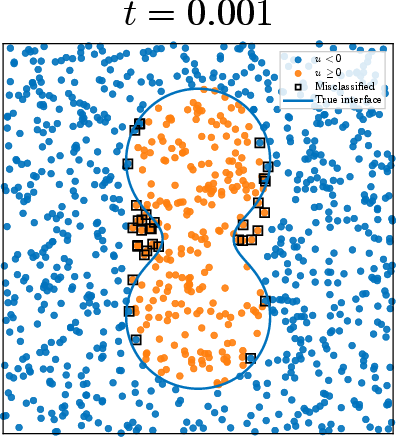


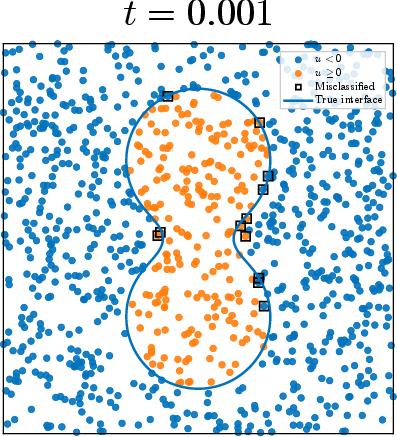


Figure 4: Numerical solutions and interface classification results for Allen-Cahn task; LySep-FNN maintains fidelity to the true interface, CE-FNN degrades with depth.
In multiclass digit classification, LySep-CNN reliably improves both convergence rate and final accuracy, with the margin growing in deeper and wider CNNs. Standard deviations decrease, indicating heightened robustness to initialization variability.
Theoretical and Practical Implications
The layer separation framework transforms the optimization of deep networks with cross-entropy objective into a tractable sequence of subproblems, mitigating the adverse effects of strong nonconvexity and deep coupling. Theoretical guarantees ensure that optimization of the surrogate loss aligns with minimizing the true cross-entropy loss, even as layer separation alters the architecture. Practically, the algorithms handle deep and wide architectures with improved stability and robustness, reducing sensitivity to initialization and hyperparameter selection. The framework enables partially closed-form updates and monotonic loss decrease, and achieves performance gains in both classification accuracy and loss reduction—especially for deep learning on scientific data or structured domains.
The authors highlight, with strong empirical support, that their approach is especially advantageous in settings where increasing network depth with conventional training fails to realize the model’s capacity due to optimization barriers, directly contradicting the notion that deeper models are universally harder to optimize under cross-entropy.
Future Directions
The framework can be generalized to other architectures (residual networks, recurrent neural networks) and extended to other learning paradigms (e.g., scientific machine learning, PDE-constrained problems). Stronger convergence guarantees and further empirical validation in large-scale and more diverse tasks remain promising avenues. The layer separation principle may also inspire new regularization and architectural strategies for handling nested composition in optimization across the broader landscape of deep learning.
Conclusion
The paper delivers a formal, theoretically rigorous, and empirically validated layer separation optimization strategy for cross-entropy training in deep learning. By introducing adaptively weighted auxiliary variables and decomposing the optimization into weakly coupled subproblems, the framework provides provable upper bounds for performance, monotonic training dynamics, and improved empirical outcomes, especially for deep architectures in classification tasks. This work augments both practical and theoretical understanding of deep model optimization, and lays groundwork for future extensions to more complex domains and architectures.