- The paper finds that group-mean centering in GRPO fails in binary reward settings due to gradient starvation in degenerate groups.
- It demonstrates that a fixed-reference Sign advantage guarantees nonzero gradients, enabling reliable improvement in pass@k metrics.
- Empirical results reveal that the Sign advantage can boost accuracy by up to 45.4 percentage points over traditional normalization methods.
Gradient Starvation in Binary-Reward GRPO: Diagnosing the Failure of Group-Mean Centering and the Efficacy of Fixed-Reference Advantages
Introduction
Group Relative Policy Optimization (GRPO) has emerged as a prominent reinforcement learning methodology for LLM finetuning in the presence of verifiable (binary) rewards—especially in math and reasoning tasks. This approach constructs group-relative advantages by generating multiple responses per prompt, scoring them, and centering policy updates relative to the group mean. However, when rewards are binary, standard group-mean centering becomes susceptible to a debilitating phenomenon: gradient starvation. This essay provides a comprehensive technical synthesis of the mechanisms underlying gradient starvation, the rigorous empirical and theoretical evidence quantifying its real impact, and a critical analysis of the simplest and most effective remedy: switching to a fixed-reference, "Sign" advantage. The implications for RLVR algorithm design are profound, particularly in sample-efficient or low-compute regimes.
Mechanism of Gradient Starvation Under Group-Mean Centering
In GRPO with binary rewards (r∈{0,1}), group-mean centering computes advantages Aj=rj−rˉ. In groups where all responses are either correct or incorrect (degenerate groups), rˉ equals each rj, yielding zero advantage for all responses, and thus, zero policy gradient. This degeneracy is frequent when per-prompt success probabilities px approach $0$ or $1$. The critical insight is that, due to the convexity of the degeneracy function D(px,G)=pxG+(1−px)G and per-prompt bimodality, the real degeneracy rate significantly overshoots the i.i.d. Bernoulli prediction (Jensen gap). For instance, at G=4, over 69% of groups were degenerate in GSM8K training with Qwen3.5-9B (Figure 1), confirming that the majority of training computation is wasted without providing a learning signal.
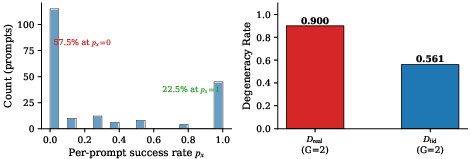
Figure 1: Left: The per-prompt success-rate distribution at training start (G=2) is highly bimodal, explaining the unexpectedly high observed degeneracy. Right: Observed degeneracy is 0.90, vastly exceeding the Bernoulli prediction due to bimodality in Aj=rj−rˉ0.
This phenomenon is not merely empirical observation but is underpinned by formal justification. By Jensen's inequality, Aj=rj−rˉ1, where the gap grows with the variance of Aj=rj−rˉ2, leading to unexpectedly high starvation even for moderate group sizes.
Theoretical Analysis: Fixed-Reference Advantages and Pass@Aj=rj−rˉ3 Failure Descent
To bypass gradient starvation, the paper considers fixed-reference advantage formulations, specifically the Sign advantage: Aj=rj−rˉ4. Unlike group-mean centering, this approach always imparts nonzero gradient for all groups, regardless of their composition. The paper provides a formal theorem establishing that, for Sign and other fixed-reference advantages, the all-fail group component yields a gradient proportional to Aj=rj−rˉ5 (where Aj=rj−rˉ6), performing direct gradient ascent on Aj=rj−rˉ7. Thus, training explicitly increases the probability that each group yields at least one correct answer. This is in stark contrast to group-mean centering, which provides zero signal when needed most.
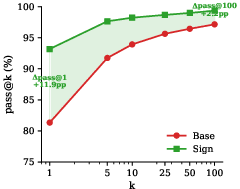
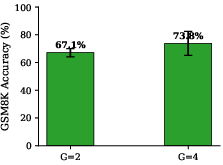
Figure 2: Left: Pass@Aj=rj−rˉ8 curves for different advantage choices illustrate that Sign delivers consistent improvements in pass@1 and modest expansion for larger Aj=rj−rˉ9. Right: The Sign advantage outperforms alternatives at rˉ0 and rˉ1.
Notably, the effectiveness of an advantage formulation is governed not by its expected gradient magnitude across all group compositions, but by its ability to provide nonvanishing gradient in degenerate groups. Thus, coverage is the critical axis for small-group RLVR success.
Empirical Results: Dominance of Sign Advantage and Group Size Effects
Experiments with Qwen3.5-9B on GSM8K reveal a dramatic performance gap between advantage formulations at rˉ2: group-mean normalized DrGRPO achieves only 28.4% accuracy versus 73.8% for Sign, a 45.4pp gain (rˉ3). This effect is directionally consistent across model scales and families (Llama, Qwen), but vanishes for extremely weak models where rˉ4 for almost all prompts.
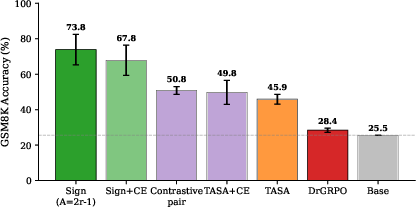
Figure 3: GSM8K accuracy (%) for six advantage formulations shows Sign superiority at rˉ5, with DrGRPO's performance indistinguishable from the base model under severe gradient starvation.
Interestingly, increasing group size (rˉ6) rescues group-mean centering; at rˉ7, DrGRPO rises to 81.7% mean accuracy. However, Sign remains competitive and slightly superior (85.8% at rˉ8), indicating that fixed-reference advantages offer further robustness even when group size mitigates starvation (Figure 4).
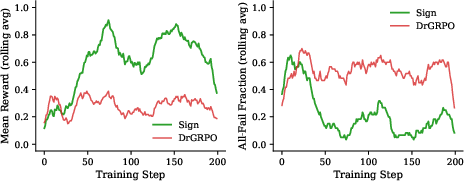
Figure 4: Left: Sign escape from low-reward gradients is rapid, while DrGRPO is stably trapped. Right: The persistent high fraction of all-fail groups explains DrGRPO's lack of progress at small rˉ9.
Pass@rj0 analysis further supports the search-compression interpretation: Sign increases pass@1 most, with diminishing returns at higher rj1, aligning with prior findings that RLVR primarily concentrates existing solution mass rather than expanding model capacity.
Broader Implications and Future Directions
These results compel a re-evaluation of RLVR protocol design. For binary reward settings—or any regime with extreme reward sparsity—advantage normalization must ensure nonzero signal in degenerate settings. Fixed-reference advantages are algorithmically trivial but principled solutions. Alternatively, increasing rj2 or employing generation-time filtering (e.g., DAPO) can mitigate starvation, but with higher computational cost. The superiority of Sign at moderate rj3 is particularly salient in scenarios constrained by budget or latency.
The exploration of cross-family and cross-dataset generalization (GSM8K, MATH-500) showed positive but limited evidence for broad applicability. Limitations include insufficient improvement for ultra-weak base models and inconsistent results on MATH-500 transfer at rj4. Additional research is needed to systematically compare fixed-reference and dynamic sampling strategies, and to examine convergence properties with larger compute or alternative RLVR architectures.
Conclusion
Gradient starvation presents a substantial and previously underappreciated obstacle when using group-mean centering in GRPO with binary rewards. The degeneracy rate is underestimated by standard i.i.d. analyses due to the prevalence of hard and easy prompts, as rigorously quantified in the paper. The simplest fixed-reference advantage, Sign, robustly resolves starvation and yields substantial performance improvements in small-rj5 regimes without incurring additional compute. While larger group sizes can alleviate starvation, fixed-reference advantages are theoretically sound, easy to implement, and empirically effective across models and datasets above a minimal base capability threshold. Going forward, RLVR algorithm design should prioritize degeneracy-aware advantage normalization for efficient and reliable reasoning model improvement.