- The paper demonstrates that injecting an MVBB-based geometric prior improves frontal grasp success on workspace-constrained manipulators by filtering diffusion-generated candidates.
- It integrates a lightweight, training-free MVBB filter with GraspGen to re-rank 6-DoF grasp candidates using face normals and a convex scoring mechanism.
- Experiments reveal a 2.4× improvement in grasp success, achieving up to 100% for symmetric objects on the Unitree Z1 with minimal computational overhead.
MVB-Grasp: Minimum-Volume-Box Filtering for Diffusion-Based Frontal Grasping
Problem Context and Motivation
The paper "MVB-Grasp: Minimum-Volume-Box Filtering of Diffusion-based Grasps for Frontal Manipulation" (2605.09672) targets the gap between state-of-the-art 6-DoF grasp generation and the deployment realities encountered on affordable, workspace-constrained manipulators such as the Unitree Z1. Conventional models like GraspGen yield strong performance under top-down view assumptions, but exhibit high failure rates in frontal workspace settings due to kinematic and approach direction constraints—manifesting as through-table, deeply penetrating, or joint-infeasible grasp candidates. The authors address this embodiment-specific performance degradation by injecting a geometric prior leveraging Minimum Volume Bounding Box (MVBB) analysis to selectively filter and re-score diffusion-generated candidates, thus improving practical grasp reliability with negligible computational overhead.
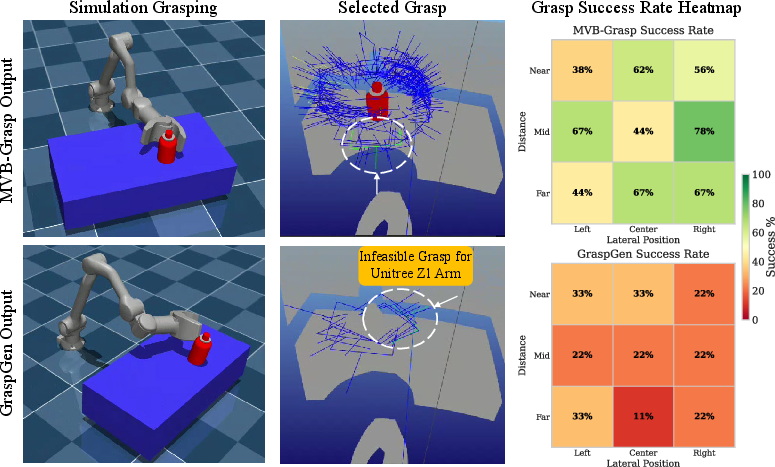
Figure 1: Comparison of MVB-Grasp versus vanilla GraspGen in simulation, highlighting robust frontal grasps and consistent success rates with MVB-Grasp.
Methodological Contributions
The MVB-Grasp pipeline extends GraspGen by integrating a lightweight, training-free MVBB filter. This module fits an oriented bounding box to a segmented object point cloud, extracts face normals, and selects faces accessible to the manipulator based on their spatial relation to the camera and workspace geometry. Grasp candidates whose approach axes are misaligned with these face normals are rejected (hard filter), and the remaining candidates are re-ranked using a convex combination score (s^j=αaj+(1−α)sˉj) blending geometric alignment and learned discriminator confidence (α=0.85). The MVBB filter exploits PCA-based fitting for rapid bounding box computation and aligns with Z1 manipulator constraints, all in O(N) time.
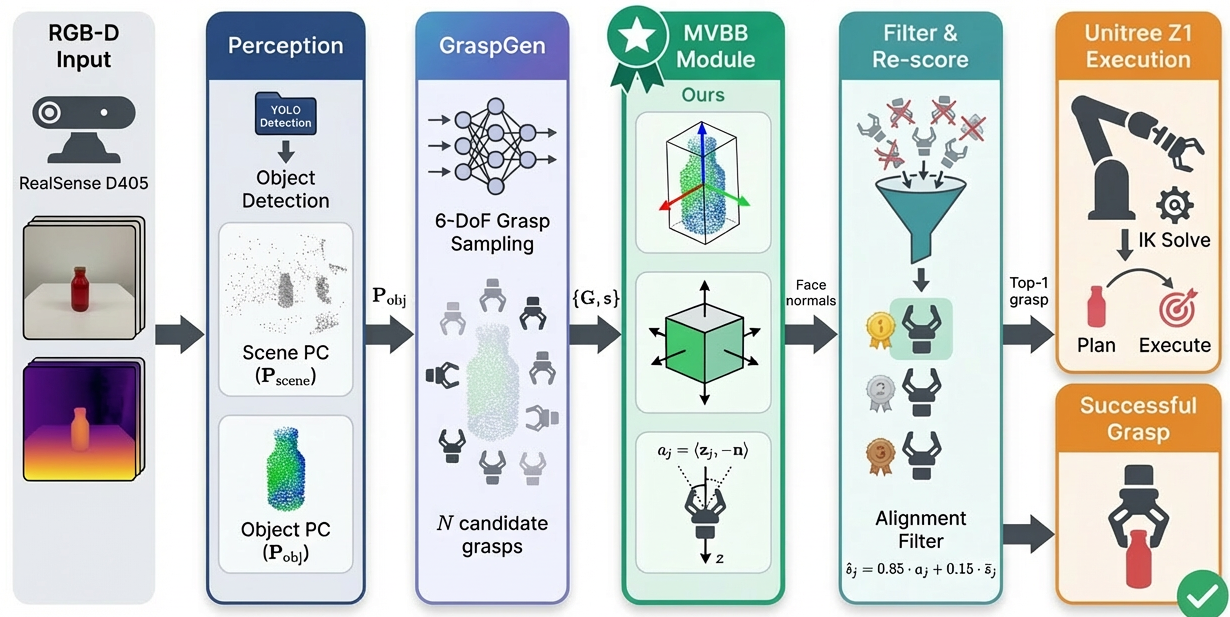
Figure 2: System architecture of MVB-Grasp, showing the flow from RGB-D capture, segmentation, GraspGen candidate generation, MVBB filtering, and execution.
Candidate generation uses GraspGen, a DDPM-based 6-DoF generator, to produce a diverse set of grasp poses. Each candidate is rigorously filtered by MVBB face alignment, and only top-ranked candidates undergo inverse kinematics and collision checking before execution.
Experimental Design
Experiments span both MuJoCo simulation and real-world Unitree Z1 hardware setups. The MuJoCo evaluation protocol covers three object types (cylinder, box, bottle), distance bins (Near, Mid, Far), lateral positions, and pitch orientations (−45∘, 0∘, +45∘) for a total of 81 scenarios per baseline. The real-world pipeline mirrors this grid for direct sim-to-real comparison. Each episode measures grasp success, candidate statistics, and latency overhead.
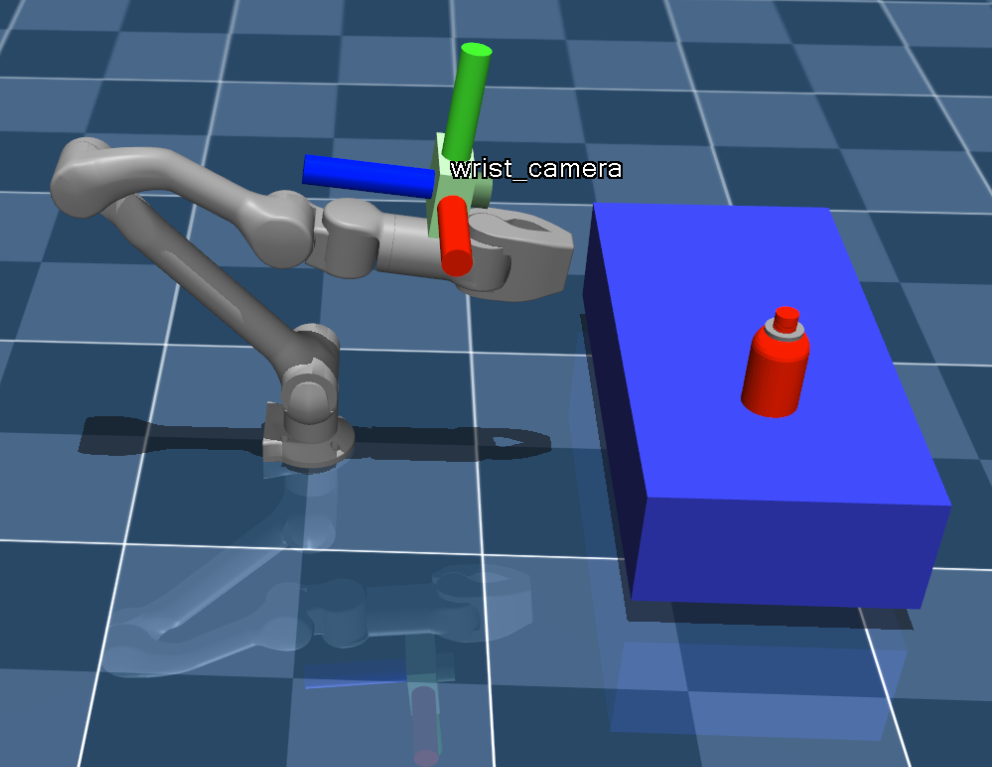
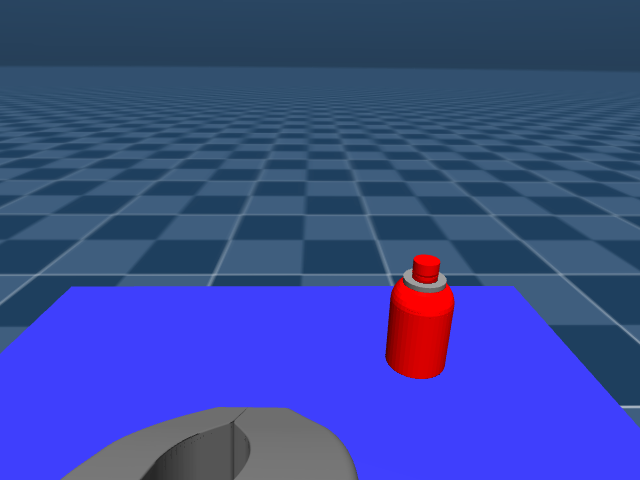
Figure 3: Unitree Z1 Pro arm in MuJoCo with wrist-mounted RGB-D camera for point cloud reconstruction.
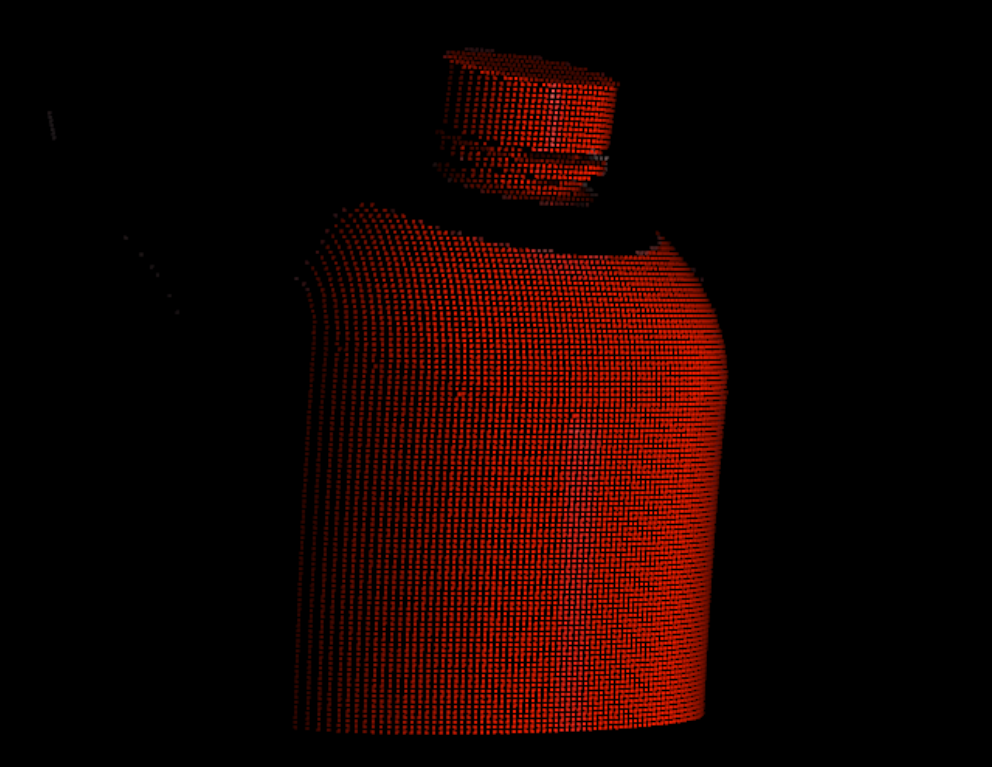
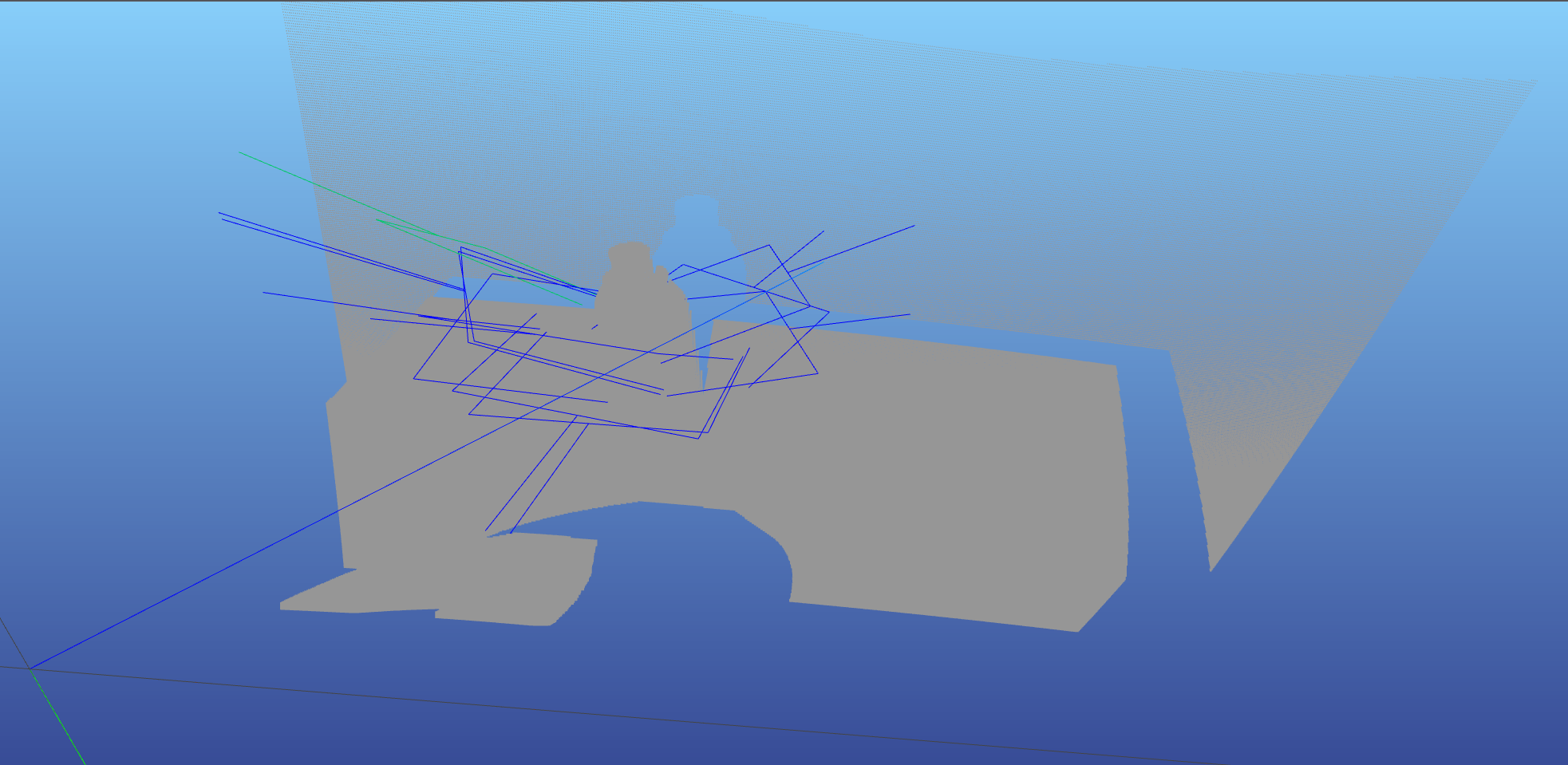
Figure 4: Example segmentations and GraspGen 6-DoF candidate proposals within simulation.
The MVBB filter module selects the nearest faces and computes grasp-face alignment efficiently, visually demonstrated in simulation.
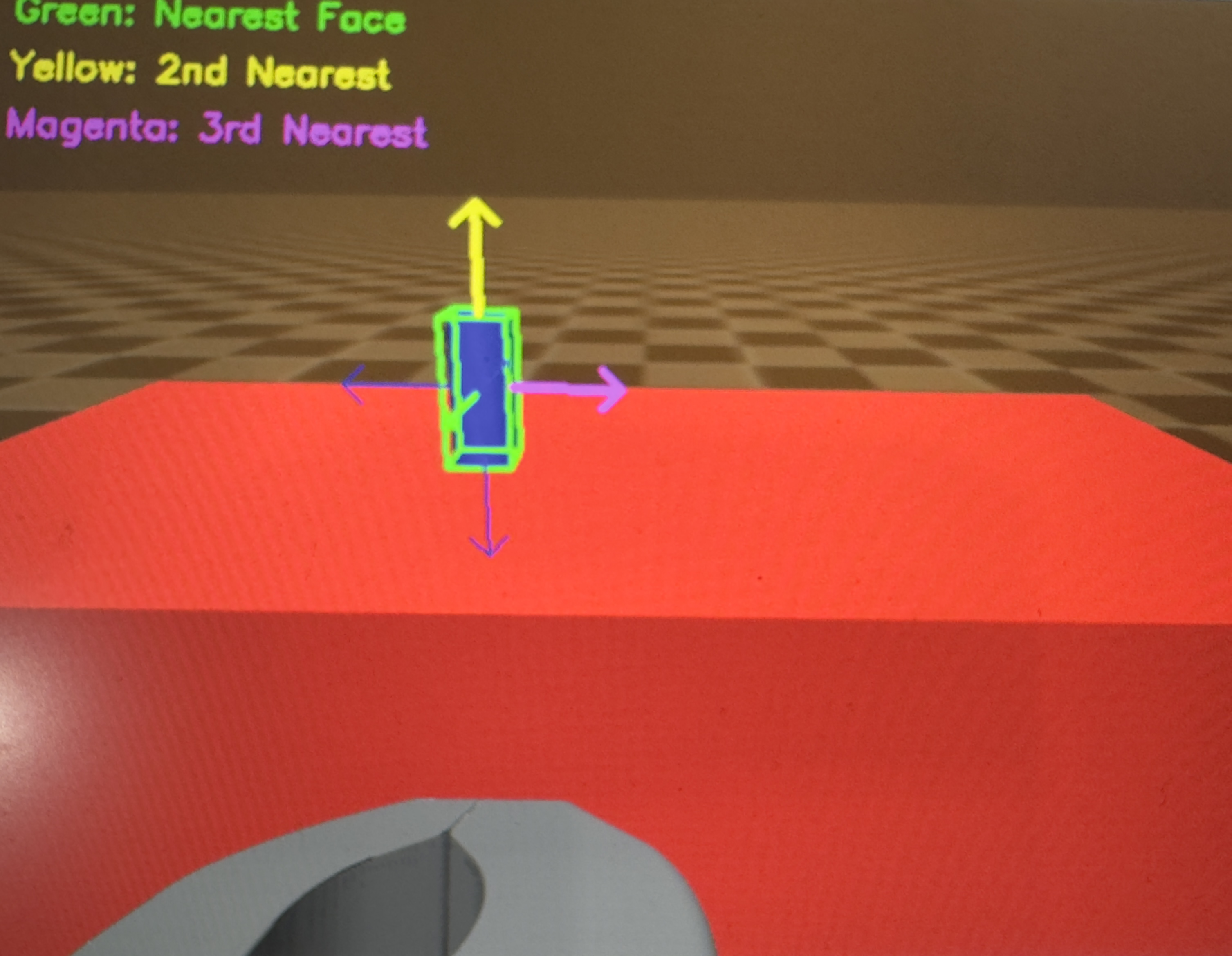
Figure 5: MVBB fitted to a simulated object and selected faces for frontal filtering and alignment.
Real-world tests employ identical object placements and evaluate approach reliability and kinematic reachability.
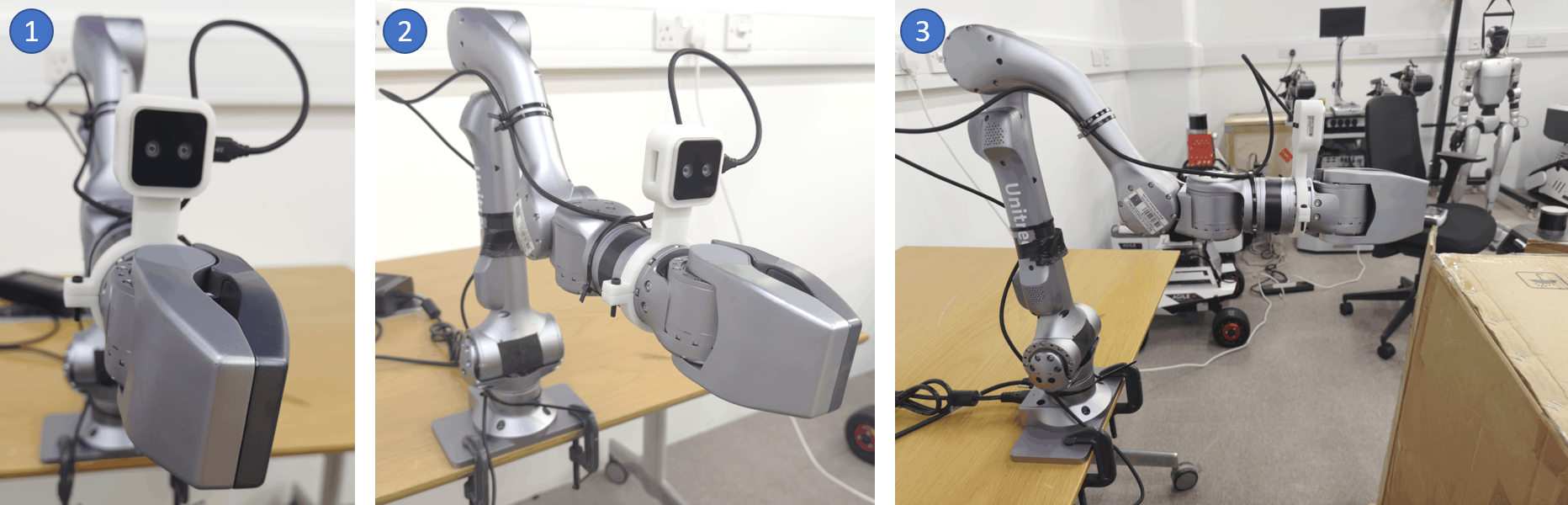
Figure 6: Physical Z1 setup with RealSense D405 camera and workspace arranged for frontal grasping.
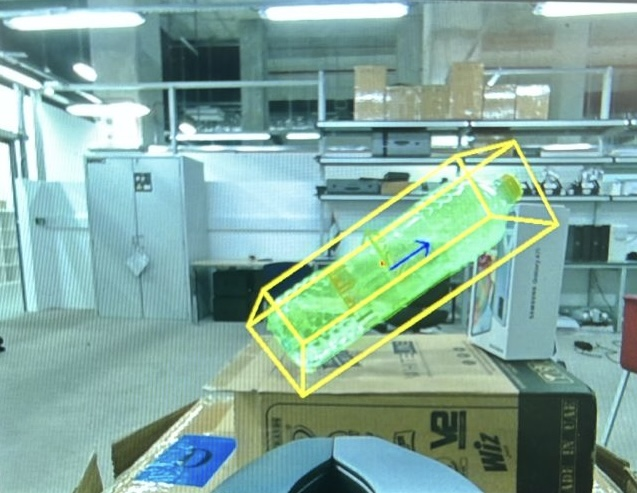
Figure 7: MVBB pipeline on real bottle point cloud—filtered candidate set and selected grasp.
Results: Quantitative and Qualitative Analysis
The MVBB-based prior yields substantive improvements across all measured axes, with performance gains quantified as follows:
- Aggregate Success Rate: MVB-Grasp: 59.3%, GraspGen: 24.7% (2.4× improvement)
- Object Type Breakdown:
- Cylinder: 25.9%→85.1%
- Asymmetric Box: 37.0%→55.5%
- Waterbottle: 11.1%→40.0%
- Distance Effects: At Far distance, cylinder success increases from 11.1% to 88.8%
- Orientation Robustness: At 45∘ pitch, cylinders reach 100% success, confirming MVBB's efficacy for symmetric shapes.
Selection latency overhead is just 6.78 ms, confirming the geometric filter’s practicality for real-time deployments.
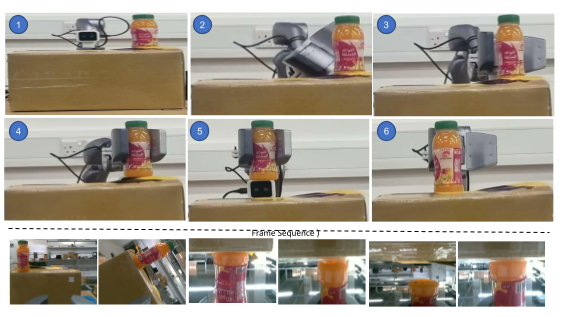
Figure 8: Real-world execution of a frontal grasp on the Z1 by MVB-Grasp.

Figure 9: Diverse real-world slanted object grasps demonstrating robust face-aligned execution.
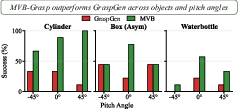
Figure 10: Analysis of object-dependent success rates by pitch orientation; MVBB prior achieves highest reliability for symmetric objects at challenging angles.
Discussion and Implications
The MVBB alignment prior effectively compensates for embodiment-specific workspace constraints, enabling a general-purpose 6-DoF diffusion generator to function robustly on low-cost manipulators. The approach is architecture-agnostic and requires no retraining of the generative or discriminator modules. Empirical results establish that geometric cues—face normals and principal axes—can replace expensive collision checking in many scenarios and dramatically improve candidate quality for frontal grasping configurations. However, the approach’s benefit is contingent on object symmetry and camera placement; for asymmetric objects or tightly occluded poses, over-reliance on MVBB filtering can over-constrain candidate diversity.
Theoretical implications include the demonstration that simple, low-latency geometric adapters allow practical deployment of generic deep grasping models on resource-constrained hardware. Practically, this enables reliable pick-place and manipulation in everyday settings without the need for specialized model retraining or top-down camera setups.
Future directions may include dynamic MVBB adaptation to handle non-convex objects, integration with multi-view perception systems, and generalization to other manipulator architectures. Further work could combine geometric priors with learned adaptation for objects where MVBB over-constrains grasp candidates, or develop hybrid filtering approaches that dynamically adjust alignment weighting based on object shape uncertainty.
Conclusion
MVB-Grasp demonstrates that injecting an MVBB-based geometric prior into state-of-the-art diffusion-based grasp generation substantially improves success rates for frontal manipulation on workspace-constrained, low-cost arms, as exemplified by the Unitree Z1. The method maintains computational efficiency, does not require retraining, and addresses embodiment-specific failure modes prevalent in real-world deployments. These results validate thin, geometric adapters as a practical mechanism for tuning generic deep robotic perception to diverse manipulation platforms.